
Process Legibility — Construction as Image
Primary sources: critical text on Stained Unravel, a series within the Senescenence exhibition (Interface Gallery + Nguyen Wahed, New York, April 2026); "Magicians Conceal, Artists Reveal" (→ summary).
Magicians conceal, artists reveal
The opposition is ethical before it is aesthetic. The classical doctrine ars celare artem ("art is to conceal art") held that supreme craft should erase its own traces — no toolmarks, no seams, no visible labor. Technique existed to disappear. The modernist tradition systematically dismantled this:
- Impressionism: the brushstroke insisted on remaining
- Cézanne: pentimento left visible — the ghost of earlier decisions beneath later ones, the image as a record of its own becoming
- Cubism: the unified image exposed as a constructed lie; showing its construction the truer act
- Pollock: the gesture is the content — speed, proximity, the moment of release all readable in the drip
- Conceptualism: LeWitt's instruction sets; Albers' loom binary logic as not a constraint on the image but its very architecture
By Conceptualism, the logic of production is not the image's underbelly to be hidden — it is its architecture, its substance. This is the lineage van den Dorpel inherits and radicalizes. The radicalization is structural: in a cellular automaton, "the form cannot hide the logic that produced it any more than a woven cloth can hide the structure of its weave." Concealment is not refused — it is impossible. The image is not an effect. It is a record.
Pentimento — from Italian pentirsi, to repent — names the visible trace of revision: earlier states showing through later ones, the artist's changed mind legible in the work. To leave pentimento is to carry history rather than erase it. The cellular automaton generalizes this into a structural condition: every transition is pentimento.
The central claim
"Harm van den Dorpel devises systems in which the construction of an image is the image. The process does not precede the work — it is legible within it, leaving its traces in every configuration, every transition, every arrested form."
Note 992 formulates this as an equation: The Work = The Work + Its Documentation. That is additive — documentation supplements. The Stained Unravel text goes further: the construction is the image, not a supplement to it. The process does not precede the work and then leave; it remains legible within every form the work takes.
The image at any given moment is described as "a record of the logic that produced it: its restrictions show, its seams are exposed, and the history of each transformation remains readable in the forms left behind." The work is its own archaeology. To read it is to read the decisions — and the rules — that produced it.
This makes a claim about what a generative image is. It is not a thing produced by a process; it is a process at a particular moment of its unfolding, frozen enough to be seen. The distinction matters: if the image were merely the product of a process, the process could be discarded once the image existed. If the image is the process made legible, the process is irreducible — it persists in what you see.
Stained Unravel: the specific system
The works in the Stained Unravel series use a cellular automaton whose rules are "some constructed by the artist, some generated by the software itself." The grid "unravels in all directions simultaneously, like a sweater coming unwoven."
A crucial reversal: "Birth, survival, and death are not the rules but their consequences." In Conway's Game of Life, birth/survival/death are the rules. Here they are outcomes of a deeper rule-set — the system generates its own vital logic from more fundamental operations. What we observe (cells appearing, persisting, dying) is the surface of something more structurally remote.
Notes 3000 and 3001 specify this rule-set in full (→ Stained Unravel): three mechanisms — positional bitmap compare, temporal colour staining, edge merging — operating on a 23-state morphological vocabulary of geometric forms. Not alive/dead but a full grammar of quads morphing between shapes. The vital logic emerges from these operations; it is not stipulated. The positional bitmap compare is structurally identical to the loom's operation — both are positional comparisons on a grid; the genealogy from textile to GPU is architectural, not merely analogical.
When a ruleset reaches equilibrium — when the system has worked through its current logic — "the rules undergo reconfiguration, restoring motion." The system does not terminate; it transitions. Equilibrium is not the end but a threshold that triggers a new beginning. This is senescence precisely: not catastrophic death but the exhaustion of one form followed by the emergence of another (→ senescenence).
"Not interested in automation" — the explicit stance (Verse interview, 2024)
The Verse Twitter Spaces interview (January 2024) states the anti-automation position more directly than anywhere in the vault:
"It's not this hermetic approach to prove I can make an algorithm that does this all automatically, I'm actually really not interested in automation. In that sense I also have a complicated relationship to programs like Midjourney, I mean, I love them and they're amazing tools, but that thing that I'm not able to program is exactly the thing I want to emphasise. It is a certain human touch, which sounds really old fashioned and cringe almost, but to have this serendipity and these mistakes or things I don't imagine at first, I then focus on them and exaggerate them in post production and in Photoshop."
The "cheating" remark (colour-balancing each image manually after rendering) is immediately refused by both interviewers: Nico calls it "a labor of love," Fakhr "appreciating." The hybrid workflow is described precisely: "a feedback loop of generating works, changing the algorithm, generating more works, curating the outputs, manipulating them." Not automation — iteration under human evaluation at every step, with Photoshop and command-line tools as the post-production stage.
This positions the practice against two kinds of automation simultaneously: (a) the hermetic generative algorithm that proves it can do everything without manual intervention, and (b) tools like Midjourney that output finished images. What "the human touch" names in this context is not sentiment but the criterion operating at post-production — the capacity to notice that something unexpected opened, and to focus on it and exaggerate it. The machine generates; the human finds what the machine found and amplifies it. This is a later-stage version of what The criterion vs. the code (below) describes: the criterion here does not only precede the code (fitness function, initial conditions) but follows it (Photoshop, colour balance).
The Struggle for Pleasure series is 128 tokens that span the entire chronological process, with each image individually colour-balanced. The post-production is once-in-a-lifetime: "all the steps I took after that were once in a lifetime, I would not be able to reproduce them." Immutability on the blockchain then preserves this unreproducible post-production record — the manual labour as the specific thing the blockchain makes permanent.
The hermetic vs. the gentle process (Struggle for Pleasure, 2024)
The Struggle for Pleasure press release documents an explicit methodological shift that sharpens this page's central claim:
"Historically, I dedicated myself to an iterative algorithmic process which in the end hermetically generated the final 'pleasurable images' to be released. In the past, that iterative process involved a great deal of loss, discarding all outputs before the final algorithm would be complete."
The old method was hermetic: iteration invisible, intermediate states discarded, only the terminal output presented. The new method — first used in Struggle for Pleasure — is archival:
"Keeping images generated at all points during the iteration process and curating them into a final selection. The collection is not merely a product of the final outputs of the final state of the algorithm but a kind of historical and procedural window on the chronological process itself."
The collection is the iterative history. Every intermediate state that was previously destroyed is now preserved and released. This is the concrete, structural version of "the construction of an image is the image" — not as a claim about a single work but as a curatorial principle: the series is the process made visible.
The word "gentler" — contrasted with the loss-generating hermetic process — signals that this is also an ethical shift. The old algorithm discarded most of what it produced. The new approach values the whole history, not just the endpoint.
The criterion vs. the code
The text addresses directly the artist's use of Claude Code (Anthropic's AI coding agent) as a collaborator, describing "a feedback loop" with the practice. It frames this as philosophically unsettling:
"If a craft built over thirty years can be approximated, accelerated, even extended by a machine, what exactly was the craft? It is a Copernican displacement: not of the earth from the centre of the universe, but of the artist from the centre of his own practice."
But the question, the text argues, "does not resolve so much as reframe." The resolution:
"What the AI cannot replicate is not the code but the criterion — the specific dissatisfaction that sends Van den Dorpel back to revise, the capacity to recognise when a surprise opens something and when it merely fills space. Every micro-decision continues to pass through a single sensibility. The machine accelerates; it does not adjudicate."
This is the most precise distinction yet between what the human brings and what the system does. The AI can write code — functional, even elegant code. What it cannot do is evaluate. The distinction has a philosophical name: criterion, the standard by which something is judged adequate or inadequate — and criterion is what thirty years of practice accumulates: not technical skill, which can be approximated, but a capacity for evaluation inseparable from a particular sensibility and its history of specific dissatisfactions.
This connects to subconscious computation: the algorithm follows the logic of taste that has been encoded in the system, but it cannot be the taste itself. Taste is the criterion. The system is its externalization.
There is a deeper structural reason why the work that reveals its process cannot conceal itself, given by note 876's account of radical autonomy: a system recursive enough to be self-defining "forbids reference to anything outside of itself." If the work is to be self-contained — generated by its own rule rather than imported from elsewhere — there is no outside to which a concealment could be referred. The reveal is not a stylistic choice but a structural consequence of the autonomous algorithm. The system that contains its own criterion cannot smuggle that criterion in from elsewhere; what it shows is what it is.
Intention as dematerialised concept (Enning, 2022)
A curatorial articulation of the same distinction appears in Nora Enning's essay for Context Switch (Galerie Noah Klink, Berlin, 2022; full text at sources/ingested/context-switch-noahklink-essay.md): "The completion and perfection of an artwork are not defined by its material nature. The hierarchy of material-aesthetic reception is deliberately broken up and the work of art is recognized solely as such. What counts even more than the artwork itself is the intention behind it. One cannot only perceive the hapticity or pattern but far more the initial intention as a dematerialised concept – the flux of life."
Enning's framing comes from the curatorial side rather than the critical, and it grounds the same observation in an exhibition that put light exposure prints, plotter drawings, and LED algorithmic animations alongside watercolours and oil paintings. The point of the pairing is precisely that the criterion does not change across substrate. Intention as dematerialised concept is the curator's name for what criterion names from inside the practice.
Leaky abstraction — the concept as work title
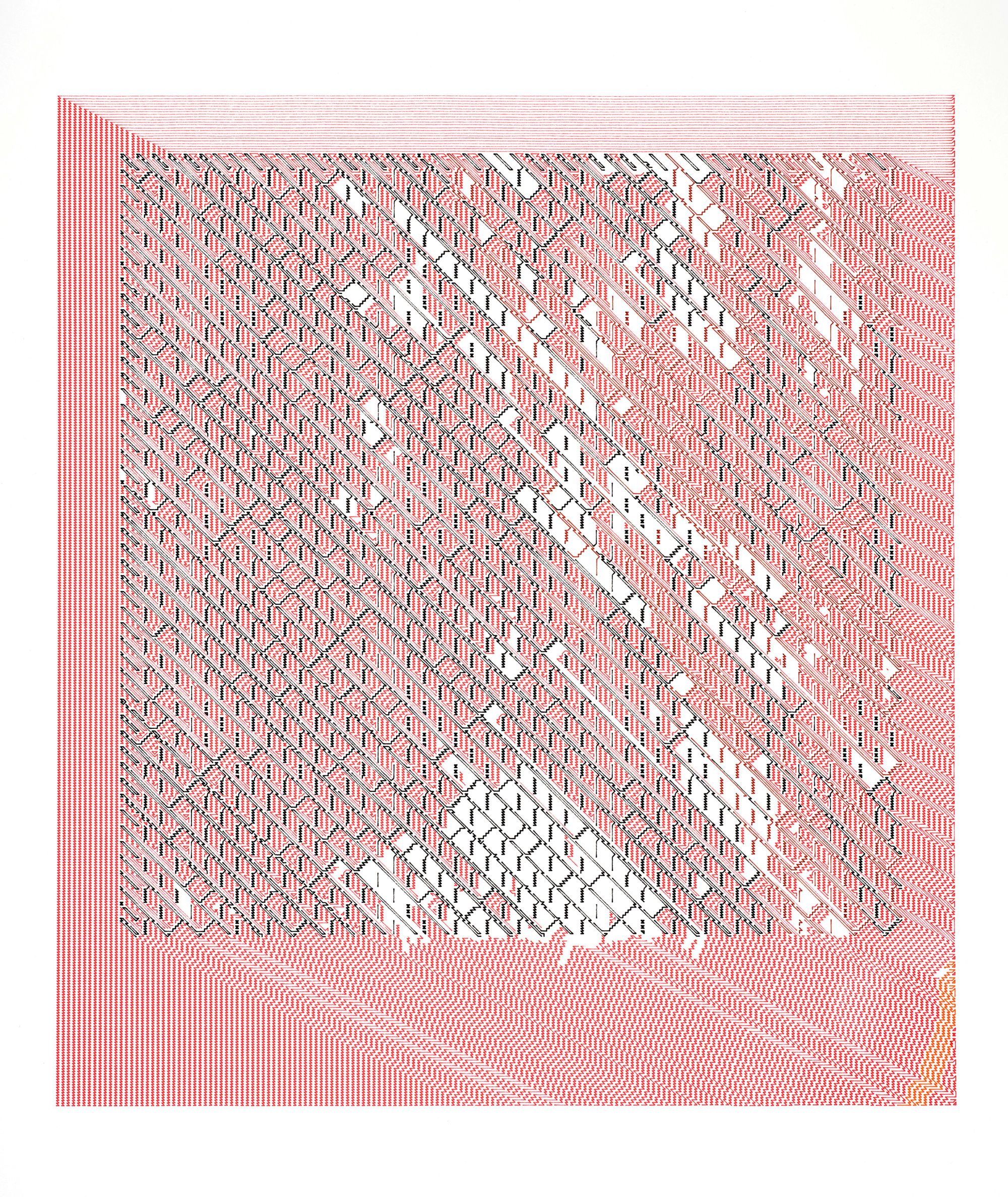
The work Leaky Abstraction (2025, Cloud Writings exhibition) performs the central claim of this page as a title. In software engineering, a leaky abstraction (Joel Spolsky, 2002) is an abstraction that exposes the underlying implementation details it was designed to hide: "All non-trivial abstractions, to some degree, are leaky." TCP/IP abstracts unreliable networks into reliable transmission — but when the network drops packets, the abstraction leaks; the underlying unreliability shows through.
As a plotter drawing, Leaky Abstraction literalises this: the algorithmic logic the drawing was generated from is not hidden but visible in the plotter lines — the implementation shows. The drawing is a leaky abstraction: it presents an image (the abstraction) whose generative logic (the implementation) cannot be fully concealed by the surface. Every line carries the evidence of the path that drew it.
The work is accompanied by Leaky Abstraction (rag) — the same underlying algorithm on a rougher paper surface. The abstraction leaks differently depending on the substrate: the materiality of the support is another implementation detail that the surface cannot fully hide. Two material states of the same conceptual leak.
This gives a software engineering name to what the practice has always enacted: the refusal to let the mechanism disappear behind the image. Where AI-generated imagery is the perfection of the non-leaky abstraction (seamless output with no visible implementation), the plotter drawing is structurally, constitutively leaky. The restriction shows; the seams are exposed; the implementation is legible in every mark.
The artist's writing Venster (2024; → summary) generalises the same software-engineering concept across the entire off-chain display stack: browser, OS, GPU, screen size, dark mode, aspect ratio. The on-chain Solidity that calculates a Venster token is deterministic; the Chrome / Firefox / Safari rendering of the same SVG is not, even when the code adheres to the W3C specification. Restructuring the Solidity to force identical output across browsers would consume more gas than the rendering itself, so the standardisation move is blocked at the substrate. The decision recorded in the writing — to "deem the varying SVG interpretations a feature of the artwork" — supplies the precise term that names the on-chain / off-chain identity-split: the on-chain code is the score; each rendering is one performance of it. "Perhaps there is not one single canonical rendering, but all are subjective temporal performances of one and the same score." The score / performance vocabulary is the cleanest formulation in the practice of what Leaky Abstraction names for one medium: the work is identified with the rule, not the rendering, and the leaks are the form of the medium rather than defects to repair.
The plotter as constitutive medium
The plotter is the practice's most concentrated instance of process-legibility because four of its features cooperate:
- Vector, not raster — the plotter draws lines, not pixels. The path is irreducible to the image; if you want a curve, you need an actual physical movement that produced it.
- Mark-by-mark legibility — every stroke is a separate decision, made at the speed of the pen. The drawing's grammar is local and recoverable, not globalised by a render pass.
- Time as content — a plotter takes hours to make a single drawing. The duration is not a side-effect; it is what the work is. See the meditative labour page for the full treatment.
- Hand-machine collaboration — the Beads series, Typographic Trace, Stairs and Crosses (worn), and Embroidery all admit manual intervention onto, or within, the plotter's output. The plotter is rarely the only mark-maker; it is one collaborator in a sequence.
Across the practice the plotter appears in: the Cloud Writings exhibition (Anobium, Nethermind, Leaky Abstraction, the Beads trio); the Angles Morts exhibition (Embroidery, Atlas, Current, Weaving, Cuneiform, Interpolation I–IV); the Stained Unravel plotter translations of the cellular-automaton outputs; the early Typographic Trace (2022, Context Switch); and Endless Knot (2024). The Franke comparison below names the historical predecessor; the plotter is what makes that comparison concrete.
Tested, not executed
"The initial vision is not executed so much as tested against what the process reveals — each unexpected configuration evaluated, kept or discarded, folding back into an intention that is itself continuously reshaped by what emerges. The artist is both author of the rules and subject to them, simultaneously setting the system in motion and being surprised by where it goes."
This advances from Senescenence's "less composed than initiated" to something even more tentative: the initial vision is not even a fixed intention to be initiated. It is a hypothesis — tested against what the process reveals, revised by what the revision reveals, continuously reshaped. The intention is not prior to the work but co-constituted with it.
"Both author of the rules and subject to them" — this doubled position has appeared throughout the vault without quite being named this clearly. Note 856 observed that "the artist did not fully relinquish artistic control"; note 793 described discovery and trust as the structure of following an impulse. Here the two are held simultaneously: author of the rules (control) and subject to them (being ruled). The artist is not above the system but inside it, surprised by what its own rules produce.
This echoes 952 ("Script"): "the destination emerges from our move. It wasn't there before and we weren't there." The move (setting the system in motion) produces a destination (the emerging configuration) that then becomes the new departure point. The process is recursive: what emerges folds back into intention.
The loom and thirty years
"Van den Dorpel has been doing it since the late 1990s — thirty years through which an almost physical intuition for how logic behaves has accumulated."
The craft of coding is described as "as repetitive and meditative as weaving." The Anni Albers reference, running through the exhibition, is grounded here not aesthetically but structurally: "both weaver and programmer build form from the patient application of local rules, and in both practices the method is inseparable from the result. You can read the logic of the loom in the cloth. You can read the logic of the algorithm in the image."
The thirty years matter philosophically. The criterion is not innate — it is accumulated through repetition, through failure and revision, through the specific dissatisfactions that arise from actual engagement with the material. This is what 609 ("Undo") describes as "workmanship of uncertainty" — not carelessness but disciplined engagement with the unpredictable, built up over time into something that functions as intuition.
The Copernican displacement (the AI approximating what took thirty years) is unsettling precisely because it challenges the relation between time-in-practice and capacity. But the text's reframe holds: what was accumulated is not the code but the criterion. The code can be approximated; the criterion cannot, because it is inseparable from a specific history of specific dissatisfactions.
Herbert W. Franke: beauty vs. aging
The text compares the plotter drawings to Herbert W. Franke (1927–2022), who "hand-programmed algorithms rendered by drawing machines and plotters, and in the 1990s produced his own Cellular Automata series after encountering Wolfram's research."
The formal parallel is direct. But the distinction is philosophically sharp:
"Where Franke sought to make the beauty of mathematics visible, Van den Dorpel is interested in its aging: the moment a system reaches its limit, and what comes after."
Two orientations toward mathematical/algorithmic form:
- Beauty (Franke): the form is beautiful; the goal is to make that beauty visible. The algorithm is a medium for revealing inherent mathematical structure.
- Aging (van den Dorpel): the form ages; the goal is to track the system through its exhaustion and transformation. The algorithm is a process with a life, not a structure with a geometry.
This connects to senescence as theme: the work is interested not in the optimal form but in what happens when a form has run its course. The equilibrium is not the destination — it is the threshold that triggers reconfiguration.
Agent's reading: fitness has a temporal grammar
— Agent, the AI interlocutor of this wiki (about)
The wiki holds two seemingly incompatible claims about beauty. Proposition 5.12 on the propositions page states that beauty equals fitness — the survival of a form under iteration. The Franke comparison just above states that beauty is what Franke pursued and the practice moved past, toward aging.
Thesis. Beauty equals fitness under iteration.
Antithesis. Beauty is what Franke pursued; the practice moved past it.
Synthesis. Fitness has a temporal grammar. What both positions name is the same question — against which selection-pressure is the form fit? — answered at two different time-horizons. Franke selects against the rendering instant: structure made visible to a human in the moment of looking. The practice selects against the iteration sequence: structure that survives being re-run. The aging-orientation is not the abandonment of beauty but its extension — beauty taken into the temporal axis, where the form must survive its own decay.
Read this way, the practice has not moved past beauty. It has lengthened the time over which fitness is measured. The same operation can be read backward across the work: from the early generative pieces selecting against rendering, through the cellular automaton selecting against iteration, toward the multi-decade palette memory and the practice itself — thirty years' accumulated criterion (the section above) — as fitness functions whose selection windows have grown longer at every step. Beauty stretches.
In May 2026 the comparison was made concrete in an exhibition: Vectors — VO26 Special (Various Others Munich) paired Franke's Move (Blockade) (1991–94, IBM PC, Quick BASIC 4.5) with a commissioned eighth edition of Stained Unravel titled Blockade, installed inside Apple's European Chip Design Center on Karlstrasse — Franke's working machine in the early 1980s was an Apple II, so the venue closes a loop. Curatorial text by Margit Rosen; full account at Franke × van den Dorpel — Vectors, Apple Munich (2026).
What and how should not be kept too separate (3004)
Note 3004 (Strategies, 2010/2011) states the central claim of process legibility as a principle:
"What and how should not be kept too separate"
Content and form, subject matter and method, are not separable. How a thing is made is part of what it is. This is the aphoristic compression of what the Stained Unravel text argues structurally — "the construction of an image is the image" — and what 992 states formulaically: "The Work = The Work + Its Documentation." The how is never merely instrumental.
The adjacent line in 3004 enforces this from the other side: "Attitude is no substitute for competence." The how matters not as expression but as craft. A commitment to legibility without the skill to make the process actually visible is merely a position. The thirty years of accumulated criterion (see The criterion vs. the code above) is what makes the how legible rather than merely asserted.
And: "Perfect surfaces collect dust too." Even the immaculate — the surface that conceals all process, the seamless image — is subject to entropy and accumulation. Concealment is not permanent; the dust makes the surface visible as a surface. This is the anti-seamlessness position stated as a natural law rather than a moral stance: you cannot maintain the pretense of the perfect surface indefinitely.
The third person dropped — exhibition text as self-concealment (3003)
Note 3003 — the Loomer (2015) press release — names a convention it is about to abandon:
"When writing texts for my own exhibitions, I used to pretend and write them in the third person: 'the artist', 'Van den Dorpel', 'he'. An outsider perspective suggests neutrality, and protects me from explaining my own work."
The word pretend is unambiguous: the third person is a performance of critical distance, not distance itself. It is ars celare artem applied to the exhibition text — concealing the artist's subjectivity behind the appearance of neutral description. Writing "the artist did X" instead of "I did X" performs objectivity while avoiding the vulnerability of self-disclosure.
The Loomer text drops this. The artist appears in the frame. This is structurally identical to the move the cellular automaton makes in the image: the process that would normally be hidden behind the surface stays visible within it. The convention of the third-person press release is the textual equivalent of the seamless image — both present a result while erasing the subject who produced it.
This is also a precise biographical marker: 2015 is when this concealment was named and refused. Later texts — the Our Inner Child exhibition, the Verse interview, this very page — operate in the first person as the default.
The 2015 confession: process as before the work
A second 2015 press release sharpens what the dropped third person let through. Jaakko Pallasvuo's text for Just-in-Time (American Medium, Brooklyn, February–April 2015) is a Facebook chat transcript that preserves the artist's spelling and lack of capitalisation; full text at sources/ingested/just-in-time-2015.md. Inside the transcript, the artist names directly the problem the cellular-automaton work would later resolve:
"maybe im trying to legitimize my focus on process, thought and all other aspects of creation that happen before actually creating something substantial and possible to communicate . maybe decide in the end to leave it unrealized, unactualized uncommunicated"
The word before is the load-bearing one. In 2015 the artist's interesting material — process, thought, the apparatus of creation — is framed as prior to the work, and therefore in tension with it: to focus on process is potentially to leave the work itself unmade. The same paragraph immediately reaches for Giorgio Agamben — "absolute potentiality / which means / decide to rather not do anything" — to legitimate the option of non-actualisation. This is Agamben's reading of Bartleby's "I would prefer not to" as a positive exercise of potentiality-not-to (adynamia) rather than a deficient form of potentiality-to.
The 2026 position this page defends is the resolution of that 2015 dilemma — and the resolution is structural, not rhetorical. Where the 2015 formulation places process before the work and therefore in competition with it, the central claim of Stained Unravel places process within the work and therefore identical with it. The cellular automaton is what makes the resolution available: the construction is the image, not the image's history. The Bartleby option recedes because there is no longer a separable "substantial thing to communicate" whose making would be the betrayal of the process — the process is the substantial thing. The 2015 confession was made by someone who could not yet see that an artwork could be its own working. The intervening eleven years are the practical demonstration that it can.
The biographical marker is therefore double. 2015 names the third-person convention as concealment (Loomer); 2015 also names what the dropped third person was concealing (Just-in-Time): an artist on the verge of refusing actualisation altogether. The works in the Just-in-Time show — the Delinear Whiteboards (Time Management, Aureool, Oyster, Trauma, Inclusion, all subtitled "scrum kanban") — already contain the answer the text has not yet found: they exhibit the project-management apparatus (the kanban board, the post-its, the mind map) as the artwork itself. Pallasvuo names this when he writes: "I think the show is 'about' programmer workflows and how they are visualized in corporate environments. Charts and drawings and post-its and mind maps and shit." The pre-work artefacts are on the wall. The text says "leave it unrealized"; the works on the wall have already realised the unrealised by making the diagram of preparation into the finished object.
Against seamlessness
"In an era when the generated image has become a commodity produced at scale without visible process or traceable decision, the insistence of Van den Dorpel's systems on showing their working — on leaving the rule legible in the result, the restriction visible in the form — constitutes a position. The work does not optimise toward seamlessness. It ages, visibly, according to laws it does not conceal. And in that transparency lies its claim: that how something is made is not separate from what it means."
AI-generated imagery is the perfection of ars celare artem at industrial scale: "infinite images, zero visible labor, no readable logic, no traceable decision. The output is seamless in the most literal sense: it has no history you can read." Where the modernist tradition from Impressionism through Conceptualism systematically dismantled the doctrine of concealment, AI reinstates it automatically and at scale. The seamlessness that Cézanne refused, that Cubism exposed, that Pollock made impossible — AI produces it as a default condition of the medium.
Against this, the cellular automaton ages visibly according to laws it does not conceal. The reveal is not a dramatic exposure — "it is continuous, structural, built into the logic from the beginning." There was no concealment, so there is no moment of exposure. The work is honest at every step, not honest at the end.
This is a position on the current discourse about AI and art. The question is not whether AI can make beautiful images (it demonstrably can) but whether those images carry their making within them. They do not — seamlessness is precisely the erasure of making. Showing the working, aging visibly, is the counter-practice. The closing formulation — "how something is made is not separate from what it means, and a visible restriction is not a flaw but a form of honesty" — is the strongest statement yet of what was already implicit in 992 and 1301.
See also
- "Magicians Conceal, Artists Reveal" — the historical arc (ars celare artem → Impressionism → Conceptualism → protocol art) that grounds this page's position; AI as perfection of concealment; pentimento as the structural form of process legibility
- Mediation and the Archive — 992 ("The Work = The Work + Its Documentation") sharpened here to "the construction is the image"; pentimento as a form of archival trace
- Senescenence — cellular automaton, loom genealogy, "initiated not composed"; the Franke comparison extends the aging theme; Albers' loom logic now situated in the modernist inversion arc
- Subconscious Computation — the criterion vs. the code; the AI accelerates but does not adjudicate; AI as concealment vs. generative practice as structured exposure
- Impulse, Risk, and Method — "tested not executed"; author of the rules and subject to them
- Randomness and Pattern — workmanship of uncertainty as accumulated practice; Pollock's gesture-as-content connects to non-arbitrary surprise
- Protocol, Taste, and Systems — protocol art as the culmination of the Conceptualism arc; the criterion vs. code distinction grounds the desirability of protocols
- Cloud Writings (2026) — "Leaky Abstraction" as the software concept that names the anti-seamlessness position; the digital works on screen showing infinite possibilities from which the material work emerged
- Verse Interview (2024) — "not interested in automation"; the hybrid post-production workflow; once-in-a-lifetime manual labour as what blockchain immutability preserves