
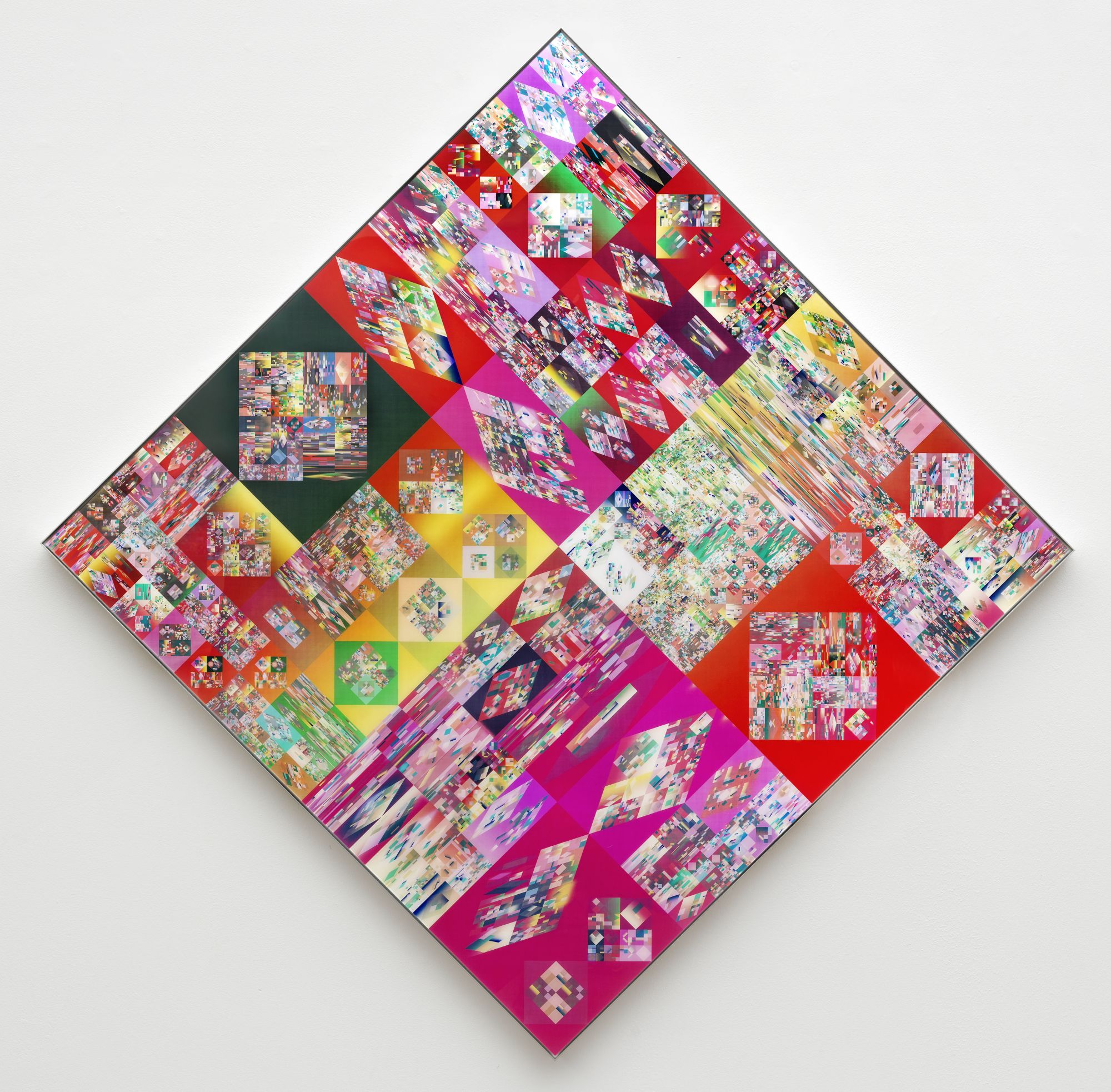
Subconscious Computation
The biographical and theological ground (ZORA ZINE, 2021)
The ZORA ZINE interview provides the most direct statement of what "subconscious computation" actually means, grounded biographically and philosophically:
"By creating conditions that have certain outputs that are not fully predictable, I think you can even say that the unconscious is manifested through that."
The context: van den Dorpel's background in Jungian psychoanalysis ("I am fascinated by psychoanalysis") and his upbringing in a religious household ("My father has run a church at some point; theology has always been in my life"). Carl Jung's model — the unconscious as a structured, symbolic, impersonal dimension that exceeds conscious control — maps onto the generative algorithm: both produce what the conscious mind cannot directly intend.
The threefold parallel is stated explicitly:
"Theology is interpreting scripture or deciphering language. As a literary writer, you have power by creating worlds; when you're a coder, you write conditions; and with generative art, you are, on the one hand, a creator, and [because] you cannot fully prepare yourself for what is coming out of this algorithm…you're also a bystander."
The creator/bystander doubled position — which process-legibility calls "both author of the rules and subject to them" and senescenence calls "less composed than initiated" — is here rooted in a theology of creation: the relationship to conditions that exceed the one who sets them. The generative system is not a tool but a site of revelation.
The theology at work is specifically apophatic. The unconscious, like the God of negative theology, is the term that cannot be specified directly and is reached only by negation — by building conditions that remove conscious intention from the loop so that what exceeds it can surface. The Our Inner Child "religious algorithm" (below) sharpens the point: the legislative moral rule-set is the cataphatic posture — the good specified positively by a list one must satisfy — and it is exactly what the practice sheds, keeping the apophatic remainder, the relation to what exceeds specification.
Jung's mandala and individuation — the destination (Murayama Q&A, 2026)
The Cloud Writings Q&A with Goro Murayama (Tokyo, 2026) gives the Jungian ground its specific destination, by way of a direct Jung quote that van den Dorpel offers as the urgency that drew him to the mandala:
"I saw that everything, all paths I had been following, all steps I had taken, were leading back to a single point — namely, to the mid-point. It became increasingly plain to me that the mandala is the centre. It is the exponent of all paths. It is the path to the centre, to individuation."
Until this Q&A, the Jungian frame on this page was a model for the production of the unconscious — the algorithm as a mechanism by which what cannot be consciously specified is allowed to surface. The Jung mandala quote names what that surfacing is for: individuation — the lifelong process of becoming the integrated self that contains both conscious and unconscious dimensions. Jung's "exponent of all paths" is precise: the mandala is not one path among many but the function all distinct trajectories turn out to have been computing all along.
This reframes the lineage Anicca (2025) → Quantizer (2025) → Anobium / Nethermind / Nethermind Quilt (2025): not just mandala-themed works, but a sustained algorithmic engagement with the form Jung identified as the destination of inner work. See the Mandala Q&A summary for the full discussion of the lineage and the Markov-chain mechanism. The link to the religious algorithm critically named in Our Inner Child sharpens: the legislative moral algorithm is shed; another rule-based system — the mandala as Jungian individuation form — is taken up. The practice does not abandon structured form when it leaves the religious algorithm; it migrates from the legislative to the integrative.
Our Inner Child (2023): from theory to visceral impulse
The exhibition text for Our Inner Child (Upstream Gallery Amsterdam, 2023) offers the most autobiographically direct account of what the subconscious ground of the practice actually feels like — not as philosophical position but as lived crisis and therapeutic recovery.
After a period of recognition (Stedelijk Museum acquisition, institutional arrival of generative art), van den Dorpel found himself overwhelmed. Seeking professional help, he encountered Inner Child therapy — a modality distinct from the Jungian analysis that grounds the ZORA ZINE account. Where Jung maps structural archetypes of the collective unconscious, Inner Child work addresses the personal biography: specific formations of the child self that persist into adult experience.
The therapy sent him back to "the feelings that first inspired me to make images." This is the most precise biographical statement of what impulse and risk calls the "deepest impulse" (→ 793): not an abstract principle but the specific affective origins of the practice — feelings, not theories. For years, van den Dorpel notes, he had been "engaging in highly theoretical and technologically sophisticated approaches to art," and this cerebral mode had come at a cost: "I felt I was obscuring a part of myself." The theoretical apparatus, however generative, had been functioning as a kind of self-concealment.
The Resolution Paintings that resulted are described as an embrace of "immediate sense of joy" — an insecurity resolved: where earlier he "might have sought something more supposedly 'intellectual' to buttress a creation I viscerally enjoyed," here the visceral is admitted as the legitimate starting point.
Nacre. A Resolution Painting exposed onto metallic paper at 150×150cm — the decompressed form held at full material resolution, and the visceral, joy-first turn that followed Inner Child therapy.
The religious algorithm
Our Inner Child also extends the religious background in a new direction. Where the ZORA ZINE account uses theology positively — as a model for the creator/bystander position, the relationship to conditions that exceed the one who sets them — the Our Inner Child text uses the same biography critically:
"I spent many years trying to figure out the rules — the algorithm, one might say — to being a good person. How could I do this and avoid the terrors of the Hell that I was told about, and which I was constantly at risk of being sent to. Therapy here has helped me understand the limits of narrow legislative approaches to morality, both towards oneself and towards others."
The word "algorithm" applied to the childhood religious moral code is precise. It names exactly what an algorithm is: a rule-set intended to produce correct outputs, applied to the self as substrate. The legislative approach — enumerate the rules, follow them, produce correct behaviour — is the same model that the generative practice refuses at the level of art-making. The system of conditions that allow something unanticipated to emerge is the opposite of the algorithm as moral legislature.
This does not contradict the ZORA ZINE account. Both are true simultaneously: the religious background is both a resource (the creator/bystander theological model, the interpretive relationship to scripture) and a formation to be worked through (the legislative algorithm, the moral rule-set as self-obscuration). Therapy helps distinguish them. The practice enacts that distinction in its form: not rules that must be followed toward a predetermined correct output, but conditions that allow something to emerge that the rule-setter could not have specified.
The phrase and its stakes
The artist bio describes systems that "draw on intuition and subliminal processes of the mind in order to continually output unexpected and curious aesthetic forms that embody a feeling of subconscious computation."
Subconscious computation is not just a description of medium — it is a claim about what the algorithm is for. The system is designed to externalize subliminal cognitive processes: to produce what the conscious, intentional mind cannot directly generate or predict. The output is "unexpected" not because the system is random but because it operates below the threshold of deliberate control; the designer authors the generative conditions, not the specific form.
Catastrophic forgetting and the Markov solution (3004)
Note 3004 (Strategies, 2010/2011) introduces the technical problem of machine learning memory with precision:
"Learning something new causes forgetting of older material on the basis of competition between the two"
This is catastrophic forgetting (also called catastrophic interference) — the phenomenon in connectionist neural networks first documented by McCloskey and Cohen (1989). When a neural network is trained on new data, the weight updates that encode the new material overwrite the weights that encoded old material. New and old patterns compete for the same representational resources; the new typically wins, and the old is degraded or lost.
Van den Dorpel studied artificial intelligence at the Vrije Universiteit, and this line demonstrates that knowledge operating in the work as technical substrate. Its consequence: a system that genuinely learns is a system that genuinely forgets. The aspiration to a subconscious that accumulates indefinitely — that carries all prior experience as available ground for new computation — runs into this architectural limit.
The Markov chain is a specific response to this problem. The Markov chain is memoryless by design: the next state depends only on the current state, not on any history before it. This is not a failure of memory but its deliberate refusal. The Markov chain sidesteps catastrophic forgetting by never trying to remember. The cost is that no prior state influences the current computation; the benefit is that the chain is not subject to the overwriting that learning systems suffer. Markov's Dream (2022) and Markov's Window (2004) carry the logic of this deliberate amnesia as their structural principle — and "Markov melancholia" names the affect it produces: the beautiful and the ephemeral as the same thing (→ protocol, taste, and systems).
The complementary evolutionary formulation arrives adjacent in 3004: "The more highly adapted an organism becomes, the less adaptable it is to any new change." Catastrophic forgetting in neural networks and over-specialization in organisms are the same structural problem at different scales: optimization for the present environment increases vulnerability to environmental change. This pair of observations is the theoretical ground for Stained Unravel's equilibrium/reconfiguration cycle — the system that reaches equilibrium is deliberately destabilized before it becomes too adapted to its current state.
The specific algorithm: Cartesian Genetic Programming
The generative engine in Mutant Garden is Cartesian Genetic Programming (CGP) — a graph-based representation that solves the halting problem for code mutation by constraining it to a safe topology. Its non-coding gene mechanism (dormant genes that persist, mutate, and can later activate) is the most philosophically significant feature: the system carries more potential than it currently expresses. Full technical account at Evolutionary Logic.
Source Unknown. A specimen bred by Cartesian Genetic Programming — the engine whose dormant, non-coding genes let the system carry more potential than it currently expresses.
The algorithm as a device for following the deepest impulse
Note 793 argues that the most valuable action is discovery rather than decision: "find your deepest impulse, and follow that… the notion that one trusts what is so discovered, although unclear where it will lead." The problem is that the deepest impulse is by definition not available to direct introspection — it is subliminal.
The algorithmic system offers a solution to this problem. If you can encode the conditions that correspond to your intuitions — the aesthetic criteria, the structural tendencies, the feedback parameters — the system can follow the impulse further and faster than conscious deliberation would allow. The output is alien enough to surprise its own maker, yet recognizably consonant with the maker's sensibility.
This is a different understanding of AI in art from both "tool use" (the artist uses AI to execute intentions) and "generative art" (the system produces random variation). It is closer to: the system makes explicit what was previously only implicit in the practice.
Filter mode — Lexachast (2017)
The wiki's account so far has read "subconscious computation" through the generative lineage: conditions designed by the artist produce outputs the artist could not have specified. The 2017 Ableton text on Lexachast (with Bill Kouligas and Amnesia Scanner) describes a structurally adjacent but technically inverted mode — the same bystander/creator structure realised by a filter over an existing dataset rather than by generation from rules:
"My algorithms filter random NSFW imagery from across the internet… The filtering process was done with the open_NSFW classification model and word2vec tag cloud analysis. From this massive pile of image data, I live 'curate' the output and mix it with self-programmed, MIDI controlled Open GL software."
The pipeline is two off-the-shelf ML models — open_NSFW (a binary classifier originally released by Yahoo) for the NSFW/SFW probability, word2vec for semantic neighbourhoods of tag clouds. Nothing is synthesised; the system selects and weights from the existing image-pool of the internet. The artist is still the bystander to outputs they could not have specified — but the outputs are found rather than bred. The subconscious surfaced here is the unconscious of the network, not of the maker.
The bystander role is, in this work, made literal: it is realised in real time, on stage, with a MIDI controller and OpenGL mixer. The ZORA ZINE formulation ("you cannot fully prepare yourself for what is coming out of this algorithm… you're also a bystander") is here a performance posture rather than a posture toward an offline generative system. The artist sits at a console and mixes the algorithmic stream as it arrives.
The "Ken Burns effect on steroids" cadence (rapid cross-fades between filtered images) means the unit of visual experience is the interval of becoming — one image fading into the next — rather than any held frame. The condition the artist designs is therefore not the image but the rate at which images replace each other; the system handles the rest.
Two consequences for the page's overall claim:
Generator and filter are two modes of the same design principle. Both produce something the maker could not have specified; both place the maker in the bystander position. They differ in what supplies the substrate — internal generation in Mutant Garden / Stained Unravel / Quantizer; the indexed image-pool of the internet in Lexachast. Subconscious computation is not committed to either; it is committed to the structural relation between the rule-setter and the rule's output, regardless of whether the output is generated or found.
The destination differs. The generative lineage runs toward Jung's mandala-as-individuation (Murayama Q&A) — the integrated self as the form the algorithm reaches toward. The filter lineage in Lexachast runs in the opposite direction: not toward integration but toward the "dystopian" summed-multitude unity (see Colour The summed-multitude limit; Randomness and Pattern The summed-multitude threshold). Both are particular feelings produced by algorithmic operation; they sit at opposite affective ends of what subconscious computation can be designed to disclose.
Persistent web version: lexachast.com (a different draw on each refresh). Audio on PAN: amnesiascanner.bandcamp.com/album/lexachast. Full ingest at sources/ingested/ableton-lexachast-2017.
Feedback loops as design
The bio specifies that works are "informed by feedback loops and the design of algorithmic systems." In 709 (artist statement), the feedback loop appears as a description of the practice's complexity: "every single parameter depends on all the others, and my interference amplifies as a feedback loop." There it is a condition encountered; here it is something designed.
The shift from metaphor to architecture matters. A feedback loop built into a software system is not just a way of describing complexity — it is a mechanism that makes the system's outputs depend on its own prior outputs. The work is continuously evolving not because the artist keeps revising it but because the system's history shapes its next state. This connects directly to assemblage identity: the identity of the evolving work is constituted by its history, not only its current state.
Net art and the extended lineage
The bio places the practice "within and beyond the lineage of 'net art.'" Net art (1990s–2000s) foregrounded the network as both medium and subject — distribution, participation, link structure, the browser as canvas. Working "beyond" this lineage means the network logic has been internalized into the generative system itself: the connections are now inside the algorithm, not just between websites.
The continuity: the fundamental concern with how structure produces meaning — how the shape of a system (a network, an algorithm, a feedback loop) determines the kinds of things that can emerge from it. This is also the concern of assemblage theory: the emergent properties of a whole are not reducible to its parts but follow from the relations between them.
Craft and skill as enabling conditions
The bio insists on "immense skill and craftsmanship." This is significant against a background where algorithmic and AI art is often presented as post-skill — as if the machine does the work. Here skill is what makes the system capable of subliminal output rather than merely arbitrary output. The difference between a generative system that produces unexpected-but-resonant forms and one that produces noise is the craftsmanship of the designer.
This connects to workmanship of uncertainty (609): it is not randomness but the disciplined engagement with uncertainty — the "reconciliation of accident" — that produces genuine mutation.
Fitness functions as formalised impulse
A fitness function is the mechanism by which the generative system knows which outputs are better than others; without one, randomness produces "no direction or growth" (Spike #70). With one, the system can evolve toward something — not a predetermined end, but a direction. The fitness function is the computational encoding of the deepest impulse: what 793 calls "discovery" rather than "decision" is here formalised as a criterion that the system applies in place of conscious deliberation. The progression of fitness functions across works (manual → crowdsourced → structural → formal) is tabulated at Evolutionary Logic and read as the personal → collective → systemic externalisation of taste at Protocol, Taste, and Systems.
Music as the highest form — the transcendental aspiration (Verse interview, 2024)
The Verse Twitter Spaces interview (January 2024) gives the most direct statement of what the practice is ultimately reaching toward:
"I think music is the highest form of art. I say that because music can, by employing purely abstract, structural compositional rules and methods, create this delicate tension between repetition and variation, and it can bring me to tears. Music has this very emotional capability, while at the same time, it is also very cerebral."
Johann Sebastian Bach is the paradigm: "sometimes when I listen to music in bed and I hear part of the Johann's Passion and I cry and I think, if I would have to die now, it would be okay." The aspiration for the pixel works: "I just hope that with something like pixels, I can make some kind of image where I lose myself and where the viewer can lose themselves and sort of have a transcendental, ecstatic experience. That's a very big thing to ask. There's a lot of melancholy, I think."
The melancholy is structural: it follows from the scale of the aspiration relative to the medium. The gap between what music achieves (non-representational, abstract, yet tears-inducing) and what visual work has reliably achieved is itself melancholic. The pixel works are an attempt to close this gap — to find the visual equivalent of purely abstract structural rules that generate deep emotion.
This connects to the "subconscious computation" phrase from the bio: the algorithm externalized the subliminal, but the goal of that externalization is not formal but experiential — transcendence, ecstasy, catharsis. The system is built to serve this aspiration, not to demonstrate its own elegance.
Shoegaze as structural parallel — the texture of sound (Verse interview, 2024)
The Swallow, Only Shallow series (2024) introduces My Bloody Valentine-era shoegaze as an explicit structural analogy:
"With shoegaze it's almost as if the band is there only to supply signals for this half heavy signal processing chain, where the texture and the complexity of the harmonics is created by using lots of delays and echoes and all these other effects to create new textures."
The structural equivalence: the band (or found image) is a signal source, not a performer. The processing chain transforms it into texture. The source is legible as trace but not as image — figurative material processed into abstraction.
"The texture of sound is something I can really relate to" — texture as the cross-modal connective category. Not composition, not melody, not structure: texture. The quality of dense, layered complexity that exists at a sub-thematic level, experienced as felt density rather than followed as argument. This is also how the generative algorithm works at high resolution: not read symbolically but encountered texturally.
The genre name itself encodes the method: shoegaze musicians stared at their floor effects pedals, absorbed in the transformation chain rather than performing to the audience. The focus is on processing, not display.
Biographical confirmation: father, conversion, programming (Verse interview, 2024)
The interview provides the most precise biographical statement of the religious/programming confluence:
"He was working on the stock market until he converted to evangelical Christianity around my 12th year, around the time when I started programming."
The coincidence of the household's rule-set changing (father's conversion as the family algorithm being overwritten) and the beginning of the child's programming practice is now confirmed as contemporaneous. The religious algorithm the ZORA ZINE account described critically — the childhood rule-set intended to produce correct outputs, applied to the self as substrate — arrived exactly when programming itself arrived as a counter-practice.
The traffic accident before Our Inner Child is also confirmed: "I had to make the exhibition in bed because I had to rest." The making of Our Inner Child under physical constraint (bed rest) is part of what pushed the practice back toward visceral, non-cerebral impulse.
See also
- Apophatic Theology — the via negativa as the practice's method; the unconscious as the term reached only by negation; the legislative (cataphatic) algorithm vs. the generative unknowable; the Nag Hammadi Demiurge / invisible-Spirit distinction
- Impulse, Risk, and Method — discovery vs. decision; the deepest impulse as the thing the system is designed to follow
- Randomness and Pattern — the dialectic the generative system inhabits
- Assemblage Identity — the work as continuously evolving historical entity
- Evolutionary Logic — CGP as the specific mechanism; fitness functions; non-coding genes; the halting problem as the condition of creative mutation
- Works Overview — Death Imitates Language and Autobreeder as the primary instantiations of subconscious computation in practice
- Process Legibility — distinguishes two senses of "AI": the generative algorithm (externalizes subliminal taste, this page's subject) vs. Claude Code as coding collaborator (accelerates but does not adjudicate)
- Verse Interview (2024) — music as highest form; shoegaze structural analogy; biographical confirmation of father's conversion and programming beginning simultaneously
- Our Inner Child (2023) — the primary source for the visceral turn and the religious algorithm; Inner Child therapy as distinct biographical modality from Jung
- Mandala Q&A — Goro Murayama (2026) — Jung's mandala-as-individuation quote as the explicit destination toward which the algorithmic practice tends; the Anicca → Quantizer → Nethermind / Anobium lineage
- Lexachast (2016–17) — the project page; filter-mode subconscious computation treated in full, with the affective divergence (dystopian summed unity vs. mandala individuation) and the bystander role as live performance posture
- sources/ingested/ableton-lexachast-2017 — the 2017 Ableton fragment in full