
Verse Twitter Spaces — Harm van den Dorpel with Nico Epstein and Leyla Fakhr (2024)
Source: verse.works/journal/twitter-spaces-harm-van-den-dorpel...
Occasion: Verse SOLOS — Struggle for Pleasure, January 2024
Full transcript: sources/ingested/verse-interview-harm-van-den-dorpel-2024.md
The pixel as interpolation device

The most philosophically precise new formulation in this interview concerns why pixels engage cognition differently from other marks:
"What is at play with pixels is that our mind tries to interpolate the space between those pixels and construct more complicated entities behind those pixels. By varying the resolution of the pixels within one work, my eyes and my mind was jumping back and forth between feeling that I understood what I saw and constructing what I thought it would be."
This is distinct from the nostalgia account of pixels (8-bit games, CryptoPunks). The interest is cognitive: variable resolution forces the viewer into an active, oscillating mode of perception — recognition and construction alternating. The image is never fully given; it is continuously being made by the viewer.
The animation mechanism extends this: resolution increases "almost as if it's rendering the work. Normally when we are rendering something or sharpening an image, we expect something to be revealed. In this case, the resolution is sharpening but nothing more is revealed." The expectation of revelation is invoked and denied. At high resolution the image is as abstract as at low resolution — the revelation was always the act of looking, not the thing looked at.
An additional strand: pixellation as censorship creates "a certain almost macabre fascination with the low resolution image." The obscured image (crime footage, watermarked video) generates more desire than the clear image would. Low resolution as withholding activates the viewer's imagination just as stereoscopic images (mentioned by Nico) require active ocular commitment to resolve the hidden depth.
Not interested in automation
Van den Dorpel states this more directly here than anywhere else in the vault:
"It's not this hermetic approach to prove I can make an algorithm that does this all automatically, I'm actually really not interested in automation. In that sense I also have a complicated relationship to programs like Midjourney, I mean, I love them and they're amazing tools, but that thing that I'm not able to program is exactly the thing I want to emphasise. It is a certain human touch, which sounds really old fashioned and cringe almost, but to have this serendipity and these mistakes or things I don't imagine at first, I then focus on them and exaggerate them in post production and in Photoshop."
This directly complicates the standard account of generative practice as autonomous system output. The "cheating" remark — "I also colour balanced each image manually after rendering because I love to obsess on that... So as a generative artist it's like I'm completely cheating" — is immediately rejected by Nico ("it's a labor of love") and by Fakhr ("it's appreciating"). The manual intervention is not a failure of the system; it is the human criterion applied at the post-production stage, not just encoded in advance. This connects to process legibility: what the AI cannot replicate is not the code but the criterion — and here the criterion operates after the code has run, in Photoshop and command-line tools.
The hybrid workflow is described precisely: a "feedback loop of generating works, changing the algorithm, generating more works, curating the outputs, manipulating them." This is not automation but iteration under human evaluation at every step.
Shoegaze as structural analogy
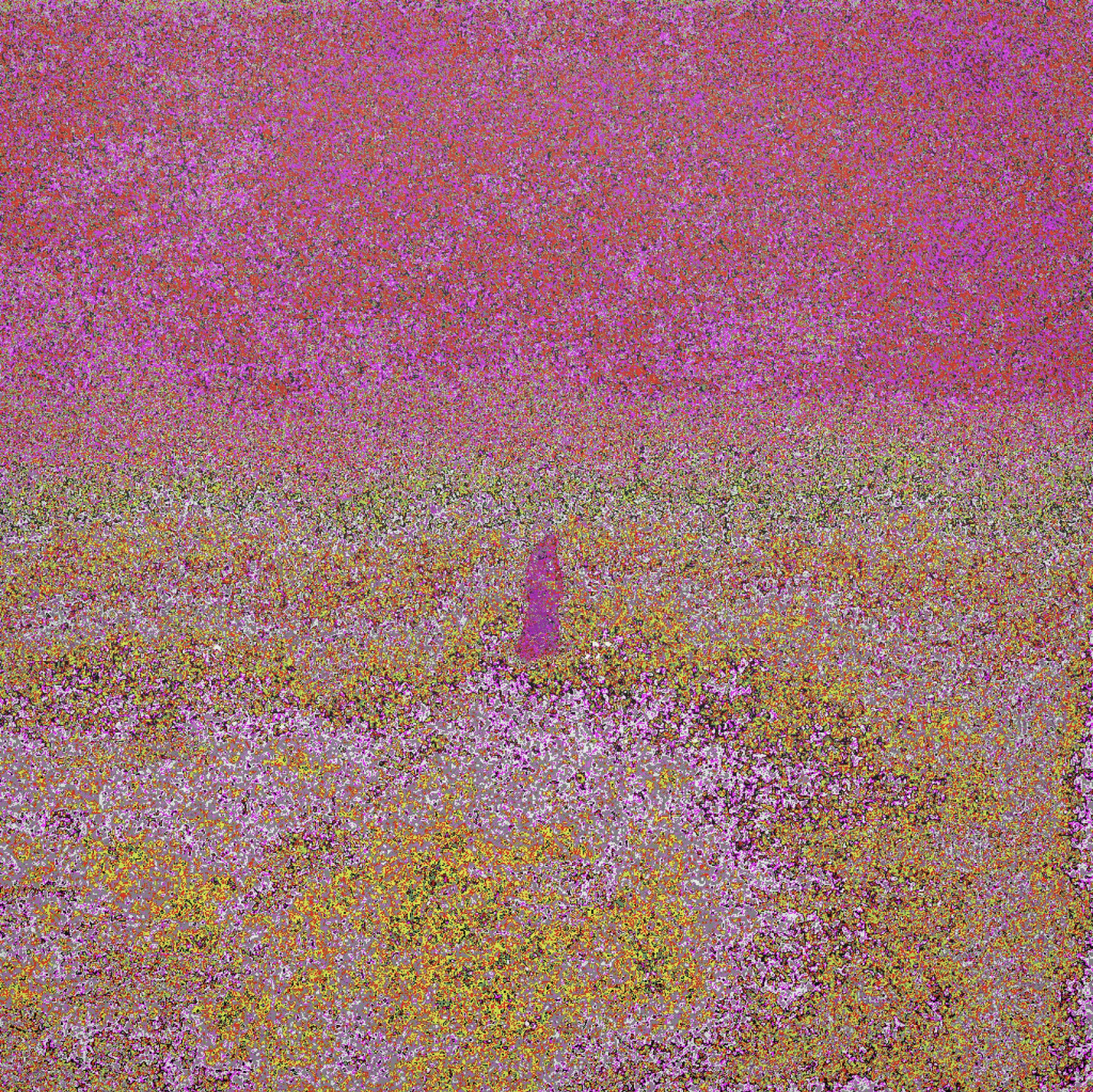
The Swallow, Only Shallow series (found images processed through the pixel algorithm) introduces shoegaze music as an explicit structural parallel:
"With shoegaze it's almost as if the band is there only to supply signals for this half heavy signal processing chain, where the texture and the complexity of the harmonics is created by using lots of delays and echoes and all these other effects to create new textures."
My Bloody Valentine named as the paradigm case. The origin of the genre name: guitarists staring at their floor effects pedals, shoegazing. The band as signal source for the processing chain rather than as performer — this is structurally equivalent to the found image (video still from the shoegaze era) as signal source for the pixel algorithm. The source material is not displayed but processed into texture.
This generalises: the generative algorithm is always a processing chain applied to some input signal. When the input is abstract geometry, the chain's output is also abstract. When the input is a figurative image (shoegaze album covers / video stills), the chain introduces a new tension — figuration processed into abstraction, the source image legible as trace but not as image.
"The texture of sound is something I can really relate to" — texture as the connective category between visual and sonic work. Not composition, not structure, but texture: the quality of dense harmonic complexity that exists below the level of melody or theme.
Music as the aspiration
The most personal aesthetic declaration:
"I think music is the highest form of art. I say that because music can, by employing purely abstract, structural compositional rules and methods, create this delicate tension between repetition and variation, and it can bring me to tears. Music has this very emotional capability, while at the same time, it is also very cerebral. And I'm a great lover of Johann Sebastian Bach, and sometimes when I listen to music in bed and I hear part of the Johann's Passion and I cry and I think, if I would have to die now, it would be okay."
The combination Bach achieves — purely abstract structural rules → emotional catharsis — is the explicit aspiration for the pixel works: "I just hope that with something like pixels, I can make some kind of image where I lose myself and where the viewer can lose themselves and sort of have a transcendental, ecstatic experience." And: "There's a lot of melancholy, I think."
This is not a decorative remark. It frames the entire practice as aspiring to the condition of music: to access deep emotion through purely structural, non-representational means. The melancholy is structural — built into the aspiration itself (the very big thing to ask).
Net art → post-internet: the trajectory clarified
Van den Dorpel gives here the clearest account of his movement through these labels:
- Net art: making internet art "to specifically comment on that context of the browser of your devices"
- Invitation to galleries: work transplanted into a space it wasn't made for, "became about other things"
- Post-internet: "the same mindset from commenting on the context of the internet, to instead commenting on the context of the gallery space" — sculptures, material, the art market
- Return: "I also started to miss my programming roots and went back more towards making art online"
Post-internet is precisely defined: "It's not that the internet is over, but it is the sort of mindset from this internet generation expressed with material in a gallery space." The endpoint — Artie Vierkant, who wrote the defining essay in 2011 and "no longer makes work at all" — is the counter-example. Van den Dorpel persevered by not settling in that phase but returning to his roots.
Mondriaan inverted: the Dutch diagonal
Van den Dorpel confirms and deepens the Dutch lineage claim while marking his structural inversion of it:
"One thing in this Dutch modernist tradition is that there's a sense of determinism. Mondriaan would obsess for a long time about how a particular composition would have to be, but for me it's actually the opposite. I generate things at random, or I breed generations, and then I curate and manipulate. It's very different, I embrace undecidedness."
The compression/decompression frame from randomness and pattern is here cast as a temperamental and methodological inversion: Mondriaan as the figure of maximal determination (obsessing toward the one right composition), van den Dorpel as his opposite (generating at random, selecting from abundance). Both arrive at grids — but one through elimination, the other through generation.
The Stedelijk moment — van den Dorpel's work hung next to Mondriaan — is described by Fakhr as a "powerful image." Van den Dorpel's desire to see his work hold up next to an oil painting is here fulfilled not just with any painting but with the originary Dutch modernist grid.
Biographical confirmation: father's conversion and programming begin together
Stated here directly: father "was working on the stock market until he converted to evangelical Christianity around my 12th year, around the time when I started programming." The biographical coincidence between religious conversion (the household algorithm changing) and the start of programming (the algorithmic practice beginning) is explicit. The traffic accident before Our Inner Child confirmed: "I had to make the exhibition in bed because I had to rest."
Blockchain as medium of immutability
On on-chain vs. off-chain:
"I think blockchain can be a medium, in particular, the unique possibility of it is immutability. We didn't have that before the blockchain. Projects can have varying degrees of immutability, and this project is more about the particular image."
Mutant Garden Seeder: blockchain as subject matter (its native mechanics as the work's content). Struggle for Pleasure: blockchain as preservation medium (immutability of the specific image, including all the non-reproducible manual post-production steps). The distinction between these two modes is clear — blockchain as medium of content vs. blockchain as medium of permanence.
Artists mentioned
- Dieter Roth — "if there's one artist that I feel really close to, it's Dieter Roth" (most direct affinity claim)
- Sigmar Polke, Seth Price, Hilma af Klint — day-to-day inspirations
- Jeffrey Scudder and Travess Smalley — "two artists that I would like to mention who inspired me to dare to go into pixel art"
- My Bloody Valentine — paradigm of shoegaze; structural model for Swallow, Only Shallow
- Johann Sebastian Bach — highest aspiration; music as the condition visual work aims toward
- Artie Vierkant — counter-example; post-internet essay author who no longer makes work
See also
- Randomness and Pattern — pixel interpolation as cognitive construction; resolution oscillation; "embrace undecidedness" vs. Mondriaan's determinism
- Process Legibility — not interested in automation; manual post-production as explicit hybrid stance; "cheating" reframed
- Subconscious Computation — music as highest form; transcendental aspiration; religious biography confirmed
- Struggle for Pleasure (Verse SOLOS, 2024) — the press release text this interview accompanies
- Our Inner Child (Upstream Gallery, 2023) — biographical context for the Inner Child therapy and traffic accident