
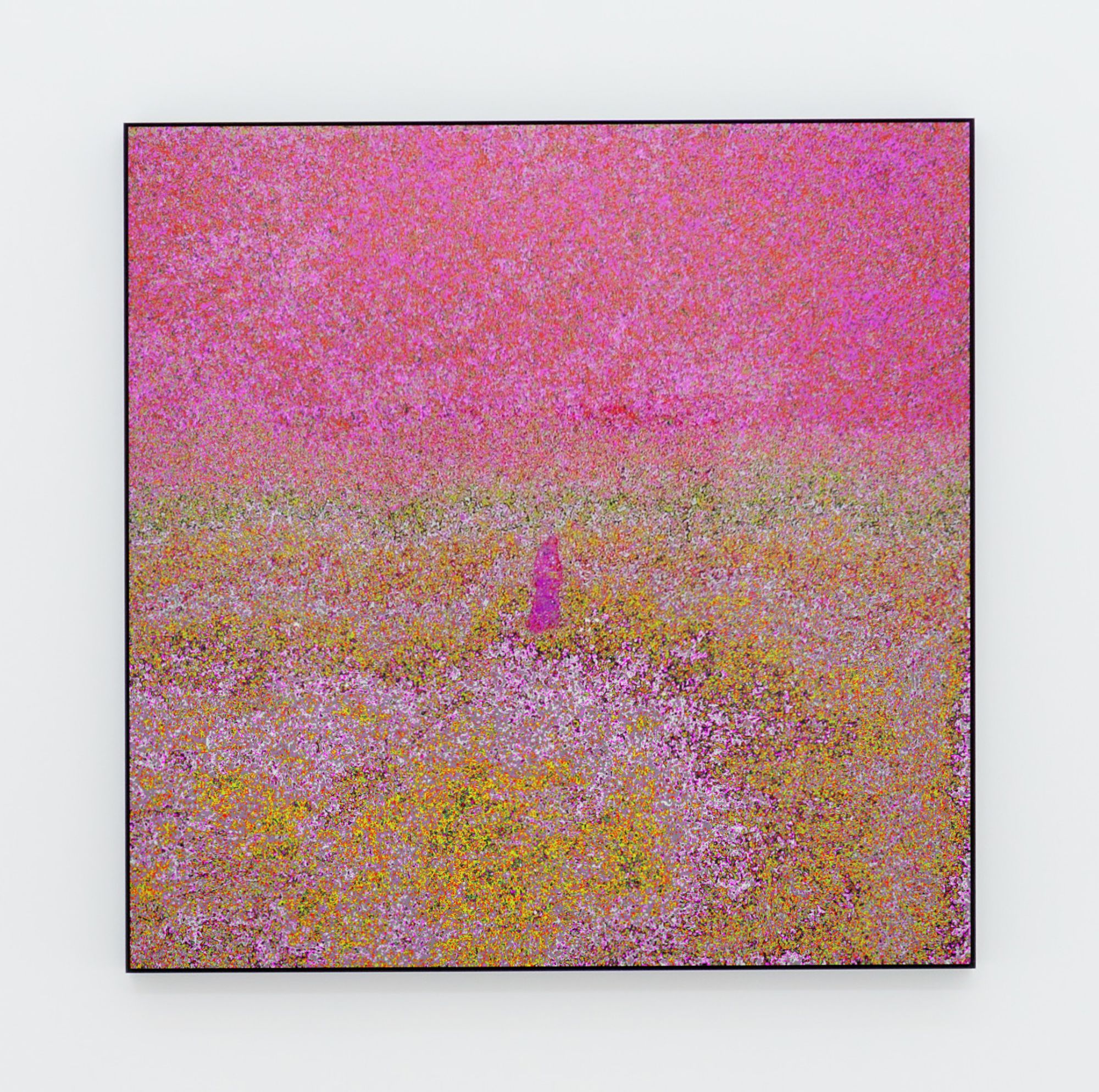
Struggle for Pleasure — Verse SOLOS London, 2024
Curated by Leyla Fakhr. Text by William Kherbek based on a conversation with Harm van den Dorpel, 2023.
Source: sources/ingested/struggle-for-pleasure-press-release.md
Overview
Solo exhibition at Verse SOLOS London, 2024. Works: Person in a Field and Creation of Light (wall objects); Struggle for Pleasure and Swallow, only Shallow (NFT collections). The press release is written in the first person — van den Dorpel's own account of the work's conceptual genesis — mediated by Kherbek from conversation.
Person in a Field. One of the two wall objects in the London show — the pixel treated as the minimal unit of digital display, meaning arising from position and adjacency rather than the mark itself.
Swallow, Only Shallow. The companion NFT collection, its title lifted from My Bloody Valentine — the found image as a signal source processed into texture, shoegaze's method transposed to the pixel.
Struggle for Pleasure. The 128-token collection that keeps every intermediate state of the iterative process — the algorithm's chronological history released as the work rather than discarded on the way to a final output.
Key ideas
1. The title: simultaneous attraction and resistance
The title comes from a 1983 piece by Belgian minimalist composer Wim Mertens. Van den Dorpel's response to it is structurally dual: "There are aspects of the composition that I always find myself falling for, even though there are other aspects I find a bit kitschy." He likes it and resists it at the same time. "I don't want it to work on me, but it does."
This phenomenology — pleasure that arrives despite or through intellectual resistance — is the work's generative question. Pleasure that is freely given is not the subject; the subject is the struggle toward pleasure, the resistance that makes it earned rather than automatic. "It is a work that lives up to its title; it is a struggle but a pleasurable one."
This introduces a new dimension not yet present in the wiki: the relationship between pleasure and suspicion. Van den Dorpel writes: "how pleasure can often seem suspicious somehow, and why this might be." Aesthetic pleasure is not trusted at face value — it requires examination, resistance, and eventual negotiation. This connects to the semiotic square's refusal of easy positions: just as relevance is "the problem that remains after the obvious answers are exhausted" (→ semiotic square), lasting pleasure is what remains after the suspicious or nostalgic forms have been worked through.
2. The pixel as the minimal unit of digital display
"There is a kind of rhyming element between the fundamental features of minimalist composition and the minimal units of digital display." The pixel is to digital art what the single note is to minimalist music: a minimal unit whose meaning arises not from itself but from its relations — position, density, adjacency.
Van den Dorpel explicitly resists the nostalgia reading of the pixel (CryptoPunks, 8-bit graphics): "The pleasurable hit of playing up 8-bit graphics has always seemed to me a kind of easy way out of the problem of making an interesting visual work." Such work "becomes about the viewer, but less about who they are personally, than about their generational position." Pleasure reduced to recognition, to the viewer's place in a generational timeline, is not lasting.
The alternative: examine "how we relate to pixels, how they reveal something about how we perceive and mentally construct images." Each "assemblage or organisation of pixels has a personal, individualised aspect" — not generational but cognitive and perceptual, general and particular simultaneously. This is the language of assemblage identity: the singular assemblage that belongs to a population without being reducible to a type.
3. Pointillism as the historical precedent
Monet's "elusive coherency of strokes" and Seurat's Pointillism sought "a place where perception, image, and emotion met." Van den Dorpel draws the explicit parallel: "The point is information, but it can only become meaningful in the presence of other points, and other minds."
The pixel inherits this structure. It is information in isolation; it becomes image in relation. And "other minds" is crucial — the image is not completed in the pixel or even in the arrangement, but in the encounter with perception. This is the dialogic condition: the work requires an other to be activated. "In these works, I seek to take the fundamental element of digital display and examine how it can be dialogic rather than simply nostalgic."
4. The iterative process as historical window — a shift in method
This press release documents an explicit methodological change:
"Historically, I dedicated myself to an iterative algorithmic process which in the end hermetically generated the final 'pleasurable images' to be released. In the past, that iterative process involved a great deal of loss, discarding all outputs before the final algorithm would be complete."
The old method: hermetic iteration — all intermediate states discarded, only the terminal state released. The process was invisible; the output presented as if fully formed.
"For 'Struggle for Pleasure', I opted for a different, gentler process: keeping images generated at all points during the iteration process and curating them into a final selection. Therefore, the collection is not merely a product of the final outputs of the final state of the algorithm but a kind of historical and procedural window on the chronological process itself."
The new method: the collection is the iterative history. Each image in the series is a frame from the algorithm's chronological unfolding. The process is no longer discarded — it is the work. This is the strongest instantiation yet of process legibility's central claim ("the construction of an image is the image"), but made concrete at the level of collection structure: the series literally preserves what was previously thrown away.
The word "gentler" is notable. The old process involved "a great deal of loss." The new process is less violent toward its own intermediate states — it keeps them, values them, releases them. This is a different relationship to the algorithm's output at every stage.
5. Simple operations → transcendental complexity → the mandala
The operations used: "mirroring, rotation, repetition, and in particular subdivision." These are the same austerity that defines minimal music — a small vocabulary of transformations applied iteratively. The outputs "paradoxically took on an exceptionally complex, transcendental quality not unlike... the way the apparently straightforward components of a mandala can."
The mandala reappears — already in senescenence as a precedent for rule-based meaning-making ("Buddhist mandalas... rule-based systems in which local decisions accumulate into forms that exceed their individual construction"). Here it is the artist's own analogy, not the press release writer's: the simple operation that opens onto something that exceeds comprehension. "Simplicity of operation can become a window into territories of complexity where knowledge itself breaks down."
"Knowledge itself breaks down" — this is a stronger formulation than "complexity that exceeds direct control." It suggests that the outcome is not just unpredictable but cognitively overwhelming: not more knowledge but the failure of knowledge, and, in that failure, something opens.
6. Openness to uncertainty as the ground of pleasure
The closing formulation: "This openness to uncertainty and to the dialogic process of the realisation of a work is central to the struggle for pleasure. It is my uncertainty, but it appeals to a wider openness, an openness where pleasure can flourish."
The uncertainty is personal — van den Dorpel's own — but it reaches toward something shared. Pleasure cannot flourish in the closed system (the hermetic algorithm, the nostalgic recognition of 8-bit); it needs an opening, an incompleteness, a point where knowledge breaks down and something else becomes possible. This is the "workmanship of uncertainty" (→ randomness and pattern, 609) with pleasure as its stakes.
Works referenced
- Person in a Field — wall object, Verse SOLOS London 2024
- Creation of Light — wall object (no harm.work page confirmed)
- Struggle for Pleasure — NFT collection; pixel-based; iterative process preserved as collection
- Swallow, only Shallow — NFT collection (title from My Bloody Valentine)
Connections to existing wiki pages
- Process Legibility — the iterative process as historical window is the strongest concrete instantiation of "the construction is the image"; the methodological shift (hermetic → gentle/archival) directly extends this page
- Senescenence — mandala as explicit analogy for simple operations → transcendental complexity; "knowledge itself breaks down" echoes "forms that emerge beyond control"
- Randomness and Pattern — simple operations + iterative transformation; openness to uncertainty as the condition of lasting pleasure; workmanship of uncertainty
- Assemblage Identity — the pixel as assemblage: individual and population simultaneously; personal yet general
- Semiotic Square — refusing both nostalgia (Old) and mere novelty (New); lasting pleasure as "relevance" in a different register — the problem that remains after the easy answers
- Impulse, Risk, and Method — "openness to uncertainty"; the dialogic process; uncertainty as the condition of discovery
- Subconscious Computation — the algorithm as a site where something transcendental emerges beyond conscious control; "knowledge itself breaks down"
- Works Overview — Struggle for Pleasure, Swallow only Shallow, Person in a Field