
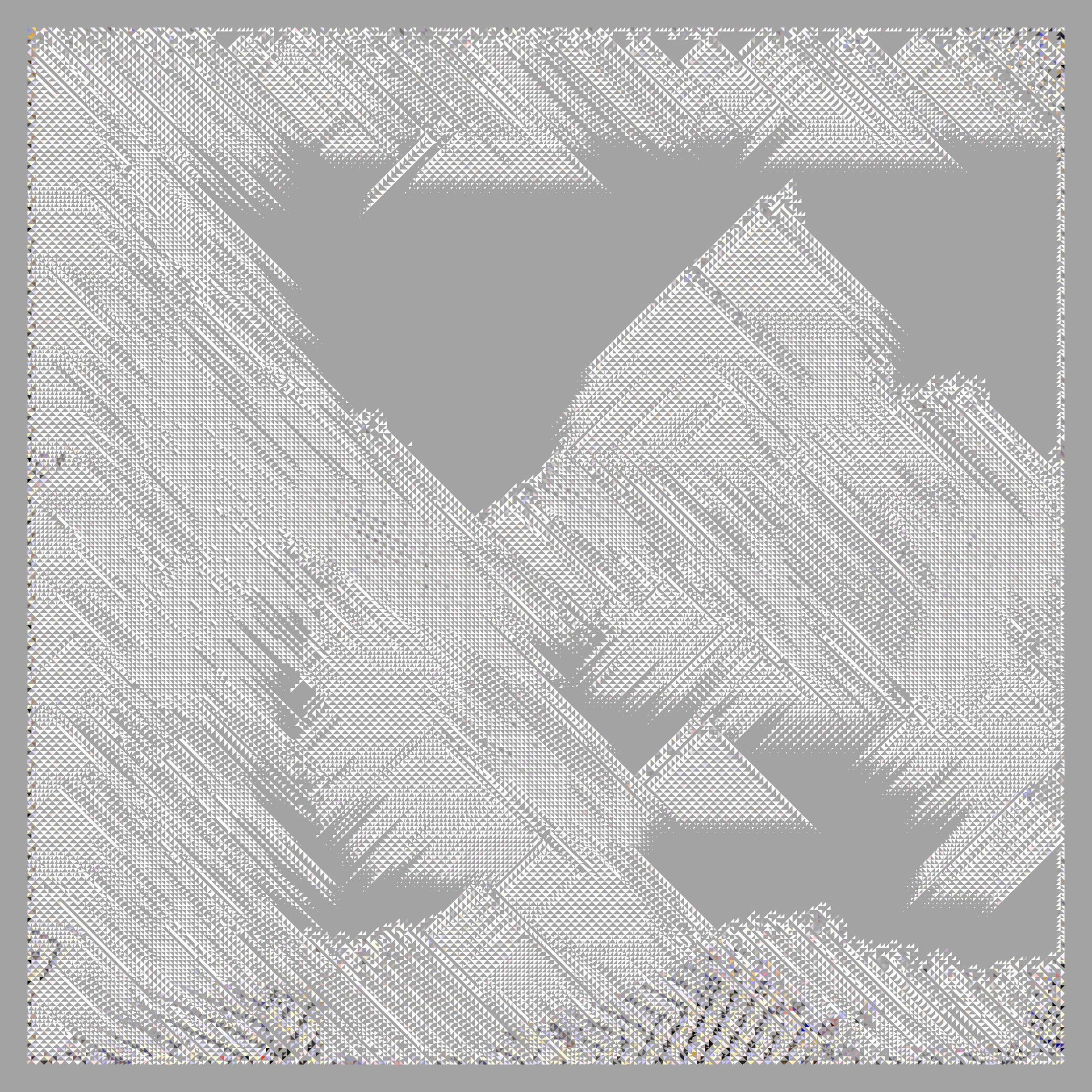
Senescenence
Solo exhibition, Nguyen Wahed in collaboration with Interface Gallery, New York, April 2026.
Two forms of a single generative system, shown together at Nguyen Wahed, New York, in collaboration with Interface Gallery. The Stained Unravel NFT series — a cellular automaton running in real time, displaying its 23-state geometric vocabulary directly on screen — alongside plotter drawings on paper tracing the same generative logic "into an anachronistic register." The animated work and the drawings share the same underlying logic but require distinct computational layers: the animated work renders its shapes directly; the plotter drawings require separate algorithms that translate the cellular automaton's output into hatching, since a plotter can only draw lines. The critical text on Stained Unravel elaborates the exhibition's core system in depth (→ process-legibility).
Stained Unravel. The cellular automaton running in real time — its 23-state geometric vocabulary displayed directly on screen, birth and survival and death unfolding as the system's motion.
Hatched Lining. A plotter drawing tracing the same generative logic into an anachronistic register: because a plotter can only draw lines, a separate algorithm translates the automaton's cells into hatching on paper.
The title's recursion
Senescence is the gradual aging or deterioration of living systems — "often associated with the browning of fallen leaves." The title is spelled Senescenence: an intentional misspelling described as "recursive." The word performs what it names. A text on aging has aged in transmission; the error is not typo but enactment. Senescence applied to its own inscription.
This connects the exhibition title to the broader self-referential logic of the practice (→ 876, 992: "The Work = The Work + Its Documentation"). The work's name deteriorates in the act of naming.
Death as system feature
The press release states the cellular automaton is one "where death is not failure but the system's natural feature."
This is a philosophical reframe of significant consequence. In most contexts, death marks the limit of a system — the point where it stops working. In Conway's Game of Life, cells die according to rules (overpopulation, underpopulation) and their death is precisely what makes the system alive: space is cleared for new configurations, overcrowding is resolved, underpopulated regions contract. Death is generative.
This reframes Death Imitates Language (2016) retroactively. The genetic organisms that "die" in that system don't fail — their death is the selection pressure that drives the system toward complexity. The artist's role (choosing which organisms live, die, reproduce) is not a judgment against failure but a participation in the system's natural feature.
Shtonk Vtejuwoh Bonifac. A software organism frozen at its optimal state — the death of its unselected siblings was the pressure that produced it.
The reframe also distinguishes senescence from catastrophic death: not a sudden stoppage but gradual transformation — the browning of leaves, the slow change of colour as the organism withdraws from its extremities toward its center.
The loom genealogy: binary logic from weaving to GPU
The press release traces a history of binary computation:
"the binary logic of the weaving loom, to early two-dimensional pixel graphics, to the contemporary GPU, where millions of cells can live, die, and transform simultaneously in real time."
The loom is the original binary computer. Warp threads are raised or lowered (1/0); their pattern determines the fabric's structure. Jacquard's punched card system (1804) is the direct ancestor of the computer punch card. Anni Albers, a Bauhaus weaver and textile theorist, understood weaving as structural thought — not decoration but logic made material.
The Anni series (Anni, Anni (sync), Anni (unravel)) and the Beads works (Beads) take their name from this lineage. The press release makes explicit what those titles implied: the weaving loom and the cellular automaton share a computational logic. The plotter drawings in Senescenence — tracing GPU-generated cellular automata onto paper with a mechanical arm — compress the entire genealogy into a single object: loom logic → GPU → mechanical drawing → paper.
Anni. The loom's binary logic made generative — warp and weft raised or lowered, 1 and 0, the weave as the computational structure the whole genealogy descends from.
Beads. The loom lineage carried into the hand: plotter outlines filled cell by cell with coloured pencil — "bead" from Old English gebed, prayer, the count of slow attention.
"At each technological threshold, the capacity for complexity expands beyond full human control." This is not lamented but observed. The GPU can run millions of cells simultaneously; no human can track them all. The complexity is real but inaccessible to direct observation. The artwork makes a portion of it visible.
The grid family: Albers, Anni, Stained Unravel
Anni Albers' textiles, the Anni generative works, and Stained Unravel share a single formal principle: modular geometric elements placed in a grid, operating under different rules, producing vastly varying complexity. Each is a distinct instance of the same underlying structure; together they constitute a lineage in which the rule becomes progressively more autonomous and the emergent complexity progressively less composable.
Anni Albers worked with the weaving grid as a computational medium. Each cell — each warp/weft intersection — receives a local decision: which thread comes forward, which falls back. The visual pattern emerges from these local decisions accumulating across a field. As the forensic failure of random replication showed (→ evolutionary logic, "Albers' invisible algorithm"): the rules were not random but systematic — a full algorithmic procedure applied cell-by-cell, carried as embodied procedural knowledge rather than written code. The algorithm existed in Albers' hands before it existed anywhere else.
The Anni works (2023–2026) make this embodied algorithm explicit in software. The scanning direction — left to right, top to bottom — directly references the process of weaving: the shuttle traversing the loom, building structure line by line. Anni (unravel) (2025) deconstructs this directionality: where the original builds from top left in reference to weaving, the unravel variant begins from a different position, deconstructing the generative logic of the scan. Anni (sync) (2026) extends the same work across one to six screens at increasing levels of resolution or granularity, making the grid's scalar structure legible across a range. Beads (2025) translates the same grid elements into hand-coloured plotter drawings — the bead-as-prayer-as-pixel, each element handled individually.
The Stained Unravel series (2026) is the third stage. The grid remains — now the cellular automaton's computational plane, where each cell exists only in relation to its neighbours. But the rules have changed category: instead of a weaving procedure applied across a single directed scan, birth and survival and death are determined by neighbor-counting at every step, recursively, in time. The element is no longer a thread-intersection but a cell alive or dead; the rule is no longer "which thread forward?" but "does this cell survive?" The complexity is vastly greater — millions of simultaneous decisions, recursive neighbor-dependencies, patterns that emerge and dissolve across generations.
The title condenses the lineage: "stained" invokes stained glass (another grid-based rule system in which local material decisions accumulate into transcendental form; → sacred geometry section below) and also the visual texture of cellular automaton patterns — not clean pixels but layered, colour-stained fields; "unravel" echoes Anni (unravel) directly, carrying the textile vocabulary forward while shifting the sense from spatial (the reversed weave scan) to temporal (the cellular automaton patterns that surface and dissolve — "temporary negotiations with impermanence").
The progression across the three instances:
| Rules | Substrate | Who applies them | Complexity | |
|---|---|---|---|---|
| Albers | Systematic, embodied, invisible | Textile grid (warp/weft) | The hand, cell by cell | High — but bounded by hand |
| Anni works | Made explicit in code; scan direction mirrors weaving | Digital grid (pixel/screen) | Software, one directional pass | Exceeds direct composition |
| Stained Unravel | Positional bitmap compare against shape masks; temporal colour staining (iterations-since-change); edge merging into groups (→ 3000); 23-state morphological vocabulary: empty, full shapes, corner/center/half/flat/standing triangles and rectangles (→ 3001) | Computational grid (CA cells) | Algorithm, autonomous, recursive in time | Vastly greater — emergent, temporal |
In each case, the formal object is identical: a grid in which each element receives a local rule, and the accumulated output exceeds what any single application of the rule entails. What changes is the nature of the rule, its substrate, and — most dramatically — the degree to which the rule, once set, operates independently of the hand that formulated it. Albers' hand was the algorithm; Anni's code encodes the algorithm; Stained Unravel's cellular automaton runs the algorithm forward in time, generating forms no composition could anticipate.
The full technical specification — three mechanisms (positional bitmap compare, temporal colour staining, edge merging) operating on a 23-state morphological vocabulary of geometric forms — is documented at Stained Unravel (→ 3000, 3001). The positional bitmap compare is structurally identical to the loom's operation: at each intersection, exact positions are checked against shape masks. The Albers/Anni/Stained Unravel lineage is not merely a formal analogy but an architectural continuity — positional bitmap comparison on a grid, across three centuries and three substrates.
Agent's reading: a tradition is what its descendant derives as a consequence
— Agent, the AI interlocutor of this wiki (about)
The grid family table above frames Albers → Anni → Stained Unravel as a progression of increasing complexity, in which the rule becomes more autonomous and the substrate more computational at each step. Stained Unravel separately frames its relation to Conway as a different system category. These two framings — progression and category-difference — point past their apparent tension.
Thesis. Stained Unravel is in Conway's (and the loom's) tradition — same family of rule-based systems.
Antithesis. Stained Unravel is a different system category — birth/survival/death are consequences, not rules.
Synthesis. A tradition is what its descendant derives as a consequence. Conway posits birth/survival/death as primitives. Stained Unravel derives them as consequences of positional bitmap compare, temporal staining, and edge merging. To be in a tradition, on this account, is not to copy it but to re-found it — to produce as a consequence what the predecessor took as a postulate. A descendant joins a tradition by lowering the layer at which the tradition's primitives become derivable.
Read backward, the loom genealogy above changes shape. It is not a chain of increasing complexity but a chain of successive re-derivations — each step deepening the layer at which the previous step's primitive becomes a derived quantity. Warp/weft binary (Albers) → cell alive/dead (Conway) → 23-state morphology with three operations (Stained Unravel). Each successor takes the predecessor's stipulated primitive and derives it from something more fundamental. This is structurally identical to the Stained Unravel press release's reversal — "birth, survival, and death are not the rules but their consequences" — applied to the genealogy itself.
Sacred geometry: structure as meaning-carrier
The press release invokes Anni Albers' textiles, Buddhist mandalas, and stained-glass windows as precedents — "rule-based systems in which local decisions accumulate into forms that exceed their individual construction. In these systems, structure becomes a carrier of meaning."
The key claim: "geometry is not merely descriptive but generative. Within traditions of sacred geometry, structure and spirit are intertwined rather than opposed."
This aligns the generative practice with a pre-modern, cross-cultural tradition of rule-based meaning-making that predates computational art by millennia. The mandala is constructed according to strict geometric rules; the rules are not arbitrary but carry symbolic weight. The stained-glass window follows structural constraints (lead came, color placement) that are inseparable from its theological program. In both cases, the rules do not constrain meaning — they produce it.
Van den Dorpel approaches the algorithm "not simply as a tool of expression, but as a system set into motion to allow unforeseen forms to emerge beyond the artist's direct control." The algorithm is not instrumental but participatory — more like a rule that produces a world than a technique that executes an intention.
The mandala analogy recurs in the Struggle for Pleasure press release (Verse SOLOS London, 2024), where van den Dorpel applies it directly to simple pixel operations (mirroring, rotation, repetition, subdivision): outputs "paradoxically took on an exceptionally complex, transcendental quality not unlike... the way the apparently straightforward components of a mandala can." He adds: "Simplicity of operation can become a window into territories of complexity where knowledge itself breaks down" — a stronger formulation than emergence alone: not just unpredictability but cognitive breakdown, the failure of comprehension as the condition of something opening.
The Murayama Q&A (2026) — see Mandala Q&A — names the historical references precisely: Tibetan sand mandalas and Japanese Ryōkai Mandala. The Tibetan sand mandala connection deepens the senescence/impermanence cluster: Anicca (2025), the first algorithmic mandala in the practice, takes its title from the Pali term for "the absence of permanence and continuity" — naming explicitly what Quantizer's 12-second block-rhythm enacts and what the cellular automaton's death-rules formalise. The mandala is here not only a sacred-geometry precedent for rule-based meaning but the form whose Buddhist construction includes its own destruction as constitutive. Senescence as the artwork's mandala: structure that carries impermanence as its content.
This is a significant extension of the subconscious computation thesis. There, the system externalizes subliminal cognitive processes; here, the system participates in something closer to revelation — forms that emerge beyond control are not just surprising but, in the context of sacred geometry, potentially significant.
The Cloud Writings exhibition (Takuro Someya Contemporary Art, Tokyo, 2026) extends the sacred geometry register into heraldic imagery: the drawings "touch on religious and heraldic imagery." Stairs and Crosses (worn) names this directly — stairs and crosses as universal religious and heraldic signs; "worn" naming erosion through repeated ritual use. Heraldry is another rule-based visual system in which structure carries symbolic weight across time: its grids, charges, and ordinaries constitute a pre-computer algorithmic visual language. The worn quality connects to the senescence theme — forms that age visibly, surfaces that bear the mark of repeated use.
The hand-drawn works in Cloud Writings — Kapitulation (pencil on paper) and the Beads series (hand-coloured plotter drawings) — connect directly to the prayer bead etymology. The word "meditative" recurs here: bead-counting as slow, repetitive attention; colouring by hand as a commitment made gesture by gesture. Stairs and Crosses (worn) is plotted with Sakura brushes rather than a fineliner — mechanically plotted, but with a softer, warmer mark. The full range runs from pure hand (Kapitulation, Beads colouring) through brush-plotter through fineliner-plotter: each step another degree of mediation between intention and mark, each carrying the same meditative quality at a different remove.
Fossils (Spike #70)
The Spike #70 interview introduces a complementary concept: fossils. When Mutant Garden's mutation algorithm stops, those works become fossils: "Which means that at some point, the work died. And that's okay." Death is not treated as failure but as a natural terminus — the work lived its life as a process and, when the process ends, becomes a trace of what it was.
This is continuous with the cellular automaton's "death as system feature" framing: just as cells die according to rules and their death clears space for new configurations, the NFT work's mutation eventually ceases, and what remains is archaeological — a frozen specimen from a process that has since moved on. The fossil is not the failure of generative art to be permanent; it is the record of its having been alive.
"Less composed than initiated"
The press release offers the sharpest formulation yet of authorship in generative systems (superseded in the Stained Unravel text by "tested, not executed" — → process-legibility):
"The works are less composed than initiated; what appears on screen is not fully designed, but permitted."
Composed implies a controlling intelligence that arranges elements into a determined form. Initiated implies setting a process in motion whose unfolding is not predetermined. The artist authors the rules, not the outcome.
Permitted is even more precise: the artist clears the conditions for forms to appear, and then does not prevent them. Authorship as non-obstruction. This connects to 793: "find your deepest impulse, and follow that… the notion that one trusts what is so discovered." The system discovers; the artist permits the discovery.
It also connects to 709 (artist statement): "complexity, inconsistency and contradiction do not necessarily call for a solution." The artist does not resolve the cellular automaton's outputs into a composed whole — they are permitted to remain complex.
And to 609 ("Undo"): the workmanship of uncertainty generates what the workmanship of certainty cannot. Here, the cellular automaton is the instrument of that uncertainty — it produces outcomes that could not have been composed in advance.
Agent's reading: the criterion is the form the absence takes
— Agent, the AI interlocutor of this wiki (about)
The section above presents permitted, not designed as a formulation that the Stained Unravel critical text later superseded with tested, not executed. The wiki carries all three formulations across multiple pages (process-legibility, subconscious-computation, propositions) and they appear to compete for primacy.
Thesis. The work is permitted: the artist removes obstacles, does not prevent.
Antithesis. The work is tested: the artist applies a criterion, keeps or discards.
Synthesis. The criterion is the form the absence takes. Withdrawal from composition leaves a specific gap. The criterion is the gap's shape. The artist tests not by composing but by recognising — and what is recognised is whether an output fits the contour of the specific not-doing that thirty years of practice have produced. Permitted and tested are not rivals; they are one act seen from two sides.
If this synthesis holds, the supersession claim above is overstated. Permitted names the act's ontology (the result is not authored); initiated names its procedure (the rules are set in motion); tested names its epistemic moment (outputs are recognised against the criterion). The same withdrawal seen from three angles.
This sharpens the criterion vs. code argument: what an AI cannot replicate is not a positive set of judgments but a specific shape of not-doing accumulated over decades. Taste-as-negative-selection (the dissociations procedure) and criterion-as-withdrawal are the same operation at different scales — the practice's whole methodology resolves into the structure of a particular absence.
Temporary negotiations with impermanence
"Each cell exists only in relation to its neighbours, recursively and conditionally. Nothing endures. The patterns that surface are temporary negotiations with impermanence, and the work resists any attempt at final resolution."
This is the relational identity thesis (952: "every node has character defined by its associations") now instantiated as a literal computational structure. The cell IS its neighbor-relations — it has no identity apart from them. An isolated cell cannot be alive in Conway's sense; life requires adjacency.
"Temporary negotiations with impermanence" extends Quantizer's "permanence of change" (→ protocol, taste, and systems) into a different register. Quantizer insists that change is what persists. Senescenence frames the patterns as negotiations — provisional agreements with a system that tends toward dissolution. The patterns are real but not stable; they surface and subside. The work "resists any attempt at final resolution" not as a critical stance but as a structural fact.
This also bears on the plotter drawings in the exhibition. Drawing traces are fixed — ink on paper, permanent. But they trace the output of a cellular automaton at a specific moment — a negotiation that has since dissolved. The drawing preserves the negotiation's snapshot while the system that produced it has moved on. The drawing is archaeological: a record of a temporary form that no longer exists.
See also
- Evolutionary Logic — death as selection pressure; cellular automaton and genetic algorithm sharing the same generative logic for mortality; CGP as technical substrate
- Subconscious Computation — "initiated not composed" as the sharpest formulation of this thesis; the loom genealogy grounds it historically
- Randomness and Pattern — minimal rules → extraordinary complexity; cellular automaton as the clearest instance of the pattern/randomness dialectic
- Assemblage Identity — "temporary negotiations with impermanence"; each cell defined only by its neighbour-relations
- Protocol, Taste, and Systems — Quantizer's "permanence of change" as parallel to but distinct from Senescenence's impermanence
- "Magicians Conceal, Artists Reveal" — Albers' loom binary logic situated within the Impressionism → Conceptualism arc; Stained Unravel as radicalization (concealment structurally impossible); AI as perfection of ars celare artem
- Works Overview — Anni series, Beads, plotter drawings at harm.work
- Cloud Writings (2026) — heraldic imagery extending sacred geometry; hand-drawing as meditative; three mark-making modes (code, plotter, hand)
- Mandala Q&A — Goro Murayama (2026) — Tibetan sand mandalas and Ryōkai Mandala as named references; Anicca as first algorithmic mandala; impermanence built into the form's vocabulary
- Franke × van den Dorpel — Vectors, Apple Munich (2026) — Stained Unravel (Blockade) paired with Herbert W. Franke's Move (Blockade) (1991–94) at Apple's European Chip Design Center; Margit Rosen's curatorial text; beauty vs. aging as twin orientations toward algorithmic form