
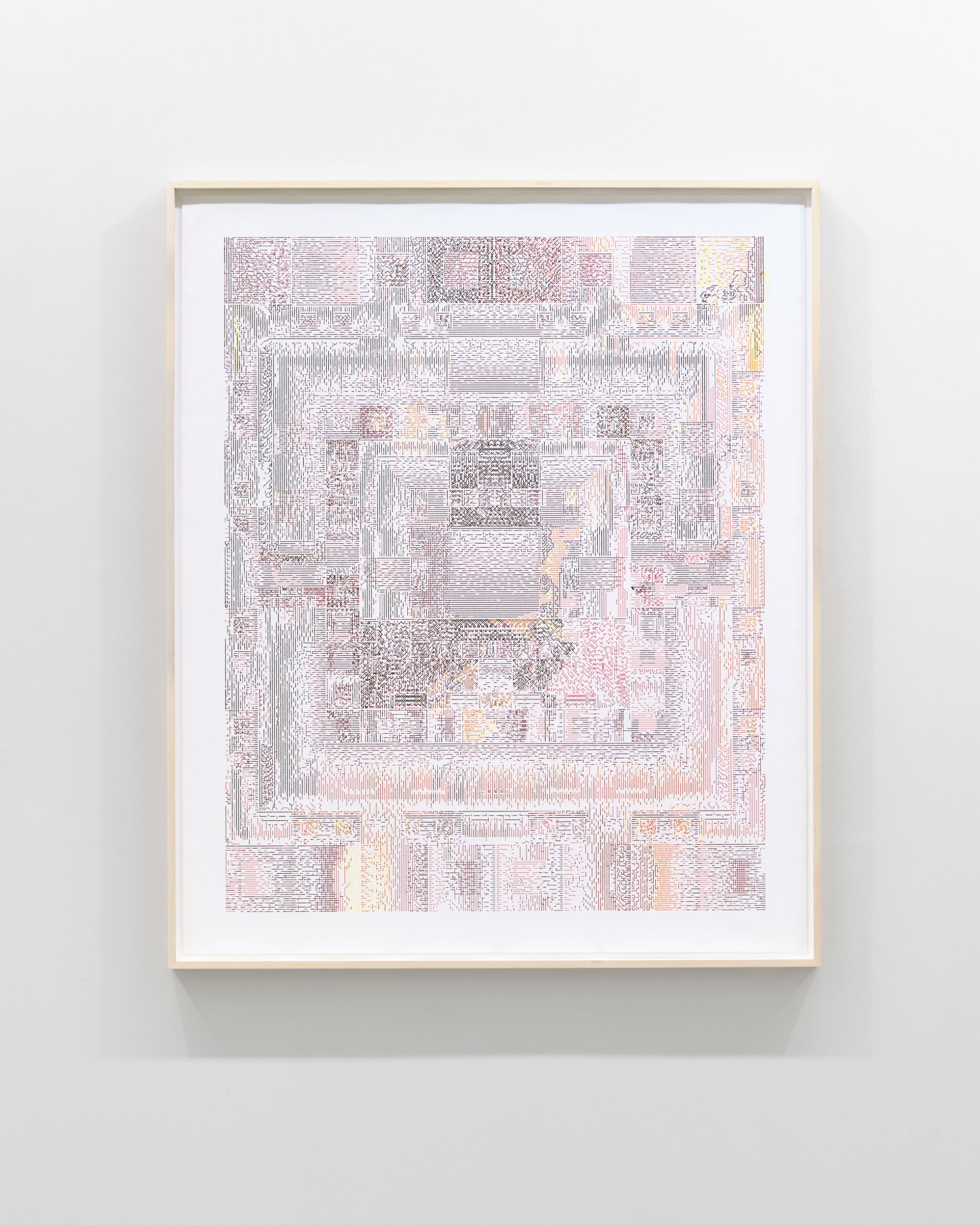
Cloud Writings — Takuro Someya Contemporary Art, Tokyo, 2026
Exhibition text by Harm van den Dorpel. First solo exhibition at Takuro Someya Contemporary Art.
Photography: Shu Nakagawa. Original: https://harm.work/exhibition/cloud-writings/all
Overview
Solo exhibition at Takuro Someya Contemporary Art, Tokyo, 2026. First showing in Japan. Works include plotter drawings on paper (Hahnemühle, watercolour paper, grey paper) and generative software installations on screen. The exhibition brings together the Cloud Writings series and the Anni/Beads works within a framework the artist names algorithmic archaeology.
The gallery press release characterises the works as "algorithmic drawings shaped by his generative practice and the ideas of female artists active in minimalism and conceptual art in the late 20th century."
Nethermind. A plotter drawing that renders an output of the Quantizer algorithm in ink on watercolour paper — the digital protocol relayed into a physical mark.
Key ideas
1. Algorithmic archaeology — the self-named methodology
"Since 2019, I have dedicated myself to researching artists such as Anni Albers, Vera Molnár, and Charlotte Posenenske, who are known for their systematic approach in creating work with two-dimensional grids, even before the computer as we know it was invented. I develop contemporary algorithms inspired by these historical ones — a methodology I call 'algorithmic archeology'."
This is the most direct first-person definition of algorithmic archaeology across the entire corpus. The term appears in the Spike #70 interview (2022) in relation to preserving old algorithms as living code; here it is broader and more generative: van den Dorpel researches historical methodologies — systematic, grid-based approaches developed before the computer — and develops new algorithms inspired by them. The historical practice does not need to have been computational for it to generate a contemporary computational descendant.
The three named precursors are significant:
- Anni Albers (1899–1994) — Bauhaus weaver and textile theorist; understood weaving as structural thought; loom as binary computer (→ loom genealogy). The Anni series and Beads works directly carry this lineage in their names.
- Vera Molnár (1924–2023) — founding figure of computer art; worked with rule-based systems before computers were available. Pression des pairs (2024) is directly "inspired by the work 'Quatre éléments distribués au hasard' by Vera Molnár from 1959."
- Charlotte Posenenske (1930–1985) — German Minimal/Conceptual artist known for serialized, modular, reproducible forms; committed to systems that could be assembled and reassembled. Her work dissolves individual authorship into structural instruction — a parallel to the generative protocol.
All three worked with systematic, rule-based, reproducible structure before or alongside the computer. All three are women. The acknowledgment is explicit — an "effort to identify and honor my influences."
2. The plotter — philosophical necessity
"A plotter is a specialized mechanical device that creates precise technical and architectural drawings by moving pens or markers across paper on an X-Y axis. Unlike printers, which apply ink in lines from left to right, top to bottom, the plotter draws lines in all directions. This process gives drawings an organic quality that goes beyond the precision of digital prints. The plotter draws lines in all directions, and through its slow, mechanical movement creates unique and unrepeatable results that bring a human and unpredictable materiality to my digital works."
The plotter is not just a medium choice — its distinctiveness from the printer is stated as philosophically necessary. The printer is raster-based: systematic, left-to-right, top-to-bottom, reducible to a grid of deposition. The plotter is vector-based: it moves freely in all directions, lifts and releases the pen, produces lines rather than deposits. The distinction maps directly onto the randomness/pattern dialectic: the printer executes a predetermined raster; the plotter follows paths that can be as non-linear as the algorithm allows.
"Slow, mechanical movement" introduces time into the mark. A plotter drawing takes time — the arm moves, the pen drags, the paper responds. Each line is a duration, not an instantaneous deposit. This connects to the practice's broader interest in aging, senescence, and the trace: the plotter drawing is a record of a movement through time, as legible as a Pollock drip. See process legibility: "you can read the logic of the algorithm in the image."
"Unique and unrepeatable" is precise: even algorithmically identical instructions produce slightly different drawings each time, because the pen, the paper, and the mechanical tolerances vary. The algorithm specifies a pattern; the plotter introduces the workmanship of uncertainty (→ randomness and pattern). This is the same structure as the generative algorithm's relationship to subconscious surprise: conditions are set; specific outcomes are not.
3. Grid, writing, weaving — three overlapping logics
"The drawings are composed of two-dimensional grid structures: rows and columns of repeating elements. They refer to the process of writing text and the process of weaving textile."
Three overlapping logics inhabit the same formal structure:
- Weaving: warp/weft, binary over/under — the loom as the original digital computer (→ loom genealogy). The grid is the weave's spatial logic.
- Writing: rows and columns of characters — text as organized grid space. "Cloud Writings" — the series title — names inscription that is also atmosphere, writing that dissipates, text that has become weather.
- Algorithm: the repeating element processed by a rule-set — the same grid logic abstracted into code.
These three are not metaphors for each other; they share a structural identity. Writing IS weaving IS algorithmic grid processing, at the level of the spatial logic they all employ. The plotter drawing makes this identity legible in a single object: the mechanical arm executes the algorithm (computation) by drawing lines (writing) across a grid structure derived from textile logic (weaving). Three histories in one mark.
4. Religious and heraldic imagery
"Their designs touch on religious and heraldic imagery."
The work Stairs and Crosses (worn) names this directly: stairs and crosses are among the most universal religious and heraldic symbols. "Worn" suggests age, erosion, repeated handling — the way sacred objects become smooth through use. The plotter draws with Sakura brushes on watercolour paper — a softer, more responsive tool than a fineliner, giving the lines a warmer, more gestural quality while remaining mechanically plotted.
This thread has roots in the Senescenence press release (→ senescenence), which invokes Buddhist mandalas, stained-glass windows, and sacred geometry as "rule-based systems in which local decisions accumulate into forms that exceed their individual construction." Here the sacred forms are not cited as precedents but inhabited: the drawings themselves carry heraldic structure. They are not about religious imagery; they are made in its manner.
The connection to van den Dorpel's religious upbringing (→ Our Inner Child) is implicit but present: returning to the grids and crosses of childhood religious visual culture, but now through the logic of systematic art. The rigid algorithm-as-moral-code has been replaced by structural forms that carry sacred resonance without legislative demand.
5. Leaky abstraction — a title that performs the concept
The title comes from software engineering: a leaky abstraction (Joel Spolsky, 2002) is an abstraction that exposes, through its use, the underlying implementation details it was designed to hide. TCP/IP abstracts unreliable networks into reliable transmission — but when the network drops packets, the abstraction "leaks": the underlying unreliability shows through. "All non-trivial abstractions, to some degree, are leaky."
As a work title, Leaky Abstraction performs the process-legibility claim in concentrated form. The drawing is a leaky abstraction: the algorithmic logic it was generated from is not hidden but visible — it leaks through the plotter lines. The abstraction (the drawing as a coherent image) does not fully conceal the mechanism (the algorithm, the pen, the grid). The implementation shows. This is the anti-seamlessness position as a software concept: every attempt to hide the workings produces a surface through which the workings remain readable.
The pairing Leaky Abstraction and Leaky Abstraction (rag) doubles this: the same underlying algorithm generates two different material states, "rag" naming the irregular, frayed quality of the paper surface. The abstraction leaks differently depending on the substrate.
6. Nethermind — from Quantizer to ink
Nethermind — "Plotter drawing based on an output of the Quantizer algorithm."
Nethermind (98×118cm) and Nethermind Quilt (97×97cm) are plotter drawings produced from outputs of the Quantizer (2025) algorithm. This is an important relay: the Quantizer "makes the underlying rules perceptible as aesthetic material" (→ protocol, taste, and systems); its output is then fed into the plotter workflow, materializing the protocol as ink on paper. Digital protocol → software output → mechanical drawing → physical object.
The word nethermind suggests a mind operating below the surface — the unconscious, the subterranean. As a compound with "nether" (lower, underground, infernal), it echoes the compression/depth logic: the algorithm works at a level below conscious perception; the drawing brings it up to the surface of paper.
7. Anobium — the trace of dwelling
Anobium punctatum is the common furniture beetle, the woodworm — the most common species of wood-boring insect in domestic settings. It spends most of its life as a larva inside timber, eating from within, leaving a network of tunnels invisible from the outside. Its presence is only revealed when the adult beetles emerge, leaving small exit holes.
As a title, Anobium names the logic of the work: the algorithm operates from inside the grid, leaving its trace on the surface. The drawing is the exit holes — the visible consequence of an interior process. This connects to mediation and the archive: the work is the surface record of a process that occurred below visibility. The plotter drawing makes the tunnels legible.
8. Hand-drawing and the meditative
"Some drawings I made partially by hand, which was a rich and meditative commitment for me."
The hand-drawn works in the exhibition are Kapitulation (not shown here, but present in Angles Morts) and the Beads series — "hand-coloured plotter drawing[s]." In the Beads works, the plotter lays down the base drawing, and the artist then applies colour by hand: two processes layered, neither erasing the other. The word "meditative" connects directly to the prayer bead etymology (gebed = prayer): bead-counting is a technology of slow, repetitive attention, and the hand-colouring enacts the same quality.
The Sakura brush plotter drawings (such as Stairs and Crosses) are plotted — the plotter holds the brush — but the softer, more responsive brush tool produces a qualitatively different mark than a fineliner: warmer, less mechanical in appearance, closer to the hand even when not of the hand. The full range runs from pure hand (Kapitulation, Beads colouring) through brush-plotter (Stairs and Crosses) to fineliner-plotter — each step another degree of mediation between intention and mark.
Hand-drawing as meditative echoes the "meditative as weaving" description in the Stained Unravel text (→ process legibility): "the craft of coding is as repetitive and meditative as weaving." The mandala precedent from senescenence is relevant here: "rule-based systems in which local decisions accumulate into forms that exceed their individual construction."
9. Infinite possibilities and the material instantiation
"I have installed multiple digital works on screen to give insight into the inner workings of the algorithms that created the drawings, allowing the viewer to experience the potentially infinite possibilities from which the material works emerged."
The digital works on screen (Anni sync, Anni unravel) are shown alongside material drawings — not as documentation but as a different register of the same generative logic. The screen shows infinity; the paper holds a specific choice. The installation makes legible the relationship between the algorithm's space of possibilities and the particular drawing that one realization of it produced.
This is a spatial version of the hermetic vs. gentle process distinction: the old method discarded all intermediate states; this exhibition preserves the generative space alongside the specific output. The viewer can see not just what the algorithm produced but what it could have produced — the infinite space from which the drawing emerged as a specific, unrepeatable choice. Anni (sync) makes this explicit by rendering the same work across multiple screens at different resolutions: the same algorithm, the same parameters, but experienced at different scales simultaneously.
10. Two more from the show — Rag and Slant (pastel)
Rag takes the frayed-substrate idea to full scale: a large square pen-plotter drawing whose watercolour "rag" surface lets the algorithmic line settle irregularly, the paper's texture becoming part of the mark.
Slant (pastel) shifts the register into colour and reflectance: metallic and pastel media plotted on grey paper, where the neutral ground makes the tilt of the ruleset legible as a soft, luminous field rather than a stark line drawing.
Works in this exhibition
| Work | Year | Medium | Dimensions | harm.work |
|---|---|---|---|---|
| Slant (pastel) | 2025 | Metallic & pastel plotter drawing on grey paper | 42×42cm | → |
| Anobium | 2025 | Plotter drawing, Sakura fineliner on Hahnemühle paper | 70×90cm | → |
| Rag | 2025 | Pen plotter drawing on watercolour paper | 98×98cm | → |
| Leaky Abstraction | 2025 | Plotter drawing, Sakura fineliner on Hahnemühle paper | 63×69cm | → |
| Stairs and Crosses (worn) | 2025 | Sakura brushes on Hahnemühle watercolour paper | 110×100cm | → |
| Leaky Abstraction (rag) | 2025 | Plotter drawing on watercolour paper | 110×100cm | → |
| Current | 2024 | Plotter drawing on Hahnemühle paper | 59.4×84.1cm | → |
| Girl/Boy Song | 2024 | Plotter drawing on Hahnemühle paper | 59.4×84.1cm | → |
| Nethermind | 2025 | Ink on watercolour paper (from Quantizer output) | 98×118cm | → |
| Nethermind Quilt | 2025 | Ink on watercolour paper (from Quantizer output) | 97×97cm | → |
| Beads | 2025 | Hand-coloured plotter drawing, ink & pencil | 59×84cm | → |
| Beads II | 2025 | Hand-coloured plotter drawing, ink & pencil | 59×84cm | → |
| Beads III | 2025 | Hand-coloured plotter drawing, ink & pencil | 59×84cm | → |
| Anni (sync) | 2026 | Generative software, 1–6 screens | variable | → |
| Anni (unravel) | 2025 | Generative software | variable | → |
Connections to existing wiki pages
- Evolutionary Logic — algorithmic archaeology as a self-named methodology; extending from preserving old algorithms (Spike #70) to developing contemporary algorithms from historical female artists' systematic practices; Charlotte Posenenske as new named precursor
- Senescenence — loom genealogy (Anni Albers → Anni series → Beads); sacred geometry, mandalas, stained glass as rule-based precedents; hand-drawing as meditative; heraldic imagery inhabited not just cited
- Process Legibility — "Leaky Abstraction" as a title that enacts the concept (implementation shows through the abstraction); plotter drawing as time-based mark; digital works on screen showing infinite possibilities alongside material instantiation
- Protocol, Taste, and Systems — Nethermind/Nethermind Quilt as Quantizer outputs rendered as ink drawings; protocol → physical artifact relay
- Randomness and Pattern — plotter's "unique and unrepeatable results" as workmanship of uncertainty at the level of the mark; the drawing as one specific realization from an infinite algorithmic space
- Our Inner Child (2023) — religious and heraldic imagery in Cloud Writings connects to the religious upbringing explored there; the systematic grid as the formal inheritance of the religious visual culture; hand-drawing as meditative
- Subconscious Computation — the digital works on screen show the infinite possibilities the unconscious generated; the material drawing is the specific thing the practice crystallized from that space
- Works Overview — Cloud Writings series, Anni, Beads, Anni (sync/unravel) all documented there; this exhibition is the first Japan presentation