
Mediation and the Archive
The archive transforms what it records (837)
Note 837 contains a passage from Derrida (Archive Fever):
"In what way has our field been determined by a state of the technology of communication and of archivization? One can dream or speculate about the earthquakes which would have made the landscape of the archive unrecognizable for the past century if... our pioneers... instead of writing thousands of letters by hand, had had access to portable tape recorders, computers, printers, faxes, televisions, teleconferences and above all E-mail."
The key claim: archival technology is not a neutral recording medium. It would have "transformed this history from top to bottom and in the most initial inside of its production, in its very events." The archive is not downstream of events — it shapes the events themselves. The record and the recorded are not separable.
The note links to 901 (New and Different) and to a forest image — things growing, obscuring, compounding.
Flickering signifiers (805)
Note 805 (N. Katherine Hayles) describes "flickering signifiers" — what information technologies produce when they alter the stable relation of signifier to signified:
"Carrying the instabilities implicit in floating signifiers one step further, information technologies create what I will call flickering signifiers, characterized by their tendency toward unexpected metamorphoses, attenuations, and dispersions."
The material substrate doesn't disappear; its apparent erasure is the illusion. The signal still depends on infrastructure. But the signifier is no longer stable — it flickers, disperses, metamorphoses. The archive is not a fixed record but a dynamic, unstable process.
The artist's writing Venster (2024; → summary) supplies a concrete on-chain instance: the same deterministic SVG file calculated by Solidity renders differently in Chrome, Firefox, and Safari in 2024 — and sometimes the GPU itself "glitches with red pixel noise." The signifier is stable (the bytes the chain returns are identical to every viewer); the signified flickers (the rendered image is not). The writing's resolution closes the gap Hayles names by relocating the work's identity below the flickering layer: the on-chain code is the work; each browser rendering is one performance. The flickering does not need to be repaired because what flickers is no longer asked to be the work. The same move addresses the Flash deprecation case (below): if a work is identified with its on-chain bytes rather than its rendering technology, the obsolescence of the renderer does not extinguish it.
The work as accumulated mediation (1301)
Note 1301 ("Everything vs. anything") is the most concrete enactment of these ideas. The sculpture's making is a narrative of layered mediation:
- The original event: smashed bank windows at Kottbusser Tor — kaleidoscopic patterns in safety glass
- Missed: the moment passed before it could be photographed
- First displacement: Google Image Search → "Mannequins in broken shop window" (a generic image standing in for the singular event)
- First watermark: the stock photo bears a Getty/Fotolia watermark (legally unacquirable — no credit card)
- Upscaling: "PhotoZoom Pro 5" unregistered version adds its own watermark
- Printing: UV-printed on PET-G (synthetic glass — a double of the broken glass)
- Protective foil: left on the final assembled sculpture
Each layer of mediation adds its own mark. The watermarks — corporate, software — are not removed but incorporated as texture. The Derrida/Hayles point is not made rhetorically but structurally: the work IS its conditions of transmission.
The title Everything vs. anything registers this as a philosophical problem: the everything (the singular, irreplaceable event) vs. anything (the interchangeable substitute that stands in for it). The work does not solve this problem — it is built from the gap.

Documentation as constitutive (992)
Note 992 ("About Documentation") states it as a formula:
The Work = The Work + Its Documentation
This is recursive — the documentation is not separate from the work but part of its identity. An undocumented work is not fully itself. This connects to Derrida twice over: the archival technology shapes the event, not only its record (Archive Fever, below); and the formula is the artistic form of "il n'y a pas de hors-texte" — there is no work reachable outside its mediation, just as there is no meaning reachable outside the text (→ Différance, There is nothing outside the text). And it connects to assemblage identity — the assemblage includes its history, its conditions of emergence, not just its present material state.
The metaphysical meaning of ownership (ZORA ZINE, 2021)
Researching the tax implications of NFT ownership led van den Dorpel to a deeper question: "it also made me think a lot about the metaphysical meaning of ownership." Who owns something when ownership is asserted by a smart contract? Is a smart contract a company? Who pays taxes?
The legal question opens onto the philosophical: ownership in a decentralised system is not a simple property relation but a claim embedded in a chain of technological and institutional mediations. The smart contract is another link — and another opacity. The blockchain presents itself as a transparent ledger of ownership, but what the ledger records and what ownership means in practice diverge as soon as real-world questions (taxes, legal standing, jurisdiction) are asked.
This extends the assemblage identity argument: the work's identity — including who holds it, what it means to hold it — is constituted by its history of mediations, not by any single moment of transaction.
Ownership and the cloud (846)
Cloud On Title takes its name from the legal concept of a defect in ownership records — a claim or encumbrance that introduces doubt about who holds clear title. Applied to an artwork: who owns it? What does it mean to hold title to an image that has passed through stock photo agencies, watermarking software, print shops? The chain of provenance is murky by design.
Non-coding genes as genetic archive
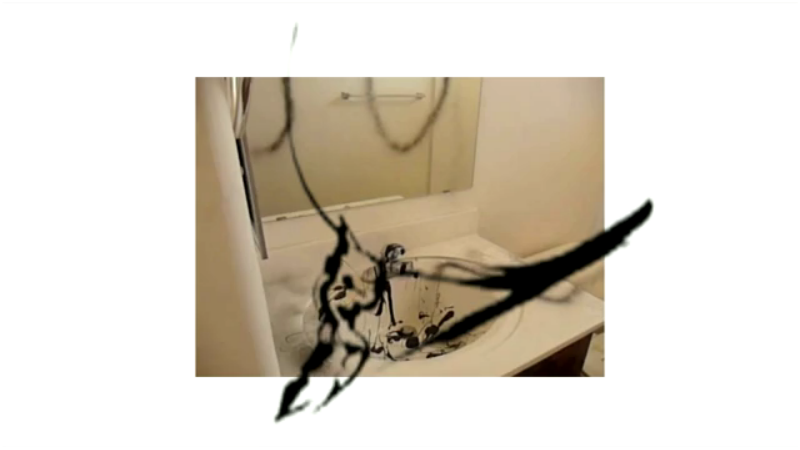
Within Cartesian Genetic Programming (the algorithm underlying Mutant Garden), non-coding genes are genes present in the chromosome that currently contribute nothing to the computation — but persist, mutate, and can activate after several generations, producing new structures from dormant material. This is a biological archive of unused possibilities.
The parallel to the documentary archive is precise: just as the archive carries what is not currently active but shapes what can emerge, the non-coding gene archives possibility without expressing it. What is dormant is not lost — it is carried forward, transformed by mutation, and available for future activation. The organism (biological or computational) contains more history than it currently shows. See evolutionary logic.
Algorithmic archaeology (Spike #70)
The Spike #70 interview introduces the concept of algorithmic archaeology: the Cartesian genetic programming algorithm used in Mutant Garden was developed in the 1990s for industrial circuit board problems. Using it for art is archaeological — excavating an algorithm within its historical layer. Algorithms are not "objective and universal and true" but are, like fossils, "products of particular historical situations."
Van den Dorpel qualifies: some code accumulates so much legacy (Windows still contains Windows 3.1 remnants) that it cannot be changed — "you cannot replace the sewer system in New York." Tina Rivers Ryan's reformulation is the sharpest: "code isn't law, but rather destiny." Programmers create a legacy future programmers must build on or around.
Legacy code thus does to future systems what Derrida says archival technology does to events: it shapes them from inside. The algorithm is an archive that acts — historical, contingent, shaped by the conditions of its original production.
Immutability ≠ accessibility — the ascribe.io lesson (Tokenising Sustainability, 2021)
The essay Tokenising Sustainability (2021) provides the crucial qualification to the on-chain archival argument:
"Although the token provenance information that ascribe stored on the immutable Bitcoin blockchain will always remain there, in practice, we have lost access to it, as their web interface to retrieve it was discontinued."
Ascribe.io minted van den Dorpel's Event Listeners editions on the Bitcoin blockchain in 2015. When ascribe shut down around 2017, their web interface disappeared. The Bitcoin blockchain record is still there — immutable, permanent, undeleted. But there is no longer an interface to retrieve or act on it. The ledger exists; the reading apparatus does not.
This is the gap between immutability and accessibility: an archive without a retrieval mechanism is a sealed vault. On-chain data requires both the persistence of the record and the persistence of a means to interpret and retrieve it.
The double blockchain situation that followed confirms this: van den Dorpel re-minted Event Listeners on Ethereum in 2018, resulting in editions tokenized on both Bitcoin (immutable, inaccessible) and Ethereum (accessible, operative) simultaneously. Ownership became a palimpsest — two records, different protocols, neither superseding the other. The work's provenance history is constituted by overlapping chains, one of which can no longer be practically read.
The archival technology shapes not only what is recorded but what can be retrieved: platform death kills access before it kills data.
Platform death and on-chain preservation (Field, 2023)
Field (2023) provides the most concrete instance in the corpus of the archive problem as an event that has already happened:
"Initially, I wrote this piece called 'Field' in Actionscript: the programming language of Macromedia Flash... Adobe... shut down Flash in 2020... A rich heritage of interactive online net art became instantly inaccessible."
Every Flash-based work — van den Dorpel's 2008 Field among them — was cut off from any means of display without deteriorating at all. The Derrida thesis (the archival technology shapes and can destroy what it records) is not theoretical here; it has a date: December 2020, when a corporate decision ended decades of net art heritage.
The 2023 response is a deliberate archival strategy: porting Field entirely on-chain, all code contained in the Ethereum smart contract — no IPFS, no web server, no external dependencies. Where most NFTs store the artwork on IPFS or a web server and record only a pointer on-chain (if the server fails, the token persists but the artwork vanishes), Field stores the generative code itself: the token IS the work, not a reference to it. The durability condition is explicit and measured — "as long as Ethereum exists, and our computers are able to display SVG, it should be fine" — not permanence claimed, but a more distributed dependency, maintained by financial infrastructure rather than a single corporation's product roadmap.
This answers the ascribe.io lesson directly: the SVG renders from the contract in any standard browser, so the data and its reading apparatus are the same thing. The irony van den Dorpel notes — porting from Actionscript (designed for animation and play) to Solidity (designed for financial transactions) — captures the archive condition: Solidity's rigidity provides what Actionscript's flexibility could not.
See also
- Assemblage identity — the historical contingency of assemblages connects to the archive as constitutive
- Randomness and pattern — "flickering signifiers" as the informational version of the pattern/randomness dialectic
- Process Legibility — sharpens the mediation thesis from additive (Work = Work + Documentation) to constitutive (the construction is the image); the seams and restrictions are not supplements but the work itself
- Field (2008/2023) — Flash's death as the archive problem made concrete; on-chain strategy as deliberate archival response; the financial infrastructure repurposed as art preservation
- Tokenising Sustainability (2021) — ascribe.io as the immutability ≠ accessibility case; the dual-blockchain palimpsest; left gallery losing its "blockchain soul"
- IOU (Narrative Projects, 2015) — the earliest blockchain provenance claim in the corpus ("supposedly perpetual blockchain, our only hope"); thermopaper as the ephemeral physical substrate that makes the blockchain's permanence claim most pointed