
Tokenising Sustainability — 2021
Text by Harm van den Dorpel, edited by William Kherbek. Published c. 2021.
Source: sources/ingested/tokenising-sustainability.md
Overview
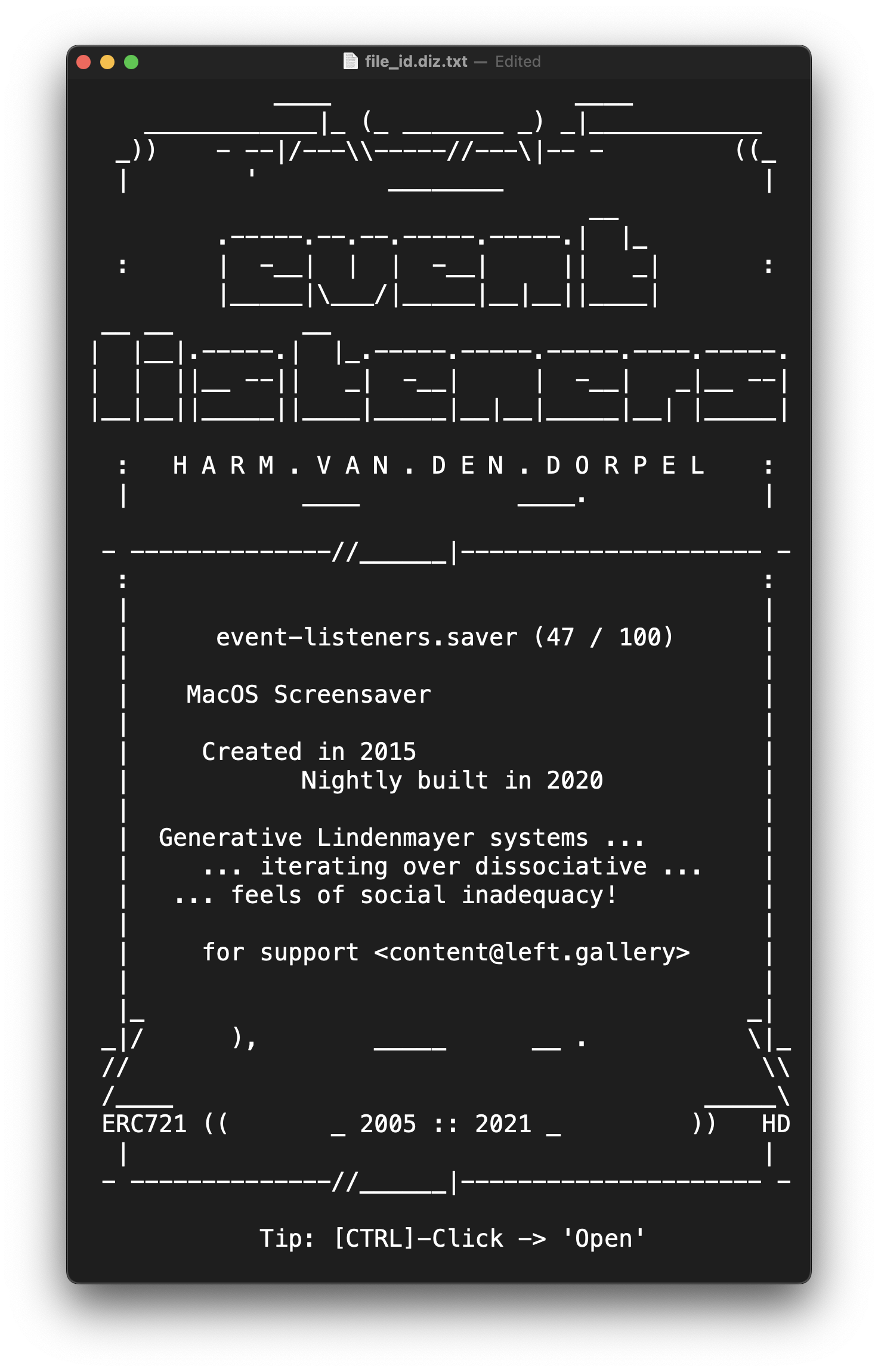
A personal essay written at the peak of the 2021 NFT boom, covering van den Dorpel's history with tokenisation from 2015 forward: ascribe.io and Event Listeners, the founding of left gallery, the 2020 COVID rebuild, and the environmental critique of proof-of-work Ethereum. Written before the Ethereum Merge (September 2022), which did complete the transition to proof-of-stake. Edited by William Kherbek.
Key ideas
1. Immutability ≠ accessibility — the ascribe.io lesson
"Although the token provenance information that ascribe stored on the immutable Bitcoin blockchain will always remain there, in practice, we have lost access to it, as their web interface to retrieve it was discontinued."
This is the sharpest lesson in the corpus about what on-chain storage actually provides — and what it does not. Ascribe.io's service allowed creators to mint editions on the Bitcoin blockchain from 2015. Van den Dorpel used it for Event Listeners. When ascribe shut down around 2017 and "pivoted to become a database company," their web interface disappeared.
The data — the provenance records — remains on the Bitcoin blockchain. It is immutable. No one can delete it. But it is practically inaccessible: there is no longer an interface to retrieve or interact with it in any meaningful way. The ledger exists; the reading apparatus does not.
This is a crucial qualification of the archival case made by Field (2023). Field argues: "As long as Ethereum exists, and our computers are able to display SVG, it should be fine." The ascribe.io story shows that "Ethereum existing" is not sufficient — what must also persist is a layer that allows the on-chain data to be read and used. The blockchain is the archive; the interface is the finding aid. Destroying the finding aid renders the archive functionally inaccessible even while it remains physically intact.
This extends the Derrida/archive thesis (→ mediation and the archive): the archival technology shapes not only what is recorded but how it can be retrieved. An archive without a retrieval mechanism is a sealed vault. The durability of the data does not guarantee the durability of access.
2. The dual-blockchain situation
Van den Dorpel's response to ascribe.io's shutdown was to "deploy an ERC721 smart contract and mint Ethereum tokens for the editions that had been sold," transferring tokens to owners who provided Ethereum wallet addresses. The practical outcome: "some editions were now tokenized on two blockchains at once" — both the original (inaccessible) Bitcoin record and the new Ethereum token.
This is an unintended but philosophically interesting instance of what the mediation thesis describes: identity constituted by overlapping chains of provenance. The edition is not simply owned; it is owned twice, by two different protocols, neither of which fully supersedes the other. The Bitcoin record is immutable and inaccessible; the Ethereum record is accessible and operative. The work's ownership is a palimpsest.
3. Left gallery and the loss of "blockchain soul"
"Left gallery had lost some of its 'blockchain soul'."
During the 2020 COVID rebuild, the Ethereum integration was dropped: transaction costs had risen to the point where minting and transfer costs "exceeded the sales price of the actual artworks by orders of magnitude." Left gallery became a regular marketplace with ownership stored in a database. Van den Dorpel describes this as painful.
The phrase "blockchain soul" is doing real philosophical work. What was lost was not functionality but a specific relationship to permanence and verifiability — the quality that distinguished a tokenised work from a database record. A database record is mutable: the operator can change it, delete it, dispute it. A blockchain token is not. The soul of left gallery was the commitment to a form of ownership that did not depend on the gallery's continued goodwill or existence.
That this could not survive the economics of transaction costs is itself a lesson: the archival/sovereignty argument for blockchain tokenisation is practically contingent on the costs of operating the protocol remaining low enough to justify it. When costs became prohibitive, the principle was abandoned. The soul was a luxury.
Status as of 2026. Whether left gallery's blockchain integration was restored after the Ethereum Merge (September 15, 2022) reduced gas costs by ~99.95% is not established by the available sources. The platform continues to exist as a sales venue (referenced as the artist's primary marketplace in interviews through 2025), but whether the post-2020 database-only ownership model still applies or has been partially returned to chain is currently unknown.
4. The 2021 boom — aesthetic distance
"In my humble opinion, the works now offered as NFTs were not very interesting, or just plain ugly. Why were people suddenly willing to pay so much Ether for such bad 'art', while they often hesitated to pay for the affordable, non-NFT artworks on left gallery?"
Van den Dorpel participated in the 2021 boom ("I did profit from this second(?) wave of NFT") while maintaining aesthetic distance. Old and newer works found new audiences; the NFT format suited them. But the enthusiasm was "not grounded in a genuine appreciation of the artworks" — it was speculative, financial, hype-driven.
This maps onto the pattern described in the ZORA ZINE interview and Spike #70: the pre-/post- cycle — utopian energy, plateau of disillusionment, new surge. Each time, the financial froth obscures the genuine cultural project. Van den Dorpel's position is consistently non-cynical but undeceived: he participates, profits, and names what was happening without pretending it was something else.
The aesthetic complaint is also continuous with the semiotic square's refusal of easy positions: the suddenly-valuable NFT work is not "New" in any meaningful sense; it is merely positioned as new by financial momentum. The "hipster algorithm" (Nested Exchange) — value by difference from the crowd — is inverted: value by belonging to the crowd.
5. Environmental argument — proof-of-work vs. proof-of-stake
The environmental section makes two moves:
Relativisation: "I find it hard to judge exactly how wasteful the Ethereum blockchain is... compared to the Google data centres that power our daily search queries, or CI/CD pipelines, or credit card payment networks." The energy use of NFTs was being compared not to other energy uses but to an implicit standard of zero. Van den Dorpel's point: "Were all artists to abandon Ethereum en masse, it would not make our planet greener." The validators do not scale down because artists leave; the energy cost is borne by the network regardless of NFT volume.
Acknowledgement: "I think that it's hard to deny that the current Ethereum blockchain is wasteful by design." Proof-of-work (PoW) requires electricity to solve "meaningless mathematical riddles" that secure the network. This is not incidental — the wastefulness is the security mechanism. The essay was written in anticipation of the PoS transition ("the Ethereum website promises to complete the transition... in 2022"). The transition happened: the Ethereum Merge, September 15, 2022, reduced Ethereum's energy consumption by approximately 99.95%.
The text is thus a historical document of the moment before the transition. The environmental concern it raises was addressed — though not in time to prevent it from being the defining cultural objection to NFTs in 2021.
On-chain conservation: a fuller picture
Read together, Field (2023) and Tokenising Sustainability (2021) construct a more complete account of on-chain archival strategy than either provides alone:
| Field (2023) | Tokenising Sustainability (2021) | |
|---|---|---|
| Core argument | On-chain is durable — no single point of failure | On-chain is immutable — but not automatically accessible |
| The risk | Ethereum or SVG becoming unsupported | Interface layer disappearing (ascribe.io) |
| The lesson | All code in the contract; no external dependencies | Data persists; retrieval mechanism must also persist |
| Resolution | Self-contained: the SVG generator IS the contract | Unresolved: Bitcoin record still exists but unreachable |
The full archival argument: durability requires both the immutability of the data AND the persistence of a means to access and interpret it. Field's on-chain strategy addresses this by eliminating dependencies at the data layer — the SVG renders in any browser, from the contract, with no intermediary. The ascribe.io failure is the case where the data layer survived but the interpretation layer did not.
Connections to existing wiki pages
- Mediation and the Archive — ascribe.io as the sharpest instance of immutability ≠ accessibility; the blockchain as sealed vault without a retrieval mechanism; extends and qualifies the Field on-chain archival argument
- Field (2008/2023) — direct counterpoint: Field's on-chain strategy is the response to the ascribe lesson; together they construct a complete archival argument
- Protocol, Taste, and Systems — left gallery history; the "blockchain soul" as the protocol-level commitment to non-mutable ownership; Mutant Garden Seeder as another case where the protocol was undermined by use patterns
- "Subdued Iconoclasm," ZORA ZINE (2021) — Event Listeners / MAK Vienna first museum NFT purchase covered in detail there; the pre-/post- cycle; institutional recognition
- Assemblage Identity — the dual-blockchain editions: provenance as palimpsest; identity constituted by overlapping, partially inaccessible chains
- Semiotic Square — the 2021 boom as value-by-belonging-to-the-crowd inverting the hipster algorithm; aesthetic quality displaced by speculative position