
Field ✲ — 2008/2023
Text by Harm van den Dorpel, published 2023.
Source: sources/ingested/field.md
Work: https://harm.work/nft/field — 6 fully on-chain Ethereum NFTs
Overview
Field is a remake of a 2008 Flash animation, fully ported to the Ethereum blockchain in 2023 as 6 unique on-chain NFTs. All code — including the animated SVG — is contained in the smart contract. No IPFS, no web server, no external dependencies. The text accompanying the release is written in van den Dorpel's most autobiographical register: birthday eve, COVID isolation, a rescue of something that "never got much attention."
Key ideas
1. Flash's death and the inaccessibility of net art heritage
"Initially, I wrote this piece called 'Field' in Actionscript: the programming language of Macromedia Flash. Adobe bought Macromedia in 2005 and shut down Flash in 2020. Even though I think they made the right call, it's a loss that they withdrew the Flash player altogether. A rich heritage of interactive online net art became instantly inaccessible."
This is the clearest statement in the corpus of the archive problem as lived experience. When Adobe discontinued the Flash Player in December 2020, every Flash-based work — interactive animations, net art, browser games — became inaccessible without a special emulator or deliberate preservation effort. The work did not deteriorate; it was cut off from its means of display. The platform died; the art died with it.
This is Derrida's archival condition made concrete: the technology of archivization is not neutral. It transforms — and can destroy — what it records. The work existed in Actionscript; the Actionscript environment is gone; the work was gone. Not lost (the source code survived), but practically inaccessible to the public for whose attention it was made.
The loss is described without melodrama: "I think they made the right call" — the technical argument for Flash's discontinuation (security vulnerabilities, battery drain, mobile incompatibility) is accepted. But the cultural consequence is named: a heritage, not just files.
2. On-chain as archival strategy
"The 2023 version of my art piece lives entirely on the Ethereum blockchain. The code that generates those animated spinners is fully contained in the smart contract. Unlike the majority of NFTs, the artwork itself is not hosted on a web server or IPFS and has no external dependencies. As long as Ethereum exists, and our computers are able to display SVG, it should be fine."
The on-chain strategy is framed explicitly as a response to the Flash problem: what killed Field was external dependency — the work depended on Adobe's continued support of the Flash Player. Remove the dependency and you remove the single point of failure.
The durability claim is conditional: "as long as Ethereum exists, and our computers are able to display SVG." Van den Dorpel does not overclaim permanence — he names the remaining dependencies (the Ethereum network continuing, SVG remaining a displayable format) while noting these are far more distributed and open than a single corporation's product decision. This is not naïve blockchain maximalism but a considered archival trade-off.
The contrast with "the majority of NFTs" is pointed: most NFTs store the artwork on IPFS or a web server and record only a pointer on-chain. If the server goes down or IPFS pins are dropped, the NFT persists but the artwork vanishes. Field stores the work itself — the animated SVG generator — in the contract. The token IS the work, not a pointer to it.
3. Actionscript to Solidity — the irony of the host language
"There is something ironic about porting graphics from the intuitive language that Actionscript was to the rigid unforgiving smart contract language Solidity, which was developed to support (economic) transactions."
Actionscript was designed for animation and interactivity — playful, visual, expressive. Solidity was designed for financial contracts — precise, rigid, adversarial. To use Solidity as the host for a visual art piece is to force a language built for transactions to carry something transactions were not designed to contain.
The irony is structural, not just tonal. The blockchain's value for art preservation comes from properties derived from its financial purpose: immutability (transactions cannot be reversed), decentralization (no single authority can delete the record), and longevity (financial infrastructure is maintained because money depends on it). The rigidity that makes Solidity "unforgiving" for artistic expression is the same rigidity that makes the blockchain a durable archive. The tool is misused, and the misuse is the point.
This connects to algorithmic archaeology: using a system for a purpose its designers did not anticipate, and finding that the constraints of its original purpose generate something new.
4. Spinners → flowers, wind turbines, field
"The first time I put spinners in a two-dimensional grid, it struck me that they become something like flowers. Or wind turbines. We find ourselves in a large open field: a field without boundaries."
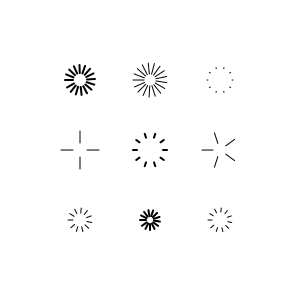
The spinner is a UI element — a loading indicator, a functional sign whose only message is wait. Isolated, it has no aesthetic content; it signals a process, not an image. Placed in a two-dimensional grid, the spinner's function is suspended. It is no longer waiting for anything; it is simply rotating. The grid strips the functional meaning and leaves only the form: a radiating circle with spokes.
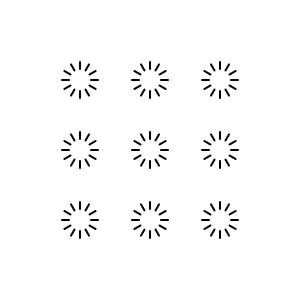
And the form reads as natural: flowers, wind turbines, a field. The grid does not turn spinners into flowers by adding anything — it removes the context that made them functional, and what remains is a pattern that resembles organic growth. This is the compression/decompression logic (→ randomness and pattern): a minimal input (the spinner grid) generates unexpected semantic richness (the field of flowers). The algorithm takes the simplest possible element and, by repetition and variation, produces something that exceeds its origin.
The six tokens vary this field parametrically: odd tokens show one kind of spinner at different rotation speeds; even tokens show a range of spinners at different sizes with varying spoke counts. Two dark backgrounds, two classic grey, two gradient backgrounds that respond to the OS appearance setting — the last making the work context-sensitive, its appearance literally shaped by the viewer's environment.
5. "One cannot suspend being"
"Spinners are shown when UX designers want to make clear that you need to wait for something. I came to realise in particular now in my early 40s, that one cannot suspend being. The separation between productive time, and time supposedly 'on hold' is entirely based on my own perception and interpretation. I am free."
The spinner's cultural function is to name a suspension: something is happening elsewhere, your participation is on hold, your being is in the waiting room. Van den Dorpel's meditation refuses this: the waiting room is not a gap in being but a mode of it. The distinction between productive time and waiting time is a perceptual frame, not an ontological fact.
"I am free" closes the reflection with something that reads as sudden and genuine — the relief of recognising that the waiting room does not exist, that one was never suspended. This connects to impulse, risk, and method's navigation-as-ontology (→ 952): "the destination emerges from our move. It wasn't there before and we weren't there." There is no state prior to the move, no position of waiting from which the move will eventually begin. The spinner that promises arrival is always already unnecessary.
The biographical context amplifies this: the reflection arrives at 42, during COVID isolation, on the eve of a birthday, porting a 15-year-old work that "never got much attention." The philosophical generosity of the moment — I am free — is made with a specific lightness of tone that runs through the whole text.
Works / token structure
| Token | Kind | Appearance | Description |
|---|---|---|---|
| Field 1 | Similar | Auto (OS responsive) | One spinner type, varying rotation speeds |
| Field 2 | Diverse | Classic grey | Range of spinners: different sizes and spoke counts |
| Field 3 | Similar | Dark | One spinner type, varying rotation speeds |
| Field 4 | Diverse | Classic grey | Range of spinners: different sizes and spoke counts |
| Field 5 | Similar | Dark | One spinner type, varying rotation speeds |
| Field 6 | Diverse | Auto (OS responsive) | Range of spinners: different sizes and spoke counts |
All 6 tokens are fully on-chain animated SVG, Ethereum Mainnet.
Contract: 0xc1cb5ea3a3541af83b0417dc26e04628193a53d3
Connections to existing wiki pages
- Mediation and the Archive — Flash's death as the archive problem made concrete: platform discontinuation as immediate inaccessibility; on-chain strategy as deliberate archival response; "as long as Ethereum exists and SVG is displayable"; the conditional durability claim
- Protocol, Taste, and Systems — fully on-chain as the strongest instantiation of the "permanence of change" argument; the work stored in the contract, not pointed to; no single point of failure
- Evolutionary Logic — Solidity as a misused language: financial rigidity repurposed for art; Flash's constraints (Actionscript) vs. Solidity's constraints (economic precision); both are historical assemblages repurposed
- Randomness and Pattern — the grid transforming function into form; spinners becoming flowers; parametric variation (rotation speed, spoke count, size) generating field-like richness from a minimal element
- Impulse, Risk, and Method — "one cannot suspend being"; no waiting-room state; time on hold is still being; echoes navigation-as-ontology (→ 952)
- Meditative Labour — the spinner meditation read dialectically against the labour argument (under The spinner — time that cannot be suspended); Agent's synthesis: undivided time; the spinner grid as the 2008 opening of the organic-software-forms thread
- Subconscious Computation — the net art lineage; working "within and beyond the lineage of 'net art'"; Flash as the platform that hosted early net art; the rescue as continuity of the lineage