
Impulse, Risk, and Method
The deepest impulse (793)
Note 793 argues against making rational control the ideal of human agency:
"I would suggest to find your deepest impulse, and follow that. The notion that there is something that is one's deepest impulse, that there is a discovery to be made here, rather than a decision; and the notion that one trusts what is so discovered, although unclear where it will lead — these, rather, are the point. The combination — discovery, trust, and risk — are central to my sort of outlook, as of course they are to the state of being in love."
The move from decision to discovery is crucial. A decision operates on known options and applies a criterion. A discovery is what happens when you follow something whose destination is not known. This is not irrationalism — the note explicitly accepts that rational control is "a basic condition of growing up" — but it refuses to make that control into an ideal. An ideal of rational control "rules out a priori most forms of spontaneity. And this seems to be absurd."
Being in love appears here not as a metaphor but as a model: discovery, trust, and risk are the structure of love, and they are also the structure of the practice.
The biographical face of the deepest impulse
The exhibition text for Our Inner Child (Upstream Gallery Amsterdam, 2023) gives 793's "deepest impulse" a biographical address. Where 793 argues philosophically that "there is something that is one's deepest impulse, that there is a discovery to be made here, rather than a decision," Our Inner Child names what that impulse actually is: "the feelings that first inspired me to make images."
Van den Dorpel describes years of "highly theoretical and technologically sophisticated approaches" that yielded interesting aesthetic results but at the cost of "obscuring a part of myself." The cerebral apparatus — the very thing that grounds the conceptual rigour of the practice — had been functioning as a buffer against the feelings that preceded it. Inner Child therapy led him back to those feelings: the insecurity about visceral pleasure (the worry that a colourful composition that "immediately appealed" was intellectually insufficient) was identified and released.
The shift this describes — from intellectual buttressing to embracing the visceral — is not the abandonment of rigour. It is the biographical enactment of 793's distinction between decision and discovery. The theoretical approach decides: it applies criteria, builds structures, produces outcomes. The visceral impulse discovers: it finds something whose destination was not known. The Resolution Paintings are the result of following the discovery rather than the decision.
Non-dialectical simultaneity and reverse causality (3004)
Note 3004 — the transcript of Strategies (2010/2011), a video composed of rewritten aphorisms from business experts, martial arts gurus, software developers, and Jacques Derrida — provides the most compressed theoretical statement of what reverse engineering actually requires:
"All takes place at the same time, non-dialectically"
"Seeing everything at the same time, you get the ability to reverse causality"
The second follows from the first. The dialectical model is sequential: cause precedes effect, each stage sublates the previous one, the present is the outcome of the past. In this model, reverse engineering is a special technique — moving against the direction of time. But in a non-dialectical view, where everything coexists simultaneously and no moment is privileged as origin, reverse causality is simply available: you can start from any point, including the effect, and work back to the system that produced it. The desired output is already there; the task is to deduce the conditions.
This is the epistemological ground for what 709 calls the reverse engineering method: "In order to gain deeper insights into the inner workings and logic of a system we are required to disassemble it." Disassembly is possible — reverse causality is possible — because the system and its output are simultaneously available. You don't need to have been there at the beginning.
"Fail noisily and as soon as possible" (3004)
"When you must fail, fail noisely and as soon as possible" (→ 3004)
A rewrite of Eric Raymond's open source doctrine and the Agile fail-fast principle. Two precisions: noisily (publicly, informatively — the failure as a signal, not a shame); as soon as possible (let the error occur early so the feedback loop is short and correction is cheap). Together they describe the risk ethic that makes discovery possible: failure is not the opposite of the deepest impulse but its productive friction. The system that fails loudly and fast learns more than the system that never fails at all.
Compare 609: "There is no way to gain wisdom but by making risky commitments and thereby experiencing both failure and success." The Strategies formulation sharpens this: the commitment should fail noisily (so the failure is legible) and soon (so the loop is short).
Reverse engineering Anni Albers (Angles Morts, 2024)
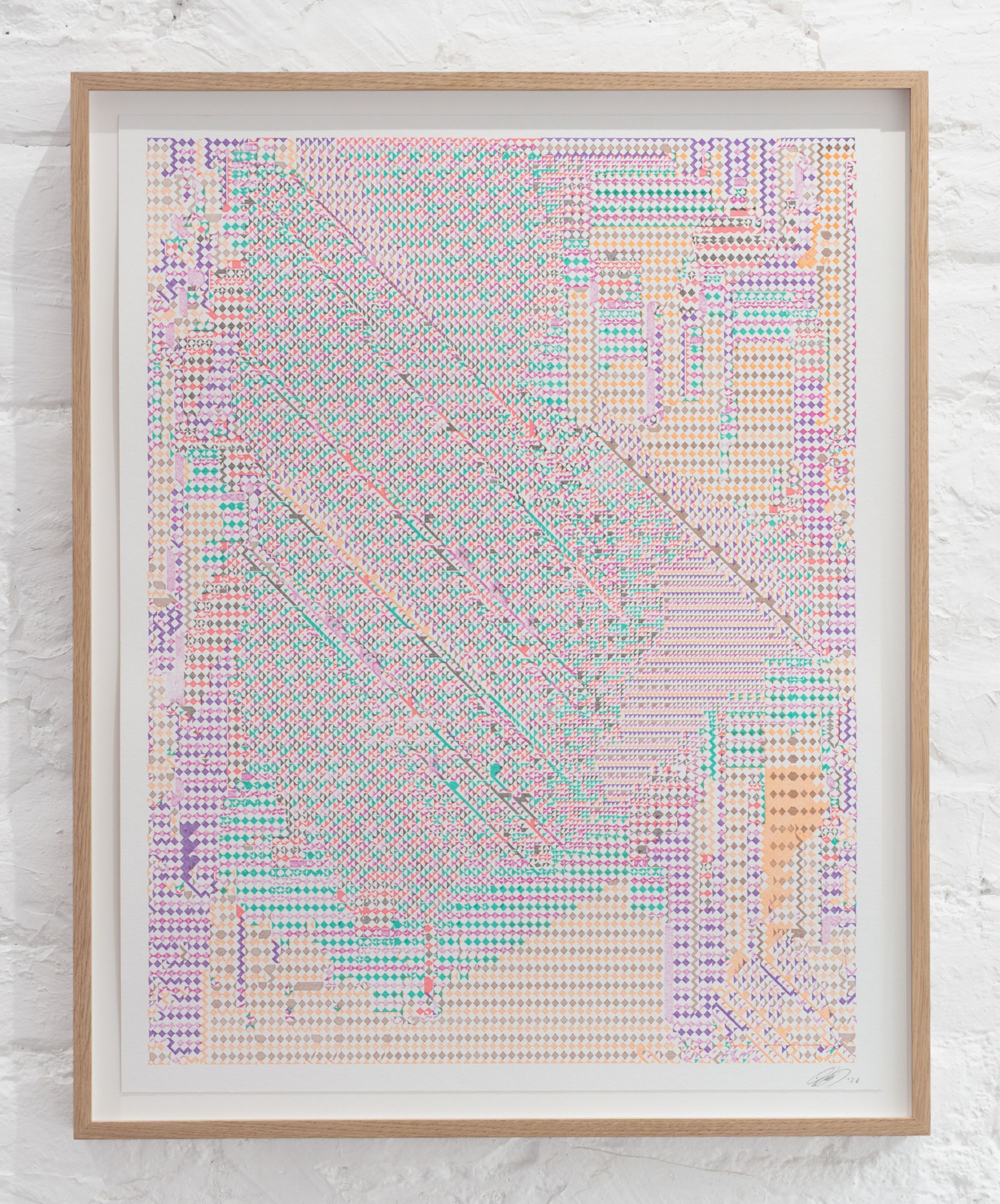
The Angles Morts exhibition catalogue provides the most concrete biographical instance of the reverse-engineering move described in 709. Van den Dorpel attempted to computationally replicate Anni Albers' triangle patterns — "technically easy to programme an algorithm that replicated her triangle patterns." The first attempt: place triangles randomly.
It failed. The random version did not achieve the aesthetic effect of Albers' work.
The inference: "Van den Dorpel realised that Albers must have formulated clear rules in her head, which she applied algorithmically to each cell of the grid." The aesthetic failure of random replication became a diagnostic tool — it proved the presence of implicit structure that the random approach could not reconstruct. Albers' work was already algorithmic; the rules were invisible because they were never written as code, only embodied as procedural knowledge applied by hand.
This is the reverse-engineering move made literal: not starting from the system to understand its output, but starting from the output to deduce the system. The desired result (Albers' aesthetic) could not be achieved without reconstructing the rules; the reconstruction required first experiencing the failure of the rule-less attempt. Discovery, not decision — and it arrived through failure.
Reverse engineering and the feedback loop (709)
The artist statement 709 translates this into a description of method:
"In order to gain deeper insights into the inner workings and logic of a system we are required to disassemble it, to break it down into parts and to apply reverse engineering. This is not a reactionary, but a progressive attitude."
Reverse engineering moves backward from effect to cause — it follows the impulse of the artifact rather than designing forward from intention. The system then becomes a feedback loop: "Every single parameter depends on all the others, and my interference amplifies as a feedback loop."
The key resolution: "Complexity, inconsistency and contradiction do not necessarily call for a solution." This is a philosophical stance, not just a working preference. The equation with too many variables is not a deficiency — it's the condition of interesting work.
The approach personal-to-universal is also stated here: "Try to connect the personal with the universal; approach the general by being subjective." This is the epistemological method implicit in 793's deepest impulse — the subjective is not opposed to the universal but the route to it.
Risk and commitment (609)
Note 609 ("Undo") grounds the role of risk in learning and craft:
"There is no way to gain wisdom but by making risky commitments and thereby experiencing both failure and success."
And the negative formulation: "Where there is no risk and every commitment can be revoked without consequences, choice becomes arbitrary and meaningless." The title — Undo — is the name of the safety net that defeats this: the ability to undo removes the commitment that makes a choice meaningful.
The evolutionary model follows: innovation requires aberration, mutation, adaptability. The "workmanship of uncertainty" is not carelessness but a structural openness to accident. Craft advances through mutation, not refinement alone.
The future haunts the present (3004)
"The past haunts the present, but equally important so does the future" (→ 3004)
The phrasing is Derrida's — from his concept of hauntology (Specters of Marx, 1993). Derrida's argument: the specter represents temporal disjunction; time is "out of joint." The past haunts the present not as nostalgia but as an unfulfilled demand. But the haunting is bidirectional: the future also exerts pressure backward. What has not yet happened is already shaping what is being done.
In the practice, this is the structural ground for what 3003 (Loomer) describes as "what the work is about runs ahead of myself." The future exerts traction on the present act of making: anticipated demands, as-yet-undesigned systems, future contexts the work does not yet know. The maker cannot catch up because the work is not only responding to the past — it is also being pulled forward by what it might become.
This bidirectional haunting is different from the semiotic square's "relevance" problem, which concerns positioning relative to existing coordinates. The hauntological claim is more radical: the future is already present as a pressure, even before its coordinates are known. Discovery — the act of following the deepest impulse into unknown territory — is how you respond to that pressure without being able to see its source.
Navigation as method (952)
Note 952 ("Script") offers a complementary formulation of the same position at the level of ontology:
"The destination emerges from our move. It wasn't there before and we weren't there (…) and upon arrival its novelty fades immediately."
Method here is not a plan applied to a known terrain — it is navigation that produces the terrain as it moves. The arrival immediately begins to lose its novelty: the discovered becomes the familiar, which prompts the next move. The cycle of impulse, discovery, and fading arrival is the rhythm 793 names discovery, trust, and risk.
The work runs ahead (3003)
Note 3003 — the press release for Loomer (2015), van den Dorpel's first solo show in Los Angeles — provides the most phenomenologically direct statement of what following the deepest impulse actually feels like from inside the practice:
"What the work is about, runs ahead of myself, and I will never quite fully catch up with it (even though I suspect it's always about the same)."
Where 793 describes a philosophical structure (discovery rather than decision, trust, risk), 3003 describes a lived condition: the work is literally ahead of the maker's understanding of it. Not a choice to avoid over-explaining — an incapacity to catch up. The artist is always in arrears with respect to what the work is doing.
The parenthetical is the crucial addition: "(even though I suspect it's always about the same)." The work runs perpetually ahead — always new to its maker — yet may be a continuous investigation of a single underlying thing at different angles. This is the temporal structure of 952's "upon arrival its novelty fades immediately" seen from the maker's side: each arrival is unexpected; once arrived, it reveals itself as another instance of the same destination.
"Try again. Fail again. Fail better."
In his interview with CGP inventor Julian F. Miller, van den Dorpel frames his creative process via Beckett: "I personally experience the most creative magic in this feedback loop of trying and failing." Miller confirms the same structure in scientific discovery: CGP's non-coding genes were "originally there purely because it made it easier for me to write the program. I only discovered the extreme importance of non-coding genes for evolution later on." An accidental feature of implementation becomes a central discovery.
Both interlocutors locate creativity in the same structure 793 describes: discovery rather than decision, with the destination emerging from the move rather than being specified in advance. The unexpected result of a failed attempt becomes the premise of the next iteration. Risk is not the obstacle to knowledge — it is the mechanism.
See also
- Randomness and pattern — the "workmanship of uncertainty" as the craft correlate of impulse and risk
- Assemblage identity — the destination emerging from the move connects to identity as deferred and relational
- Senescenence — "both author of the rules and subject to them" is the clearest enactment of the discovery/impulse structure; "less composed than initiated" as permitted rather than decided
- Our Inner Child (2023) — the biographical grounding of the deepest impulse: the feelings that first inspired image-making; therapy as the route back to discovery from decision
- Angles Morts (2024) — the Albers reverse-engineering: aesthetic failure as diagnostic tool; deducing the implicit algorithm from its effects