
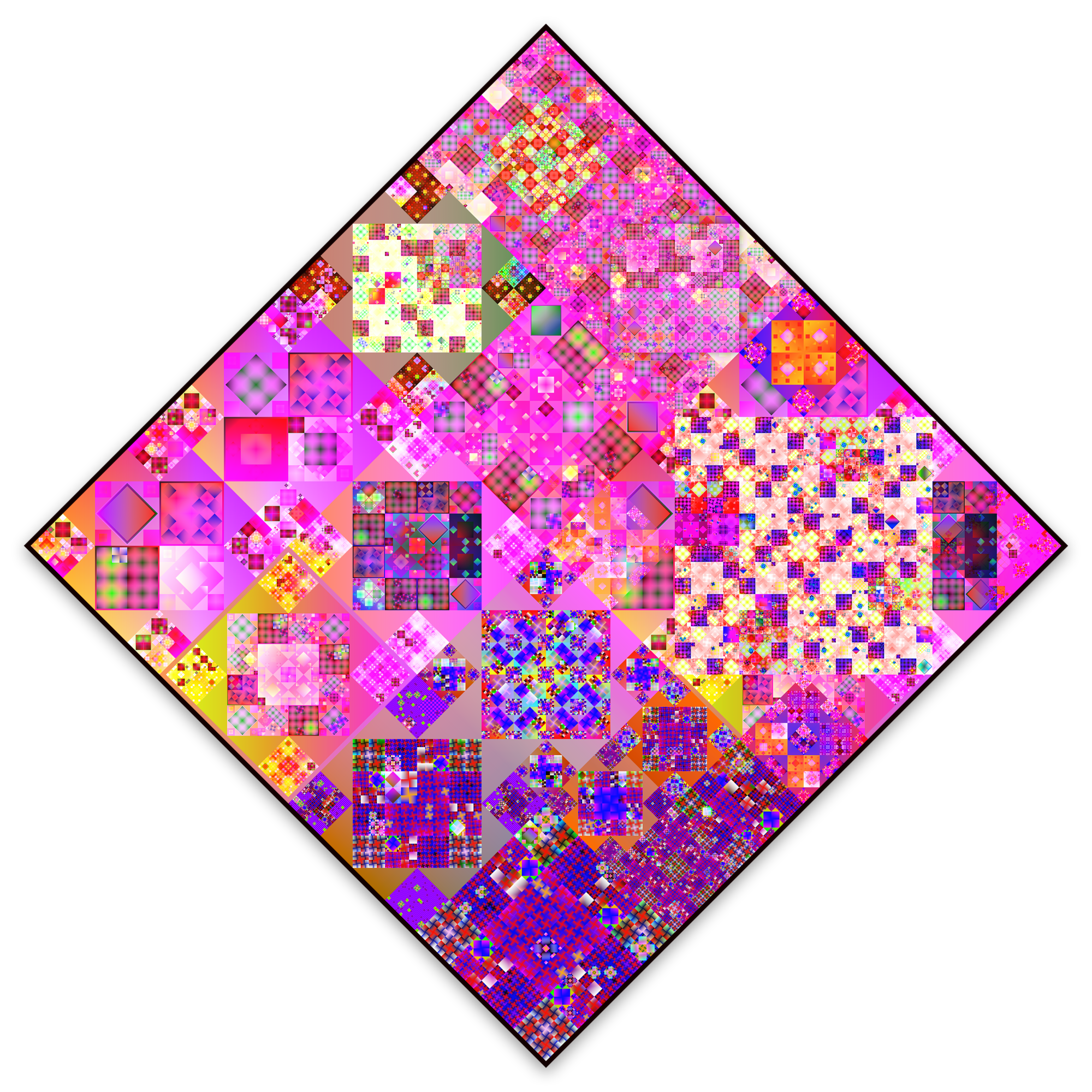
Our Inner Child — Upstream Gallery Amsterdam, 2023
Exhibition text by Harm van den Dorpel.
Source: sources/ingested/our-inner-child.md
Original: https://harm.work/exhibition/our-inner-child/all
Overview
Solo exhibition at Upstream Gallery Amsterdam, 2023. The works belong to the Resolution Paintings series — photographic exposures on metallic paper (some UltraChrome HD prints on Canson paper), mounted behind acrylic glass in aluminium frames, ranging from 85×85cm to 150×150cm. The text is written in the first person and is one of the most autobiographically candid statements in the corpus.
The exhibition comes "at the end of a very intense period" — a convergence of successful exhibitions, the NFT rise and fall, and the Stedelijk Museum's acquisition of Markov's Window (2004) for their permanent collection. Recognition of generative art at institutional scale, something van den Dorpel had "sometimes lost hope in," had arrived. And it overwhelmed him.
Key ideas
1. Recognition, overwhelm, and the hermit impulse
The period brought a "frenzy of obligations and conversations." Recognition produced the opposite of what might be expected: "Recognition made me want to become a hermit." This biographical detail is philosophically significant — it frames the works not as a celebration of arrival but as a response to the cost of that arrival. The exhibition is about what lies beneath the successful practice, not on top of it.
The Stedelijk acquisition is the pivot. Markov's Window — a 2004 work based on a memoryless stochastic system — represents the practice before it had become recognized as significant. Its entry into a museum collection named the "culmination of decades of work" and simultaneously produced the destabilisation that sent van den Dorpel toward therapy.
2. Inner Child therapy and biographical examination
During this period of instability, van den Dorpel sought professional help and encountered "Inner Child" therapy — a form derived from psychotherapy that led him to examine "aspects of my situation, and my own biography in more detail than I had ever previously done." This is a distinct modality from the Jungian psychoanalysis mentioned in the ZORA ZINE interview (2021). Where Carl Jung maps structural archetypes of the collective unconscious, Inner Child work addresses the personal biography — specific formations of the child self that persist into adult life.
The therapy "gave me a new perspective on my work." The works in the exhibition grew out of "searching into my own psyche, and attempting to make contact with the feelings that first inspired me to make images."
This is the most precise biographical account of what subconscious computation means at its root: not the Jungian unconscious abstractly, but the specific affective origins of the practice — the feelings, not the theories.
3. From cerebral to visceral
"For a long time, I had been engaging in highly theoretical and technologically sophisticated approaches to art. This cerebral approach certainly brought me to ideas that yielded interesting aesthetic results, but also I felt I was obscuring a part of myself."
The theoretical and technological are not abandoned — they are identified as having come at a cost: self-obscuration. The work had been "buttressing" intellectual pleasure rather than admitting the immediate visceral response.
"Where once I might have felt insecure that certain artistic choices, certain colourful compositions, for example, immediately appealed to me, and I might have sought something more supposedly 'intellectual' to buttress a creation I viscerally enjoyed, here I have chosen to embrace that immediate sense of joy and bring the viewer into those moments of creative freedom and excitement."
This is a significant move. The insecurity about visceral pleasure — the anxiety that enjoyment without intellectual justification is artistically inadequate — is named and then refused. The Resolution Paintings are the result of giving that refusal a material form. Compare this to the Struggle for Pleasure press release (2024): there, pleasure is "suspicious somehow," requiring resistance and negotiation. Here, one year earlier, the suspicion of visceral pleasure is what is being worked through and released.
4. The religious algorithm and the limits of legislative morality
"In my own story, this has meant thinking back to the religious orthodoxy that characterised my upbringing. I spent many years trying to figure out the rules — the algorithm, one might say — to being a good person. How could I do this and avoid the terrors of the Hell that I was told about, and which I was constantly at risk of being sent to. Therapy here has helped me understand the limits of narrow legislative approaches to morality, both towards oneself and towards others."
The word "algorithm" applied to the religious moral code is not casual. Van den Dorpel is mapping his childhood religious framework directly onto the logic of the generative system: a rule-set intended to produce correct outputs, applied to the self as substrate. The work Hell — one of the largest in the exhibition — names this directly. That a 150×150cm photographic work should be titled Hell in an exhibition about the inner child is not incidental.
The therapeutic insight — "the limits of narrow legislative approaches to morality" — resonates through the entire practice. The generative algorithm, taken as a moral legislature, tries to enumerate the correct behaviour. But that enumeration obscures the subject who follows it, just as it once obscured the child trying to avoid hell. The release from the algorithm-as-moral-code is the release toward the algorithm-as-discovery — not a system of rules but a system of conditions that allows something unanticipated to emerge.
This deepens the tension already present in subconscious computation: the ZORA ZINE account uses theology positively (the creator/bystander position as analogous to a theological relationship to scripture). Our Inner Child uses the same biography critically: religious rules as a legislative algorithm whose rigidity obscures the self. Both accounts are true; they are different aspects of the same formation.
Endless Knot (2024) — the Buddhist iconography of the same predicament
A year after Our Inner Child, Endless Knot (2024) — Sakura fineliner plotter drawing on Hahnemühle watercolour paper, 63×69cm — names the same predicament in a different theological register. The work-text reads: "The endless knot iconography symbolised Samsara i.e., the endless cycle of suffering of birth, death and rebirth within Tibetan Buddhism."
The juxtaposition is structurally exact. The exhibition text describes the religious orthodoxy of van den Dorpel's upbringing as an algorithm: "I spent many years trying to figure out the rules — the algorithm, one might say — to being a good person. How could I do this and avoid the terrors of the Hell that I was told about." Hell is the largest work in the Inner Child exhibition; Endless Knot one year later renders saṃsāra — the Buddhist counterpart of that predicament: not eternal damnation, but the unbounded cycle of suffering, birth, and rebirth, from which liberation is not the avoidance of one bad outcome but the cessation of the cycle itself.
The two religious vocabularies sit on the same structural problem named in 876: "[u]nless forcefully brought to a halt, by nature recursive structures tend to be endless. The absence of a stop condition causes values to infinitely self enforce. This Self inflation (or feedback loop) grows out of control and eventually bursts like a bubble." The child trying to compute the algorithm of moral correctness, and the Buddhist subject inside saṃsāra, are inhabitants of the same recursion-without-halt — the legislative rule-set that calls for ever-more-detailed compliance, the cycle that turns on itself without exit. Hell names the Christian instance from inside the upbringing; Endless Knot names the Buddhist instance from outside it, with the calm of iconographic distance.
The drawing's fabrication is part of this reading. The traditional iconography is read as endless; the plotter drawing is not built that way. It is composed of many short strokes through a hatching algorithm — the same translation layer used for Anobium, Nethermind, and the Senescenence drawings — and occasional pen switches to yellow produce passages that read as oxidized, locally marking the icon of the unending cycle with the visual signature of decay. The icon of birth-death-rebirth is rendered by a procedure that halts and that, in its hatching, simulates the aging the icon names. The form of the unending cycle is built by an operation that ends.
Therapy is the practical answer offered in the exhibition text — "the limits of narrow legislative approaches to morality, both towards oneself and towards others." Psychologically, it is the engineered stop condition: the moment the cycle is recognised as a cycle and the demand for further compliance is released. Iconographically, the endless knot encodes the cycle as a bounded lattice — saṃsāra drawn into a finite frame, where the very procedure of drawing it terminates. This is the same move the recursion page describes at the abstract level (under Iconographic: the Endless Knot — samsara as recursion without halt): the closed-lattice icon as ancestor of the mandala's symmetrical subdivision and the engineered halt-condition in Cartesian Genetic Programming — recursion held in form rather than allowed to burst.
Read this way, Endless Knot is a continuation of the Inner Child exhibition's psychological work in another register. The therapy named the cycle and stepped out of it; the plotter drawing names its iconography and renders that iconography by an algorithm that, in its own working, demonstrates termination. The visceral release the exhibition text describes — the embrace of "immediate sense of joy" against the legislative algorithm — finds its iconographic counterpart in a tradition that has, for a millennium, encoded both the diagnosis (samsara) and the form of its containment (the bounded knot, the mandala) in a single visual object.
5. Compression and decompression
"I began to think about the way that compression and decompression work in the artistic space. I thought about the way that painters such as Mondriaan and Theo van Doesburg would look at, for example, a tree and take the enormous amount of complexity they would perceive and reduce it to a few shapes or lines to convey its essence. You could think of this as a kind of compression which perhaps reaches its highest level in Mondriaan's grid-like canvases. I thought about what could happen if you moved in the opposite direction, taking something very basic, and applying the capacities of generative art to that form. In that way it becomes a process of decompression, you can move from very simple geometrical shapes to extreme complexities, moving from shapes to the level of pixels."
This is the most explicit art-historical framing in the corpus of the practice's relationship to twentieth-century abstraction. Mondriaan and van Doesburg are not treated as precursors to be cited but as instances of a directional operation: compression. They start with the perceptual complexity of a tree and reduce it toward essence — the grid as the limit-case of compression.
Generative art runs the reverse operation: decompression. Simple geometric forms are the input; extreme complexity at the pixel level is the output. The Resolution Paintings enact this — their very name points toward resolution as the threshold at which compression ends and the full complexity becomes visible. A low-resolution screen compresses; a 150×150cm metallic print at full resolution decompresses all the way down.
This connects to the practice's relationship with pattern and randomness but adds a directionality: compression is the movement toward pattern (reducing complexity to essential structure); decompression is the movement back out toward the material fullness that the compressed form held in potential.
6. Material objects and full resolution
"My generative works are originally software, and originally were seen on screens with far lower resolutions than those of today, but any kind of screen display reduces visual complexity, therefore the only way these works could truly convey their full complexity was to produce them as material objects."
Screens reduce. Even high-resolution screens impose a ceiling on the complexity the generative algorithm can produce. The material object — the photographic exposure on metallic paper — does not. The Resolution Paintings are not "prints of digital works" in the sense of translations; they are the works in their full state, with the decompression carried to its conclusion.
This connects to mediation and the archive: every display medium is a form of mediation that transforms what it records. The screen is a mediating layer that imposes a compression regardless of the algorithm's capacity. The material print removes that mediating compression — or rather, replaces the screen's resolution ceiling with the physical limit of the photographic process, which van den Dorpel treats as "full."
Altibzz takes its title from an Autechre track — the generative field printed at UltraChrome resolution so the material object, not the screen, holds the work's full complexity.
Sprite is exposed photographically onto metallic paper, the reflective ground letting the decompressed detail read at full depth rather than the flattened version a screen would allow.
Klimt nods to Gustav Klimt — the ornamental, densely patterned surface of the generative output finding a precedent in the painter's all-over decorative fields.
7. From personal to collective — "our inner child"
"We often speak of our own inner child, but what would it mean to embrace a larger sense of a collective inner child, the vulnerability and joy that lies at the heart of everyone. I invite visitors to begin exploring that question, to begin looking deeper at things, and embracing the complexities around us, in their full resolution."
The move from "my inner child" to "our inner child" is the personal-to-universal movement that runs throughout the practice. The artist statement 709 names this explicitly: "Try to connect the personal with the universal; approach the general by being subjective." Here it is lived rather than stated. The exhibition begins in biographical crisis (recognition, overwhelm, therapy) and ends in an invitation — to the collective experience of vulnerability and joy, approached through the specific complexity of these particular works.
"In their full resolution" closes the exhibition text by returning to the series name. Resolution is simultaneously: the technical resolution of the print (full complexity, no reduction); the psychological resolution of the therapeutic process (coming to terms with one's biography); and the formal resolution of the compression/decompression arc (arriving at complexity rather than reducing from it).
Works referenced
| Work | Series | Medium | harm.work |
|---|---|---|---|
| Synthesis Euphoria (2023) | Resolution Paintings | Photographic exposure on metallic paper, 150×150cm | → |
| Hell (2023) | Resolution Paintings | Photographic exposure on metallic paper, 150×150cm | → |
| Nacre (2023) | Resolution Paintings | Photographic exposure on metallic paper, 150×150cm | → |
| Rite (2023) | Resolution Paintings | Photographic exposure on metallic paper, 120×120cm | → |
| Altibzz (2023) | Resolution Paintings | UltraChrome HD print, 85×85cm (named after an Autechre track) | → |
| Pivot (2023) | Resolution Paintings | UltraChrome HD print, 85×85cm | → |
| Sprite (2023) | Resolution Paintings | Photographic exposure on metallic paper, 103×103cm | → |
| Klimt (2023) | Resolution Paintings | Photographic exposure on metallic paper, 103×103cm | → |
| Field (double exposure) (2023) | Resolution Paintings | Photographic exposure on metallic paper, 103×103cm | → |
| Recursive Intervention (2023) | — | Site-specific; mirroring inflatable reflecting the exhibition space | → |
| Markov's Window (2004) | — | Referenced as the algorithm source revisited for this exhibition | → |
| Endless Knot (2024) | — | Plotter drawing, Sakura fineliner on Hahnemühle watercolour paper, 63×69cm; Tibetan Buddhist Ashtamangala iconography; not in the 2023 exhibition but read here as a continuation of its psychological work in another religious register | → |
Connections to existing wiki pages
- Subconscious Computation — Inner Child therapy as a second biographical ground distinct from Jungian analysis; "the feelings that first inspired me to make images" as the visceral root of the algorithm's purpose; the religious algorithm (moral rule-set) and its limits — deepens and complicates the theology/Jung section
- Impulse, Risk, and Method — the feelings that first inspired image-making are the biographical content of 793's "deepest impulse"; the shift from cerebral to visceral is the biographical enactment of "discovery rather than decision"
- Randomness and Pattern — compression/decompression as a new art-historical framing of the pattern/randomness dialectic; Mondriaan as compressor, generative art as decompressor; the Resolution Paintings as the material form that carries what screens compress away
- Mediation and the Archive — screens as mediating compression; material objects as the only form that carries full complexity; the print as removal of the resolution ceiling
- Protocol, Taste, and Systems — Stedelijk acquisition of Markov's Window as the institutional recognition moment; personal→collective arc in "our inner child" maps onto personal→collective→systemic progression of taste
- Struggle for Pleasure (2024) — Our Inner Child (2023) is the biographical precursor: working through the suspicion of visceral pleasure; Struggle for Pleasure (2024) continues this inquiry by examining how pleasure operates through resistance
- Recursion and Self-Reference — Recursive Intervention (the mirroring inflatable) is the most literal instantiation of mise en abyme in the exhibition: the space contains itself; Endless Knot (2024) plots the Tibetan iconography of saṃsāra as the Buddhist counterpart of the religious algorithm named in this exhibition text — both are recursion-without-halt in 876's sense, and both call for the engineered stop condition that therapy and the mandala share
- Limit Experience — the exhibition's "release from the legislative algorithm" toward visceral pleasure as the practice's earlier biographical version of what Limit Experience later names philosophically (profanation rather than the sacred-against-the-profane)