
Protocol, Taste, and Systems
Primary source: Brian Droitcour, "Beautiful Rules," Outland, November 25, 2025.
Droitcour's prior engagement with the practice. Beautiful Rules is not Droitcour's first sustained reading of van den Dorpel's work. Four years earlier he moderated a long conversation between van den Dorpel and Jenna Sutela for Outland (December 2021) — see Harm van den Dorpel & Jenna Sutela (Outland, 2021). The 2021 piece operates at the level of the artist's own technical-philosophical framing (deterministic on-chain pseudo-randomness, DNA as recursive zip-file, library dependencies as the slime mould's agar, NFT as artwork-and-currency); the 2025 essay synthesises this into the discursive frame of protocol art. Read together, the two pieces show the same critic-as-interlocutor moving across a four-year gap from the technical to the categorial.
What protocol art is
Droitcour opens with a definition: protocol art names practices where artists "don't just make images but devise systems that govern how images appear, circulate, and take on meaning." Mat Dryhurst calls this operating "upstream of media." The critical distinction: protocol artists don't produce for existing channels — they reshape "the habits and expectations that structure aesthetic experience itself."
The problem Droitcour identifies: protocol art is hard to appreciate on art's own terms, because images remain objects of desire regardless of how we understand the protocols that shaped them. The article argues that van den Dorpel is "an unusually clarifying figure" because his work "transcends the split" — it "fuses protocols with form," making "the logics of digital systems into things you can look at, and maybe even desire."
Taste as the through-line
The article reads two decades of practice as a continuous investigation of a single question: what is taste, and can it be formalized? The answer evolves through three stages:
Personal taste: Dissociations
"For several years, the website Dissociations served simultaneously as his online portfolio and a durational artwork through which he trained an algorithm to understand his taste. It would select three elements—images or texts—to populate a page, and van den Dorpel would then eliminate the least coherent item in the trio, teaching the site to display a shifting map of his preferences."
This is the training mechanism of the vault we are working in. The numbered notes are the elements; the "Related" sections encode the associative links the system learned. The artist's role was eliminative: not choosing what to keep, but identifying and removing what didn't cohere. Taste as negative selection — an aesthetic immune system rather than a positive program.
The mechanism resembles assemblage theory's account of emergent identity: not a fixed set of properties but tendencies and capacities that emerge through the history of selections. What the algorithm "knows" about taste is not a list of rules but the accumulated trace of decisions.
Fitness functions as the mechanics of taste
The Spike #70 interview with Tina Rivers Ryan provides the most explicit account of how selection criteria evolve across the series:
- Death Imitates Language (2016): manual — the artist decides which specimens live and die
- Hybrid Vigor (2017): crowdsourced — the public decides
- Nested Exchange (2017): "the hipster algorithm" — each specimen succeeds by being maximally different from all others in the population
- Mutant Garden (2019–): complexity of construction (render time) vs. complexity of experience (compressed file size) as dual formal criteria
This is precisely the personal → collective → systemic progression of taste described in the Droitcour article. The interview makes the mechanics explicit: the fitness function is formalised taste. Each version encodes a different theory of what "better" means. The shift from manual to structural is the shift from taste as preference to taste as protocol.
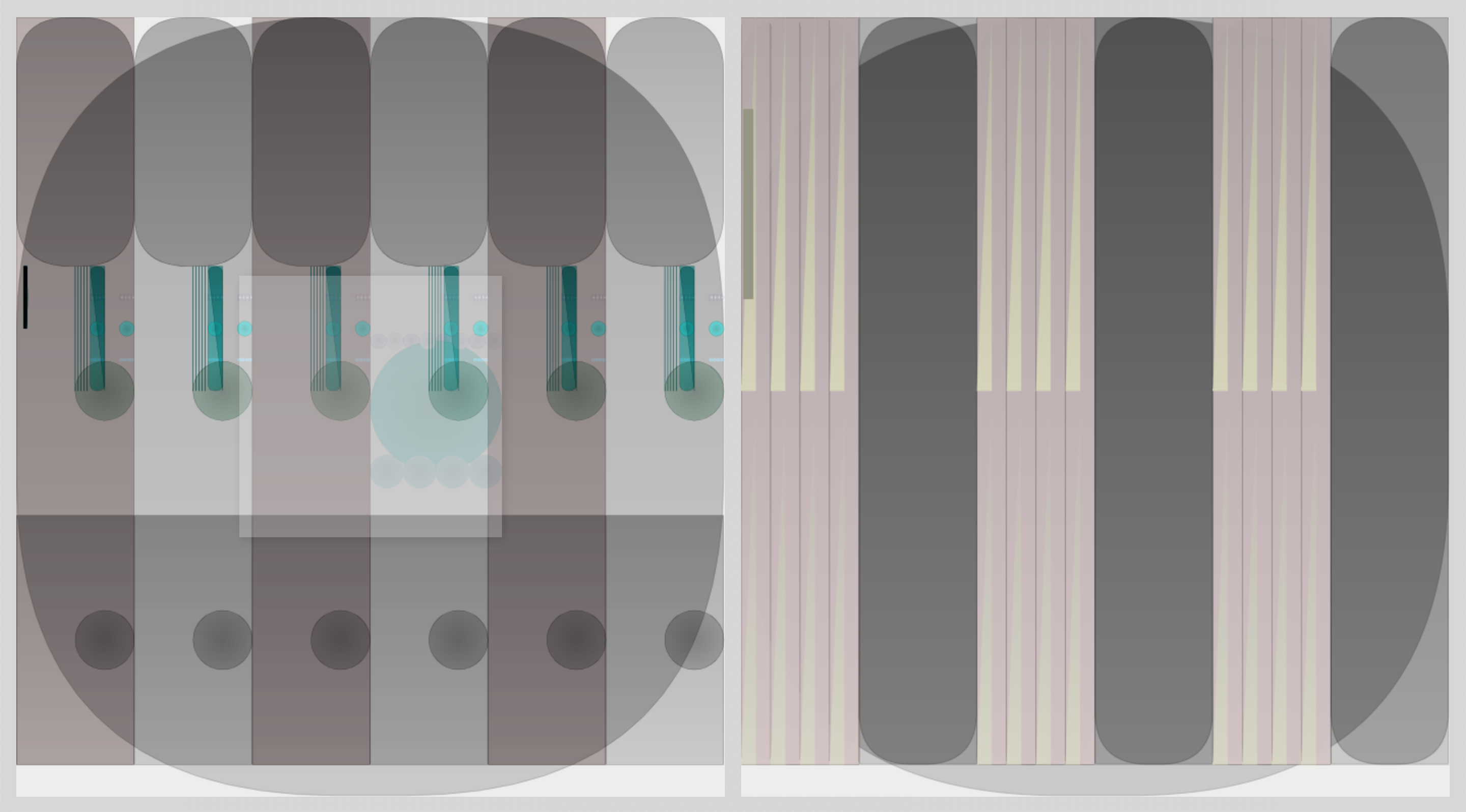
Nested Exchange. Two specimens from one population; the "hipster algorithm" rewards each for being maximally unlike every other — difference itself installed as the fitness criterion.
Collective taste: Delinear.info and Mutant Garden Seeder
Delinear.info (2014): "Instead of a linear feed with stable connections between users and their posts, the site presented a drifting assemblage of images and text, whose associative links were both structure and content. When users were online, their avatars hovered as circles over the page, marking the direction their interest."
This is note 952 ("Script") built into a social platform. That note describes a "cloud" of things whose associations are structure: "Every node has character, partially (but maybe completely) defined by its associations. Identity is deferred." Delinear.info made that deference literal — the associative links were not annotation but the fundamental material of the interface. "While the big platforms were honing their recommendation engines and training users to desire algorithmic predictability, Delinear.info proposed an interface for collaborative collage, where associations remained unstable and expressive."
The contemporary reading of the Delinear Whiteboards — the physical translation of the platform — is supplied by Jaakko Pallasvuo's 2015 press release for Just-in-Time (American Medium, Brooklyn; full text at sources/ingested/just-in-time-2015.md), the show that exhibited Time Management, Aureool, Oyster and Trauma (all subtitled scrum kanban, UV print on whiteboard with custom magnets, 100×150cm). Pallasvuo writes: "I think the show is 'about' programmer workflows and how they are visualized in corporate environments. Charts and drawings and post-its and mind maps and shit." This is not a retrospective analytic reading but the show's contemporaneous gloss — the project-management apparatus of Agile software development (scrum sprints, kanban swimlanes) lifted onto the wall as the work. The interface Delinear.info proposed for "collaborative collage" is the same interface scrum boards propose for collaborative shipping; the whiteboards stage the equivalence physically. See Just-in-Time (2015).
Death Imitates Language (2016): genetic algorithms generate "software organisms" whose traits mutate through the artist's selection feedback — which works live, die, reproduce. Optimal states are "frozen" and some fabricated as physical objects. Taste becomes a selection pressure, operating evolutionarily rather than intentionally. This is the subconscious computation thesis made concrete: the algorithm runs the logic of taste further than conscious deliberation could; the artist's role is selective, not prescriptive.
Mutant Garden Seeder (2021): collectors join the selection — decentralized authorship in theory. In practice, "collectors caught up in the speculative froth of the NFT market at the time bypassed the interface to mint directly from the contract." The protocol was gamed. Droitcour draws the lesson: "protocols can be gamed as easily as images can be circulated." The design of a system does not determine how it will be used.
The Seeder protocol runs the inverse traffic as well. NFT secondary-market valuation depends structurally on immutability — the image the collector buys must stay that image for any flip to retain its floor — and Mutant Garden Seeders designs that requirement out. Every transfer triggers a fresh mutation; a densely patterned specimen can collapse to a monochrome rectangle the next time it changes hands, taking its market value with it. Where the bypass-the-interface story is the market gaming the artist's protocol, this is the artist's protocol gaming the market: a deliberate refusal, written into the contract, of the immutability-as-price-basis logic that the rest of the NFT field relies on. See the Sutela conversation for van den Dorpel's own statement of the provocation.
Systemic taste: Quantizer
Quantizer (2025): "It makes the underlying rules perceptible as aesthetic material. In doing so, it resolves the tension at the heart of protocol art. The project asks us to judge protocols the way we judge artworks: as expressive, contingent, shaped by decisions and values."
This is the philosophical destination. Taste is no longer just the subject of the system — it is instantiated in the protocol itself as something perceptible, judgeable, desirable.
Quantizer. Here the rules themselves become aesthetic material: the work asks to be judged the way an image is, so that taste finally lives in the protocol rather than only in its outputs.
The Markov question: memory and melancholia
Markov's Window (2004) / Markov's Dream (2022). The Markov chain's defining property: "the next step of a sequence is determined by the current step and not what came before it." A formally memoryless system — each state depends only on the state immediately preceding it, not on the full history.
Yet into this memoryless structure, van den Dorpel embeds the opposite: a trait called "DSM book covers" that imbues iterations with colors and vocabulary from the Diagnostic and Statistical Manual of Mental Disorders. Melancholia inserted into a system that, by definition, cannot remember what it has lost.
The tension is philosophically precise. Melancholia in psychoanalytic terms is the failure of mourning — the inability to release an attachment to what is lost, the lost object incorporated rather than relinquished. A Markov chain cannot mourn because it has no memory of what was. Embedding melancholia into a memoryless system creates a form of affect that is systemic rather than historical — a permanent atmospheric condition rather than a response to specific loss. The system is melancholic without knowing why.
Permanence of change
Quantizer "insists on the permanence of change" against NFT culture's "obsession with permanent ownership and endlessly replayable imagery." It "lives as a single web page that can be collected but not fixed." It "frustrates the desire for return."
This is the assemblage-identity thesis applied to the digital work: the work's identity is constituted by its history of change, not by any fixed state. To collect Quantizer is not to own a stable object but to hold a position in an ongoing process. "It layers algorithms from different periods of computation to reflect the shifts of history as it embraces the dynamic fluidity inherent to digital media." The dithering algorithms from the 1980s-90s are not nostalgic quotation — they are strata, layers of computational history that the work holds simultaneously.
Droitcour's 2025 formulation has a curatorial precedent three years earlier. Nora Enning's essay for Context Switch (Galerie Noah Klink, 2022; full text at sources/ingested/context-switch-noahklink-essay.md) opens with the pre-Socratic doctrine that change is the only constant and reads the works' surfaces through it: the "vivid changes in colour and structure … make unchanging observation impossible simply by their design," so that the viewer "will ultimately fail to comprehend them in their entirety." What Quantizer would later institutionalise at the level of the protocol — a work collectible but not fixable — Enning already registers in 2022 at the level of perception: comprehension as asymptote, built into the design. The permanence-of-change reading was not coined for Quantizer; it was available to a careful observer of the light exposure prints and the Mutant Garden Autobreeder's LED animation (→ Context Switch).
The contrast with the semiotic square framework is worth noting: the square maps the logical space of positions (New/Old/Same/Different). Quantizer doesn't occupy a position in that space — it insists that change itself is the permanent condition, collapsing the square's terms. You cannot locate it as New or Old because it is never the same twice.
The blockchain soul — protocol-desire in the first person (Tokenising Sustainability, 2021)
Droitcour's closing claim — that the work makes protocols into "things you can look at, and maybe even desire" — has a first-person precedent four years earlier, recorded not as theory but as loss. In the essay Tokenising Sustainability (2021; → Tokenising Sustainability (2021), source at sources/ingested/tokenising-sustainability.md), van den Dorpel describes the 2020 rebuild of left gallery, in which the Ethereum integration was dropped and ownership records moved to a regular database:
"I was proud of what we had achieved with the left gallery relaunch, and I was amazed by all the works that artists offered on it, but also it hurt, because left gallery had lost some of its 'blockchain soul'."
Functionally, nothing was lost: sales continued, the works displayed, the records worked. What hurt was the protocol itself — the commitment to a form of ownership that did not depend on the gallery's continued goodwill or existence. A database record is mutable by its operator; a token is not. Mourning that difference while the platform runs perfectly well is desire for a protocol rather than for its outputs, felt and named before Droitcour supplied the category.
The essay also supplies the counterweight that keeps the claim honest: the soul was economically contingent. By 2020, minting and transfer costs had come to exceed "the sales price of the actual artworks by orders of magnitude," and the principle was abandoned because operating it became unaffordable. Together with the Mutant Garden Seeder story above, this closes a triangle around protocol art's material conditions: a protocol can be gamed by its users (Seeder's direct contract minting), priced out by its own infrastructure (left gallery's gas costs), and mourned by its designer. The third case is the strongest evidence for Droitcour's thesis — attachment to a protocol shows most clearly at the moment it has to be given up.
Making protocols desirable
The article's closing claim: van den Dorpel makes protocols "visible, turning the logics of digital systems into things you can look at, and maybe even desire."
Desire is the key word. Desire for images is the baseline; desire for protocols — for the rules and habits that shape aesthetic experience — requires a different kind of attention. What the work teaches is not aesthetic appreciation of images but aesthetic appreciation of systems: the capacity to feel the difference between a platform designed to maximize engagement and a protocol designed to make room for "difference, variation, and choice."
This connects to 709 (artist statement): "Complexity, inconsistency and contradiction do not necessarily call for a solution." The protocol that embraces instability and expressive association over predictability is not a deficient platform — it enacts a different set of values, readable as such.
See also
- Subconscious Computation — the algorithm as externalizing taste; craft as what separates this from noise
- Assemblage Identity — Dissociations as accumulation of taste decisions; Quantizer as work whose identity is its history of change
- Randomness and Pattern — the pattern/randomness dialectic in Delinear.info's "unstable and expressive" associations
- Semiotic Square — Quantizer's "permanence of change" as challenge to the square's positional logic
- Tokenising Sustainability (2021) — the "blockchain soul" passage in full context; ascribe.io, the dual-blockchain palimpsest, and the pre-Merge environmental argument