
Just-in-Time (2015) — Pallasvuo on the Delinear Whiteboards
Source: sources/ingested/just-in-time-2015.md — the press release for Just-in-Time, American Medium, Brooklyn (Feb 20 – Apr 3, 2015), Harm van den Dorpel's first solo show with the gallery, written by Finnish artist Jaakko Pallasvuo as a Facebook chat transcript with lyric fragments from Madonna & Justin Timberlake's "4 Minutes" (2008) interleaved between sections.
The exhibition
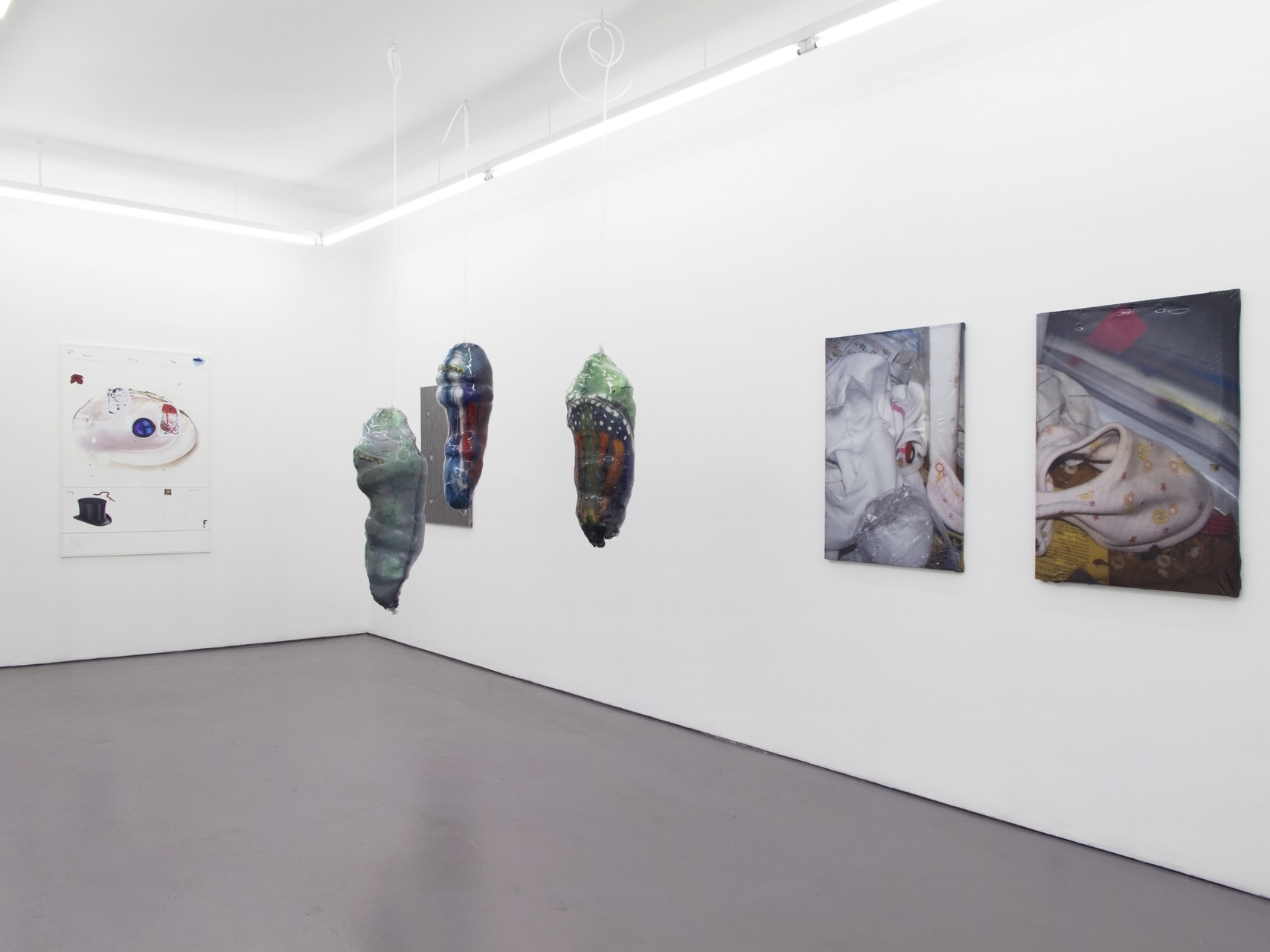
The show presented new sculpture, video and wall works across three connected bodies of work:
-
The Delinear Whiteboards — Time Management (scrum kanban) (100×150cm), Aureool (scrum kanban), Oyster (scrum kanban), Trauma (scrum kanban) and Inclusion (scrum kanban). UV print on whiteboard with custom magnets. The series translates the Delinear.info social platform (2014) into physical project-management surfaces, borrowing the visual grammar of scrum sprint planning and kanban swimlanes from Agile software development.
-
The Chrysalis sculptures — Chrysalis (blue) MK II, Chrysalis (green) MK III and Chrysalis (mint). The pupa as the sphere softened; the Assemblage series' polyhedral spheres mutate toward an organic, sealed form. See Sculpture and the Object for the lineage.
-
Wall works and a website — Macro Intimacy, Painting with lens flare, Very Beta Still (break fast), and a presentation of Delinear.info itself (the working software, shown in the gallery as the source the whiteboards translate).
Time Management (scrum kanban). The title doubles as the method: the magnets occupy the kanban swimlanes, and the swimlanes are the time being managed — the project board itself hung as the work.
Aureool (scrum kanban). Aureool is the Dutch for halo; the magnetic discs ring a centred image like a project-management corona.
Oyster (scrum kanban). Another board in the series: the printed swimlanes hold custom magnets as movable tokens, the Agile sprint surface hung as a picture.
Trauma (scrum kanban). The project-management grammar turned onto something the sprint board was never meant to schedule — the title lets the management surface carry a charge the corporate original suppresses.
Inclusion (scrum kanban). The same translation of Delinear.info into a physical board — the social platform's logic of participation restated as swimlanes and tokens.
Chrysalis (green) MK III. The Assemblage sphere softened into a pupa — a sealed object that now also names a sealed process, caught between two phenotypes.
Deli Near .Info. The working social platform shown in the gallery as an artwork; the whiteboards on the adjacent walls are its physical translation.
The text — a Facebook chat as press release
Pallasvuo's text is structurally unusual for a press release: it is a transcript of the Facebook chat in which the writer and the artist were meant to be discussing what the press release would say. The chat is the press release. The artist's responses are preserved in lowercase, without punctuation, exactly as typed. Between sections, lyric fragments from Madonna and Justin Timberlake's "4 Minutes" (2008) appear in dialogue boxes labelled [Madonna:] and [Justin:] — the title of the show punning on "Justin / In Time" and on the 2011 dystopian Sci-Fi film In Time.
The writer's relation to the work is stated as a refusal to interpret: "I don't really get Harm's work. I can be near it though." The criticism the form makes is structural — the press release as a confident interpretive frame is replaced by a record of mutual confusion preserved verbatim. This is itself the most precise 2015 statement of the wiki's process-legibility position applied to the genre of the press release: the apparatus of the announcement (the back-and-forth, the second-guessing, the lyric earworms) is exhibited rather than concealed behind the polished interpretive paragraph it would normally hide behind.
The apparatus on the wall. The project-management surfaces line the room while a sealed Chrysalis sits apart on its plinth — the exhibited workflow and the closed object side by side.
What this ingest changed in the wiki
Per the editorial principle in the project's CLAUDE.md — substance over size, no new pages unless the material introduces a structural distinction with no canonical home — the substantive payload of this ingest was distributed to existing pages. This summary records what was sharpened, with pointers to where the substance now lives.
1. Process Legibility — the 2015 confession of "process before the work"
In Process Legibility, inside the existing section The third person dropped — exhibition text as self-concealment, a new subsection The 2015 confession: process as before the work now sets the Pallasvuo chat alongside the Loomer press release as the second 2015 self-disclosure. The substantive sharpening is this:
The Pallasvuo transcript contains the artist's own formulation of what the focus on process would mean if he could not yet see how the process could be the work:
"maybe im trying to legitimize my focus on process, thought and all other aspects of creation that happen before actually creating something substantial and possible to communicate . maybe decide in the end to leave it unrealized, unactualized uncommunicated"
The word before is the load-bearing one. In 2015 the artist's interesting material — process, thought, the apparatus of creation — is framed as prior to the work, and therefore in tension with it: to focus on process is potentially to leave the work unmade. The same paragraph reaches for Agamben's reading of "absolute potentiality" — i.e. Bartleby's "I would prefer not to" as a positive exercise of potentiality-not-to — to legitimate non-actualisation as an option.
The 2026 Process Legibility position is the structural resolution of that 2015 dilemma: the construction is the image, so the option of non-actualisation no longer arises in the same way — there is no "substantial thing to communicate" separable from the process whose making would be the betrayal. The wiki now records both ends of the eleven-year arc: 2015 (Bartleby as live option) → 2026 (Bartleby option dissolved by the cellular automaton).
A second sharpening: the Delinear Whiteboards are read in the same passage as the works that already contained the answer the text had not yet found. They exhibit the project-management apparatus (the kanban board, the post-its, the mind map) as the artwork itself — the pre-work artefacts on the wall, with no "real work" they were supposed to lead to. Pallasvuo names this when he writes "the show is 'about' programmer workflows and how they are visualized in corporate environments. Charts and drawings and post-its and mind maps and shit."
2. Release Early — the motive of release named ("thats the thrill")
In Openness — Release Early, Release Often, a new section "Putting some thoughts and ideas there" — the motive named (2015) records the artist's own contemporaneous statement of why one releases. The Hannah Arendt quote ("Men always want to be influential… No, I want to understand") is introduced into the chat by the artist; his immediate gloss is:
"i think thats the point of doing it
putting some thoughts and ideas there, and then see what other people think about that
thats the thrill
in this quote of hers, im not on the side of the 'men'"
The Abrons (2013) credo reads release structurally — as a feedback loop, a software-engineering pattern applied to art. The Just-in-Time 2015 chat reads the same loop as desire: thats the thrill. The page now holds both — release as structure and release as motive — and notes the explicit anti-influence position: the feedback loop the practice trusts is understanding-among-equals, not influence-over-others.
The same section also surfaces the limit of the credo from the inside: "the incentives to actually make something are unclear to me - because they are so wound up in other processes. like market stuff, and who's going to see it anyway." The credo survives this suspicion by specifying which loop the practice trusts: not the market loop, but the equals loop.
3. Protocol, Taste, and Systems — Pallasvuo as the contemporaneous source
In Protocol, Taste, and Systems, the existing section on Delinear.info and the Delinear Whiteboards now names Pallasvuo's 2015 reading as the contemporaneous gloss on the whiteboard series — retiring the hedge that the "Agile vocabulary applied to artworks" reading is retrospective. Pallasvuo wrote, in the show's own press release, that it was "about programmer workflows and how they are visualized in corporate environments — charts and drawings and post-its and mind maps and shit." The whiteboards (the kanban swimlanes, the magnetic discs as project tickets) literalise this. The hedge was unnecessary; the analytic reading and the contemporary reading coincide.
Three references the chat introduces
The chat names three thinkers as part of its texture. Each is one sentence, but each is load-bearing for what the artist allows himself to think aloud in 2015. Recorded here for the wiki's reference, not extended into doctrine.
-
Hannah Arendt on understanding vs. influence — "Men always want to be influential. I see that somewhat as an onlooker. Do I see myself as influential? No, I want to understand. If others understand in the same way I've understood that gives me a sense of satisfaction, like being among equals." The artist's gloss: "in this quote of hers, im not on the side of the 'men'." Pallasvuo challenges this — "Hannah Arendt was massively influential and accomplished, that this humility rings false." The wiki notes the productive disagreement without resolving it; the substance lives at Release Early (motive of release).
-
Elvia Wilk on invisibility — "There are various ways to become invisible: one is to become transparent; another is to put up an opaque shield. Neither tactic is fully realizable." The artist adds a third strategy: "one way is to be like a chameleon and mimic your environment / then people also dont see you." Pallasvuo reads the two artists as wanting the same invisibility by opposite methods — Harm via the opaque shield (the algorithmic black box, the kanban diagram as cover), Pallasvuo via transparency (the chat as press release).
-
Giorgio Agamben on absolute potentiality — "i tried to read agamben / and he says something interesting about absolute potentiality / which means / decide to rather not do anything." This is Agamben's reading of Bartleby's "I would prefer not to" as the positive exercise of potentiality-not-to. In 2015 the artist reached for this to legitimate non-actualisation. The substance is folded into Process Legibility (where the dilemma is shown to be resolved by the construction-as-image position).
Why this ingest did not produce a new doctrine
The Just-in-Time press release does not introduce a new conceptual axis to the practice. It records the artist's uncertainty about whether to actualise at all in 2015, three references he reached for to think about that uncertainty, and a writer's refusal to interpret the work in favour of being near it. Each of these has a canonical home: the actualisation question goes to Process Legibility; the motive-of-release question to Release Early; the kanban-as-art reading to Protocol, Taste, and Systems. This page is the trace of that distribution — an index from the 2015 source into the pages where the wiki now carries what the 2015 source said.
See also
- Process Legibility — The 2015 confession: process as before the work — where the substantive sharpening from this ingest now lives; the Bartleby/Agamben-on-potentiality reference is folded in here
- Openness — Release Early, Release Often — "Putting some thoughts and ideas there" — the motive named (2015) — the artist-named motive of release
- Protocol, Taste, and Systems — Delinear.info and the Delinear Whiteboards — Pallasvuo named as the contemporaneous source for the scrum-kanban reading
- Loomer (2015) — the parallel 2015 self-disclosure: third-person convention dropped, "I still hesitate to call myself an artist", "post-internet" label retired
- Sculpture and the Object — the Chrysalis (2015) sub-series in the Assemblage lineage
- sources/ingested/just-in-time-2015.md — the full Pallasvuo press release