
Openness — Release Early, Release Often
The source: Eric Raymond's credo
The full phrase — Release early, release often, delegate everything you can, be open to the point of promiscuity — is drawn from Eric S. Raymond's essay "The Cathedral and the Bazaar" (1997), the founding document of open source development philosophy. Raymond's argument: the old model of software development was cathedral-like — planned, hierarchical, developed in private and released when finished. The new model was bazaar-like — released constantly, open to all, developed in public with the user community as co-developers. The value: rapid, close feedback loops between user and developer. The mechanism: frequent release keeps the gap between intent and effect small, because errors are corrected before they compound.
"Be open to the point of promiscuity" extends the credo: not merely transparency about the code, but genuine openness to contributions from any source, regardless of pedigree. The cathedral controls who may enter; the bazaar admits anyone.
Applied to artistic practice, the phrase describes:
- Frequent public release — not holding work until "finished" but releasing it into circulation, letting it be tested and modified by encounter
- Feedback loop with the audience — the user/viewer as co-constituter of the work, not passive recipient
- Blurring of producer/user — who is making the work and who is receiving it become indistinguishable at the limit
- Transparency — the process visible, the logic legible, the source open
The Abrons exhibition (2013)
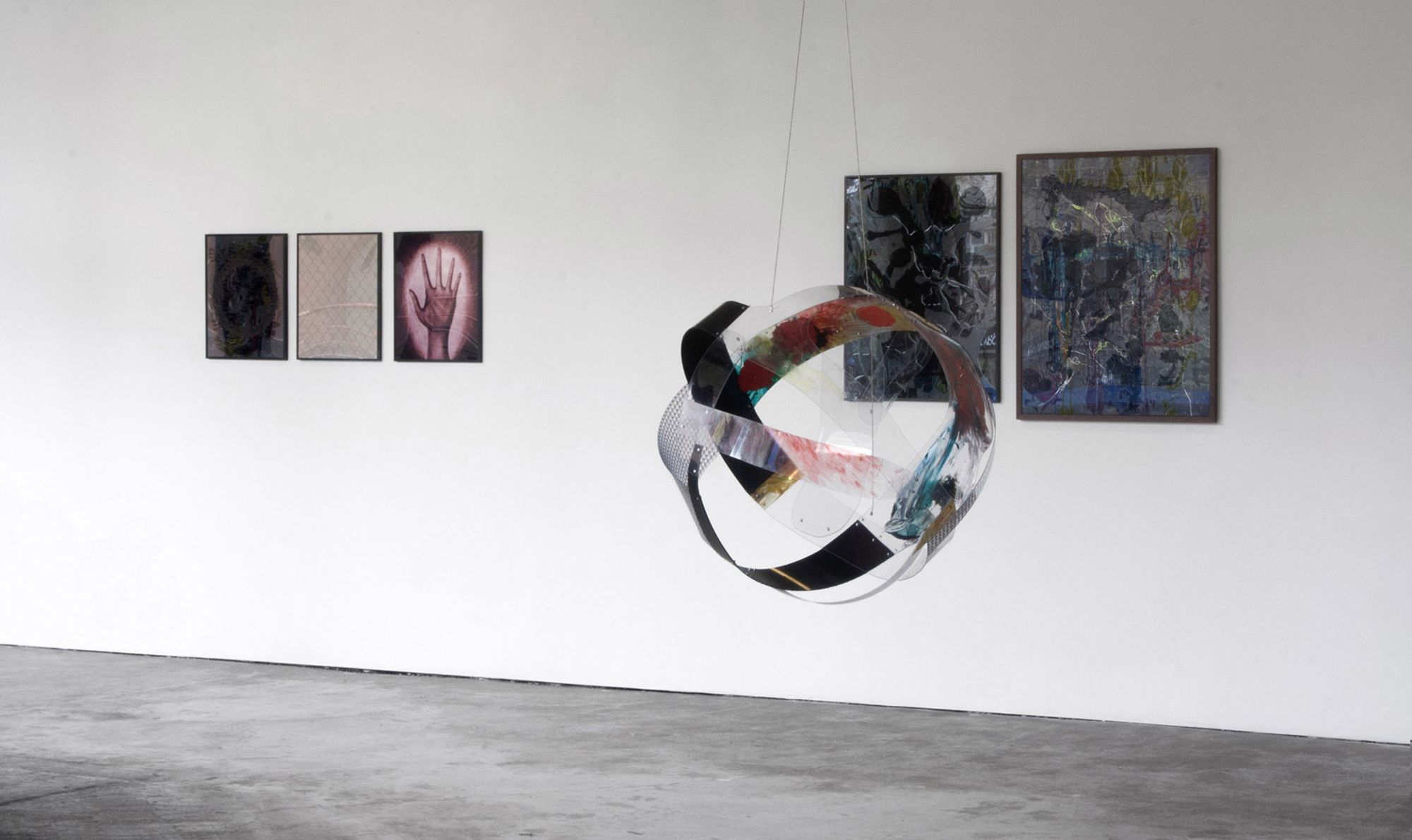
The phrase became the title of van den Dorpel's first solo exhibition in the United States, at Abrons Arts Center, New York City (April 19 – June 7, 2013), curated by Karen Archey. Source: sources/ingested/release-early-release-often-2013-press-release.md.
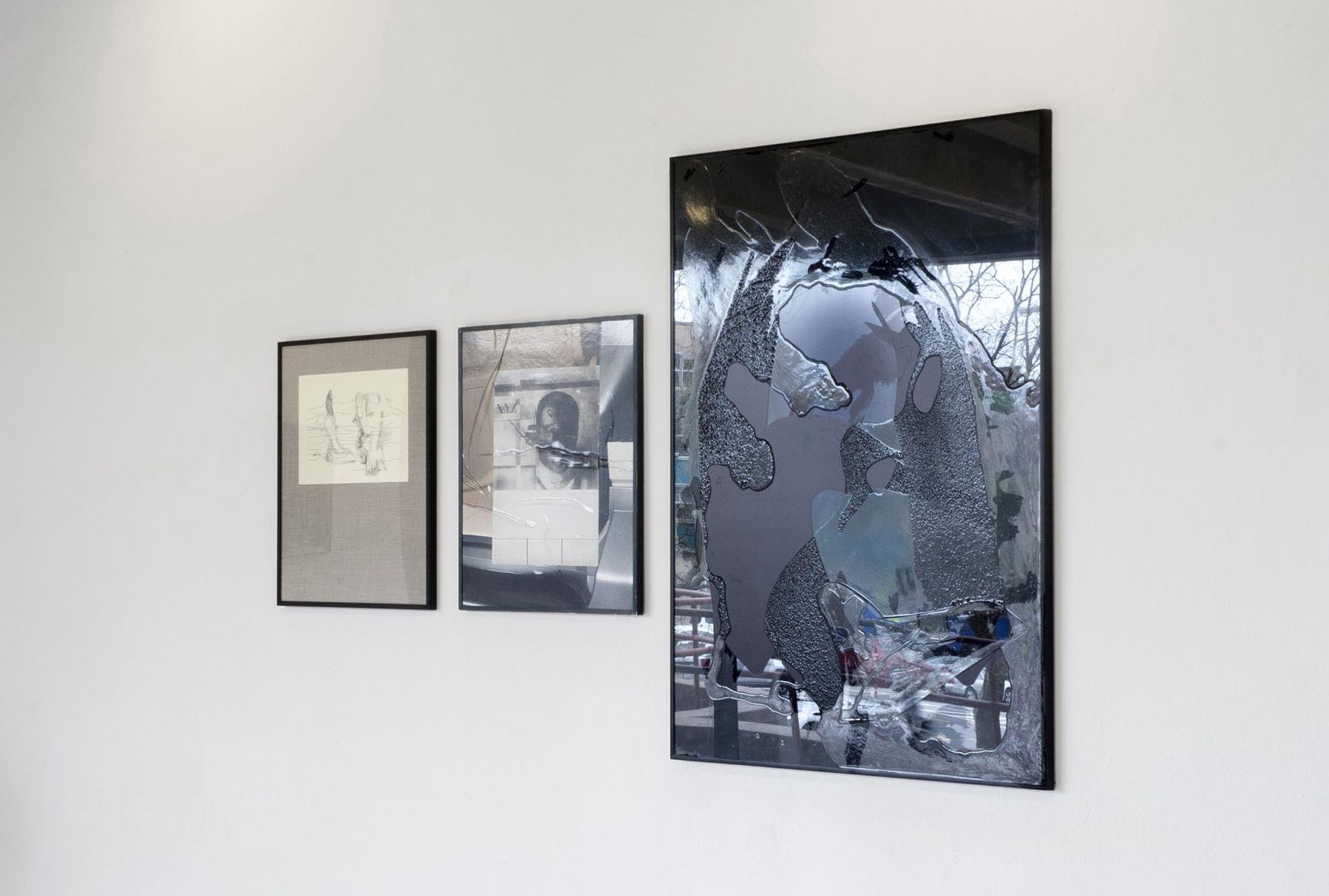
The show brought together spherical Perspex assemblages, collages, and web-based works — the precise list documented in note 1035. Works were installed associatively rather than by medium or chronology: the organisational principle was contingency, not taxonomy. Medium permeability was structural: physical and virtual works occupied the same space, neither subordinate to the other.
The press release identifies recursion as the curatorial premise. The description of the hand drawing is worth quoting in full, because it describes recursion in motion:
"A drawing of a hand appropriated from DeviantArt.com reappears in one of Van den Dorpel's collages, which was used as the lead image for a March 2012 exhibition in London; the same drawing reappears in reviews of the exhibition online and in print media, and finally recurs as a screenshot of an exhibition review printed on a strip of Plexi twisted into a new Perspex sculpture."
The hand drawing does not stay in one domain. It moves: internet source → collage → exhibition image → review → screenshot of review → new physical sculpture. Each stage is a re-release: the work enters circulation, generates context (the review), and that context is gathered back in and re-materialized. This is "release early, release often" as generative process — release causes the work to accumulate new states, which become new material.
This sequence is also the physical enactment of 992's formula: The Work = The Work + Its Documentation. The documentation (the review, the press image) re-enters the work as raw material for the next iteration. There is no separation between the work and the record of its exhibition.
Dissociations.com as data-mining tool
The press release frames dissociations.com as a tool for the artist to "data mine" his own artistic activity "by applying generative algorithms on intuitive formations of aesthetic theory." The site is not a portfolio — it is a generative system operated on the artist's own output. The openness here is reflexive: the artist is simultaneously the developer and the user, mining his own intuitions with his own algorithms.
This is the open source feedback loop turned inward: the user and the developer are the same person. The site generates associations between notes that the artist did not consciously plan; the artist navigates those associations as a user of a system he built. The gap between intent and output is the productive space — the same gap that "release early" exploits in public software development, now operating on one person's own archive.
Openness in tension with recursion
Note 876 identifies the paradox at the heart of recursion: "The prerequisite of recursion — the demand for self-referentiality — immediately also forbids reference to anything outside of itself." Radical autonomy, the logical consequence of perfect recursion, is self-enclosure.
"Release early, release often" is the counter-movement. Where recursion closes the system — making it self-sustaining, self-referential, impervious to external correction — openness insists on permeability. The work enters the world, accumulates responses, is modified by encounter, and returns changed. This is a different relationship to the outside: not the recursive system's aggressive jealousy (→ 876: "It is exclusive and aggressively jealous") but a promiscuous openness to influence.
The tension is not resolved. The practice holds both: recursive self-reference (documentation constitutive of the work, the work containing its own criterion) and radical openness (frequent release, feedback loops, permeable media). These are opposing pressures on the same material. The exhibition title names the second pole; the related notes in 876 name the first.
The artist-patron inversion
When a collector expressed interest in commissioning a new version of one of the Perspex works, van den Dorpel offered instead to make a sculpture from Facebook photos of the collector's dog. The press release describes this as "toying with conventional notions of the historical artist-patron relationship."
The inversion is precise. The patron commission traditionally: specifies a subject (portrait of the patron, religious scene), pays for its execution, acquires a fixed object. Van den Dorpel's counter-offer substitutes: the patron's own digital image-stream (Facebook photos) for the commissioned subject, van den Dorpel's sculptural process for execution, and the open source logic of "your data enters my system" for the traditional transaction. The collector does not receive a variation of an existing work — he receives a work made from the traces he himself has already released publicly. The "release early" principle: the collector's Facebook photos are already out there; the artist gathers them back in.
"Putting some thoughts and ideas there" — the motive named (2015)
Two years after the Abrons show, the Pallasvuo press release for Just-in-Time (American Medium, 2015; full text at sources/ingested/just-in-time-2015.md) records the artist stating the motive of release in his own voice. The exchange begins with a Hannah Arendt quote — "Men always want to be influential… No, I want to understand. If others understand in the same way I've understood that gives me a sense of satisfaction, like being among equals" — which the artist introduces to position himself against influence and toward understanding-among-equals. He immediately continues:
"i think thats the point of doing it
putting some thoughts and ideas there, and then see what other people think about that
thats the thrill
in this quote of hers, im not on the side of the 'men'"
The "release early, release often" credo is a system designer's vocabulary; "thats the thrill" is the artist's own. They describe the same feedback loop from different sides. Putting thoughts and ideas there = the release; see what other people think = the feedback; thats the thrill = the motive. The Abrons press release reads the loop structurally (dissociations.com as a "data-mining tool" turned on the artist's own intuitions); the Just-in-Time chat names it as desire. The work is released not to be influential but to be answered.
This also marks the limit of the credo from the inside. The same chat records the artist's doubt about whether to release at all: "i just in general feel incapable of expressing in art pieces the stuff that really interests me… because the incentives to actually make something are unclear to me - because they are so wound up in other processes. like market stuff, and who's going to see it anyway." The thrill of release is held in tension with the suspicion that the market is the wrong feedback. The credo describes the structure that survives that suspicion: release into a feedback loop that is not market-mediated. The Arendt move clarifies which loop the practice trusts — understanding-among-equals, not influence-over-others.
The work re-released — venster.harm.work (April 2026)
A work released in 2024 is not finished with its release. In April 2026 van den Dorpel announced a dedicated home for the Venster collection at venster.harm.work with the explicit framing: "The Venster collection from 2024 has a new home. Besides listing its 100 minted token, the entire seed space can now be explored." The new site filters tokens by three trait axes (visual style: lozenge / cover / diagonal split; aesthetic mood: classic / optimistic / melancholic; visual density: low / medium / high) and — the substantive addition — exposes the unminted seed space as navigable territory alongside the 100 minted tokens. The 2024 release was the work entering circulation; the 2026 re-release opens it to a different mode of encounter (exploration of the generative space rather than ownership of a token in it). The accompanying writing — Venster (2024) — already identified the work with the on-chain score rather than the rendered token; the explorer site is the score's interface, made navigable. Per Note 992's formula (The Work = The Work + Its Documentation), the new interface is part of what Venster now is.
See also
- Recursion and Self-Reference — the tension between openness and recursive self-enclosure; the Abrons hand-drawing chain as physical enactment of recursion; note 729's self-citation
- Mediation and the Archive — "The Work = The Work + Its Documentation" (992); documentation as generative material rather than supplementary record
- Process Legibility — transparency as a primary value; the open source ethic applied to the visibility of process in the work
- Assemblage Identity — the spherical Perspex assemblages; meaning through contingency; associative installation as method
- Protocol, Taste, and Systems — dissociations.com as protocol; data-mining one's own activity as the feedback loop turned inward
- Abrons Arts Center exhibition (2013) — full analysis of the press release and exhibition context