
Sculpture and the Object
"He is not aware that a gallery system exists. All his work exists in the virtual sphere, which to him is more real than the reality we all supposedly inhabit in the day-to-day. (…) Both, to him, are objects, completed works. They are just said in different ways, enunciated using two separate [languages]. (…) For him, the virtual never a critique or evasion of the actual. Virtual and actual were always one and the same."
— Travis Jeppesen, Revenge of the Spheres, catalog text for About, Wilkinson Gallery, London, 2012
Why sculpture?
An artist working since 2005 in the browser, in generative code, in collage made of screenshots and watermarked stock images — why, in 2011, does he start making three-dimensional objects in space?
The answer the practice itself supplies is: he does not consider it a departure. Van den Dorpel was reading object-oriented ontology (OOO) during precisely the period the Assemblage sculptures were made (roughly 2010–2014, the moment when Graham Harman, Levi Bryant, Ian Bogost, Timothy Morton and Tristan Garcia were consolidating the field). OOO supplies a flat ontology: digital images, polyhedral sculptures, blockchain tokens, search-engine results, and physical objects in a gallery are all objects on the same ontological footing. None is more real than another. The art object — like any object — is irreducible to both its parts and its effects; what we see of it is a surface, never the thing itself.
This is the philosophical permission slip. If a digital image is already an object, then giving it a body — printing it on synthetic glass, cutting it by hand, assembling it into a sphere — is not a translation. It is the same object spoken with a different grammar. Jeppesen captures this in the line above: "they are just said in different ways."
The Wilkinson catalog title — Revenge of the Spheres — names the form precisely. The first Assemblages are spheres (or sphere-tending polyhedra) — closed, sealed, irreducible. The most withdrawn object in geometry is the one that returns the spotlight onto matter: that the digital, having been declared post-physical for two decades, comes back as a stubborn 100×100×100 cm thing one has to ship flat.
The Assemblages (2011–2018) — the form
The works share a near-identical material recipe. From the studio checklist for About (Note 1035):
- Substrate: hand-cut synthetic glass (PET-G or acrylic)
- Surface: digital UV print of a found or made image — a scanned canvas, an iPhone snapshot, a Google Image search result, finger-painted vitrea, a watermarked stock photo, a Facebook photo album
- Geometry: a polyhedral approximation of a sphere — facets cut by hand and assembled into a closed three-dimensional body, 70 to 110 cm in diameter
- Treatment: protective foil sometimes left on; watermarks of unregistered software sometimes left in
- Shipping: flat (the work folds back down to its components for transport — itself a logical inversion of "completed sculpture")
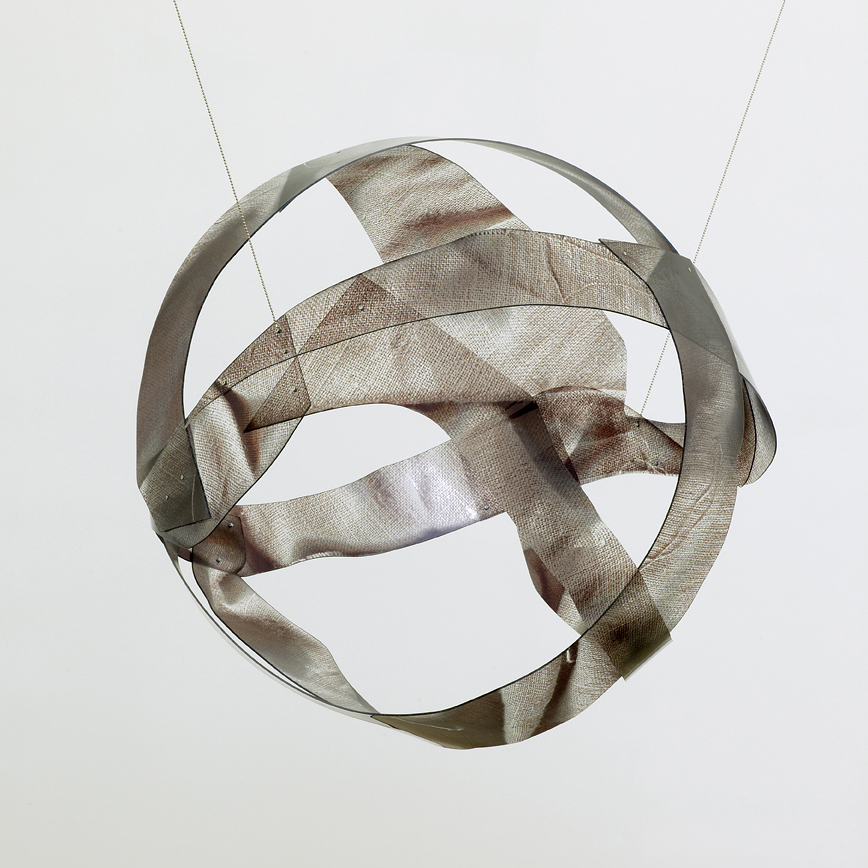
The titles parenthesize what the surface texture depicts:
| Work | Year | Texture | Note |
|---|---|---|---|
| Assemblage (shell) | 2011 | digital print, spray paint | → harm.work |
| Assemblage (canvas) | 2011 | scanned canvas | → harm.work |
| Assemblage (armor) | 2012 | digital print, spray paint | 1035 checklist — not always shown |
| Assemblage (chain) | 2012 | UV print | → harm.work |
| Assemblage (About reviews and press) | 2012 | scans of the show's own reviews | self-reference; 851 |
| Assemblage (on usability) | 2012 | finger-painted vitrea + protective foil + strap | 943 |
| Assemblage (everything vs. anything) | 2013 | watermarked stock photo of broken shop window | 1301; see Assemblage Identity |
| Assemblage (portrait of collector's dog) | 2013 | Facebook photos of the collector's dog | 1064 |
| Assemblage (leftovers) | 2013 | residual material of the prior works | 1048 |
| Assemblage (new) | 2018 | reflective foil / aluminium texture | → harm.work |
| Assemblage (About) | 2018 | (the 2018 large-format restatement of the form) | → harm.work |
The list is a roster of sources for surface. Each title is the metadata of where the texture came from: a scanned material, a Google query, a Facebook album, a press clipping of the show that contained the sculpture. The sculpture is a sphere wearing the trace of a search.
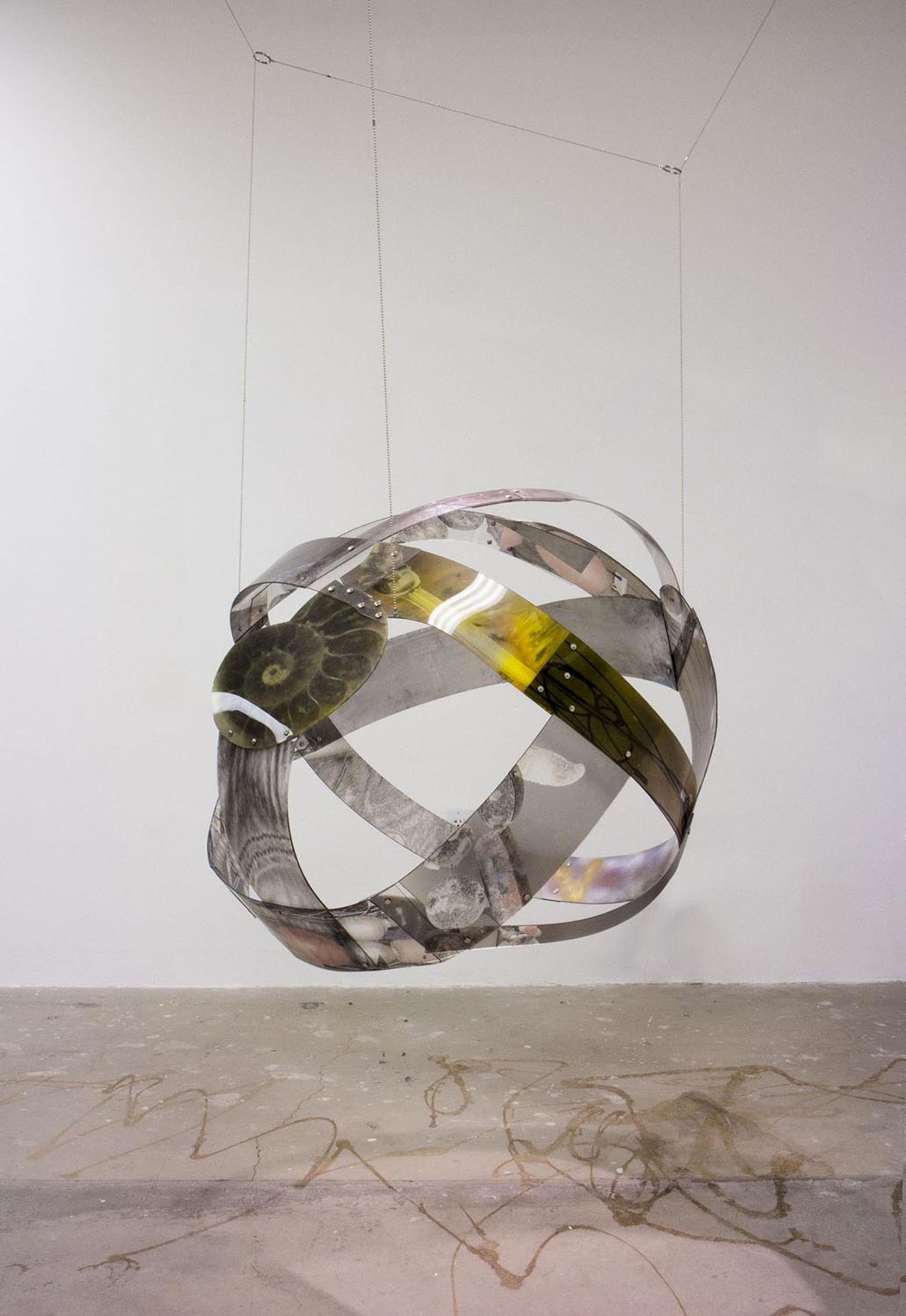
Assemblage (shell). One of the first spheres, from 2011: a digital print of a shell-like surface UV-printed onto the hand-cut facets, then worked over by hand with spray paint — the machine print and the physical mark held on one body.
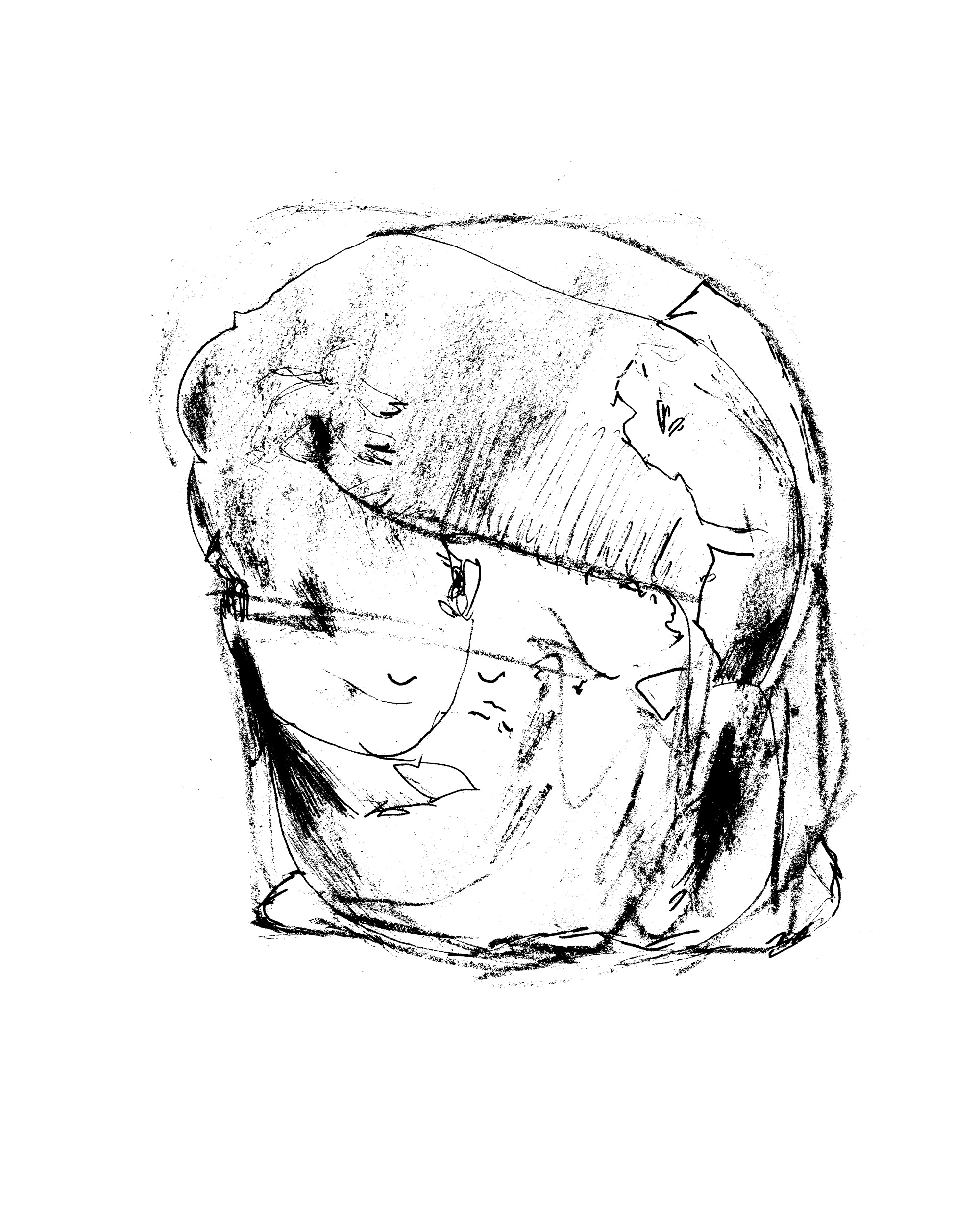
The shape studies. Seven flat developments work out how the sphere unfolds into cuttable facets — sphere-approximating but never generated by a curve: the discrete, foldable, ship-flat version of a sphere. The drawing is the program; the assembled sculpture is the execution.
The About exhibition (Wilkinson Gallery, London, 2012)
About was van den Dorpel's first solo exhibition at a commercial gallery — the first time the assemblages were shown in a larger constellation. The checklist included the About exhibition page:
- Untitled (collage with hands) — print
- Assemblage (chain) — 2012, 100×100×100 cm
- Assemblage (shell) — 2011, 100×100×100 cm
- Assemblage (canvas) — 2011, 70×70×70 cm
(The studio checklist 1035 indicates more works were prepared — including Assemblage (armor), Assemblage (About reviews and press), and several engraved-glass works — but the show ultimately presented the four above. Online works — Highway, Ethereal Self, Wishing Well .biz, Cloud on Title, Scroll, Dutch Fractal — appear in the same checklist file under "Location: Online," indicating the show was conceived as a single field that crossed the gallery / browser boundary even though only the physical pieces traveled to Wilkinson.)
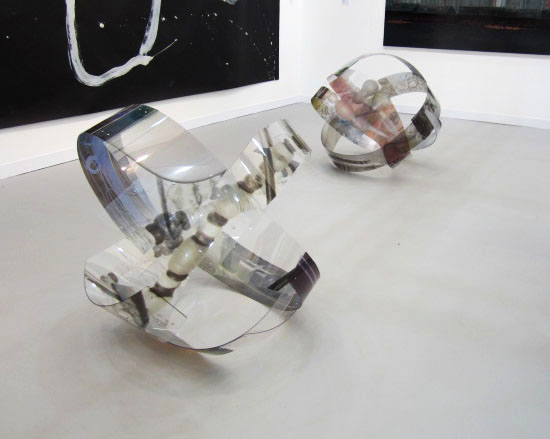
Travis Jeppesen's catalog text, Revenge of the Spheres, did the conceptual work the show could not do for itself. It identified the sculptures as the physical enunciation of a position the practice had until then held only online: that the distinction between virtual and actual is grammatical, not ontological. "Conjure a body-mind machine, mattering itself into objects. The art object is a thing that is permitted to simultaneously be something else. Many things at once, that thing."
The last clause is precisely Harman's polysemic object — irreducible to any one of its relations.
The position did not stay in 2012. A decade later, Nora Enning's curatorial essay for Context Switch (Galerie Noah Klink, Berlin, 2022; full text at sources/ingested/context-switch-noahklink-essay.md) restates it from the curatorial side, without OOO's vocabulary and without needing it: "To distinguish the digital from the supposedly tangible no longer seems contemporary, as they now seem to complement each other and merge almost seamlessly." What Jeppesen argued in 2012 as a philosophical position — virtual and actual as one, "just said in different ways" — Enning can note in 2022 as something no longer even contemporary to dispute. The claim the assemblages had to stage has become a curatorial given; the exhibition her essay frames hung light exposure prints and LED algorithmic animation alongside watercolours and oils on exactly that assumption (→ Context Switch).
Object-oriented ontology — the theoretical horizon
The years the assemblages were being made (2010–2014) coincide with the OOO moment. Graham Harman's The Quadruple Object (2011), Levi Bryant's The Democracy of Objects (2011), Ian Bogost's Alien Phenomenology (2012), Tristan Garcia's Form and Object (2011, English translation 2014), Timothy Morton's Realist Magic (2013) and Hyperobjects (2013) all land in this window. The theoretical position is summarisable as:
- Flat ontology — every object is on the same ontological footing; no class of objects (humans, mountains, neutrinos, fictions, search engines) is more real than another.
- Withdrawal — every object exceeds any of its relations. What we encounter is a surface; the thing-in-itself is permanently shielded from access.
- Allure and the unit operation — what we know of an object we know by what it does, what it allures or refuses, what unit operations it performs — not by direct insight.
Read with this in mind, the assemblages stage all three claims:
- Flat ontology: a Facebook photo album, a UV-printed sheet, a synthetic-glass cut, a hand-assembled polyhedron, the title parenthesis that names where the surface came from — all are equally the work. There is no master register.
- Withdrawal: the sphere is sealed. You cannot see inside. The surface is a digital image: it does not reveal what the object is. The closed solid is OOO's withdrawn object cast as gallery furniture.
- Allure / unit operation: the work's effect comes from the slippage between what the surface depicts (a chain, a canvas, a broken shop window, a collector's dog) and what the object does as object (occupy a hundred cubic decimetres of gallery floor, ship flat, reflect light off plastic). The categorical mismatch is the work.
Note 1266 — the Agamben citation, almost certainly from The Coming Community or Means Without End — sits in the same studio period and points to the political stakes of the same problem: the destruction of "the destructive distinctions between sacred and profane, the exception and the norm, the singular and the universal" so that they "would cease to be instruments in the hands of those in power." The OOO claim — that the digital and the physical are equally object — is, in this lineage, the artistic correlate of the political project: draining the divisive force from the most operative distinction of the practice's lifetime.
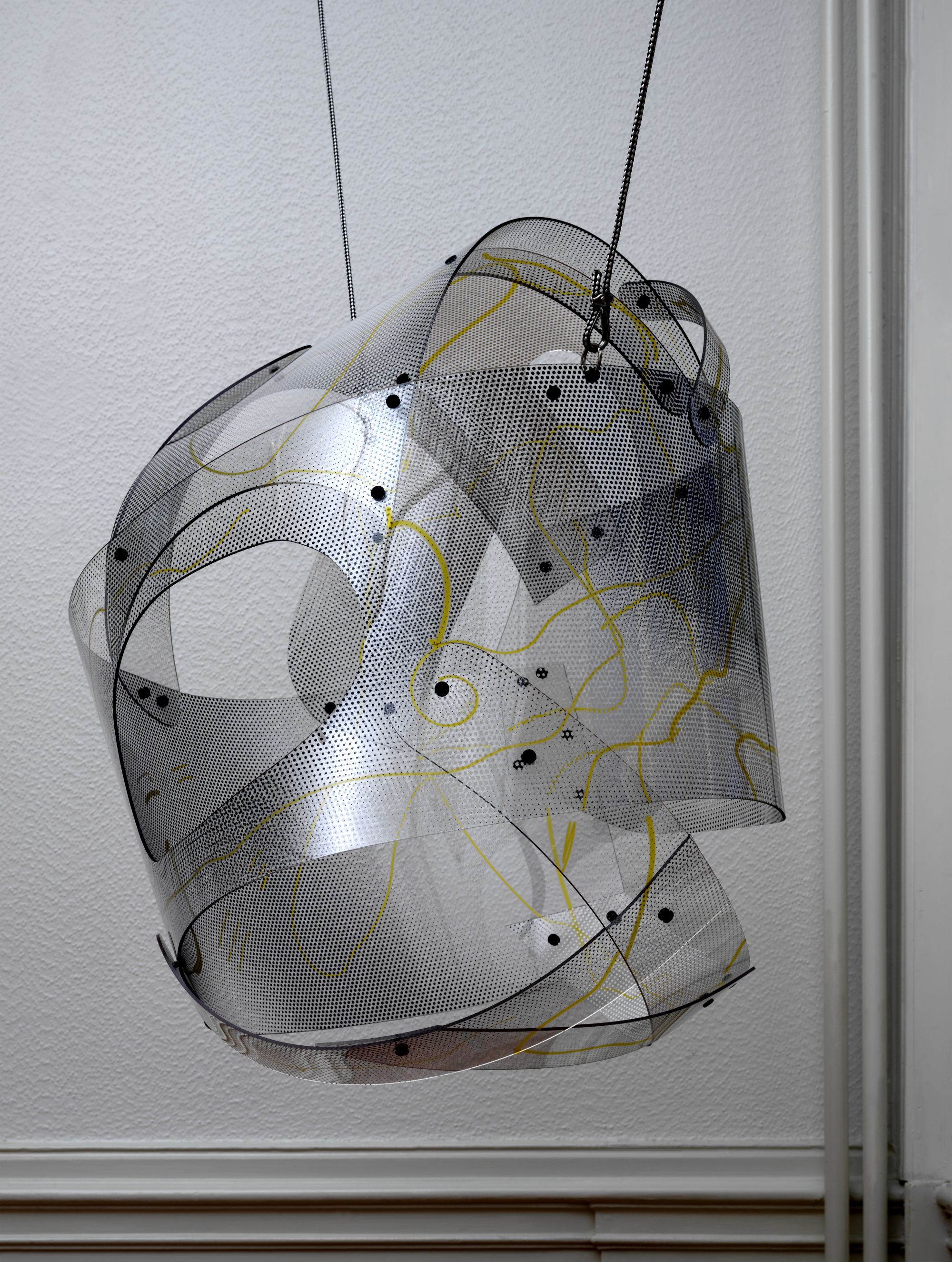
Assemblage (new). The 2018 restatement smooths and brightens the surface, the polyhedral seams surviving only as faint creases — the withdrawn solid rendered as gallery furniture. The "(new)" in the title is the family's recursive joke: the seventh sphere is still new because the work is the form, not the iteration.
Epistemological parity between sculpture and algorithm
The strongest argument for the assemblages being of a piece with the algorithmic netart is not theoretical but procedural. The two practices share an epistemology of object-formation:
1. The maker does not author the surface. In the algorithmic work — Mutant Garden, Markov's Dream, the CGP outputs — the surface (the rendered frame, the palette, the offspring) is produced by a system the artist has parameterised but not specified. The artist tests outputs (negative-selection, fitness function, protocol-of-taste) rather than draws them. In the assemblages, the surface is similarly found: a Google query, a Facebook album, a scanned canvas, a watermarked stock photo. The artist does not paint the image on the sphere; the image is projected onto the sphere from elsewhere.
2. Compositional constraint replaces compositional decision. The polyhedral geometry is the constraint that determines how a 2D image will fold into a 3D body. The artist chooses the texture and the geometry; the folding is implied by both choices and the cutting program. Compare the CGP fitness function: the artist chooses the seed and the selection criterion; the offspring is the deterministic consequence.
3. The interior of the object is opaque to its maker. The algorithm's latent space is not legible by inspection — even the artist does not know in advance what the next mutation will produce (Subconscious Computation). The assemblage is sealed, polyhedral, closed; you cannot see inside the sphere. In both cases the object withdraws.
4. The surface is evidence of process, not expression of intention. The watermark of unregistered PhotoZoom Pro 5 visible on Assemblage (everything vs. anything) (1301); the protective foil left on; the print-shop UV ink, the hand-cuts that don't quite match — all of these are the audit trail of the work's production made part of its surface. The same condition obtains in the netart: a generative output bears the seed it was drawn from; the renderer's defaults are visible in the work. Process-legibility is the shared aesthetic (Process Legibility).
5. The completed work is one node in a recurring population, not a final statement. The Assemblage series — eleven works over seven years, all sphere-tending, all surface-projected, all 70–110 cm — is a population in the DeLanda sense: each work is a singular individual that nonetheless belongs to a recognisable family. The same is true of the Markov palettes or the Mutant Garden offspring: each is unique; each shares a generative substrate. The procedural definition of population — individuals sharing a generative substrate — applies equally to the algorithm's outputs and to the studio's spheres.
This last point is what justifies the title Assemblage across both philosophical genealogies the term carries:
- DeLanda's assemblage theory (read closely in 639): a singular individual with contingent, historically emergent identity that nonetheless belongs to a population.
- Deleuze and Guattari, quoted on the artist's are.na assemblages mood-board: "Assemblages are passional, they are compositions of desire. There is no desire but assembling, assembled desire." (A Thousand Plateaus). The assemblage is not a composition completed but a composing in progress.
The sculpture is the same kind of object as the algorithmic output: a node in a population, a composition-in-progress, an object that withdraws.
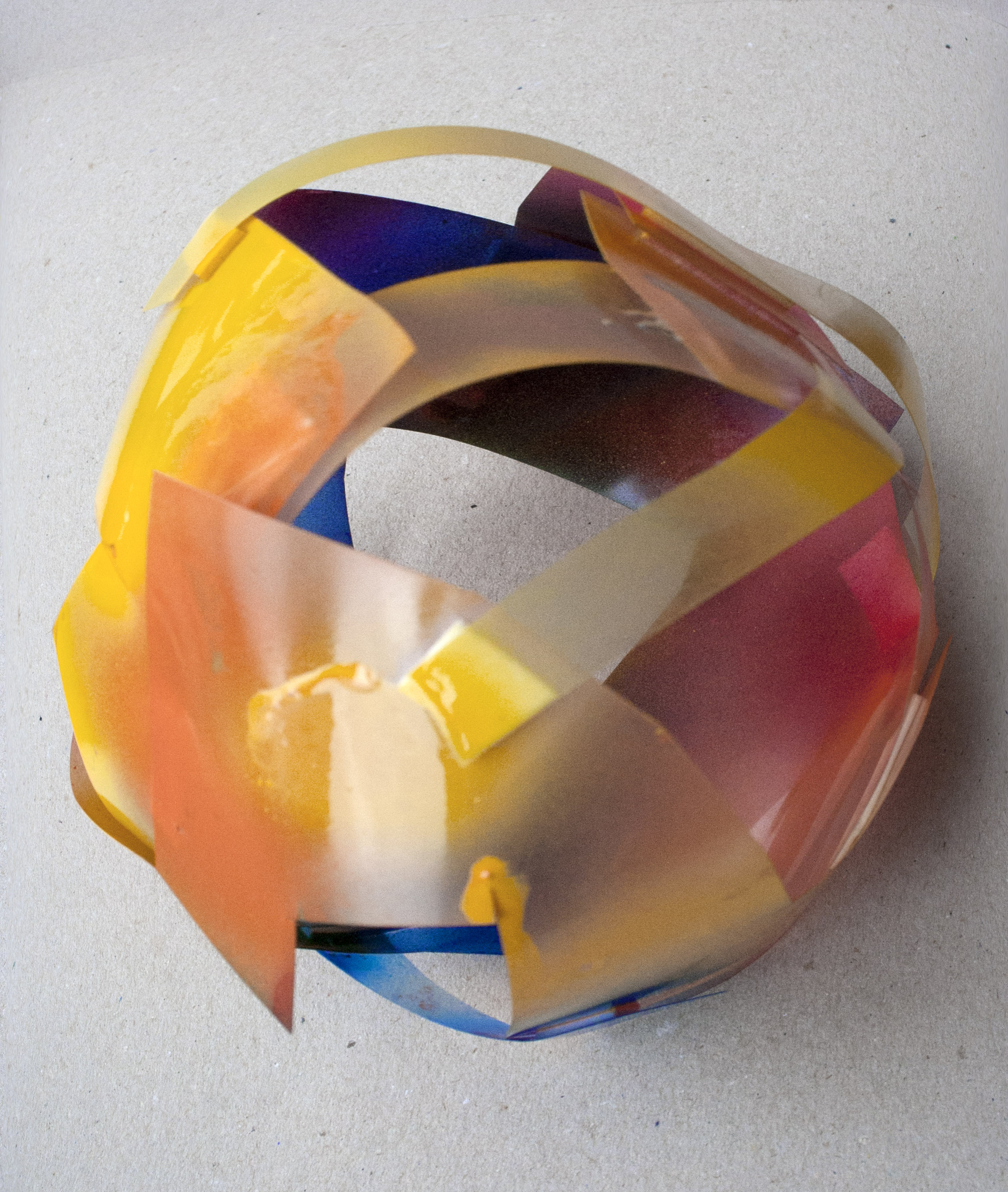
The maquette. An early paper model tests the fold before the UV print is commissioned — the sculpture preceded by paper, the "render" deferred to the assembly.
The are.na reference field
The artist's are.na channel assemblages (started 2017) is the visible mood-board around the practice. Recurring references:
- Martin Puryear — minimalist hand-carved geometric / organic sculpture; the shell-like sealed forms in Puryear's work prefigure the assemblage polyhedron as a hand-cut, intuitively-proportioned solid.
- Daiga Grantina, Anna Uddenberg — contemporary sculptors of surface-rich, post-digital bodies; the assemblages sit in this milieu of "digital aesthetics rendered physical."
- Buckminster Fuller (Radical Software interview transcription) — geodesic geometry; the sphere as the closed unit of habitation; the polyhedral decomposition of a sphere as a buildable program.
- Jean Arp's Constellations (1938) — explicitly cited as the source for Another Bag (2019) (works overview); the lineage of arrangement-as-composition that runs through Dada chance procedures into the assemblage logic.
- Hōraku, Owl Attacking a Bat (LACMA, early–mid 19th c.) — the netsuke as a hand-carved sealed object the size of a fist, dense with surface, intended to be turned in the hand. The assemblage is the gallery-scaled netsuke: held by the eye rather than the palm.
- A snail's anti-clockwise shell (Telegraph, 2016) — chirality, sealed geometry, the natural-history specimen as a closed individual.
- Joel Holmberg, Ink Jet Sculpture (2010) — a contemporary post-internet peer working on the same translation problem: digital print made into sculpture.
The channel's Deleuze-Guattari text block ("Assemblages are passional, they are compositions of desire") is the only piece of text in a primarily image-driven board — the citation is doing the conceptual work the images are illustrating.
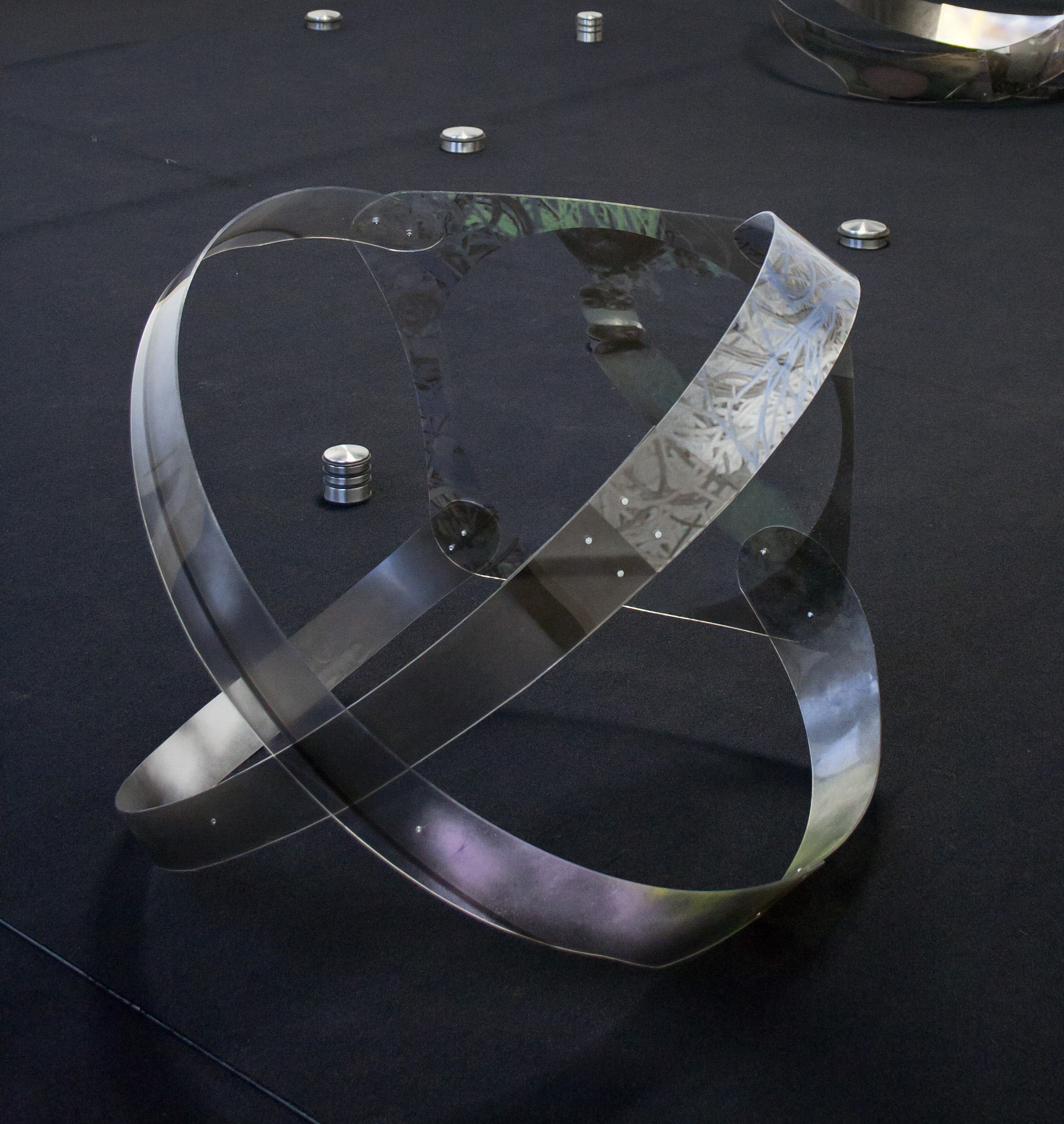
On doorstoppers. At NIMK the spheres rest on mundane floor doorstoppers rather than plinths — the sculpture made visibly to rest on the same floor as everything else, refusing the pedestal's announcement that this is the art. The flat-ontology gesture made plinth-furniture.
Lineage beyond the Assemblages (2015 →)
The sphere-as-sealed-object logic does not stop in 2018. Three later sculptures restate the question in changed materials:
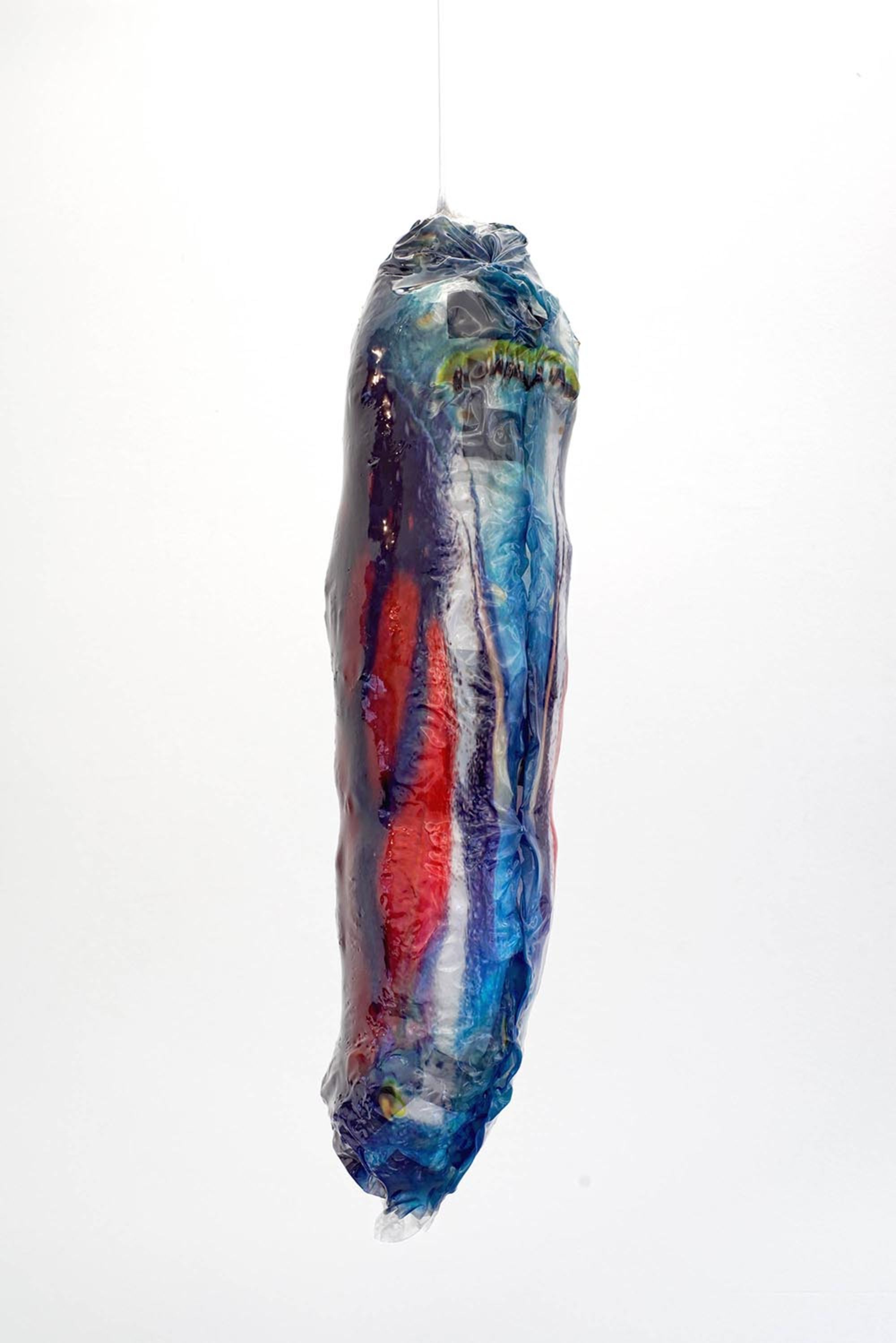
Chrysalis sculptures (2015) — Chrysalis (blue), (mint), (green). The sphere relaxes into the soft, oblong, organic form of the pupa. Where the assemblage was a polyhedral sphere with a digital surface, the chrysalis is a smoother body suggesting incubation — a sealed object that is also a sealed process, an object containing its own becoming. The connection to the generative work is in the title: the chrysalis is the body of evolution caught at its most opaque moment, between two phenotypes.
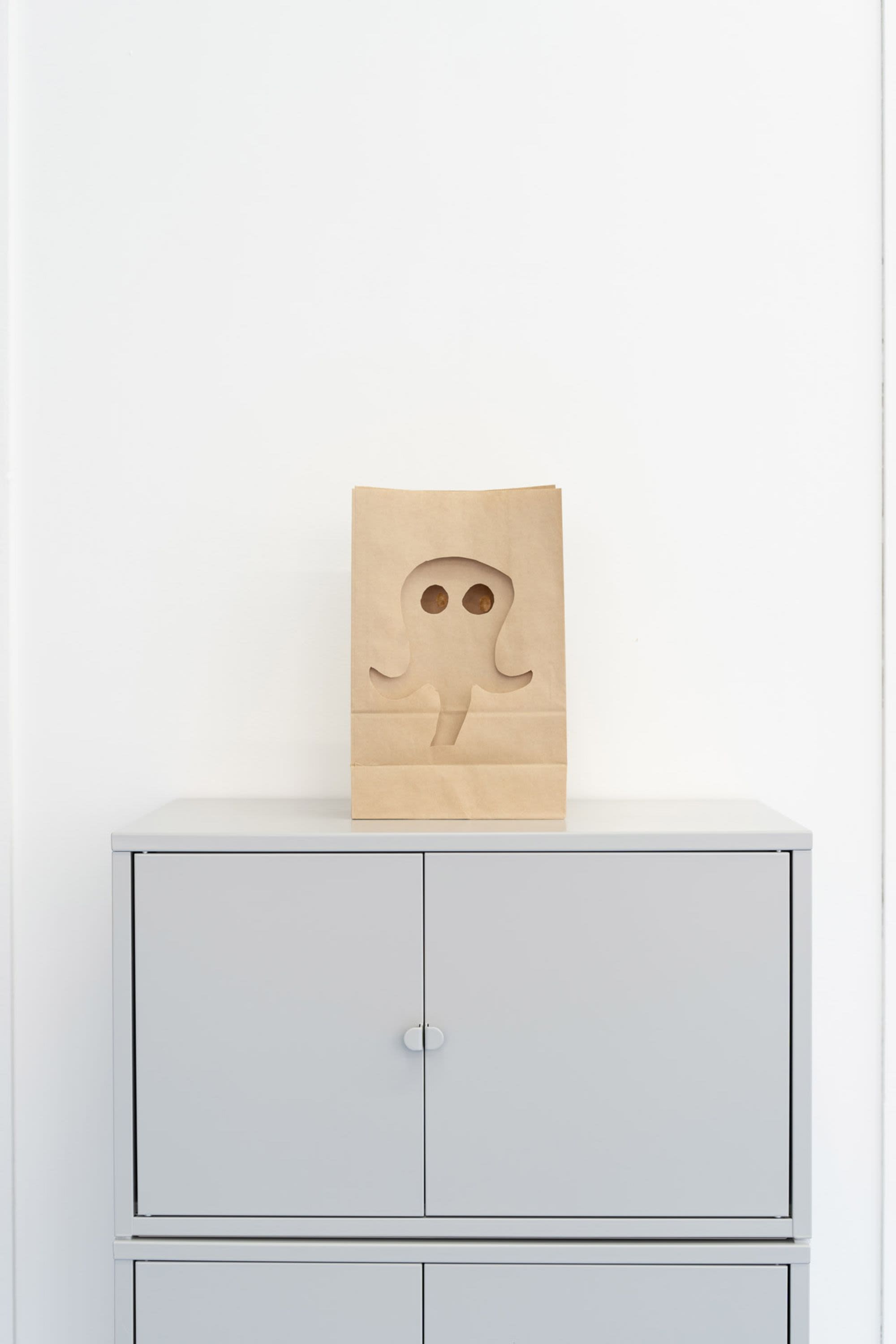
Bag / Another Bag / Spectre (2019) — hand-cut brown paper bags. The 2018 Pattern & Presence / Notes on Objects moment shifts from PETG to paper, from sphere to flat constellation. Another Bag is explicitly "based on Jean Arp's Constellations (1938)" — the assemblage's chance-procedure ancestor named directly. The hand-cut paper does what the hand-cut PETG did, in a humbler material: turns a found planar object (the brown bag) into a worked surface-as-object.
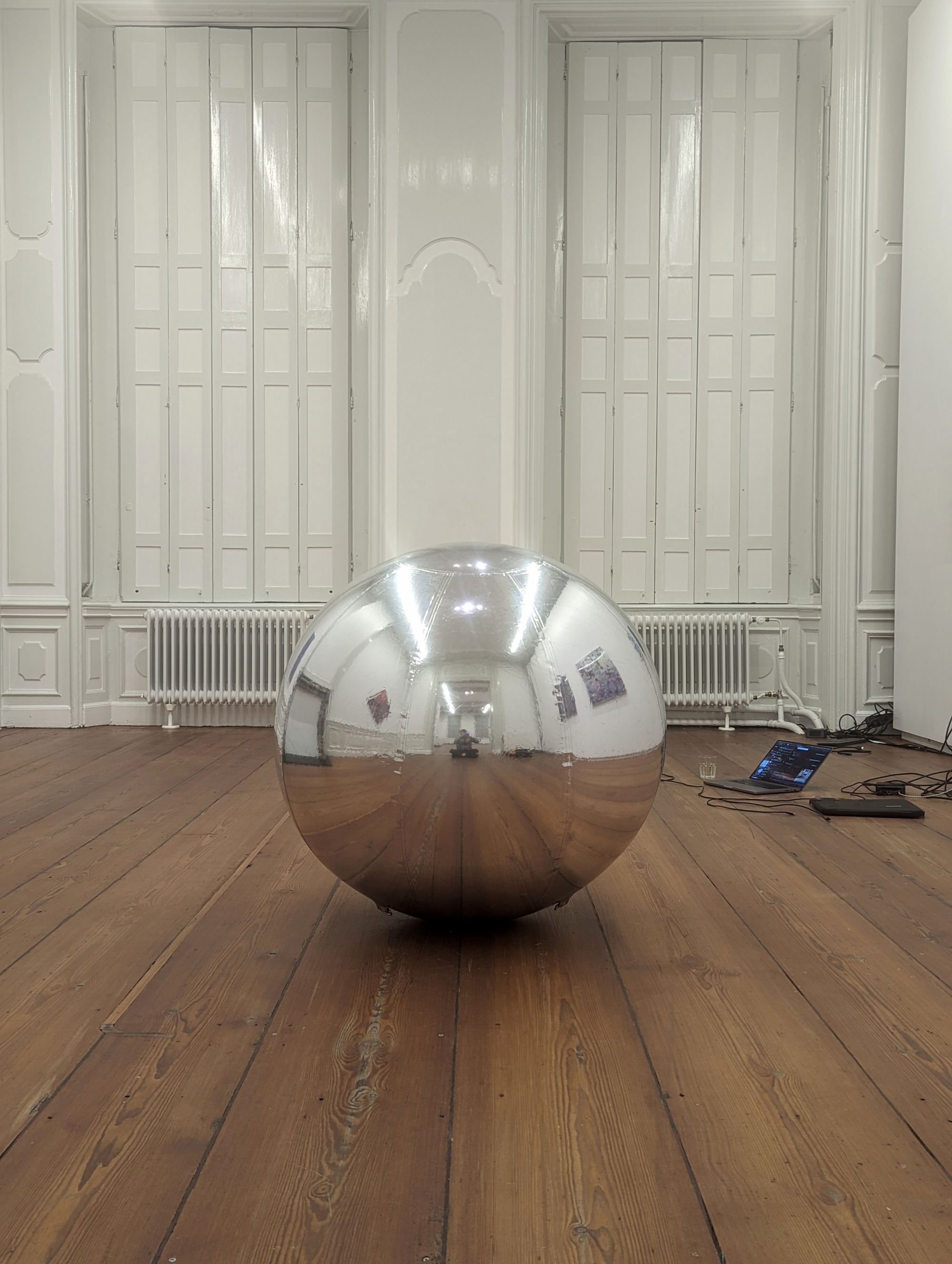
Recursive Intervention (2023) — a ready-made mirroring inflatable. Not a sculpture in the carved sense; rather, as the artist describes it, "a light, site-specific observation. The exhibition space and the works in it are reflected by a ready-made mirroring inflatable, causing the space to contain a compressed copy of itself." A part of the whole is the whole again. The sealed-sphere logic now performs recursion directly: the object is the gallery folded into itself (Recursion and Self-Reference).
The arc — UV-printed PETG sphere → soft chrysalis → cut paper constellation → mirroring inflatable — moves through four different material registers but holds the same procedural commitment: the artist designs a constraint and a substrate; the object emerges from the interaction of the two; the surface is evidence of what passed through the system.
Why this is the same epistemology as the algorithmic netart
To state the argument plainly:
Algorithmic netart, in van den Dorpel's practice, is a procedure for producing objects whose surfaces are not authored but generated under constraint — the seed, the fitness function, the taste protocol, the Markov chain, the CGP graph. The artist is responsible for the system; the system is responsible for the output. Each output is a singular individual within a population.
Sculpture, in the assemblage practice, is a procedure for producing objects whose surfaces are also not authored but projected onto a constraint geometry — a digital image (found, scanned, finger-painted, watermarked) is UV-printed onto hand-cut polyhedral facets and assembled into a sealed body. The artist is responsible for the texture-source, the geometry, and the cut; the object emerges. Each sphere is a singular individual in a recognisable population.
The two procedures share:
- the constraint-and-substrate division of labour between artist and process
- the population structure: works in a series share a generative substrate but are individually singular
- the opaque interior: the object's depth withdraws from inspection
- the surface-as-process-evidence: what you see is the trace of what the system did, not what the artist intended
- the flat ontology: digital, physical, online, offline objects are all completed objects, mutually substitutable as art-works ("Both, to him, are objects, completed works.")
This is what justifies the move from screen to gallery, and back. Object-oriented ontology gives the position its philosophical name; Revenge of the Spheres gave it its 2012 art-critical formulation; the sculptures themselves do the work.
See also
- Assemblage Identity — the philosophical reading: DeLanda's assemblage theory, Bruner's "slaves to the particular," Agamben's profane order, and the singular/universal tension in 1301 Everything vs. anything
- About — Dissociations — the wider account of the About exhibition and the practice's archival self-description
- Recursion and Self-Reference — Recursive Intervention as the 2023 restatement of the sphere logic
- Process Legibility — the surface-as-evidence-of-process aesthetic shared between the assemblages and the generative work
- Subconscious Computation — the opaque-interior argument for the algorithmic case
- Protocol, Taste, and Systems — the broader taste-as-system argument that the surface-by-search procedure exemplifies
- Works overview — chronological catalog of works including the full sculpture list
External references
- Travis Jeppesen, Revenge of the Spheres — catalog text for About, Wilkinson Gallery, London, 2012. Excerpted at harm.work/exhibition/about. Note: Brian Droitcour, who would later write Beautiful Rules (Outland, 2025) and moderate the 2021 Outland conversation with Jenna Sutela, is part of a different critical line on the same practice; Jeppesen's reading sits at the 2012 sculptural moment.
- Graham Harman, The Quadruple Object (2011); Levi Bryant, The Democracy of Objects (2011); Ian Bogost, Alien Phenomenology (2012); Tristan Garcia, Form and Object (2011/2014); Timothy Morton, Realist Magic (2013).
- Gilles Deleuze and Félix Guattari, A Thousand Plateaus (1980) — source of the "Assemblages are passional, they are compositions of desire" line in the artist's are.na board.
- are.na: harm-van-den-dorpel / assemblages — the visual reference field surrounding the sculpture practice.
- Original sculpture catalogue at harm.work/medium/sculptures and series page harm.work/series/assemblages.