
Harm van den Dorpel & Jenna Sutela — Outland, December 2021
Conversation moderated by Brian Droitcour, originally published by Outland in December 2021.
Source: sources/ingested/Harm-van-den-Dorpel-and-Jenna-Sutela.md
Linked work on harm.work: Harm van den Dorpel & Jenna Sutela
Note on archival status. The original Outland article is no longer online. The text was kindly supplied to van den Dorpel by Brian Droitcour — its original moderator — and is preserved here as an ingested source because the publishing platform's copy is not currently reachable. This is a small instance of the same archival precarity that the conversation itself thematises ("library dependencies as the slime mould's agar"; see also Tokenising Sustainability on the ascribe.io lesson that immutability ≠ accessibility). The wiki here functions as the durable copy, and the editor-as-archivist as the sustaining infrastructure.
Jenna Sutela is a Finnish artist whose practice works with non-human and other-than-human intelligences — slime moulds, bacterial cultures, language models — staging confrontations with biological systems as decentralised cognition. Droitcour's framing: in both practices "technological processes serve as metaphors for biological ones, and vice versa."
The conversation was published at the peak of the 2021 NFT boom, the same year as Mutant Garden Seeders and Sutela's first NFT, YAMSUSHIPICKLE. It sits adjacent to van den Dorpel's Tokenising Sustainability essay, which was written in the same period and develops the financial/archival side at greater length.
A prior collaboration: eAR (PAN 72), 2016
This Outland exchange is the second documented public moment in the artists' working relationship. Five years earlier, in 2016, van den Dorpel had collaborated with Sutela and the musician Ville Haimala on eAR (PAN 72), a location-based augmented-reality website released by PAN. Sutela wrote the text, Haimala made the sound, and van den Dorpel did design and programming. The piece takes the form of first-person fiction — "dramatized field recordings from a digitally mediated environment together with commentary inspired by the Let's Play format."

The 2016 piece prefigures the 2021 conversation: a digitally mediated environment treated as a field one can record from, a Let's Play voice as the human interlocutor of an alien infrastructure. The Outland exchange returns to the same orientation — the intelligent machines that we cooperate with that function as our interlocutors and infrastructure, in Sutela's phrasing — but now with five years of NFT practice on van den Dorpel's side and several major slime-mould / bacterial works on Sutela's.
Five threads
1. The vanitas / pixel-sorter parallel — decay as aesthetic
Sutela opens by proposing that YAMSUSHIPICKLE — DeFi-emblematic foods (the Yam, Pickle, and SushiSwap tokens) literally rotting in a terrarium for the duration of a video — is "a meditative piece" in the spirit of van den Dorpel's Pixel Sorters. Van den Dorpel agrees:
"Pixels fall down until they hit a dark pixel below, in which case they slip either to the left or right, creating somewhat sad collapsed compositions. They're certainly about decay and extinction."
The pairing is significant because it crosses substrates: organic decay (bacteria consuming sugar in a closed jar) and computational decay (pixels obeying a gravity rule) are presented as instances of the same compositional logic. This is also the logic of Death Imitates Language, where unsuccessful specimens are removed from the breeding pool — decay as the productive operation, not the failure mode.
2. Deterministic randomness — the block-hash seed
The conversation's most technically precise passage. Sutela's biological RNGs (kombucha colonies in Gut-Machine Poetry, lava lamps in I Magma) sit in a lineage of "alternative cybernetics" — Stafford Beer's pond brain (a 1950s proposal that an ecosystem could manage a factory), Sun Microsystems' lava-lamp wall, Cloudflare's contemporary descendant of it. Van den Dorpel's Mutant Gardens takes the opposite path:
"I used a mathematical number generator, which returns random numbers, but always in the same order. It had to be deterministic, or else each mutant would be different every time it was rendered, and there would be no point in connecting it to the blockchain. If you played the whole history of Mutant Garden Seeders, you would end up with the same results. It's all cryptography on blockchain. The block hash is taken as seed for such random number generators."
This is the crucial technical fact about on-chain generative art that the broader discourse around randomness and pattern tends to elide: the work is not random. It is determinstic pseudo-randomness, seeded by the immutable hash of the block on which the token was minted. The aesthetic of randomness is preserved; the actual computation is reproducible. The blockchain demands this — a token whose appearance could not be re-derived from its on-chain provenance would not be a token in any verifiable sense.
Van den Dorpel adds an important refusal of one common framing:
"I don't often use the word 'entropy.' I understand that systems tend to want to evolve toward the highest degree of randomness, or equal distribution. I don't know if I'm looking for that. I'm trying to provoke complexity, but also to contain complexity or tame it."
"Provoke complexity, contain it" is one of the cleanest one-line statements of the randomness/pattern dialectic in the corpus — and a reminder that maximal entropy is precisely not the goal of these systems. The fitness function tames; the mutation provokes.
3. DNA as recursive zip-file — the stop-condition
The conversation's biggest contribution to the recursion page is van den Dorpel's image of DNA as a compressed recursive program with parameters:
"A tree has millions of leaves, but the leaves don't have their own specific encoding in DNA. The DNA has programs for making leaves, and these programs are executed a million times, recursively. If the genetic info for each leaf had to be saved individually in the DNA, the DNA would be way too large. So there's compression, like a zip file. If you unzip the DNA, it becomes larger, because you have recursion, and these algorithms that are in the DNA have parameters. If a gene makes a leaf get smaller and smaller at each iteration, at some point the program decides to stop making leaves, because they are too small to be practical."
The "leaves get smaller, the program decides to stop" line is the cleanest statement in the corpus of the stop-condition problem that recursive systems must resolve to terminate. Compare:
- the Endless Knot (2024) as the Buddhist image of recursion-without-halt (saṃsāra as the absence of a stop-condition)
- Cartesian Genetic Programming (CGP) as the technical solution: the graph structure guarantees termination because no cycles are admitted
- the Miller interview's framing of "life is a 3.5 billion year old technology"
- the Our Inner Child reading of the Christian Hell / Buddhist saṃsāra as recursion-without-halt
The DNA-as-zip-file analogy then resolves the apparent contradiction between two of the practice's central concepts: compression (Mondriaan, Quantizer) and recursion (Mutant Garden, Endless Knot). Compression is what recursion does — a parameterised algorithm that can be unfolded a million times produces a vastly larger output from a tiny seed. Mondriaan compresses the visible world into a grid; DNA compresses a tree into a few thousand base pairs; the Mutant Garden chromosome compresses an entire phenotype into a string of genes. Decompression is decompression. The grid, the leaf, the mutant are all what comes out when you unzip a sufficiently parameterised recursion.
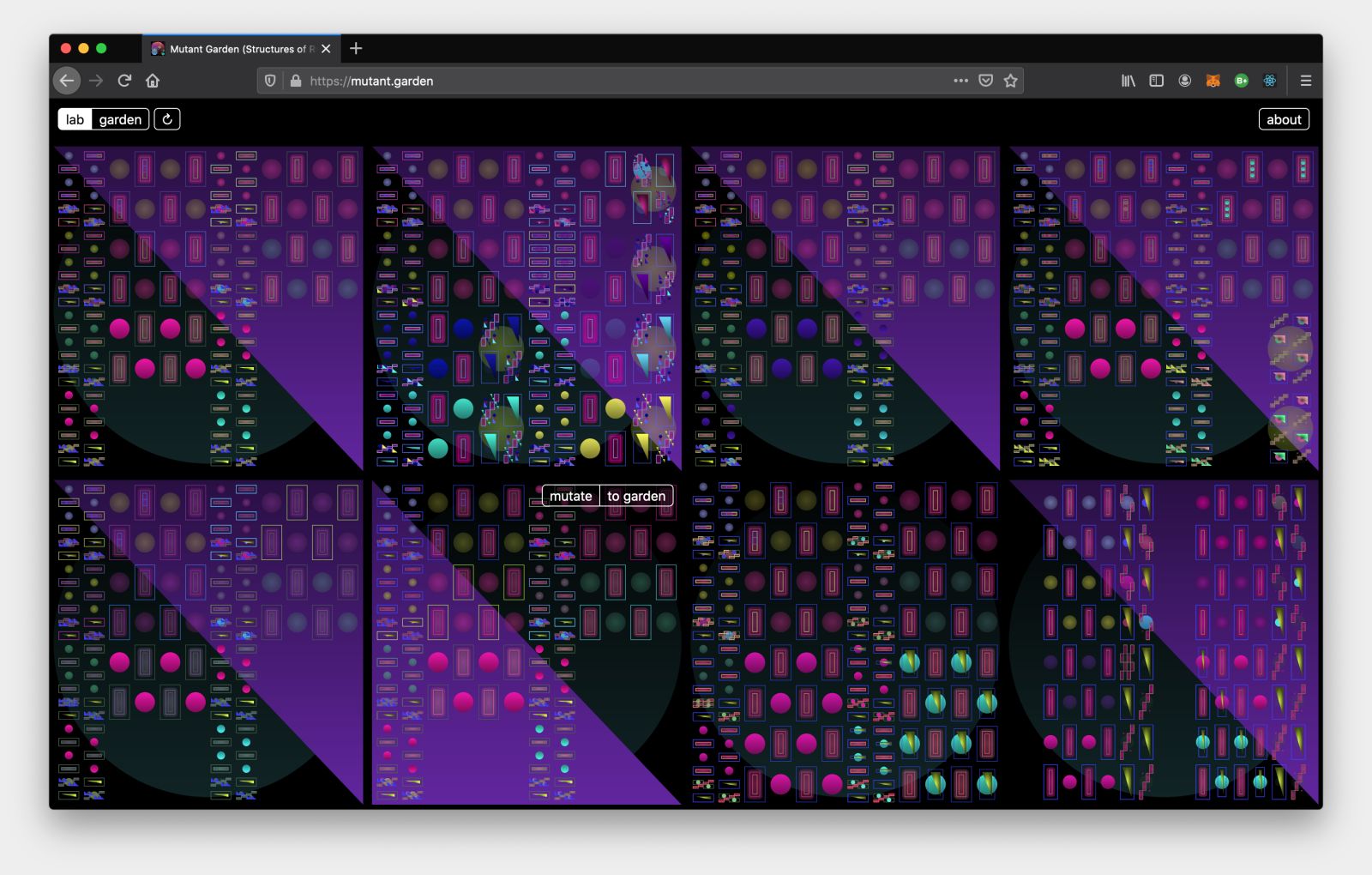
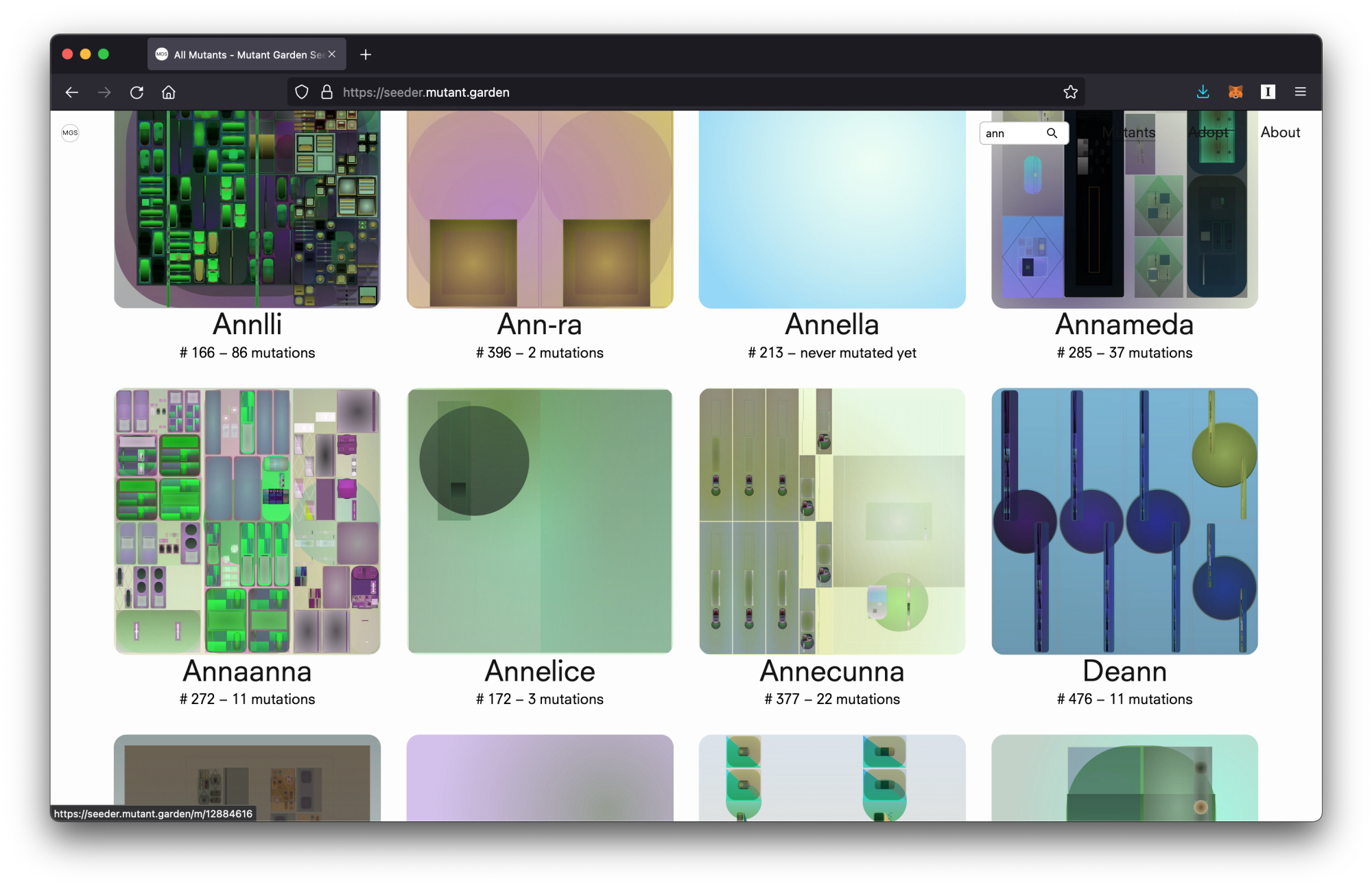
Mutant .garden. The live breeding website that preceded the Seeders — CGP chromosomes decompressed into visible specimens in real time, the recursive zip-file unpacked on screen.
4. NFT as artwork-and-currency — the dual ontology
Van den Dorpel returns to one of the harder questions in the tokenisation discourse: the work is also money.
"An NFT is exchanged for coins, which then are used to buy another NFT—happens in such a short span of time that I'm left feeling a little confused. Even so I find it fascinating to consider the artwork currency, because it does away with the common hypocrisy of thinking the artwork transcends all that."
The provocation is then doubled by the Mutant Garden Seeders protocol itself, which builds the financial precarity into the artwork's behaviour:
"It's a provocation, because NFTs are supposed to be fixed when you buy them, but mine evolve all the time. One might change from a beautiful intricate composition to a gray rectangle, and that impacts its market value. If a collector wants to flip a mutant but it turns gray, people are less willing to buy it."
This is the Mutant Garden Seeders mechanism stated bluntly: each mutation event on transfer is also a re-pricing event. The fitness function is no longer a private aesthetic choice (as in Death Imitates Language) — it is a public market signal. The mutation IS the speculation.
The deeper point — the work defies NFT market mechanics by design. Secondary-market valuation of NFTs structurally depends on immutability: a collector who buys a pretty, elaborate composition needs that image to stay pretty and elaborate for the flip to retain its floor. Mutant Garden Seeders designs the inverse into the protocol — every transfer triggers a fresh mutation, and the next mutation could collapse an intricate specimen into a monochrome rectangle, less appealing to the next collector, secondary-market price falling with it. This is not a side effect of the evolutionary mechanism that the artist tolerated; it is the mechanism's deliberate purpose. Where every other NFT collection relies on the immutability-as-price-basis logic, Mutant Garden Seeders refuses it — the very feature that establishes monetary value across the rest of the market is the feature this work programmatically defeats. The provocation is structural, not rhetorical.
Sutela's complementary observation is that YAMSUSHIPICKLE, by being a collection commission (Kanon's KSPEC protocol allowing for the unusually long 3:11 video), partially insulated her from this dynamic — "this was like baby steps into crypto."
The Boris Groys reference here — "does art die when it's acquired by a museum?" — is the philosophical hinge. Van den Dorpel's mutants do not die; they change, and the change is the work. The death-of-art question becomes a change-of-art question, but the change happens in market time, not curatorial time.
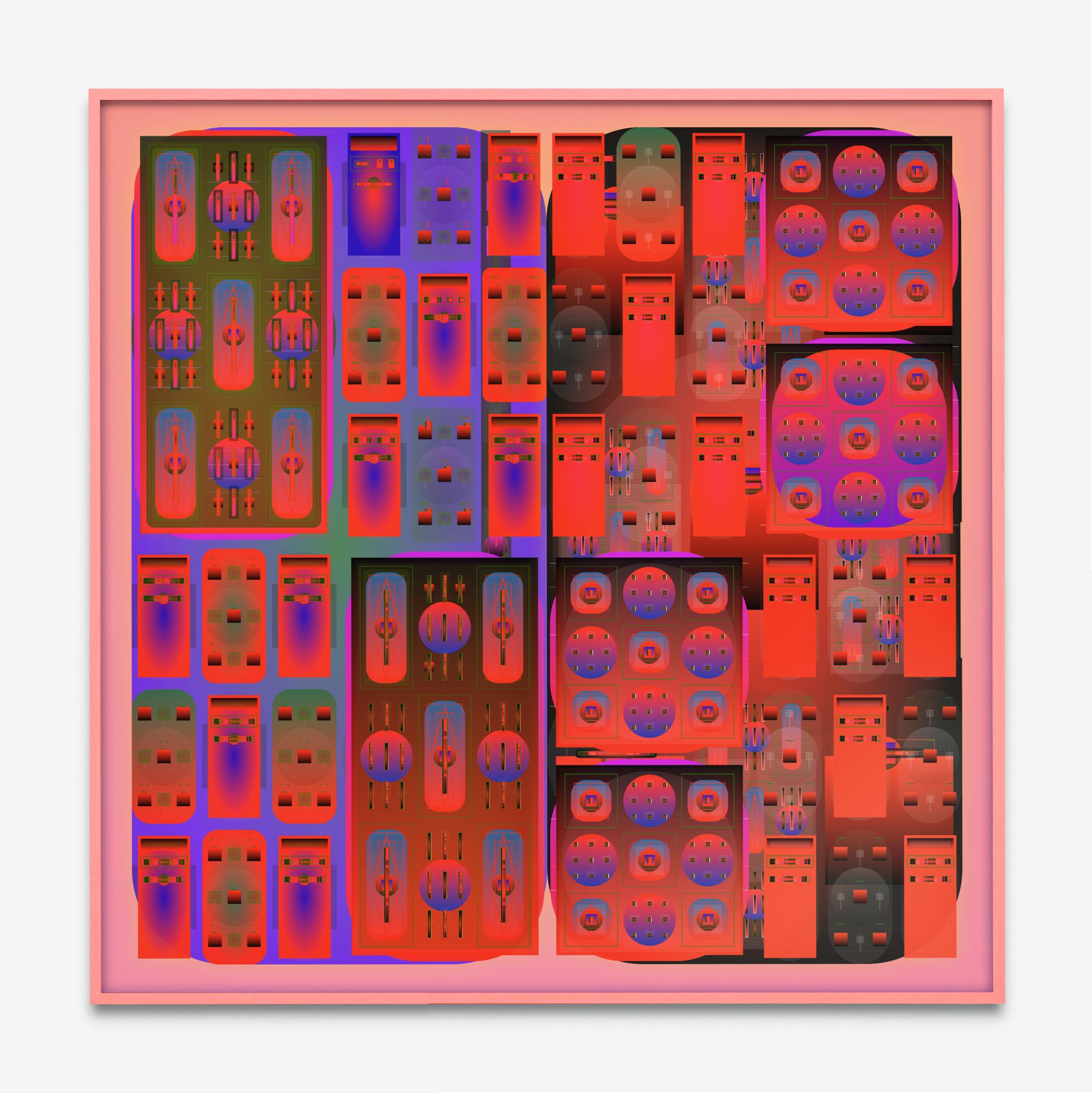
Lacelove. A Proto Seeders print that fixes a single moment of the otherwise mutating Seeder protocol into a material object — one that, on paper, no longer re-prices each time it changes hands.
5. Library dependencies as the slime mould's agar
The conversation's last technical thread is the most candid about the limits of blockchain immutability:
"There is a potential risk in my code—don't tell the collectors! My code that generates the aesthetics of the mutants depends on many external libraries that I didn't make myself. If those developers change their library, my mutants might render differently. So I tried to secure this by freezing the version numbers of those dependencies, but you can never know for sure."
Sutela mirrors this in the biological register:
"It's like my slime mold works, these large petri dish-like labyrinths that are put together in non-laboratory conditions, so other stuff gets in. They're different every time, not only because of the route the slime mold takes but because of whatever else is there and thrives on the agar that lines the labyrinths."
The structural symmetry is exact. The code is not a closed jar; the petri dish is not a closed jar. Both are open systems. The immutability of the chromosome (Mutant Garden Seeder hash) and the immutability of the slime-mould species are both protected only to the extent that the substrate is — and the substrate, in both cases, is contingent, third-party, and changing. This is the mediation/archive argument at its sharpest: the work is always partly defined by what its substrate allows or refuses, and the substrate is never fully under the artist's control.
This is also the structural answer to Tokenising Sustainability's ascribe.io lesson (immutability ≠ accessibility): even where the chain itself persists, the renderer may decay. The chromosome is forever; the JavaScript library that turns it into pixels is not.
What this conversation contributes to the wiki
Concretely:
-
The DNA-as-zip-file analogy (recursion) — the cleanest statement in the corpus of the relation between compression and recursion: they are the same operation seen from different ends. Should be cited from the recursion page and from quantization.
-
"Provoke complexity, contain complexity" (randomness/pattern) — a one-line refusal of entropy-maximisation as a goal, against the common reading of generative art as a pursuit of pure randomness.
-
Deterministic on-chain pseudo-randomness as a prerequisite of provenance (evolutionary logic, mediation/archive) — the block-hash-as-seed mechanism. Crucial when the wiki talks about Mutant Garden Seeders as on-chain, because it answers the question of why the work has to be deterministic even while looking random.
-
The library-dependencies-as-agar argument (mediation/archive, Tokenising Sustainability) — the precarity of immutability when the renderer is third-party. A different and more local form of the ascribe.io archival argument: not "the interface disappears" but "the library version changes."
-
The mutation-as-re-pricing protocol — refusing immutability-as-value-basis by design (Tokenising Sustainability, protocol/taste) — the Mutant Garden Seeders mechanism stated in its market dimension: every mutation is a public price signal, and the protocol is built to defeat the immutability that all other NFT secondary-market valuation structurally depends on. A pretty specimen can collapse to a monochrome rectangle on the next transfer; the floor falls out. This is not a side effect — it is the deliberate refusal of the market mechanic.
-
The 2016 collaboration eAR (PAN 72) — a fact about the practice that was not in the wiki until this ingest. Should be added to Works Overview.
-
The pixel-sorter / vanitas pairing (randomness/pattern, Death Imitates Language) — Pixel Sorters as compositions of decay, parallel to organic vanitas. A different reading of the series than the typical "post-internet glitch" reading.
Connections to existing notes and wiki pages
- Recursion (wiki/recursion): DNA-as-zip-file is now the cleanest formulation of the recursion → compression → stop-condition triangle. The "leaves get smaller, the program decides to stop" line should be cross-referenced wherever the wiki discusses halt (the Miller interview; the Endless Knot discussion).
- Randomness/Pattern (wiki/randomness-pattern): the entropy refusal sits well with 805's Hayles framing — randomness is not the endpoint; the dialectic is the point. Determinstic on-chain pseudo-randomness is a technical instance of the Hayles dialectic held open.
- Evolutionary Logic (wiki/evolutionary-logic): the Mutant Garden Seeders on-chain mechanism is named here in unusually plain terms; this should be the citation for "why CGP-bred specimens are deterministic on a blockchain."
- Mediation/Archive (wiki/mediation-archive): the library-as-agar argument; the renderer as a flickering signifier in Hayles' sense — the chromosome looks immutable but the substrate that produces its appearance is itself a moving target.
- Tokenising Sustainability (wiki/summaries/tokenising-sustainability): the artwork-as-currency and mutation-as-re-pricing arguments here are the public-facing counterpart of that essay's more technical archival case. Read together.
- Death Imitates Language (wiki/death-imitates-language): the Pixel Sorters parallel — decay/extinction as compositional logic — extends the death-as-selection-pressure argument into a non-evolutionary register.
- Openness — Release Early (wiki/openness-release-early, 1035): the "code as part of a larger ecosystem" phrasing here is the same medium-permeability claim under blockchain conditions.
- Note 878: mise en abyme as recursion's visual form; DNA-as-zip-file is its computational form.
- Note 992: documentation as constitutive; the Outland conversation is itself documentation that becomes part of how the Mutant Garden Seeders protocol is read.
- Note 709: "the most valuable moments emerge when the coincidental and the intuitive balance the rational" — read forward, this is the same position as "provoke complexity, contain complexity."
- Note 854: also on recursion / self-reference.
Distilled observations
-
Compression and recursion are the same operation, seen from different ends. Mondriaan's grid (the abstract zip) and the Mutant Garden chromosome (the recursive zip) compress the world by the same logic.
-
Pure entropy is not the goal of generative art. The fitness function and the deterministic seed both tame randomness; the practice is the dialectic, not its resolution into noise.
-
Blockchain immutability is asymmetric. The chromosome is permanent; the renderer is contingent. The artwork as data outlives mankind; the artwork as image is at the mercy of a JavaScript library's maintainers.
-
Sutela and van den Dorpel arrive at "open system" from opposite sides. Sutela starts from biology (the petri dish gets colonised) and looks toward computation; van den Dorpel starts from code (the library gets updated) and looks toward biology. They meet at the slime-mould-as-extremophile / chromosome-as-stone image: the resilient substrate is the only thing that survives the open system's continual disturbance.
-
The pixel-sorter is the digital vanitas. Where the historical vanitas figured biological decay in fruit and skulls, Pixel Sorters figures computational decay in falling pixels. The aesthetic of collapse is the same; the substrate has changed.