
Quantization and Dithering
Primary source: Quantizer (2025), Verse SOLOS exhibition. See also: sources/ingested/verse-quantizer-exhibition.md
Definitions
Quantization (in image processing) is the process of converting continuous information into discrete units — reducing the number of representable values to a finite set. Applied to colour, it maps the full continuous spectrum to a limited palette, introducing a measurable error at every pixel: the gap between the original value and the nearest available one. Quantization is lossy by definition. Something is always left out.
Dithering is the technique developed to manage that loss. Rather than simply mapping each pixel to the nearest palette colour (which produces visible banding), dithering distributes the quantization error into neighbouring pixels, converting systematic error into pseudo-random noise. The human eye perceives this distributed noise as colour blending — more colours than actually exist in the palette appear to be present. Key error-diffusion algorithms: Floyd-Steinberg (1975), Atkinson, Sierra3, JarvisJudiceNinke, Stucki. Ordered dithering uses fixed mathematical patterns (Bayer matrices) and is especially suited to animation.
The relationship between them: quantization creates the error; dithering redistributes it. Together they form the technique that made complex images possible on hardware that could represent only a handful of colours.
The Quantizer NFT collection
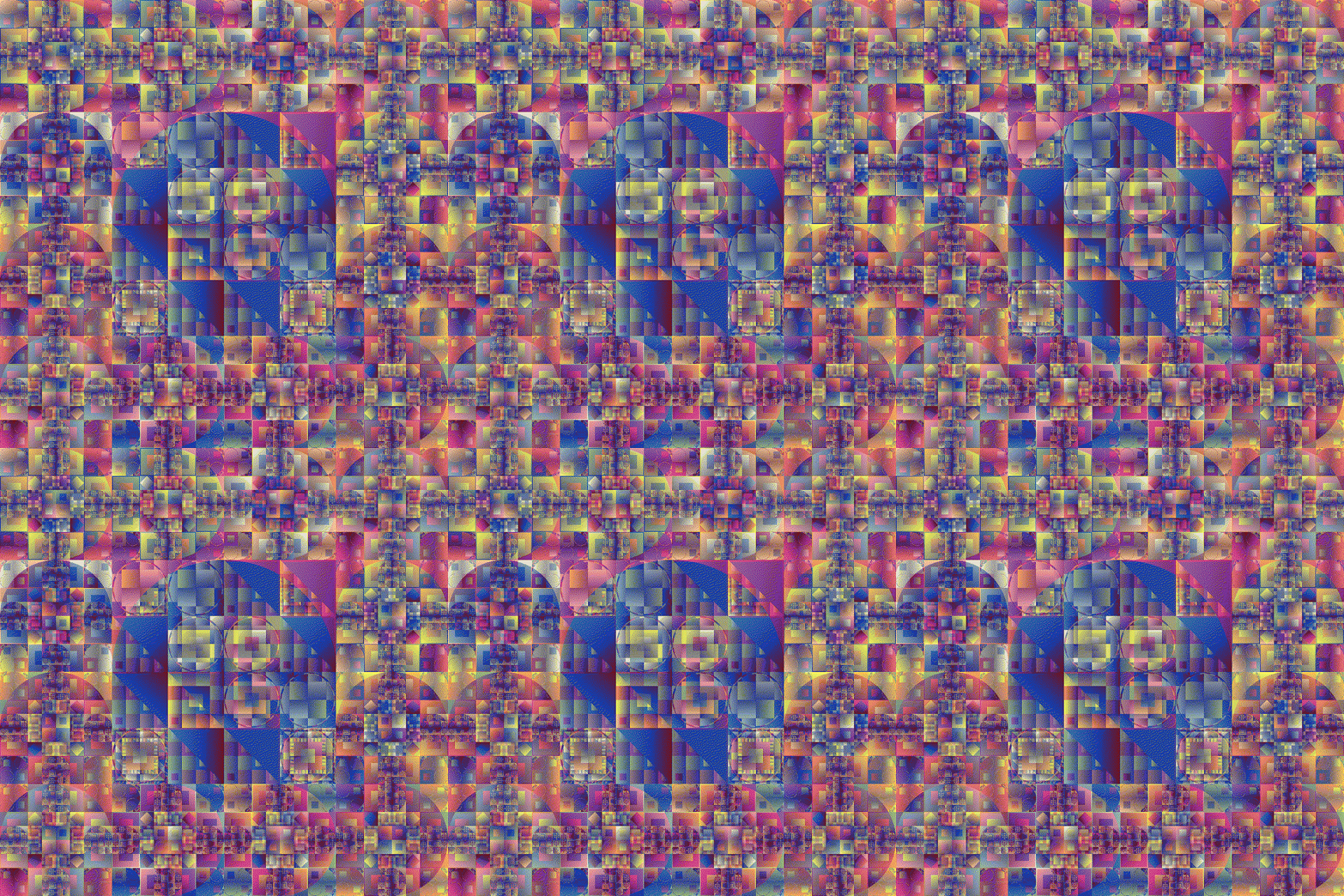
Quantizer (2025) is a 256-token NFT collection in which the title is not a label but a literal description of the generative process. The work performs quantization: continuous values are reduced to discrete palette entries, and dithering algorithms distribute the error across the image. The Verse SOLOS exhibition text states the double function of the term:
"The title refers to quantization, an algorithmic process that converts continuous information into discrete units. In this series, the term functions doubly: as a technical descriptor of the generative logic at play, and as a poetic shorthand for the beauty of precision, the elegance of working within limits."
Precision and limits are the aesthetic stakes, not technical constraints to be overcome. The work invites appreciation of the elegance of restricted systems — the beauty that emerges when a palette of four or sixteen colours is forced to carry complex visual information.
The grammar and the seed
Each token receives a fixed "grammar" of shapes and rules at mint. From there, Ethereum block hashes act as seeds: every 12 seconds a new block arrives and a new composition is generated. The system has no memory — each composition is independent of all prior states. This is structurally a Markov process: the current state is fully determined by the current seed, with no accumulated history. (Contrast with Markov's Dream, where the memoryless structure was the subject of melancholic irony; here it is simply the mechanism.)
Gaussian noise and dithering give the transitions between compositions a quality of fluid continuity despite the memorylessness — the eye perceives movement even though each frame is arithmetically unrelated to the last.
The blockchain ensures synchrony: all viewers worldwide see the same composition at the same moment. The work is experienced collectively, in real time, without fixity.
Historical palettes as strata
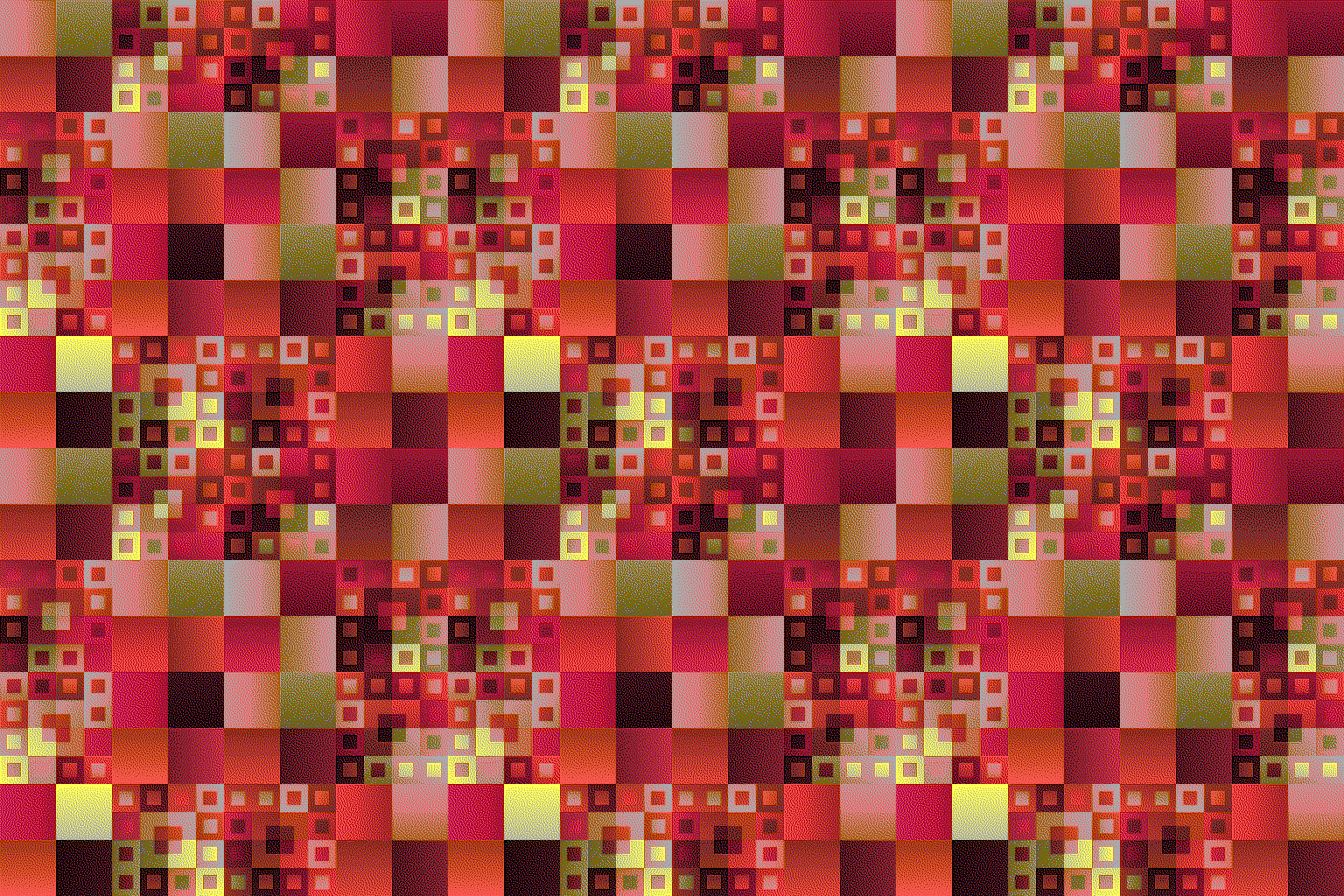
The palettes in Quantizer are drawn directly from the history of personal computing: IBM CGA, Apple II, Commodore VIC-20, Game Boy (simulated), MSX, RISC OS, IntelliVision, Fairchild Channel F, Mac Default 16.
These are not nostalgic quotations. The Verse text makes this explicit: "the dithering algorithms from the 1980s-90s are not nostalgic quotation — they are strata, layers of computational history that the work holds simultaneously." Each palette carries the chromatic signature of a specific moment in the history of digital display — when quantization was not a choice but a constraint, when four colours was not a style but a limit. Quantizer holds these strata simultaneously rather than representing any one of them.
This connects to the Cloud Writings exhibition's archaeological motif — "algorithmic archaeology" as the practice of excavating earlier computational logics and holding them alongside present ones, rather than replacing them.
Quantization of time
Colour is not the only thing Quantizer quantizes. The work operates the same logic on time.
Linear time is continuous — infinitely divisible, without natural seams. The Ethereum blockchain imposes a structure on it: one block every approximately twelve seconds. Each block is a discrete unit, a quantum of time. The infinite granularity of continuous duration is converted into a sequence of indivisible steps. This is quantization in the strict sense, applied not to colour values but to the temporal dimension itself.
Every twelve seconds, a new block hash arrives and a new composition is generated. The hash is the block's identity — a unique, unpredictable value produced by the state of the network at that moment. The composition is seeded by this value: the image is a function of where time currently is, as measured in blocks. When the block changes, the image changes. There is no in-between state.
This creates a structural parallel between the two quantization operations in the work:
| Domain | Continuous input | Quantization unit | Result |
|---|---|---|---|
| Colour | Full RGB spectrum | Palette entry (4–16 colours) | Dithered image |
| Time | Linear duration | Ethereum block (~12 seconds) | New composition |
In both cases, the quantization is productive rather than merely limiting: the constraint is what generates the work. Without palette reduction there is no dithering and no texture; without the block interval there is no rhythm and no shared viewing experience. The blockchain does not just distribute the work — it gives it its temporal form.
The "shared viewing experience, identical in every location" noted in the Verse text follows directly from this. Because all viewers are reading the same blockchain, and because the block is the unit of time, all viewers are synchronized to the same quantum of duration. The work creates a global present tense, defined not by clock time but by block time.
Dithering as aesthetic device and anchor
The Verse exhibition text describes dithering as "both an aesthetic device and a conceptual anchor." These are distinct functions.
As aesthetic device: dithering produces the characteristic visual texture of constrained digital images — the grain, the pixel-level oscillation between two colours that the eye blends into a third. It is the mark of the limit made visible, the evidence of the quantization error distributed across the surface.
As conceptual anchor: dithering was a solution invented under constraint. In early digital computing, when CGA offered four colours and ZX Spectrum offered eight (with attribute clash), dithering was the technique that allowed complexity to persist despite the limit. To use dithering in 2025, when screens can represent millions of colours, is to voluntarily reintroduce the constraint — to choose precision over richness, limits over abundance.
This voluntary constraint connects to the broader practice: van den Dorpel repeatedly chooses to work within limits rather than exploit the full range of available resolution or colour (→ pixel as interpolation device; the Struggle for Pleasure discussion of pixel nostalgia vs. pixel as cognitive mechanism).
Note 3002: dithering in print vs. screen
Raw note 3002 (the Markov's Dream palette essay) provides the only direct first-person account of dithering in the vault:
"The black to white gradient is so very easily rendered on a digital screen, but it needs dithering in printed matter. The palette is therefore very digital — aware of how it can and cannot be represented in printed matter using the CMYK colour space."
This is dithering as diagnostic tool: the presence or absence of the technique reveals the medium's limits. A black-to-white gradient on screen is trivial; in print it requires dithering because CMYK cannot produce the same continuous transition. The palette is described as "very digital" precisely because it encodes the difference between screen and print — aware of what the CMYK gamut can and cannot carry. Quantizer inherits this medium-consciousness: the chosen palettes are those that emerged from specific hardware limits, and dithering remains the technique that negotiates between the continuous and the discrete.
Impermanence and the refusal of immutability
Quantizer explicitly refuses the stable, collectible NFT image:
"The most interesting aspect of generative digital art is that it is inherently unstable and ever changing. This is a quality I want to retain, so I resist arriving at immutable outputs."
To collect Quantizer is not to own a fixed image. The work "lives as a single web page that can be collected but not fixed." Each block hash produces a composition that will never recur. The work "frustrates the desire for return." This is the "permanence of change" thesis: the work's identity is constituted by its history of transformation, not by any particular state.
The sand mandala parallel — cited in the Verse text — frames this explicitly as a Buddhist practice: elaborate compositions created over days or weeks, then destroyed in ceremony. The destruction is not loss but acknowledgment of impermanence. Quantizer performs this continuously: every 12 seconds, a composition is made and never retrievable again.
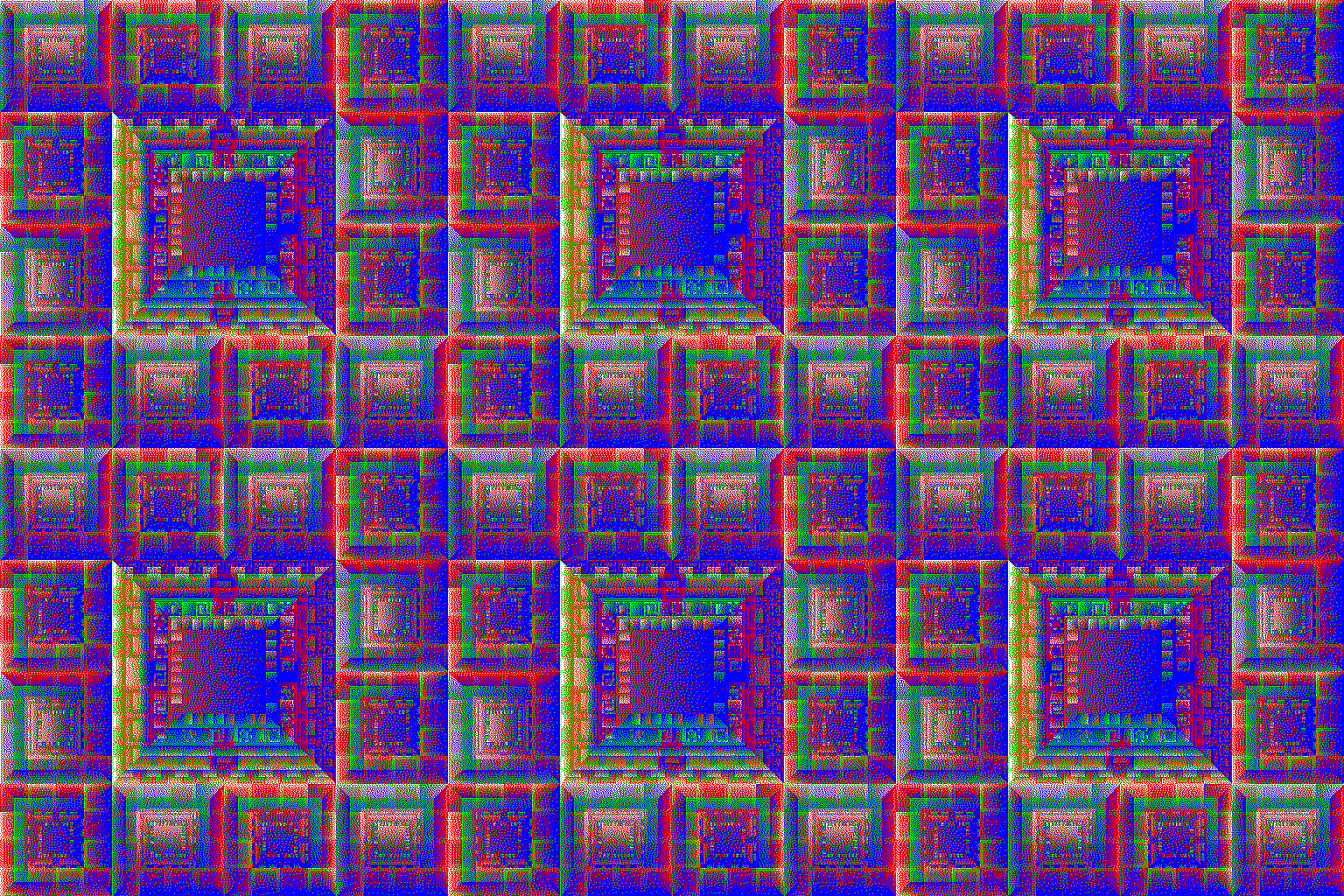
Quantizer #100. Another unrepeatable composition — every twelve seconds one is made and lost, the sand mandala's ceremonial destruction performed continuously in block time.
Anicca — the predecessor
The Murayama Q&A (2026) names Anicca (2025) as the first algorithmic mandala in the practice — predating Quantizer and using the same construction principle (Markov-chain parent-conditional descent through symmetrical subdivision). The term anicca is Pali for "the absence of permanence and continuity" — making the work's title a direct semantic complement to Quantizer's "permanence of change" thesis. Both works are about the impermanence of the composition; Anicca states it in Buddhist vocabulary, Quantizer enacts it through blockchain time.
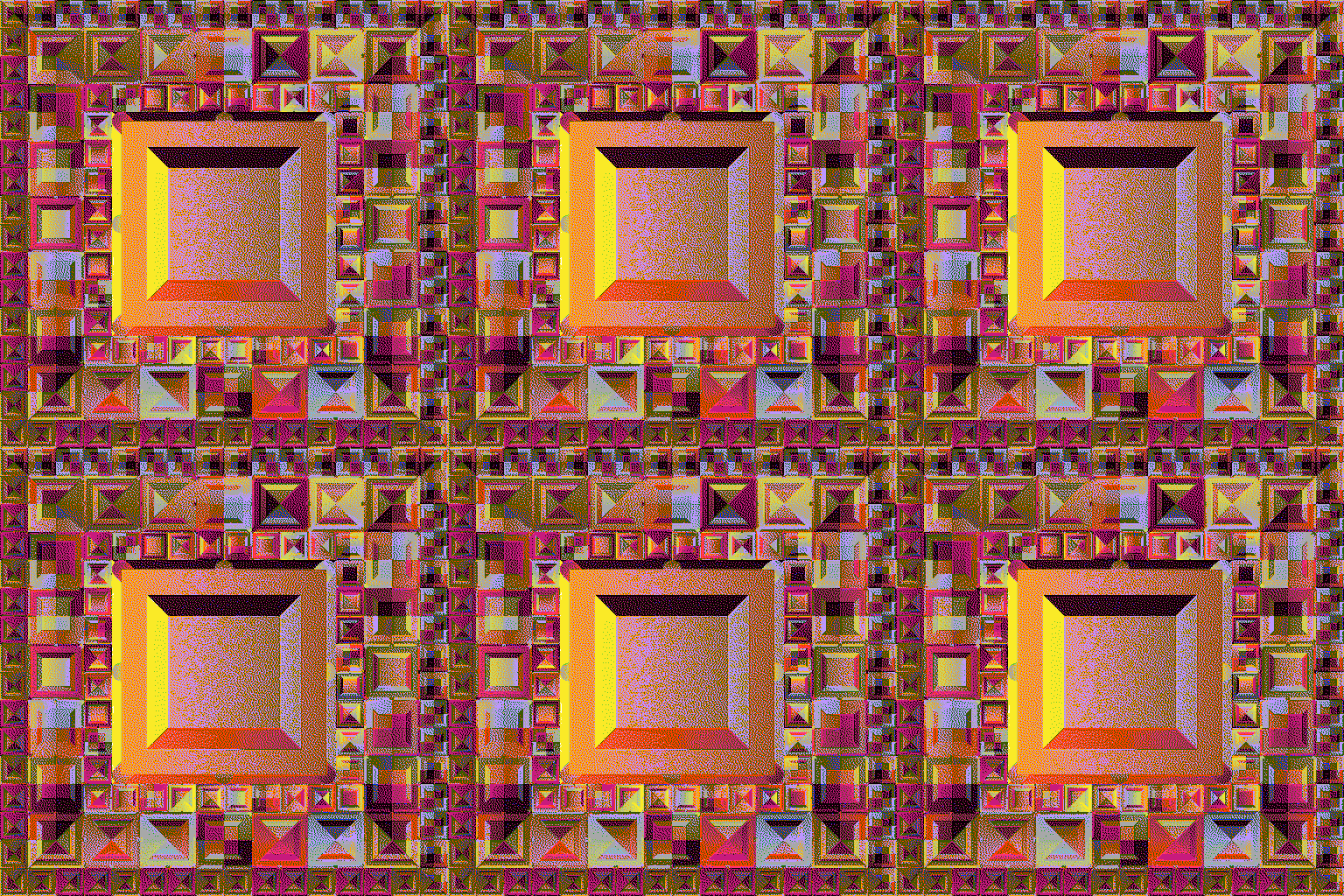
The trait taxonomy of Quantizer — explicitly named tibetan, thangka, mandala (visible at /nft/quantizer/trait/root/tibetan, /nft/quantizer/trait/root/thangka) — confirms that the mandala vocabulary is structural to the work, not interpretive overlay. The Q&A also names the historical references: Tibetan sand mandalas and Japanese Ryōkai Mandala (the paired Womb / Diamond Realm composition central to esoteric Buddhism in Japan).
Quantizer and the plotter drawings
Three works in the Cloud Writings (2026) exhibition are plotter drawings produced directly from outputs of the Quantizer algorithm. The relay is: digital protocol → software output → mechanical drawing → physical object. The quantized, dithered digital image becomes ink on paper, materialising the protocol as mark. The constraint of the historical palette becomes a plotter line.
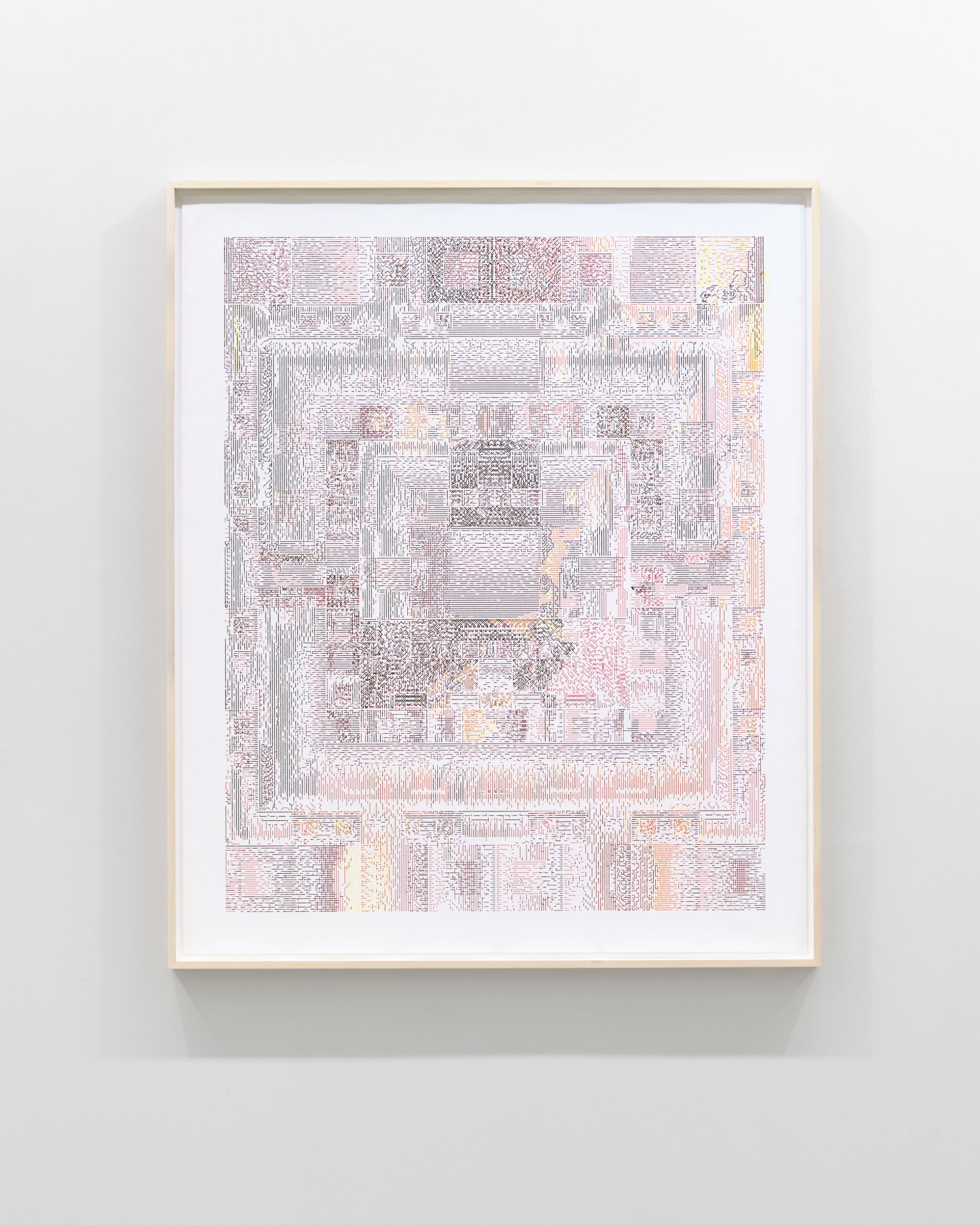
Nethermind (98×118cm) is the primary instance of this relay. The title — "nether" meaning lower, underground, infernal — suggests a mind operating below the surface: the algorithm works at a level below conscious perception, and the drawing is what rises to the surface of the paper. The quantization logic that organises the digital image is preserved as the spatial logic of the ink deposit.
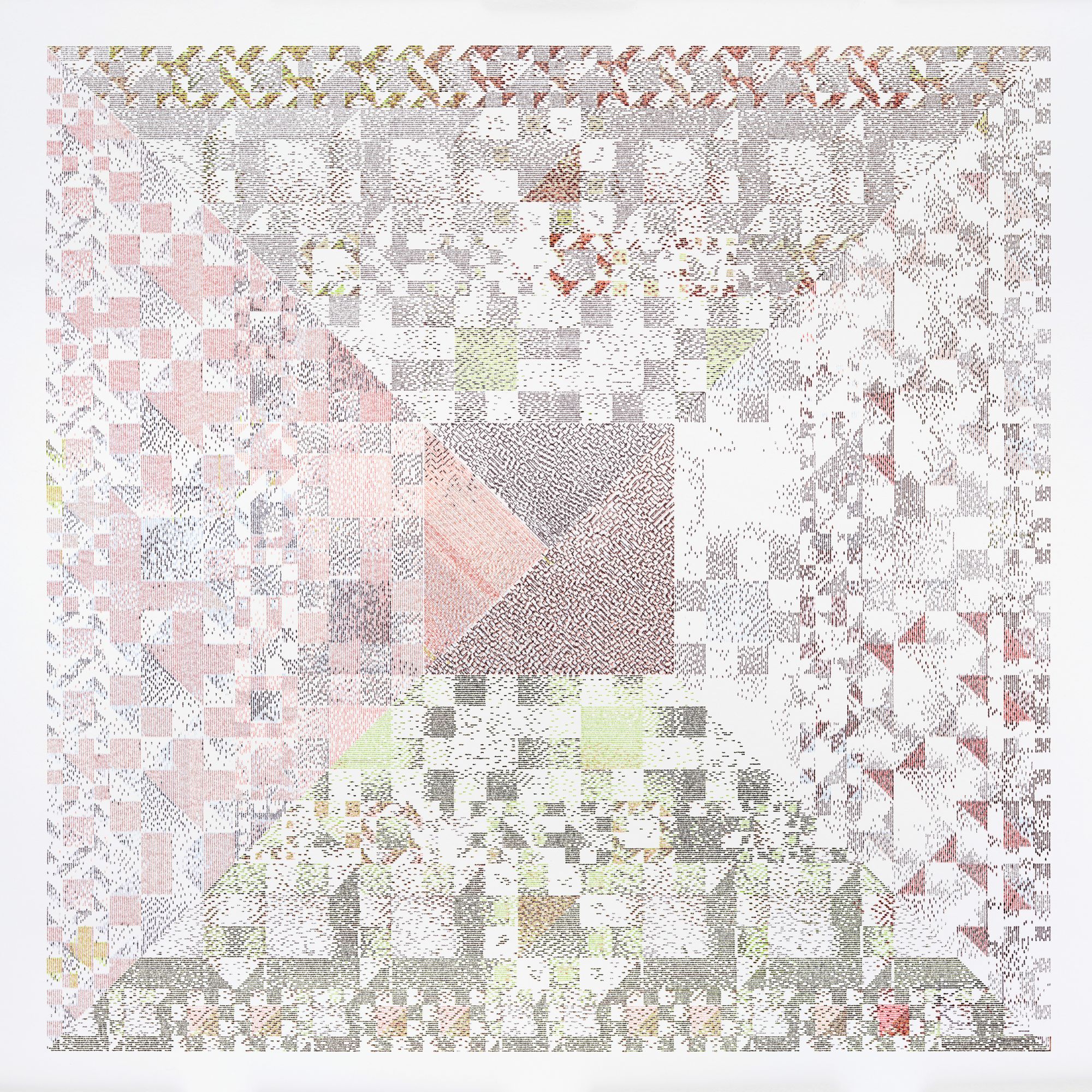
Nethermind Quilt (97×97cm) takes the same source and gives it a tiled, textile structure — the "quilt" title invoking the grid logic of weaving, connecting the Quantizer palette-stratum to the loom genealogy of Anni Albers and Vera Molnár.
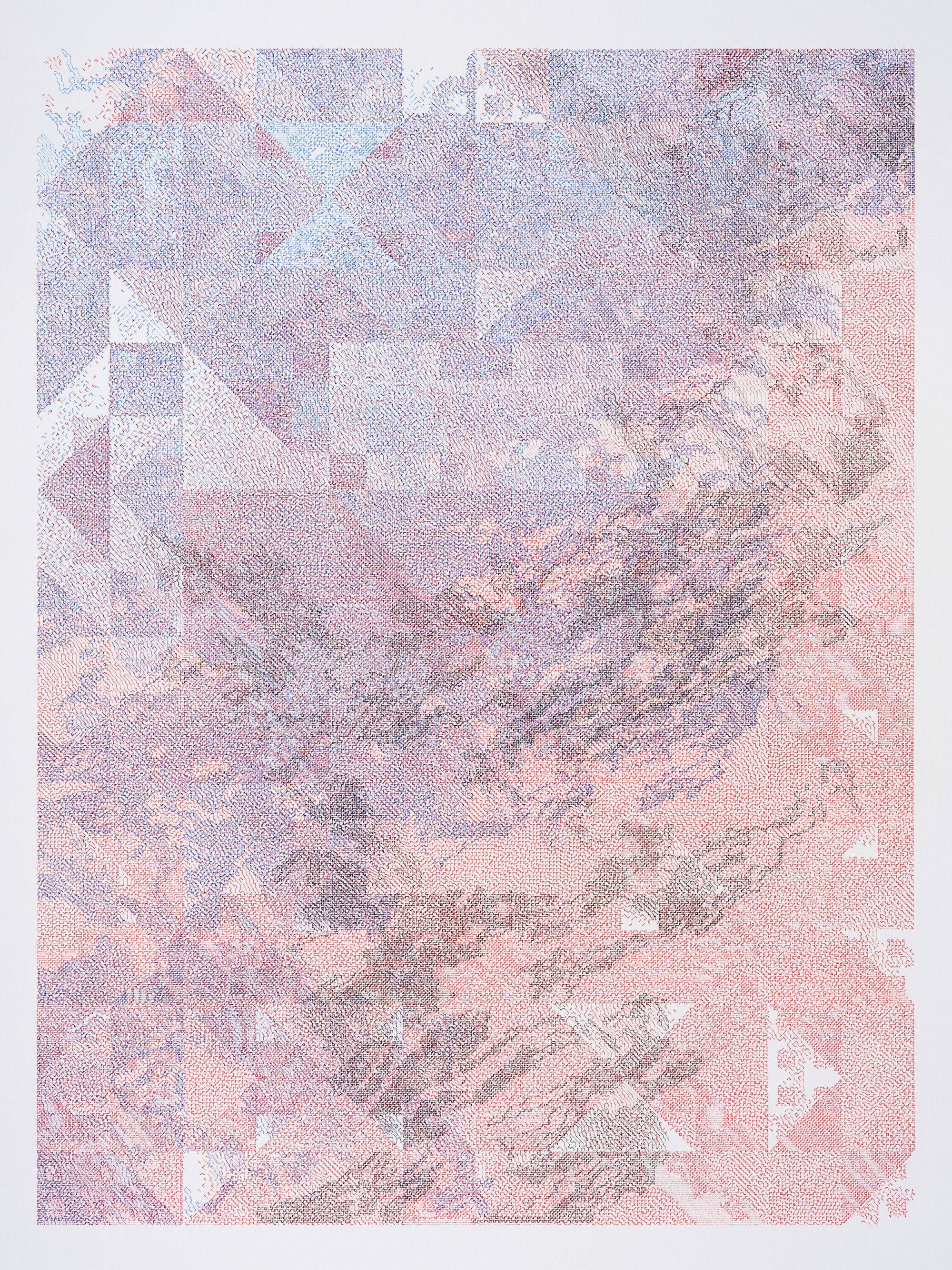
Anobium (70×90cm, Sakura fineliner on Hahnemühle paper) takes its name from Anobium punctatum, the common furniture beetle — a woodworm that spends its life as a larva inside timber, eating from within, leaving a network of tunnels invisible from the outside. Its presence is revealed only by the small exit holes the adult beetles leave behind. As a title, Anobium names the logic of the drawing: the algorithm operates from inside the grid, and the plotter trace is the exit holes — the visible consequence of an interior process. The drawing is the surface record of a process that occurred below visibility.
This relay connects quantization (digital limit, colour reduction) to the weaving genealogy (Albers' loom logic, the positional grid) and to the archive logic of mediation and the archive — both are systems in which the limitation of the medium is not overcome but made productive, and both leave a surface trace of an internal process.
See also
- Protocol, Taste, and Systems — Quantizer as the destination of the taste-externalisation trajectory; "permanence of change"; dithering algorithms as computational strata not nostalgic quotation
- Randomness and Pattern — pixel as interpolation device; variable resolution; working within limits
- Cloud Writings (2026) — algorithmic archaeology; Nethermind, Nethermind Quilt, and Anobium as Quantizer outputs made into ink
- Markov's Dream Palette — the palette essay that connects dithering in print to screen-awareness; the palette as "very digital"
- Senescenence — "temporary negotiations with impermanence" as parallel to Quantizer's "permanence of change"
- Mediation and the Archive — the work that cannot be returned to; the unrepeatable composition as archival problem
- Mandala Q&A — Goro Murayama (2026) — Tibetan sand mandalas and Ryōkai Mandala as named references; Anicca identified as first algorithmic mandala; Quantizer trait taxonomy structurally encoding the mandala vocabulary