
The Markov's Dream Palette — A Lineage
A single hand-picked palette, first used in 2004, that has returned across four distinct works spanning over two decades. The palette consists of four elements — all at extremes, none mixed:
- Blue: rgb(0, 0, 255)
- Green: rgb(0, 255, 0)
- Magenta / Fuchsia: rgb(255, 0, 255)
- Black to white gradient: rgb(0, 0, 0) → rgb(255, 255, 255)
These are the simplest possible colours in RGB space: three fully saturated additive primaries at maximum intensity, plus the complete greyscale axis from pole to pole. No mixing, no intermediate values. A vocabulary of extremes. The palette is defined by what it excludes — everything between the maxima.
Retrospectively, the artist has identified what may have drawn him to each colour specifically — each one understood against print and CMYK:
- Blue (rgb(0,0,255)): recalls a test screen; a colour that announces the monitor itself
- Green (rgb(0,255,0)): "very much not printed matter" — in CMYK, green is constructed by mixing cyan, yellow and black, which always produces a darker result than what a screen can emit at full intensity; this green is screen-exclusive
- Magenta (rgb(255,0,255)): the exception — magenta is actually native to the CMYK gamut; it is the one palette colour that crosses from screen into print unchanged
- Black to white gradient: trivial on screen; in print it requires dithering
The palette is, in this reading, a digital declaration: four colours whose relationship to the CMYK gamut is asymmetric, each one mapping a different edge of the screen/print boundary. The choice "felt simple" in 2004; the account arrived later.
The four works that carry it:
| Year | Work | Medium | System |
|---|---|---|---|
| 2004 | Markov's Window | Macromedia Flash | Recursive square subdivision, probabilistic |
| 2022 | Markov's Dream | NFT (token #1) | Rounded squares (squircles), randomised parameters |
| 2023 | Markov's Window 2023 | NFT (token #30) | Enhanced remake, recursive subdivision, extended palette |
| 2026 | Stained Unravel (Markov's Dream) | On-chain NFT (cellular automaton) | 23-state CA, temporal staining, edge merging |
Markov's Window (2004)
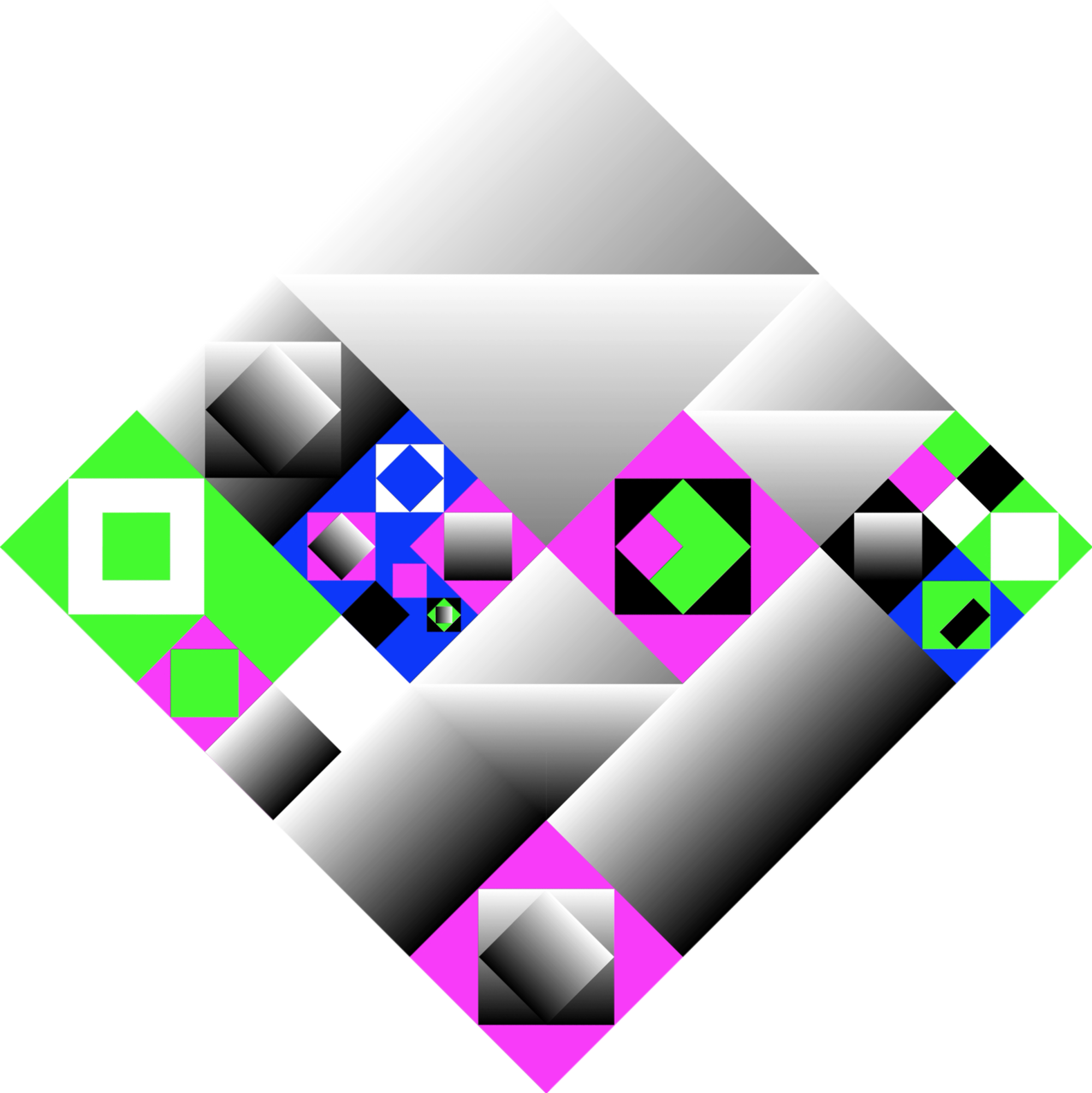
Markov's Window began as a Macromedia Flash animation made while studying computer science — outside the curriculum, not for school. Beginning with a single square filling the screen, the composition can subdivide, change colour, or rotate 45°; each transformation governed by probabilities determined solely by the current state, not prior history. The recursive subdivision can theoretically continue indefinitely. Unlike a work that iterates toward one optimal composition, Markov's Window "embraces perpetual change."
The palette was chosen directly — not theorised but picked; the CMYK account above arrived only much later. The choice felt like simplicity in 2004; in retrospect it reads as a declaration — four colours that collectively assert their medium.
The work was later acquired by the Stedelijk Museum Amsterdam and installed in the Stedelijk Base alongside Malevich, Mondriaan, and works of Russian Constructivism. The installation juxtaposition is significant: the recursive geometric subdivision and pure saturated primaries of Markov's Window are in direct visual conversation with the Constructivists. The palette was picked in 2004 as a simple technical choice; installed at Stedelijk it reveals its art-historical position — the same extremes of primary colour that Rodchenko and El Lissitzky worked with a century earlier.

At the Stedelijk. Installed in the Stedelijk Base beside Malevich and Rodchenko — the saturated-primary chord meeting the Constructivists who reached it a century earlier by independent reduction.
Markov's Dream (2022)
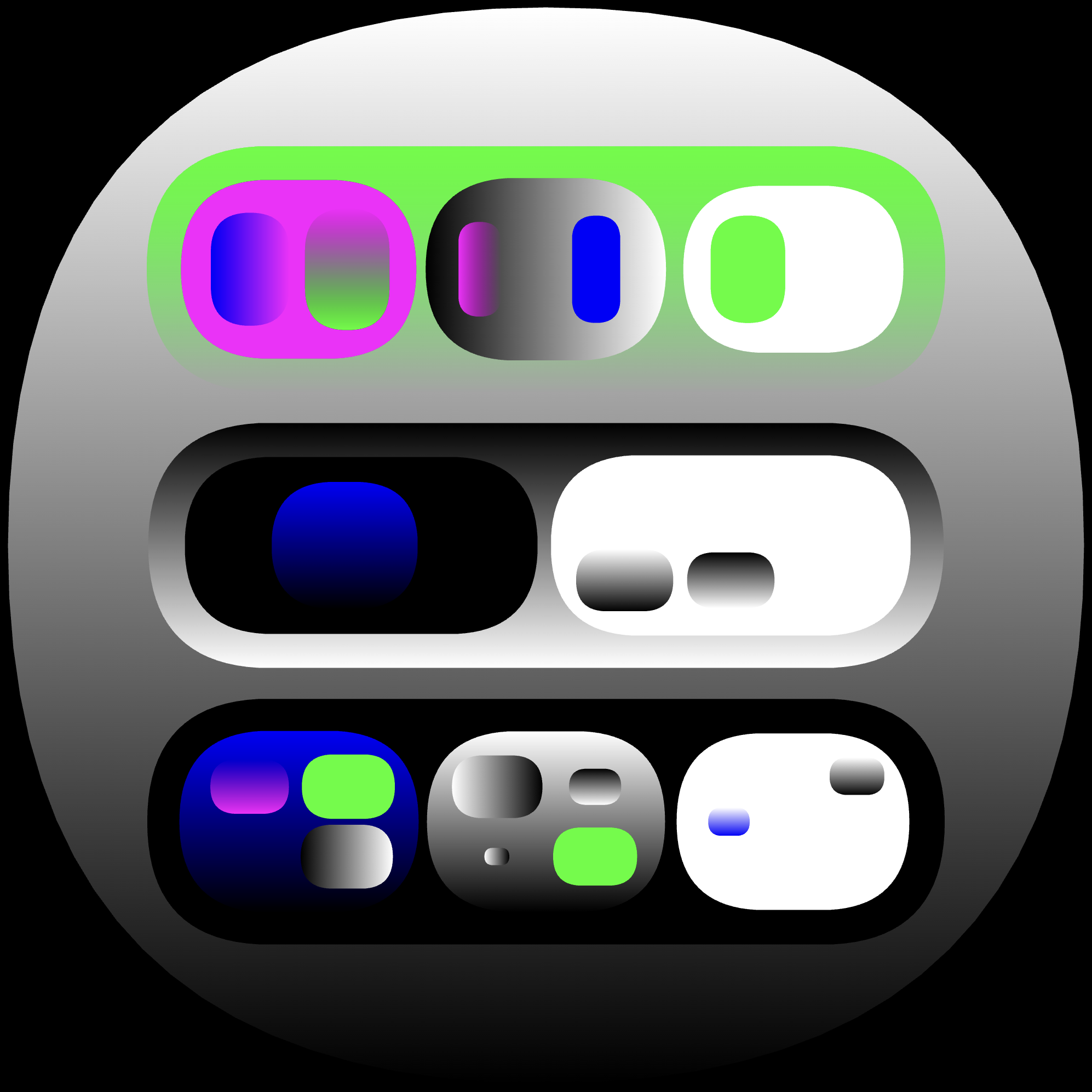
Eighteen years later, the palette returns — but the geometry has changed. The about page for this work identifies the trigger: the shift in computing from text-based tool interfaces to graphically-oriented corporate platforms. These platforms — smartphones, social networks, operating systems — replaced sharp geometry with rounded edges and organic shapes to simulate human warmth while constraining user agency. The squircle (the rounded square, Apple's defining UI shape since iOS 7) became the emblem of this shift.
Markov's Dream responds by "replacing pure geometric forms with impure circles or rounded squares." The rigid subdivision logic of Markov's Window becomes a nested structure of squircles; the recursive squares become rounded containers for one another. The palette is identical — blue, green, magenta, black-to-white gradient — but now applied to forms that acknowledge the corporate aesthetic the work inhabits. The "dream" is partly ironic: the title calls back the 2004 work while acknowledging that the formal world has changed around it.
The 32 tokens were released gradually, each unique, each "a window into aesthetic memories." The subtitle of the project text — Memories and Memorylessness — makes the tension explicit: Markov processes have no memory; these works are nothing but memory, accumulating a 22-year aesthetic history in each new token.
Markov's Window 2023 (token #30)

Token #30 in the Markov's Dream series is a special case: it is explicitly titled Markov's Window 2023, named as a remake of the 2004 original. The recursive square subdivision returns — the same logic as the original Flash animation — now running as an NFT. The composition is rendered as a rotated diamond on a vivid magenta-to-white gradient ground, the same 45° rotation that the original work could execute probabilistically, here fixed as the orientation of the whole. The "extended classic palette" specification for this token adds further gradients and fills to the original four-element vocabulary.
The image makes the palette ancestry unmistakable: royal blue, vivid green, fuchsia/magenta, white, black, and grey gradients — all at maximum saturation or pure greyscale — against a hot-pink background that is itself the magenta pushed into the surrounding field. The palette that was "hand-picked" in 2004 is now being deliberately quoted, examined, extended. Where the 2004 Flash work composited shapes as flat fills, token #30 introduces blending modes: shapes are composited against one another, so that overlapping regions produce mixed luminosities and colour interactions that lie outside the original four-element palette. The extremes are still the input; blending produces the intermediate territory they exclude.
Stained Unravel (Markov's Dream, 2026)
→ See Stained Unravel for the full series context.
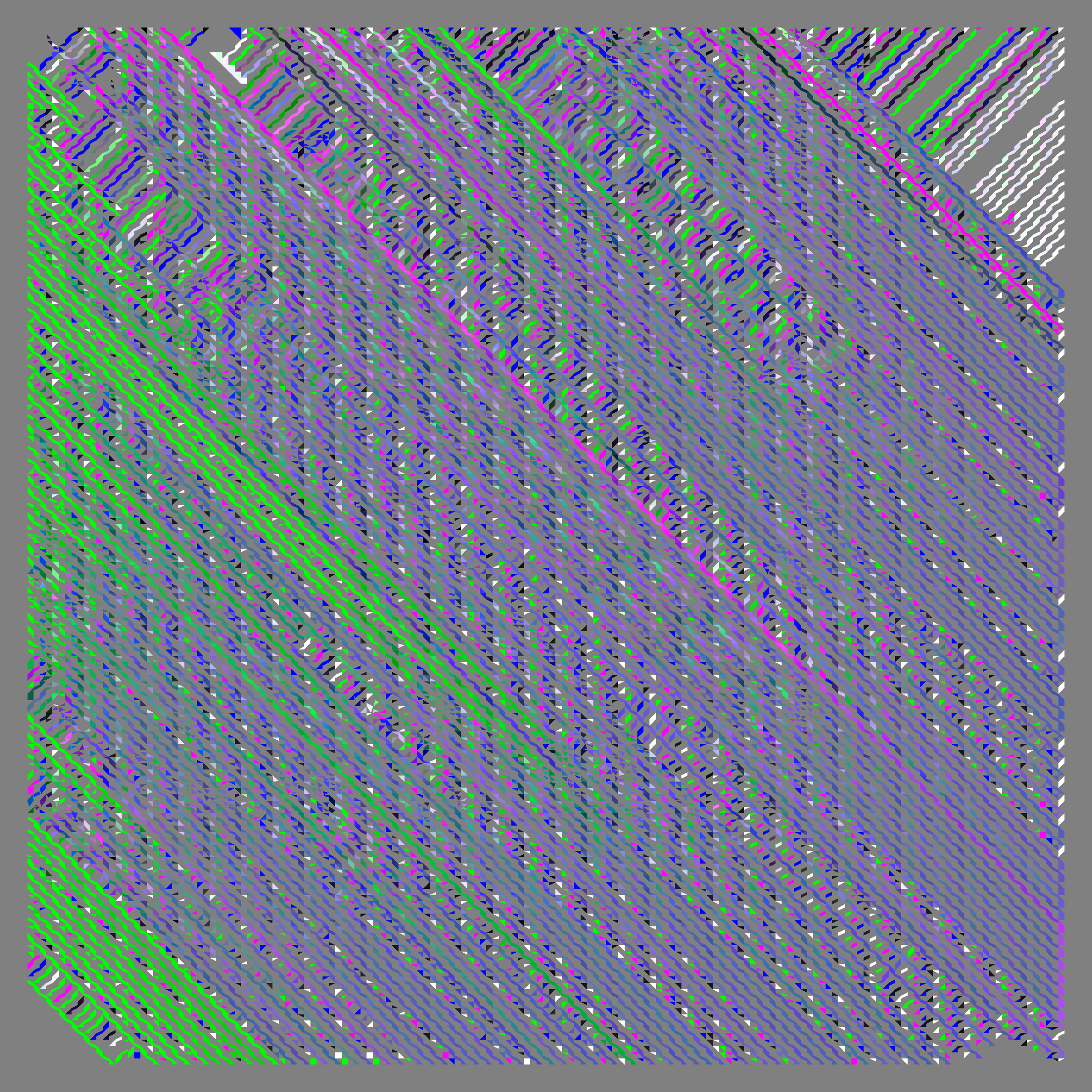
The fourth instance of the palette applies it to a cellular automaton: Stained Unravel (Markov's Dream), token #6 of the Stained Unravel series (2026). The medium has changed completely — from Flash to squircles to on-chain CA — but the same colours reappear: the vivid green diagonal band that sweeps across the grey-violet field is the same rgb(0,255,0) that has been in the palette since 2004. The grey-violet ambient texture draws on the blue and the black-to-white gradient. The small white rectangle in the upper-right corner is pure rgb(255,255,255).
The cellular automaton has temporal memory built in — its staining mechanism records how long each cell has held its form. Applying a palette derived from a work named for memorylessness to a system that is constitutively about memory produces an additional irony: the Markov palette now stains cells, accumulates in them, makes their history visible as colour. The memoryless process becomes the instrument of memory.
The palette is also treated differently here at the level of colour transition. When cells merge into larger compound shapes and the shared colour of that region changes, the shift is not a hard cut between palette values — it fades. The pure extremes of the palette are the terminal states; the path between them is traversed gradually, visibly. This is the one place in the lineage where intermediate colour values appear not as a blending of layers (as in token #30) but as a temporal event: the passage from one extreme to another is shown as duration. The palette that excludes the middle now moves through it in time.
Palette as memory, Markov as its name
The about page for the Markov's Dream project opens with the contrast between Markov processes (memoryless, present-only) and human beings ("Human beings are different"). The recurring palette is precisely what is different. A Markov process has no palette — each state is determined independently. The artist returns to the same colours across twenty-two years because humans, unlike Markov chains, carry their history forward.
The palette is memory. The works it reappears in are memories — each one bringing the same chromatic vocabulary into a new formal context, a new technical substrate, a new historical moment. The colours are unchanged; everything else has been rebuilt.
This is distinct from stylistic consistency or brand identity. The palette is not deployed to make works look related — the four works look very different from one another. The palette functions below the level of visible style, as a buried continuity that reveals itself only in retrospect, when the four works are laid alongside one another and the same blue, the same green, the same magenta appear across Flash, squircle, recursive subdivision, and cellular automaton alike.
The simplicity of the palette — all extremes, nothing mixed — is also what makes it portable. A palette of highly specific intermediate tones would look different applied to each new system; these colours are so basic that they survive any transformation. They are the RGB version of primary colours: whatever medium you work in, whatever algorithm you run, blue is still blue.
The constructivist room
The Stedelijk installation photograph shows Markov's Window — diamond-mounted, running — on the left wall, and beyond the doorway a room dense with Russian Constructivist paintings: Malevich, Rodchenko, El Lissitzky. The palette was chosen in 2004 as a simple technical gesture; installed in this context it becomes a claim. The same pure saturated primaries that the Constructivists pushed to their limits in the 1910s and 1920s reappear in a generative software work a century later — not as quotation or homage, but as rediscovery. The simplest possible colours in any medium turn out to be the same colours.
The De Stijl connection runs parallel: the Stained Unravel (De Stijl) work draws its palette from Van der Leck and Van Doesburg (ca. 1920), contemporaries of the Constructivists. Both lineages — the Markov's Dream palette and the De Stijl palette — converge on the same intuition: that primary colour at maximum saturation, applied to a rule-governed system, produces something that connects across a century. The Constructivists arrived there through ideology (the rational transformation of visual language). Van den Dorpel arrives there through reduction (the simplest possible choices in an RGB system). The destination overlaps; the route differs.
See also
- Stained Unravel — the full series; Markov's Dream as one of seven works; the cellular automaton system
- Senescenence — the exhibition that includes Stained Unravel; the loom genealogy and grid family
- Protocol, Taste, and Systems — Markov melancholia; the memoryless system carrying an emotional register; Delinear.info
- "The Squircle of Life," Spike #70 — the squircle as the defining UI shape of the era; Markov's Dream (2022) as response to this aesthetic
- Randomness and Pattern — perpetual algorithmic variation vs. a single optimal composition; "embraces perpetual change"
- Subconscious Computation — the algorithm as externalisation of subliminal processes; Markov's Window as early instance