
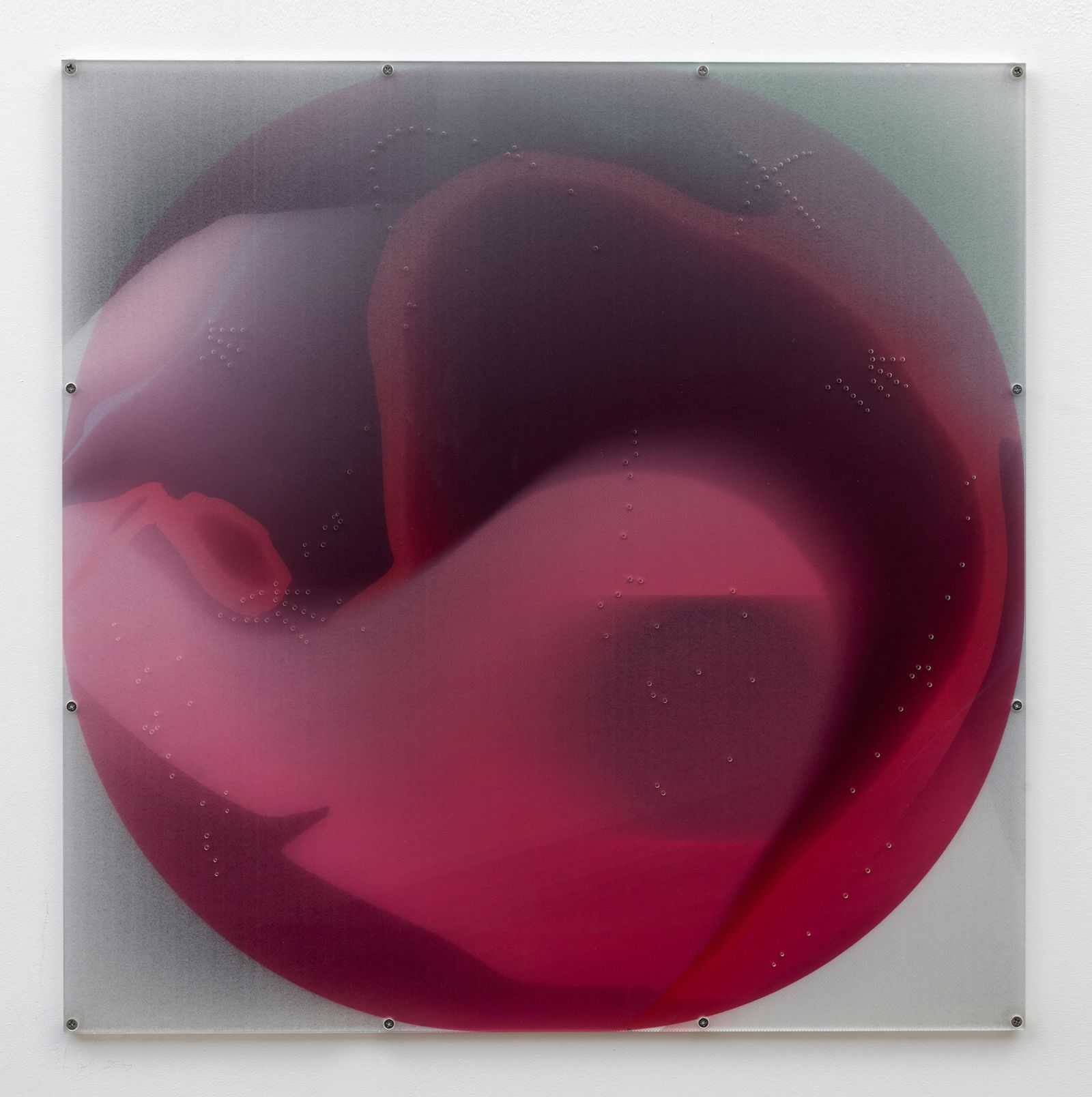
"The Squircle of Life" — Spike Magazine #70
Interview: Harm van den Dorpel × Tina Rivers Ryan
Publication: Spike Art Magazine, Issue 70 (2022)
Source: sources/ingested/spike-70-harm-van-den-dorpel.md
Overview
A conversation between van den Dorpel and Tina Rivers Ryan (curator, Albright-Knox Art Gallery), ranging across the net art → Post-Internet → Web3 trajectory, the economics of left gallery and NFTs, genetic algorithms and fitness functions, the squircle as the defining UI shape of the era, and the concept of algorithmic archaeology. The interview is anchored to the Mutant Garden series and Death Imitates Language, with Event Listeners (2015) as a touchstone.
Key ideas
1. The pre-/post- cycle
Each phase of internet art (net art, Post-Internet, Web3) begins with utopian energy and ends in disillusionment. Post-Internet meant recognising that the utopia turned into "mass surveillance and websites so bloated with advertisements that we don't load them anymore." Web3 returned the utopian energy — but also the risk of everything becoming a financialised transaction. Van den Dorpel's position is non-cynical but undeceived: "I don't even know if it's good or bad, it's just what it's going to be."
Label-agnosticism follows: "I used to be called a net artist, then I was a Post-Internet artist, now I'm a crypto artist. I don't care." This echoes the semiotic square's refusal to hold a position in the New/Different matrix.
2. The problem with pure randomness
Van den Dorpel describes the limit of random-number-based generative art: "it's always different. But it's also always the same, in a way, and after a while you get bored, as there's no direction or growth." Pure randomness is not sufficient — without a fitness function, the generative system has no telos, no accumulation. This is the problem that drives the shift from classic generative art to evolutionary/genetic approaches.
This directly extends randomness and pattern: randomness alone cannot produce the "non-arbitrary surprise" that the practice targets. The dialectic needs a criterion.
3. Fitness functions as explicit aesthetic theory
The interview is the most explicit articulation of how selection criteria work across the series:
- Death Imitates Language (2016): manual selection — the artist decides which specimens live and die
- Hybrid Vigor (2017): crowdsourced selection — the public decides
- Nested Exchange (2017): the "hipster algorithm" — each specimen succeeds by being maximally different from all others ("just like at a music festival, where everybody thinks they're unique, but also looks quite similar to everyone else")
- Mutant Garden (2019–): complexity in construction (render time) vs. complexity of experience (compressed file size) as dual fitness criteria
Death Imitates Language. The manual fitness function at its plainest: the artist alone decides which software organisms live and which die.
Hybrid Vigor. The selection is handed to the crowd — the anonymous public becomes the fitness function.
Cussos. The "hipster algorithm": each specimen succeeds by being maximally unlike all the others — difference itself as the criterion.
The progression is a formalisation of taste into code: first manual and subjective, then crowdsourced, then structurally defined. This connects directly to protocol, taste, and systems — the Droitcour article's three-stage model (personal → collective → systemic) maps almost exactly onto this sequence.
4. The squircle: intervening at the interface
The squircle (a rounded square, the dominant shape of contemporary UI design) is the interview's central formal object. Its significance:
- It is "considered impure" — mathematicians hate it — yet it defines the aesthetics of the current era's interfaces
- Malevich's square asserted art's autonomy from representation; the squircle enacts art's embeddedness in social and technical systems
- Instagram's square format, profile pictures, Mac UI rounded corners — the squircle is the shape through which we consume culture
The political claim: "To intervene in contemporary life means to operate on the level of user interface design, because that's where we spend most of our time now when we consume culture."
This is a position on what protocol art is for: not just making the protocol visible (as in the Droitcour reading) but occupying the aesthetic terrain of the interface as the site of intervention.
5. Mutability vs. immutability
The blockchain's immutability is structurally in tension with the mutability of generative work. Van den Dorpel's resolution: this is a design question, not a philosophical impossibility. The NFT can point to something dynamic even if the ledger entry is static.
The fossil concept: when Mutant Garden's mutation algorithm stops, those works become "fossils" — they died. "And that's okay." This frames digital work's death not as failure but as a natural terminus, continuous with senescenence's "death as system feature."
6. Algorithmic archaeology
Tina Rivers Ryan draws out the concept: algorithms are not "objective and universal and true" but are "the products of particular historical situations." The Cartesian genetic programming algorithm used in Mutant Garden was made in the 1990s for industrial circuit board development. Using it for art is archaeological — excavating an algorithm within its historical layer.
Van den Dorpel qualifies: some code is so large and old (Windows still contains Windows 3.1 remnants) that it effectively cannot be changed. "Code is law" is not entirely wrong — but only because legacy is too large to comprehend, not because code is inherently lawlike. Ryan's reformulation: "code isn't law, but rather destiny." Programmers create a legacy future programmers must build on or around. Art does the same.
This connects to mediation and the archive: archival technology shapes events; legacy code shapes the systems built upon it. The algorithm is an archive that acts.
7. Social engineering as biological engineering
Dating app algorithms optimised for short-term relationships (to keep users returning) are, because relationships produce offspring, "essentially engineering ten percent of the Western population." Software developers and economists are "actually designing our human species, in a direct and biopolitical way." This is the context that prompted the genetic algorithm work — not as commentary but as parallel: if dating apps breed people, can artworks breed organisms by the same logic?
8. Event Listeners (2015): melancholy and scripted social situations
The earliest tokenised work purchased by a museum generates 1990s-style recursive screensavers overlaid with descriptions of scripted social situations (family birthday parties). The melancholy: childhood isolation addressed by writing software — "trying to understand the world and myself by writing software and making aesthetic systems. But in the end, I was just more isolated." The recursive branching structures in nature (trees) are also the structures of social scripts. Generative form as emotional autobiography.
Event Listeners. Recursive 1990s-style screensavers overlaid with scripted social situations; the first tokenised work bought by a museum, and the interview's emblem of generative form as emotional autobiography.
Works referenced
- Event Listeners (2015) — first tokenised work purchased by a museum; recursive screensaver; melancholy
- Death Imitates Language (2016) — manual fitness function; artist selects which organisms live/die
- Hybrid Vigor (2017) — crowdsourced fitness function
- Nested Exchange (2017) — "hipster algorithm"; maximise difference from others
- Mutant Garden (2019–) — complexity of construction vs. complexity of experience; squircles; fossils; algorithmic archaeology
- Mutant Garden Seeder (2021) — 512+1 NFTs; collector-bred mutations
Mutant Garden Seeder. The drop that let collectors breed mutations — its interface bypassed by direct contract minting, the protocol gamed by the market.
Connections to existing wiki pages
- Protocol, Taste, and Systems — the fitness function progression (manual → crowdsourced → systemic) maps onto the personal → collective → systemic taste model; left gallery as a counter-model to NFT speculation
- Randomness and Pattern — the limit of pure randomness ("no direction or growth"); fitness functions as what gives the dialectic its telos
- Subconscious Computation — fitness functions as the formalised version of the "deepest impulse"; evolutionary systems as subconscious computation at scale
- Senescenence — "fossils" as works that died; death as natural terminus; continuity with death-as-system-feature
- Mediation and the Archive — algorithmic archaeology; legacy code as archive that acts; "code as destiny"
- Assemblage Identity — algorithms as historical assemblages with contingent, emergent identities; not universal but products of specific situations
- Semiotic Square — label-agnosticism (net artist → Post-Internet → crypto) as refusal to hold a position in the New/Different matrix
- Works Overview — Event Listeners, Death Imitates Language, Nested Exchange, Mutant Garden