
Randomness and Pattern
The dialectic (805)
Note 805 opens with a proposition from N. Katherine Hayles (How We Became Posthuman):
"We might regard patterning or predictability as the very essence and raison d'être of communication — communication is the creation of redundancy or patterning. If information is pattern, then noninformation should be the absence of pattern, that is, randomness."
So information and randomness are defined against each other — neither is prior, each constitutes the other. The dialectic is not resolved in favor of pattern (communication, meaning) but held open: "this pattern/randomness dialectic does not erase the material world."
The key claim: the apparent erasure of material infrastructure by information is an illusion that should be the subject of inquiry, not a presupposition. Information technologies create "flickering signifiers" — unstable, prone to unexpected metamorphosis — but they do not float free of their material substrate.
A strange interpolation in the same note — "When I laid there beside you, could you feel me there? My arms were wrapped around you, and I was stroking your neck" — inserts the intimate and bodily into the theoretical text. This is itself an act of disrupting the pattern of theoretical discourse with something apparently off-register.
The workmanship of uncertainty (609)
Note 609 ("Undo") applies the randomness/pattern dialectic to craft and skill:
"The workmanship of certainty is static, whereas the workmanship of uncertainty is most likely to generate innovation. Like any form of evolution, craft can only advance through mutation. Risk provokes an evolutionary mutation through the necessitated gesture of reconciliation of accident."
And: "In order for something to be truly innovative it must be the result of an evolutionary process: one that results from aberration, mutation and adaptability."
The contrast: workmanship of certainty = you know what you'll get before you make it (static, non-generative). Workmanship of uncertainty = the outcome is not predetermined; accident is encountered and reconciled. This is not chaos — it requires commitment: "Where there is no risk and every commitment can be revoked without consequences, choice becomes arbitrary and meaningless."
The title "Undo" (the ubiquitous Ctrl+Z) frames the opposite of this — the safety net that removes commitment from action.
The artist's position (709)
The artist statement 709 formulates the practice as the balance point in this dialectic:
"The most valuable moments emerge when the coincidental and the intuitive balance the rational — an irrationality without being esoteric."
Not randomness without structure, not structure without randomness. The feedback loop ("every single parameter depends on all the others, and my interference amplifies as a feedback loop") is itself a pattern that generates unpredictable outputs. Complexity and contradiction "do not necessarily call for a solution."
Cloud On Title (846)
The work Cloud On Title (extended version) takes its title from a legal term: a "cloud on title" is a claim, encumbrance, or defect in the chain of ownership records. It introduces doubt about who holds clear title to a property. As a title for an artwork, it introduces the same doubt about the artwork's status — its ownership, its clarity, its unencumbered transmission. Uncertainty as the subject matter of the work, not a deficiency to be remedied.
Chance as method (878)
Note 878 (mise en abyme): "Prints of cell phone photo of white cube gallery floor, arranged according to the Laws of Chance, then aligned." The sequence is significant — first arranged by chance, then corrected toward regularity, and the two-step procedure is legible in the grid's not-quite-regularity. The Laws of Chance (Arp, Dada) produce an initial state; alignment then intervenes. Note 856 observes: "The relatively ordered appearance suggests, however, that the artist did not fully relinquish artistic control." Both statements are true simultaneously.
The limit of pure randomness (Spike #70)
In conversation with Tina Rivers Ryan (Spike #70), van den Dorpel identifies the experiential failure of random-number-based generative art: "it's always different. But it's also always the same, in a way, and after a while you get bored, as there's no direction or growth." Pure randomness produces variation without accumulation — no telos, no memory of the path taken.
The resolution is the fitness function: a criterion that gives the selection pressure direction. Without it, randomness and pattern alternate aimlessly. With it, the dialectic becomes evolutionary — each iteration contends with the last, and the system develops. This connects the randomness/pattern dialectic to taste as the through-line: a fitness function is formalised taste.
The summed-multitude threshold — Lexachast (2017)
The 2017 Ableton text on Lexachast (with Bill Kouligas and Amnesia Scanner) adds a second resolution to the Spike #70 boredom, at the opposite scale. The fitness function resolves the boredom upstream, by giving randomness direction before it runs. The summed-multitude threshold resolves it downstream, by pushing randomness past a point at which the summation itself produces a particular quality:
"If you, for example, mix all colors together as paint, the result is this particular dark brown/grey color. Also, I used to cycle daily past a dump as a child, and it struck me that if you put all trash together, all of their smells combined create one quite specific and particular smell. This also happens with Lexachast. When 'all' images are put together, from this multitude and randomness, somehow a 'one-ness' emerges, or unity. A particular feeling."
Two analogies, one structural claim: a sufficient multitude of heterogeneous inputs, summed, does not produce noise — it produces one specific thing. The brown-grey of mixed paint is not a random colour; it is a particular colour. The dump-smell is one specific smell. The summed-NSFW image-pool, cross-faded under MIDI control in performance, produces "a particular feeling" — described in the same text as "quite dystopian." (The dump-smell as analogue for visual experience is itself a synesthetic move — see Colour Colour as scent.)
The Spike #70 boredom is therefore the affect of pure randomness at a small enough sample scale that no collapse-quality has yet emerged. Each output is different from the last, no fitness function rotates the set toward anything, and the experience is "always different… also always the same." Push the same operation past the multitude threshold and a different affect appears — not boredom but a specific summed quality. The dialectic gains a third state: pattern, randomness-without-accumulation (boredom), and randomness-summed-past-threshold (the particular one-ness).
This sharpens Cloud On Title's uncertainty as the artwork's subject (846) and mise en abyme's chance-then-alignment procedure (878): those works treat uncertainty as a local operation on a small set, with the artist's hand still arbitrating. Lexachast delegates to the multitude — no per-image selection, only a filtered draw from a vast pool — and trusts the summation to produce its own quality. The trade-off is exact: the local-uncertainty mode preserves the chord (legible relations among few elements); the summation mode collapses to a single particular feeling.
Full text at sources/ingested/ableton-lexachast-2017; also at Colour The summed-multitude limit and Subconscious Computation Filter mode.
Connection
The pattern/randomness dialectic runs across all these notes. It is not resolved — the work occupies the productive tension between them. Pure randomness is meaningless (no communication); pure pattern is dead (no mutation). The practice lives in the unstable middle, where accident is "reconciled" but not eliminated, where the coincidental "balances" the rational.
Pleasure and the workmanship of uncertainty (Struggle for Pleasure, 2024)
The Struggle for Pleasure press release (Verse SOLOS London, 2024) adds a new stake to the randomness/pattern dialectic: pleasure. The question is not just what the dialectic produces formally but what it makes possible experientially. Van den Dorpel distinguishes lasting pleasure (which requires the workmanship of uncertainty — openness, resistance, incompleteness) from easy pleasure (nostalgia, recognition, generational positioning).
"This openness to uncertainty and to the dialogic process of the realisation of a work is central to the struggle for pleasure. It is my uncertainty, but it appeals to a wider openness, an openness where pleasure can flourish."
Nostalgia (8-bit graphics, CryptoPunks) produces immediate pleasure by short-circuiting the dialectic — recognition replaces construction. The workmanship of uncertainty produces a different kind of pleasure, harder to achieve and more durable: "knowledge itself breaks down" as the condition under which something opens.
The installation. The Verse SOLOS London view gathers the 128-token series whose subject is pixel resolution as a route to durable rather than easy pleasure.
Lasting versus easy pleasure. A frame from the Verse interview where van den Dorpel sets durable pleasure against the short-circuit of 8-bit nostalgia and generational recognition.
Swallow Only Shallow. The large-format Resolution Paintings shown alongside the token series carry the decompressed output at a scale — and on a material surface — no screen preserves.
Vera Molnár's imperfections and the deliberate error (Angles Morts, 2024)
The Angles Morts exhibition (LOHAUS SOMINSKY, 2024) adds two instances of the randomness/pattern dialectic at the level of material production.
Molnár's constrained imperfections. Early computer art — specifically Vera Molnár's work — used "very limited" technology "with no screens" that "provided only simple outputs that she had to manually translate into physical objects." The translation "resulted in small imperfections, which Van den Dorpel particularly appreciates." These imperfections are not random in the probabilistic sense — they are the mark of the labour of translation between computational instruction and physical object. The gap between the algorithm's precision and the material result introduced the human hand. Van den Dorpel values this gap not as deficiency but as evidence: the imperfection is where the person appeared.
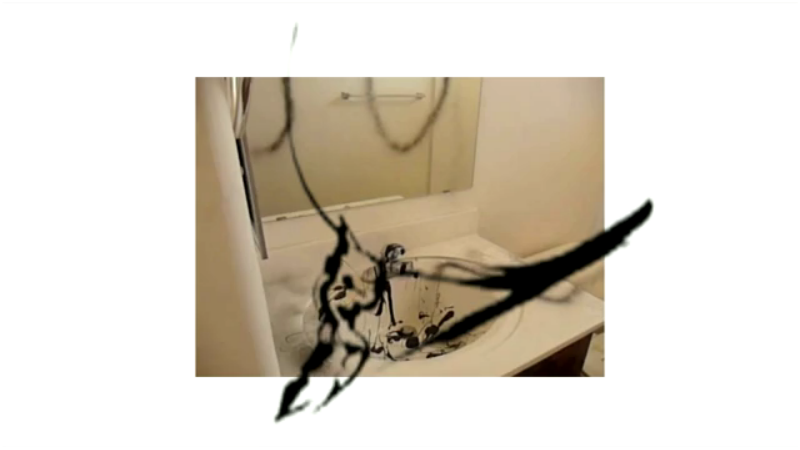
Embroidery's kept-down pen. The work Embroidery (2024) was produced by deliberately departing from normal plotter behavior: keeping the pen down during moves between drawing positions. This generates "threads" — stray marks tracing the pen's path between intended drawing locations. The "error" is not accidental but chosen; it reveals the transition paths that are normally invisible (pen lifted, no mark). The threads are the paths the algorithm took between points: the implementation made legible as image.
The two cases are structurally opposite: Molnár's imperfections were imposed by material constraint and retrospectively valued; Embroidery's threads were introduced by deliberate rule-violation and generatively valued. In both, the deviation from smooth, invisible execution is the content. Randomness here is neither noise nor method but the trace of a path taken — the record of how the mark got from one place to another.
Compression and decompression — a directional account (Our Inner Child, 2023)
The Our Inner Child exhibition text (Upstream Gallery Amsterdam, 2023) gives the pattern/randomness dialectic an art-historical directionality by framing the generative practice as the inverse of Mondriaan:
"Painters such as Mondriaan and Theo van Doesburg would look at, for example, a tree and take the enormous amount of complexity they would perceive and reduce it to a few shapes or lines to convey its essence. You could think of this as a kind of compression which perhaps reaches its highest level in Mondriaan's grid-like canvases. I thought about what could happen if you moved in the opposite direction, taking something very basic, and applying the capacities of generative art to that form. In that way it becomes a process of decompression, you can move from very simple geometrical shapes to extreme complexities, moving from shapes to the level of pixels."
The compression/decompression frame gives the dialectic a history. Mondriaan's De Stijl grid is not simply a formal choice — it is the endpoint of a reductive process: perceptual complexity → geometric essence. The grid is maximally compressed: the minimum of formal means required to carry the essential structure.
Generative art runs the reverse. The input is minimal (simple geometry, basic rules); the output is extreme complexity at the pixel level. The Resolution Paintings embody this — the medium (photographic exposure on metallic paper, up to 150×150cm) is chosen specifically because it carries the decompressed output at full resolution. As van den Dorpel notes: "any kind of screen display reduces visual complexity, therefore the only way these works could truly convey their full complexity was to produce them as material objects." The screen reimports a compression the algorithm had removed. The print does not.
Medium is not neutral in this framework: each display layer is a compression decision, and the work's complexity is determined not just by the algorithm but by the chain of compressions applied to its output. The dialectic is thereby reconfigured — Mondriaan compresses toward maximum pattern, generative art decompresses toward the full texture of what the rules produce — and the question is no longer pattern-or-randomness but at what resolution the pattern is allowed to unfold.
Klimt. A Resolution Painting exposed photographically onto metallic paper; the material print holds the full decompression that any screen would silently re-compress.
The organic/geometric continuum
The decompression thesis has a corollary the artist states directly: the geometric and the organic are not radically opposed but lie on a single continuum of complexity. Run a simple rule far enough and its output stops looking constructed and starts looking grown — weathered, sedimentary, geological. The early plotter drawings make this legible in both directions. The botanical sheets (Untitled Flower, the Thistle pair, A tree, Papaver Somniferum) take an organic subject and reveal it was only ever a mesh of straight line segments; the larger generative sheets run the move in reverse, starting from a minimal rule and arriving at organic-looking texture — Sediment (2025), one colour-grouping rule over a Vera Molnár grid that settles into strata; Atlas (2024), a single probability gradient bending a field into planetary curvature; Current (2024) and Tract (2026). This reframes the dialectic's stake: "pattern" and "the organic" are not opposite poles but the same field viewed at different depths of the decompression. (See also the are.na channel Organic Software Forms — biomorphic form produced under rule-based systems.)
The L-system is the most explicit instance of this in the practice — a grammar of a few symbol-rewriting rules that, iterated, grows the branching, plant-like structures Lindenmayer devised to model botanical development. It is literally a simple rule that produces an organic form, collapsing the supposed opposition into a single generative procedure. Van den Dorpel uses it directly: the plotter drawing Uttered Modality (2018) is built on an L-system, as is the generative work Event Listeners (2018). The L-system thus sits at the exact hinge of the continuum — geometric in its rule, organic in its output — and is the cleanest demonstration that, in this practice, the botanical and the algorithmic were never separate registers.
The earliest visible instance of the continuum in the practice predates all of these: Field (2008, ported fully on-chain in 2023). Loading spinners — functional interface elements whose only message is wait — are repeated in a two-dimensional grid until, in the artist's words, "they become something like flowers. Or wind turbines. We find ourselves in a large open field: a field without boundaries." The move here is neither decompression nor botanical reduction but a third mechanism: recontextualisation. The grid strips the sign of its function, and the geometric form that remains — a radiating circle with spokes, rotating — reads as grown. That the observation dates from 2008, before the botanical plotter drawings and before Algues Artificielles, makes the spinner grid the opening statement of the thread the are.na channel now collects (→ Field (2008/2023)).
"Embrace undecidedness" — the Mondriaan inversion (Verse interview, 2024)
The Verse Twitter Spaces interview (January 2024) names the structural opposition between van den Dorpel and Mondriaan with the most direct biographical claim yet:
"One thing in this Dutch modernist tradition is that there's a sense of determinism. Mondriaan would obsess for a long time about how a particular composition would have to be, but for me it's actually the opposite. I generate things at random, or I breed generations, and then I curate and manipulate. It's very different, I embrace undecidedness."
"Embrace undecidedness" is a new formulation, more affirmative than prior descriptions. The compression/decompression frame (Mondriaan eliminates toward the one right composition; generative art generates from minimum rules toward maximum complexity) is here recast as temperamental disposition: Mondriaan's obsession toward determination versus van den Dorpel's embrace of undecidedness. Both methods produce grids — but one by reduction, the other by generation.
Pixel as interpolation device (Verse interview, 2024)
The interview on Struggle for Pleasure (2024) introduces a new account of why pixels engage cognition differently from other marks:
"What is at play with pixels is that our mind tries to interpolate the space between those pixels and construct more complicated entities behind those pixels. By varying the resolution of the pixels within one work, my eyes and my mind was jumping back and forth between feeling that I understood what I saw and constructing what I thought it would be."
This extends the randomness/pattern dialectic into the cognitive register. Variable resolution produces an oscillation not in the work itself but in the viewer: recognition (pattern) and construction (filling in the unresolved) alternating rapidly. The image is never fully given; the viewer is perpetually manufacturing it.
The resolution-increase animation mechanism denies the revelation it promises: sharpening proceeds "almost as if it's rendering the work" — but "nothing more is revealed." The expectation of meaningful disclosure is invoked and refused. High resolution is as abstract as low resolution; the revelation is the act of looking, not the thing looked at.
A further strand: pixellation as censorship (crime footage, trademarked video) produces "a certain almost macabre fascination with the low resolution image." The withheld image generates more desire than the clear image. Low resolution is not merely a lower amount of information — it is an invitation to construct what is missing, a condition of productive incompletion.
For Ray Johnson. Mirroring and rotation alone build a complex composition from a bare operation — pattern generated by rule, not composed by hand.
Relieved Afterimage. Variable resolution within a single token keeps the eye oscillating between recognising the image and constructing it.
Undoom. Its resolution-increase animation performs the promise of disclosure and then withholds it — the sharpening reveals nothing that was not already there.
Humboldhain. Pixellation as productive incompletion: the withheld image solicits more desire than a resolved one would.
Resolution oscillation. Another interview frame on the series — the mind interpolating the space between pixels, perpetually manufacturing the image it thinks it already sees.
Parent-conditional Markov chains — the mandala mechanism (Murayama Q&A, 2026)
The Cloud Writings Q&A with Goro Murayama (Tokyo, 2026) gives the most precise statement in the corpus of how randomness is structured in the Quantizer / Anicca / Anobium / Nethermind lineage:
"I often use Markov Chains: the distribution of a certain step or operation happening is stochastically determined by the parent the new shape is in."
This is a context-sensitive Markov process. The chain is still memoryless along the time axis (each transition depends only on the current state, not on prior history) but the current state is enriched by the recursion hierarchy: the parent container conditions the probability distribution of what may happen inside. Each parent-conditional transition produces a child shape that itself becomes a container, conditioning the next layer of transitions.
The result is not "random within a pattern" or "pattern within randomness" but their tight interlocking: the symmetrical subdivision of the mandala is generated by stochastic descent through an inheritance graph. Pattern at the macro scale; randomness at every local transition; the inheritance structure carrying the constraint that translates one into the other. See Mandala Q&A for the full mechanism and the Anicca → Quantizer → plotter-hatching lineage.
This refines the earlier discussion of Markov memorylessness in protocol, taste, and systems (Markov's Dream as memoryless beauty) and in quantization (Quantizer's blockchain seeding as Markov process). The Murayama statement adds the parent-aware dimension: not all of the Markov logic in van den Dorpel's practice is flat memorylessness — some of it is hierarchical, with the recursion axis carrying contextual weight that pure time-axis memorylessness lacks.
See also
- Assemblage identity — the evolutionary/population model parallels "workmanship of uncertainty"
- Mediation and the archive — "flickering signifiers" as the informational version of this dialectic
- Senescenence — the cellular automaton as the clearest concrete instance of the pattern/randomness dialectic (minimal rules → extraordinary complexity)
- Our Inner Child (2023) — compression/decompression as the art-historical framing; Mondriaan as compressor; generative art as decompressor; the print as the medium that preserves full decompression
- Angles Morts (2024) — Molnár's constrained imperfections as workmanship of uncertainty imposed by material limit; Embroidery's deliberate pen-down as path-trace revealed
- Verse Interview (2024) — "embrace undecidedness"; pixel interpolation; resolution oscillation; shoegaze as structural analogy
- Mandala Q&A — Goro Murayama (2026) — parent-conditional Markov-chain mechanism behind Anicca, Quantizer, and the plotter drawings derived from them
- Lexachast (2016–17) — the project page; summed-multitude threshold treated in full alongside the filter pipeline that produces it
- sources/ingested/ableton-lexachast-2017 — the 2017 Ableton fragment in full
- Colour The summed-multitude limit — the same threshold treated as a boundary condition on the finite-chord logic of palette