
Mandala Q&A — Goro Murayama × Harm van den Dorpel
Source: sources/ingested/mandala-qa-murayama-2026.md
Exhibition: Cloud Writings, Takuro Someya Contemporary Art, Tokyo, 2026
Interlocutor: Goro Murayama (村山 悟郎), Japanese artist
Why this exchange matters
The three questions are unusually well-targeted. Murayama is himself an artist working with rule-based pattern systems, and his questions extract three specific precisions about the mandala lineage that no prior text in the corpus had given:
- Which mandalas, exactly. Tibetan sand mandalas; Japanese Ryōkai Mandala (the Mandala of the Two Realms — the paired Womb Realm / Diamond Realm composition central to esoteric Buddhism in Japan).
- Why the mandala matters at all. Jung's individuation quote, given as the urgency that drew the artist to the form — the mandala as "the centre," "the exponent of all paths."
- How the algorithm works. Markov chains where the next shape's probability distribution is conditional on its parent container — parent-relative stochastic descent producing symmetrical subdivision.
1. The mandala lineage as a chronology
The Q&A names the mandala-construction works in chronological order:
| Year | Work | Status |
|---|---|---|
| 2025 | Anicca | "first attempt to construct them algorithmically" |
| 2025 | Quantizer | "went deeper into their construction"; traits explicitly named tibetan, thangka, mandala |
| 2025 | Anobium | algorithm extended into plotter hatching |
| 2025 | Nethermind | algorithm extended into plotter hatching |
| 2025 | Nethermind Quilt | algorithm extended into plotter hatching |
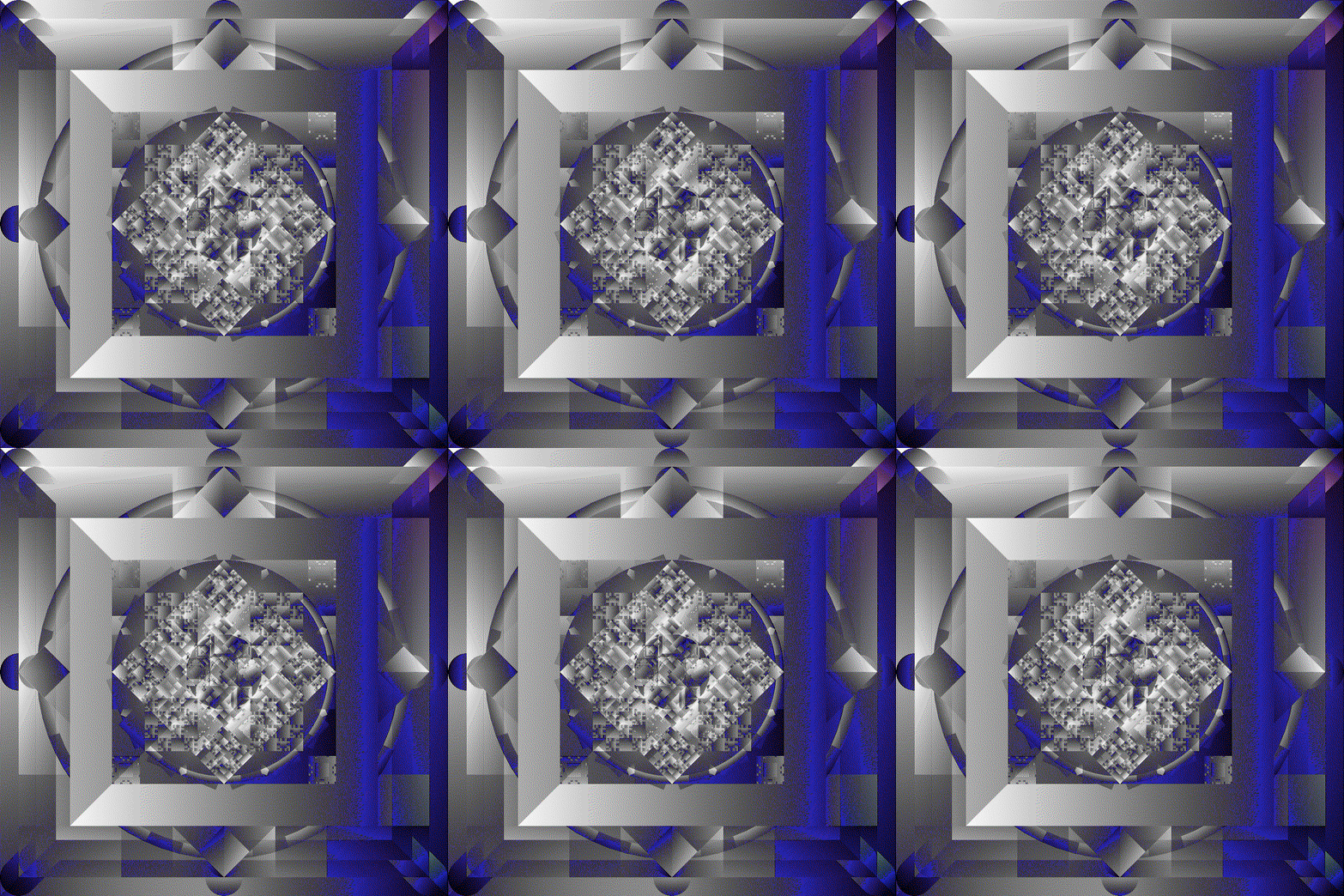
This is a single genealogy. The same algorithmic construction (mandala via Markov-chain parent-conditional subdivision) traverses three media states: (a) animated NFT tokens (Anicca), (b) blockchain-seeded NFT collection with mandala-named traits (Quantizer), and (c) plotter drawings produced by extending the Quantizer algorithm to convert filled surfaces into hatched lines (Anobium, Nethermind, Nethermind Quilt). The mandala is not a motif borrowed for one work but the construction principle of an entire branch of the practice.
The trait taxonomy of Quantizer — visible at /nft/quantizer/trait/root/tibetan, /nft/quantizer/trait/root/thangka, and parallel paths for mandala, flower, edge — is the strongest evidence in the corpus that the mandala vocabulary is structural to the work, not interpretive overlay applied afterward.
2. Jung and individuation — the new explicit hinge
The Jung quote is the most important single addition this Q&A makes to the corpus:
"I saw that everything, all paths I had been following, all steps I had taken, were leading back to a single point — namely, to the mid-point. It became increasingly plain to me that the mandala is the centre. It is the exponent of all paths. It is the path to the centre, to individuation."
This connects directly to subconscious computation's already-developed Jungian ground (the unconscious as a structured, symbolic dimension that exceeds conscious control; the algorithm as a mechanism by which the unconscious is "manifested through" outputs that cannot be fully predicted). Until now, that page had no specific Jungian destination — Jung was the philosophical frame for the unpredictable output, but the direction was unstated. The Jung mandala quote names the destination: individuation — the lifelong process of becoming the integrated self that contains both conscious and unconscious dimensions.
Jung's phrase "exponent of all paths" is precise: the mandala is not one path among many but the function that all paths jointly compute. The mandala is what every distinct trajectory turns out to have been computing all along. As an artistic stance, this maps onto the algorithmic practice: the algorithm is built as a system of conditions whose outputs are not predictable, but the mandala is the form that emerges when the conditions are tuned correctly — the "exponent" of all the trial outputs the artist has curated.
This also reframes the Our Inner Child account: the religious algorithm (childhood rule-set as moral legislature, critically named) is replaced not by an absence of structure but by another structured system — the mandala as Jungian individuation form. The legislative algorithm is shed; a different rule-based system is taken up. The mandala is what the practice was reaching toward when it left the religious algorithm behind.
3. The Markov-chain parent-conditional mechanism
"I often use Markov Chains: the distribution of a certain step or operation happening is stochastically determined by the parent the new shape is in."
This is the most precise statement of the generative mechanism behind Quantizer (and by extension Anicca, Anobium, Nethermind) anywhere in the corpus. The structure:
- A shape is generated.
- That shape becomes a container.
- Inside the container, new shapes are generated.
- The probability distribution governing what those new shapes are is conditional on the parent container.
- Each new shape becomes a container for further sub-shapes.
- Recursion continues to a stop condition.
This is a context-sensitive, hierarchical Markov process — the shape's "state" includes its position in the recursive hierarchy and the type of its immediate container. The symmetry of the mandala is not imposed externally but produced bottom-up: parent-conditional stochastic descent through the hierarchy of containers.
This mechanism reconciles two prior threads in the wiki:
- Recursion — the mandala is now identified as a recursive structure ("shapes become containers for multiple, smaller shapes, in careful symmetrical subdivision"). The Q&A makes recursion the formal description of the mandala, where prior texts had only used the word emergently.
- Randomness and Pattern — the Markov chain was described in protocol as memoryless, in quantization as the structure of Quantizer's seeding. Here the Markov logic is given a context-sensitive refinement: not only does the system not look back beyond the current state, but the current state is enriched by its parent in the recursive hierarchy. The chain is memoryless along time but parent-aware along the recursion axis.
The stop-condition problem from note 876 is operative here too: the symmetrical subdivision must halt or it self-inflates. The mandala's nested geometry is a recursive structure with built-in stop conditions encoded in the algorithm's grammar.
4. As above, so below — the macro/micro frame
Murayama's third question is sharp: many of van den Dorpel's works generate patterns through localized algorithms (each Markov transition is local; each parent-conditional descent is local), while the mandala is canonically a macro-scale cosmic image — a map of the universe, the position of deities, the structure of being. How are these reconciled?
Van den Dorpel's answer ducks the reconciliation question and replaces it with a hermetic answer:
"The hermetic observation 'as above, so below' is at work in that I sometimes experience awe by staring through a simple construed surface, into the depths of complexity."
The phrase comes from the Emerald Tablet attributed to Hermes Trismegistus: the same structure obtains at every scale of being. If true, then no reconciliation between local algorithm and macro cosmology is needed — the same patterning is at work in both. The local algorithm does not represent the cosmos; it shares its structure with the cosmos. The macro view is not a different thing but the same thing seen from further away.
The artist's specific contribution is the act of staring through — "I sometimes experience awe by staring through a simple construed surface, into the depths of complexity." The simple surface is what the algorithm produced; the depth is what looking does to it. The work does not contain the cosmic view; the encounter with the work opens the cosmic view, in the viewer.
This is also the most direct articulation of the artist's role:
"I provoke the work, structure the process, curate outputs, and highlight particular features that emerged."
Four verbs:
| Verb | What it names |
|---|---|
| Provoke | initiate the system; set the conditions |
| Structure | design the rule-set; specify the Markov transitions |
| Curate | select among outputs the system produces |
| Highlight | emphasise particular features of the chosen outputs |
What is conspicuously absent: invent, intend, mean, express. The mandala's macro-cosmology is not something the artist asserts. It is a property that surfaces, when the conditions are right, in the encounter between the algorithmic surface and the viewer's awe. The doubled creator/bystander position from subconscious computation is here decomposed into its operational parts.
Cross-references generated by this Q&A
- Subconscious Computation — Jung quote on individuation gives the practice's Jungian ground its specific destination
- Recursion — mandala explicitly named as a recursive structure with parent-conditional stochastic descent; "as above, so below" as cosmological self-similarity
- Randomness and Pattern — context-sensitive Markov chain: memoryless along time, parent-aware along the recursion axis
- Quantization — the Quantizer trait taxonomy (tibetan / thangka / mandala) is structural, not decorative; Anicca identified as predecessor
- Senescenence — Anicca (absence of permanence) deepens the senescence/sand-mandala/impermanence cluster
- Cloud Writings (2026) — the Q&A is the accompanying correspondence; the named works (Anobium, Nethermind, Nethermind Quilt) are in the exhibition
- Struggle for Pleasure (2024) — earlier mandala remark ("the apparently straightforward components of a mandala") receives its pre-history: Anicca as first algorithmic mandala already existed structurally