
Angles Morts — LOHAUS SOMINSKY, 2024
Group exhibition: Harm van den Dorpel with Vera Molnár.
Original: https://harm.work/exhibition/angles-morts/all
Overview
Group exhibition at LOHAUS SOMINSKY, 2024. Van den Dorpel's new works shown alongside works by Vera Molnár (1924–2023), the founding figure of computer art whose practice spans the period before computers were available through their emergence. The pairing is the exhibition's structural argument: van den Dorpel's contemporary practice in dialogue with the historical practice it continues.
The works belong to the Cloud Writings series — its premiere exhibition. Plotter drawings on Hahnemühle, Terschelling, Fabriano, and millimeter paper, alongside generative software (Pression des pairs, Anni).
Angles Morts is French for "blind spots" or "dead angles" — the areas outside a field of vision, the zones a mirror cannot show. As a title for an exhibition about overlooked female pioneers in generative art, it names what has been invisible.
Key ideas
1. The female lineage — a historical argument
The exhibition catalogue makes an explicit argument about gender and generative art:
"It should be noted that the artists listed are all women. In his research, Van den Dorpel recognises a dominance of female artists in the field of generative art. He considers a historical connection between the systematic arrangement of recurring elements in grid patterns and the craft of weaving, an activity traditionally dominated by women."
The four named precursors — Anni Albers, Vera Molnár, Charlotte Posenenske, Tauba Auerbach — are all women. This is not incidental. The argument is structural: the logic of the grid (rows and columns of repeating elements, systematic rules applied to each cell) is historically continuous with the logic of weaving (warp/weft, 1/0, binary over-under). Weaving was, for most of its history, women's work. Systematic grid-based visual art is, in this reading, the continuation of that tradition in a new medium — and women were already there before computers, already working algorithmically.
Van den Dorpel describes honoring "the rigorous and visionary work of these pioneers." The exhibition with Molnár performs this: the two practices are shown together not as tribute but as dialogue, as if the conversation that should have happened across fifty years is now taking place.
Tauba Auerbach is new to this context: a contemporary artist (b. 1981) who works with geometric abstraction, optics, weaving, and systemic visual logic. Her work extends the female generative lineage into the contemporary moment, bridging the historical generation (Albers, Molnár, Posenenske) and the present.
2. Reverse-engineering the invisible algorithm — Anni Albers
"In his work, the artist explores the complexity of works by female artists such as Anni Albers. While it would have been technically easy to programme an algorithm that replicated her triangle patterns, it turned out that randomly placing the triangles did not achieve the desired aesthetic effect. Van den Dorpel realised that Albers must have formulated clear rules in her head, which she applied algorithmically to each cell of the grid. This realisation led to a deep respect for the invisible structures and thought processes hidden in the works of Albers and other female generative artists."
This is the most concrete account of algorithmic archaeology in the entire corpus. The process:
- Identify a visual pattern (Albers' triangle arrangements)
- Attempt to replicate it computationally (easy — put triangles at random positions)
- Discover the attempt fails aesthetically (random triangles don't look like Albers)
- Conclude: the artist must have had implicit rules — an internal algorithm — that she applied systematically, even without coding it
The inference — "Albers must have formulated clear rules in her head, which she applied algorithmically to each cell of the grid" — is reverse engineering applied to art history. You cannot read the code from the work, but you can deduce that code must have existed, because the aesthetic result is not achievable without it. The artwork is the output; the algorithm is hidden in the artist's mind. Algorithmic archaeology as forensics.
This connects directly to impulse, risk, and method's "reverse engineering" (→ 709): "in order to gain deeper insights into the inner workings and logic of a system we are required to disassemble it." Van den Dorpel applied this to Albers' work as a system to be disassembled — not to replicate it but to understand what made it cohere.
The result: "a deep respect for the invisible structures and thought processes hidden in the works." The process of failing to randomly replicate made the structure legible as structure — invisible until you tried to copy it without rules and found you couldn't.
3. Vera Molnár's valued imperfections
"Unlike Albers, Vera Molnár worked with computer technology, but it was very limited, had no screens and provided only simple outputs that she had to manually translate into physical objects. These processes were labour intensive and resulted in small imperfections, which Van den Dorpel particularly appreciates."
Where Albers' algorithm was invisible (rules in the mind), Molnár's was operational but materially constrained: early computers with no screens, output that had to be manually translated into physical form. The translation introduced imperfections — not errors to be corrected but features to be valued.
The appreciation is specific: not the imperfections of chance (randomness for its own sake) but imperfections introduced by the labour of translation between computational output and physical object. The gap between the algorithm's instruction and the material result is where the human appeared. Van den Dorpel's plotter work inherits this explicitly — the plotter draws in all directions, "through its slow, mechanical movement creates unique and unrepeatable results that bring a human unpredictability to the digital works." The imperfection is not a bug but a feature of the translation layer.
This connects to workmanship of uncertainty (→ 609): the "reconciliation of accident" as what produces genuine mutation. Molnár's constrained early computer art is a historical instance of workmanship of uncertainty imposed by material limitation rather than deliberate method — but appreciated as such, retrospectively.
4. Embroidery — the deliberate error as image
The work Embroidery (61×47cm, Hahnemühle watercolour paper) documents a discovery in plotter behaviour:
"The artist deliberately departed from standard plotter behavior by keeping the pen engaged while moving between designated drawing locations. This unconventional approach generated unexpected 'threads' — stray marks created during transitions — that mirror the appearance of embroidery backstitching, where loose threads remain visible on the underside of finished textile work."
The plotter's normal operation: lift pen, move to next position, lower pen, draw. Van den Dorpel keeps the pen down during the move — the transition itself becomes a mark. The "error" (the thread) reveals the path the pen took between drawn points: the implementation leaks through.
The backstitching analogy is precise: embroidery's finished face hides the threads; the reverse shows them. To keep the pen down is to make the back visible on the front — to turn the finished surface inside out, making the process of getting from point to point legible as content. This is the process-legibility claim performed as a specific technical decision: the restriction (threads everywhere) is not concealed but made the image.
Embroidery also names the textile connection directly: the plotter drawing is embroidery, not just a work about it. The threads are literal threads; the process of connecting discrete points across a surface is the defining motion of both.
5. Cuneiform — writing systems and the grid
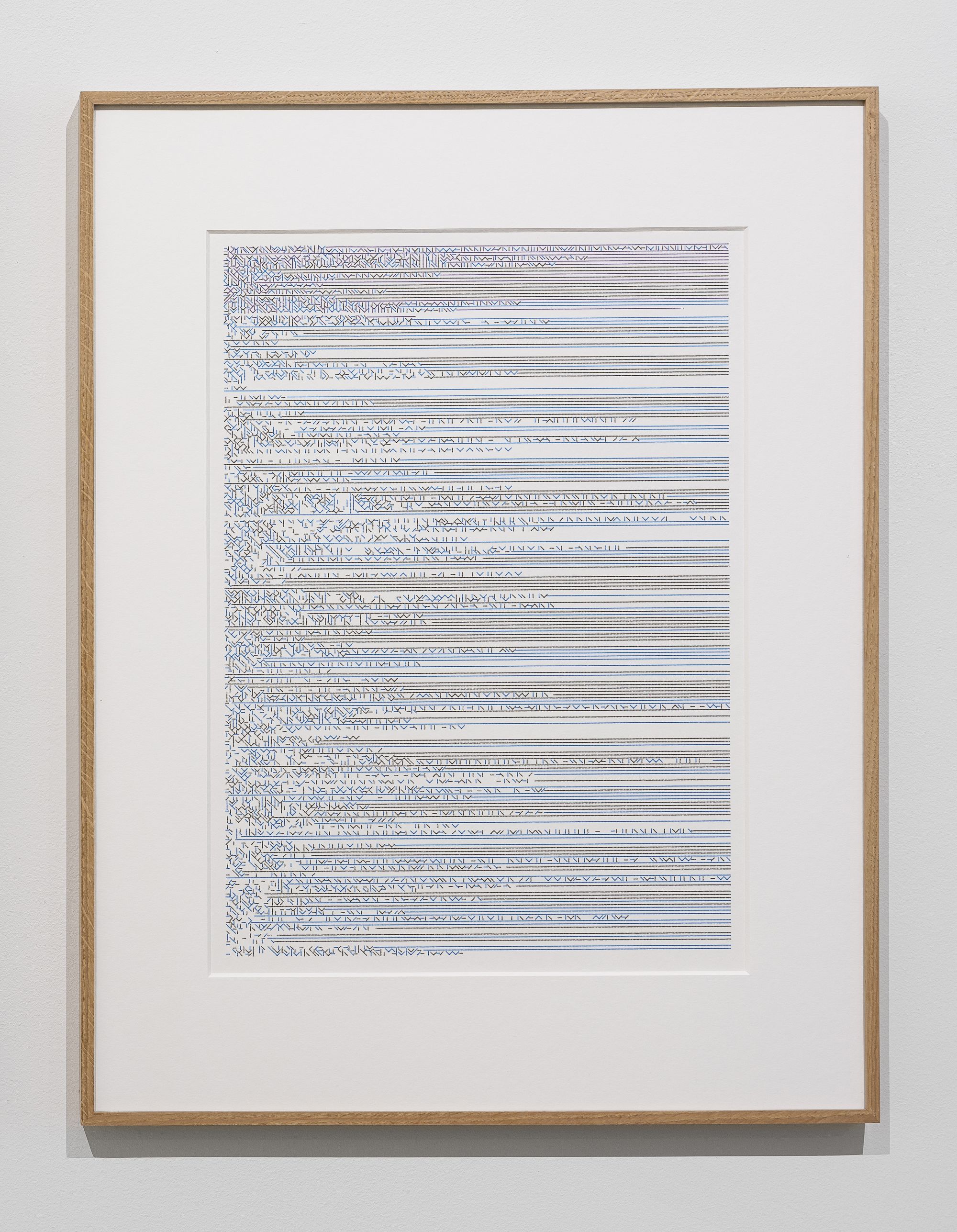
Cuneiform is the world's oldest known writing system — wedge-shaped marks impressed into clay tablets, arranged in grid-like registers. It is the most ancient instance of the grid=writing logic that runs through the Cloud Writings series. As a title for a plotter drawing composed of repeating elements in rows and columns, Cuneiform reaches back to the origin of the entire lineage: systematic mark-making as information storage.
The title extends the temporal scope of algorithmic archaeology. Where Albers and Molnár are twentieth-century predecessors and Jacquard's loom is an eighteenth-century ancestor, cuneiform writing is a five-thousand-year predecessor — the original systematic grid, applied by hand to clay. Every keyboard, every pixel grid, every plotter path is a descendant.
6. Interpolation on millimeter paper — the meta-grid
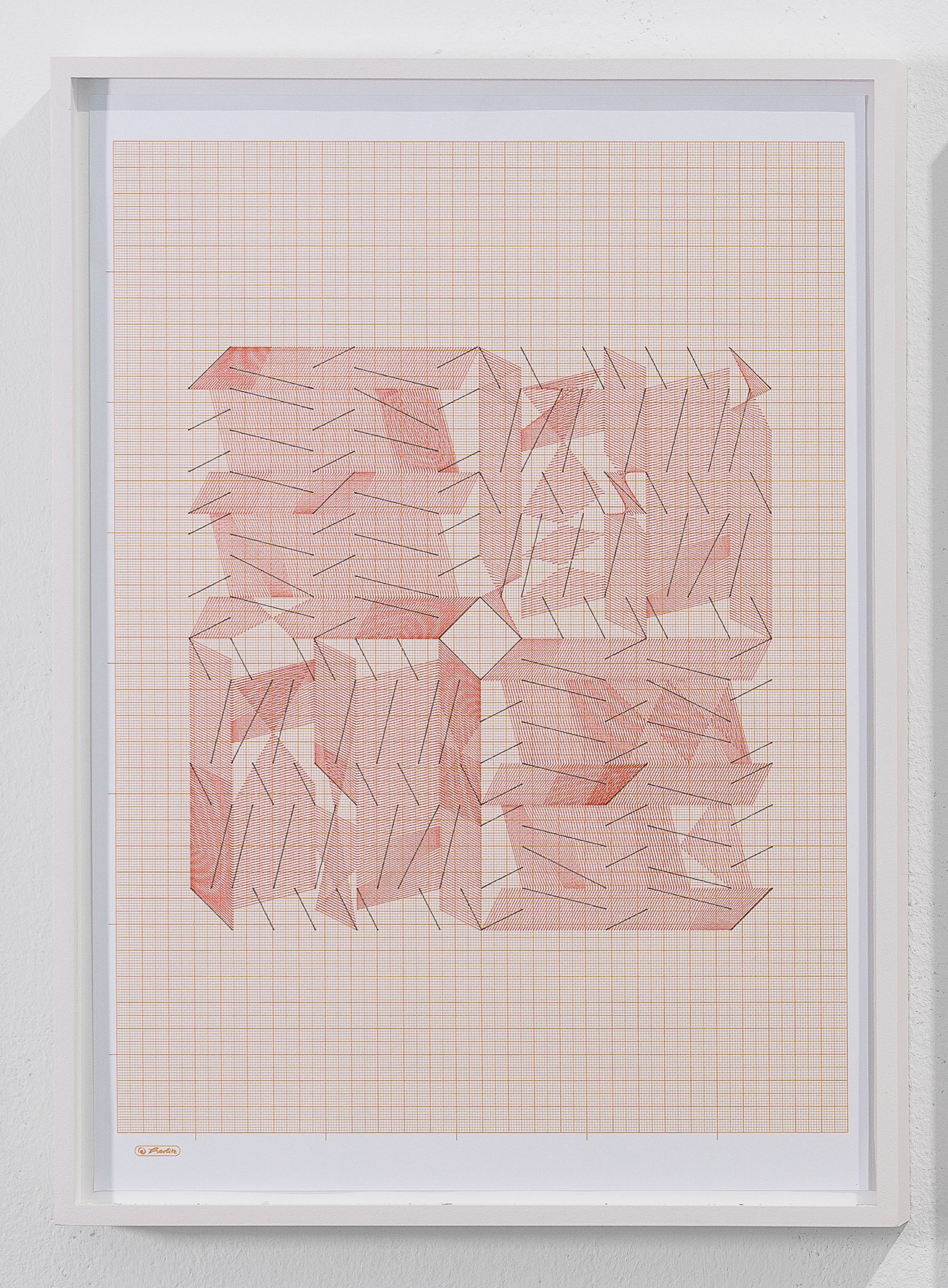
The Interpolation series (I–IV, 2024) is drawn on millimeter paper — graph paper, a pre-printed grid. The plotter draws on a surface that is already organized as a coordinate system. The algorithmic drawing is superimposed on the measuring grid that any scientific or technical drawing traditionally uses.
"Interpolation" in mathematics and computing means finding intermediate values between known data points — constructing the unknown from the known endpoints. In signal processing, image interpolation fills in missing pixels; in animation, it generates frames between keyframes. The term names the practice of making the in-between legible.
As a plotter work on millimeter paper, Interpolation draws the in-between on the coordinate system designed to measure it. The algorithmic path (the interpolated trajectory) is laid over the grid that defines how positions are measured. The drawing and its coordinate system occupy the same surface simultaneously — the artwork is not separate from the measurement of space but drawn inside it.
7. Kapitulation — surrender as method
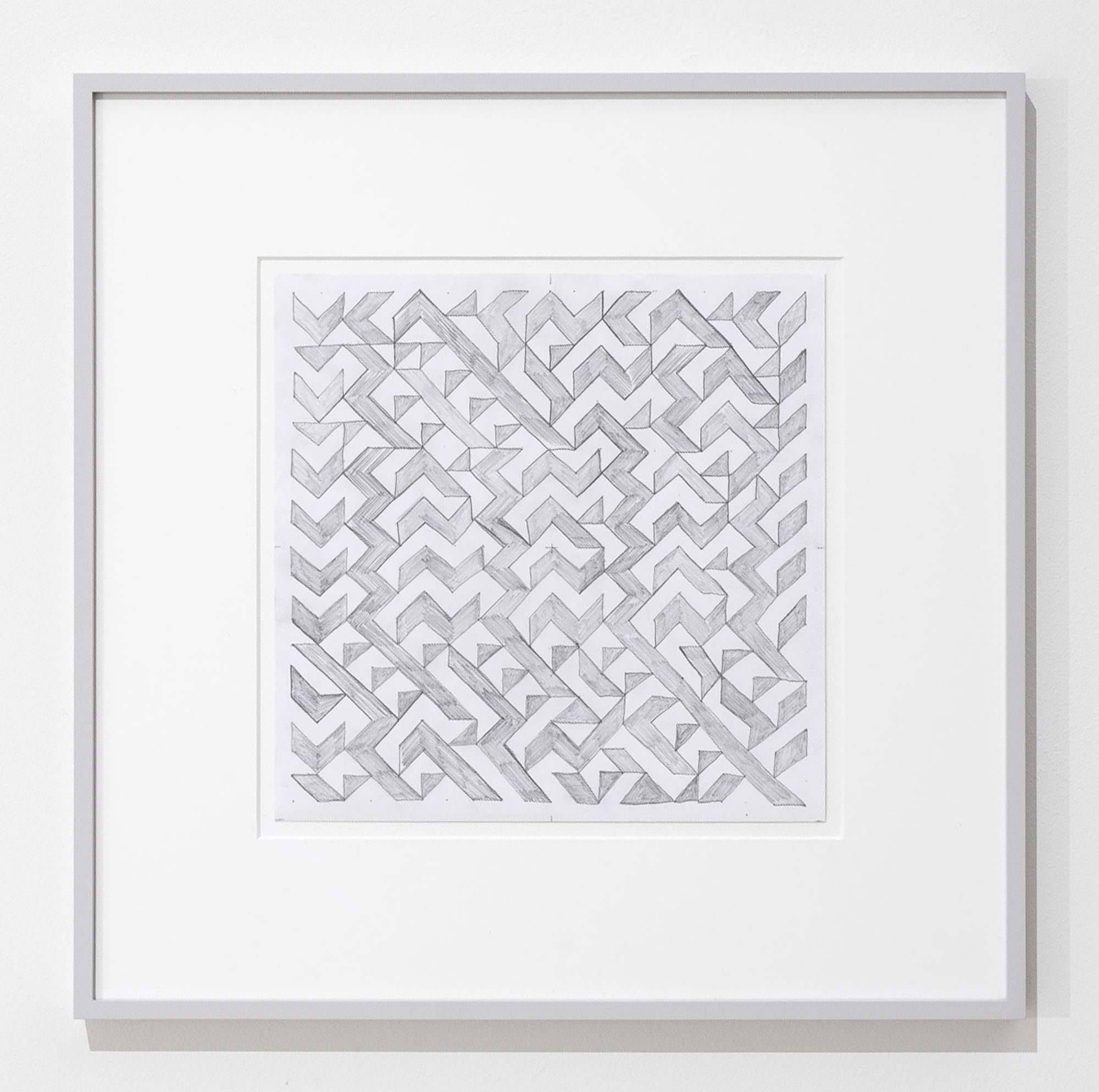
Kapitulation (German: capitulation, surrender) is the only pure hand-drawing in the exhibition — pencil on paper, 30×30cm, no plotter. In an exhibition of plotter works alongside Vera Molnár, van den Dorpel includes a single work made entirely by hand.
The title names what the act performs: surrender to the hand, to the direct gesture without algorithmic mediation. "Kapitulation" has a military resonance — the laying down of arms, the acceptance of defeat. But surrender here is not failure; it is a deliberate relinquishing of control, a step back from the algorithm to encounter what the hand alone produces. This connects to the Our Inner Child move from cerebral/theoretical to visceral: the hand drawing is the "deepest impulse" stripped of all mediation.
That this appears in an exhibition otherwise defined by algorithms and plotters, alongside the founding figure of computer art, makes it structurally ironic and philosophically pointed: in the presence of Molnár's computational rigor, van den Dorpel offers one pure surrender to the gesture.
8. Instability as the open system
"A recurring theme in van den Dorpel's practice is the instability of the digital medium, where any specific idea or form of expression is difficult to grasp. This instability avoids a fixed, definitive statement and emphasises an open system."
The exhibition text names instability not as a problem but as the defining property of the medium. An open system — one whose state cannot be fixed, whose outputs are always provisional — is the alternative to the "algorithm for being a good person" (→ Our Inner Child): not a rule that produces a correct output, but a condition that remains in motion.
This connects to the semiotic square's refusal to hold a fixed position, to assemblage identity's "permanent instability" as constitutive of the work's identity, and to Quantizer's "permanence of change." Instability is not the digital medium's weakness — it is the feature that makes the work philosophically interesting.
9. The plotter drawings in the show
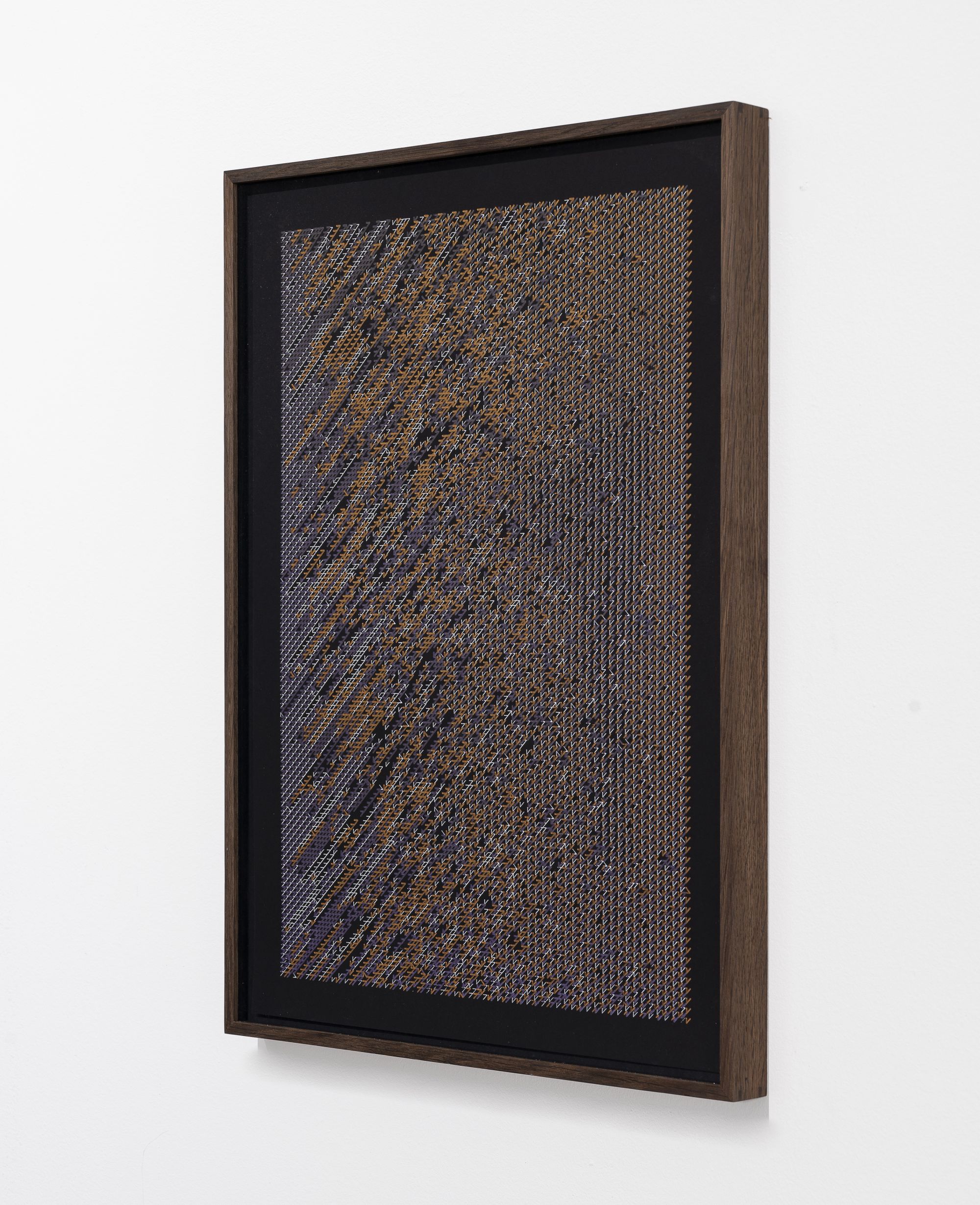
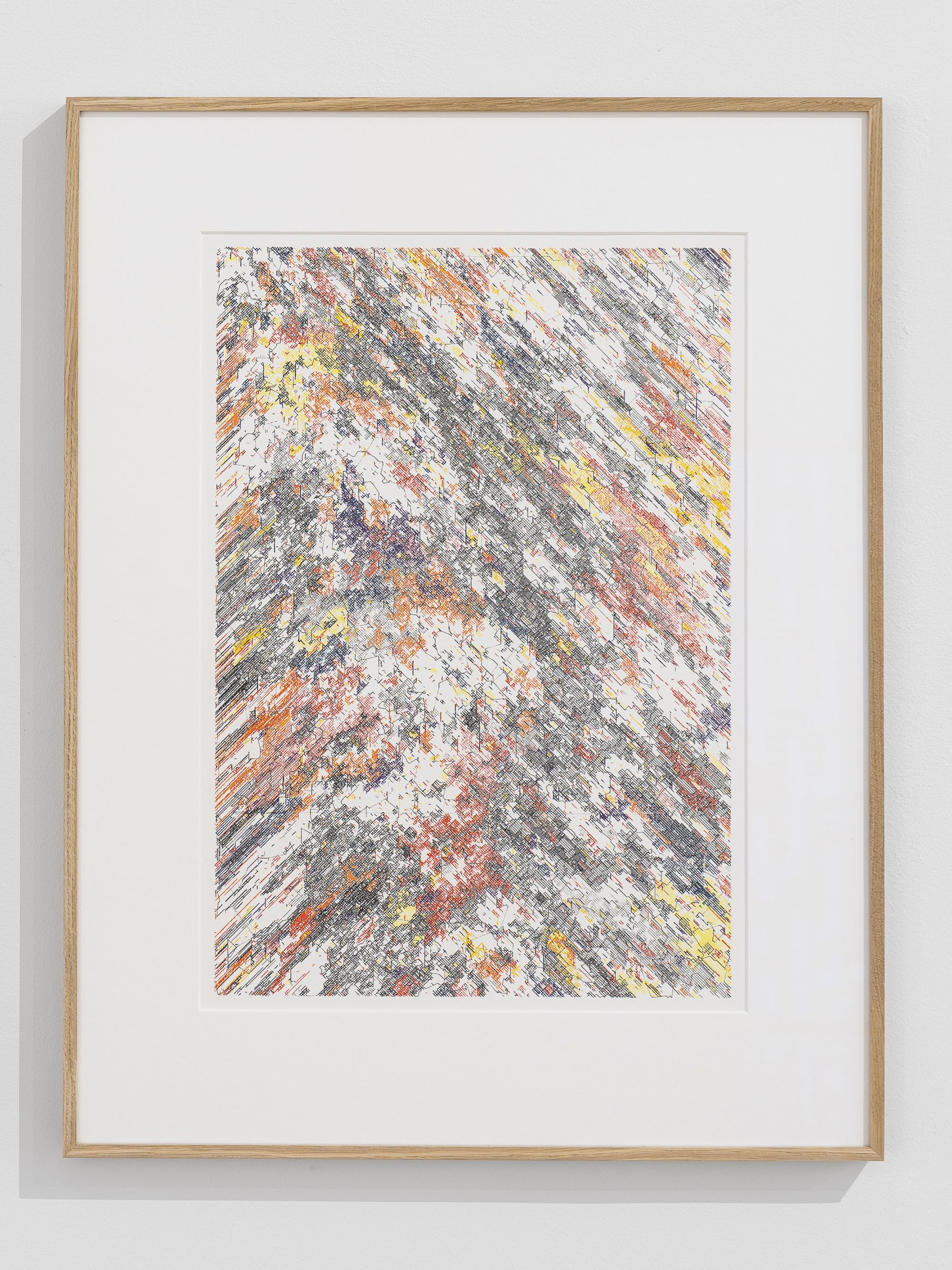
Ascent runs the line field upward, the ruleset biasing the marks into a rising drift across the sheet.
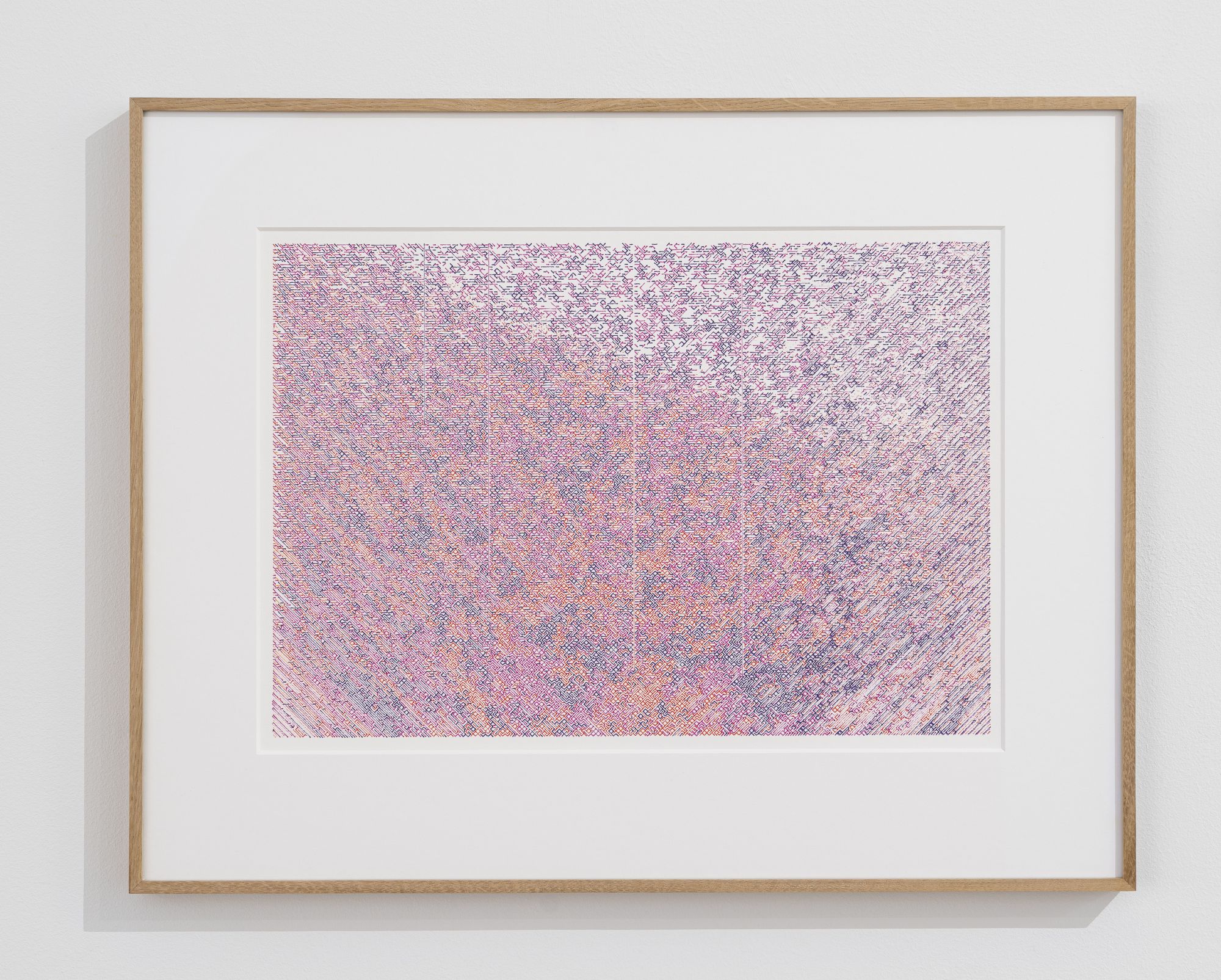
Poles makes the probabilities transition gradually according to the coordinates within the canvas (x/y) — the gradient is spatial, so the field reads as two attracting poles.
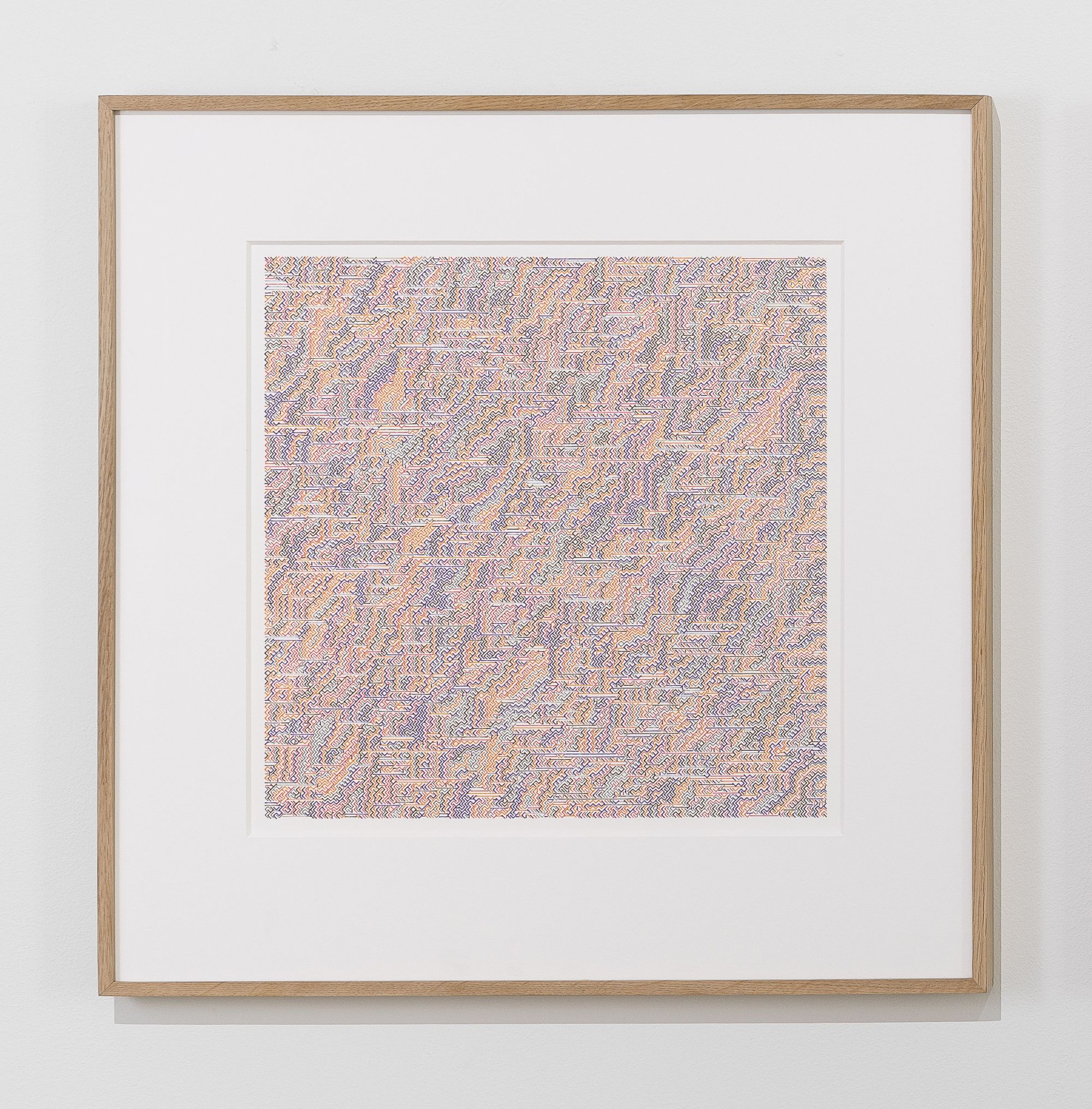
Breeze organises directional marks into a light, drifting current — the same orientation-rule logic held at a gentle, dispersed setting.
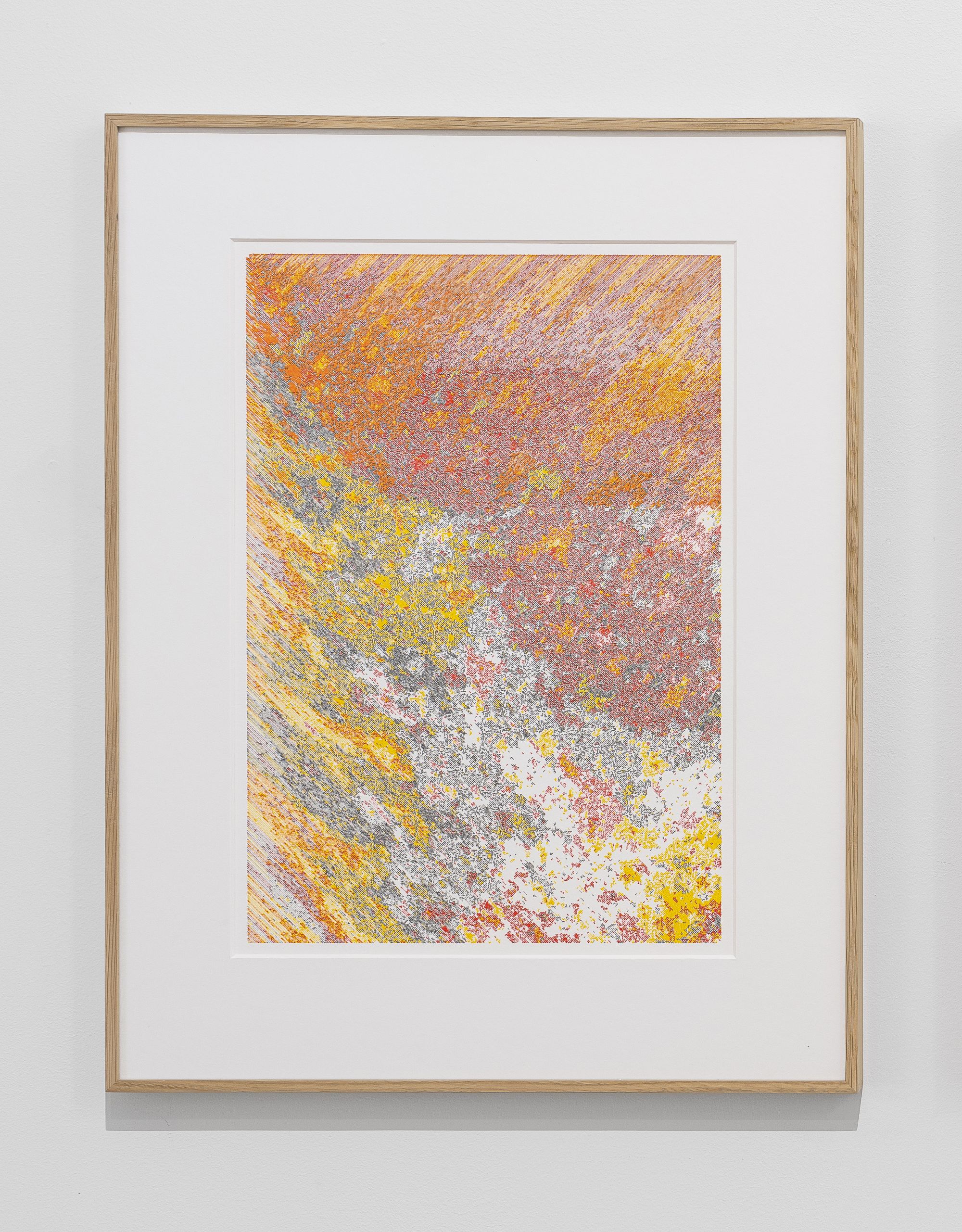
Hail pushes the same field toward density and impact — the marks accumulate into a scattered, falling texture.
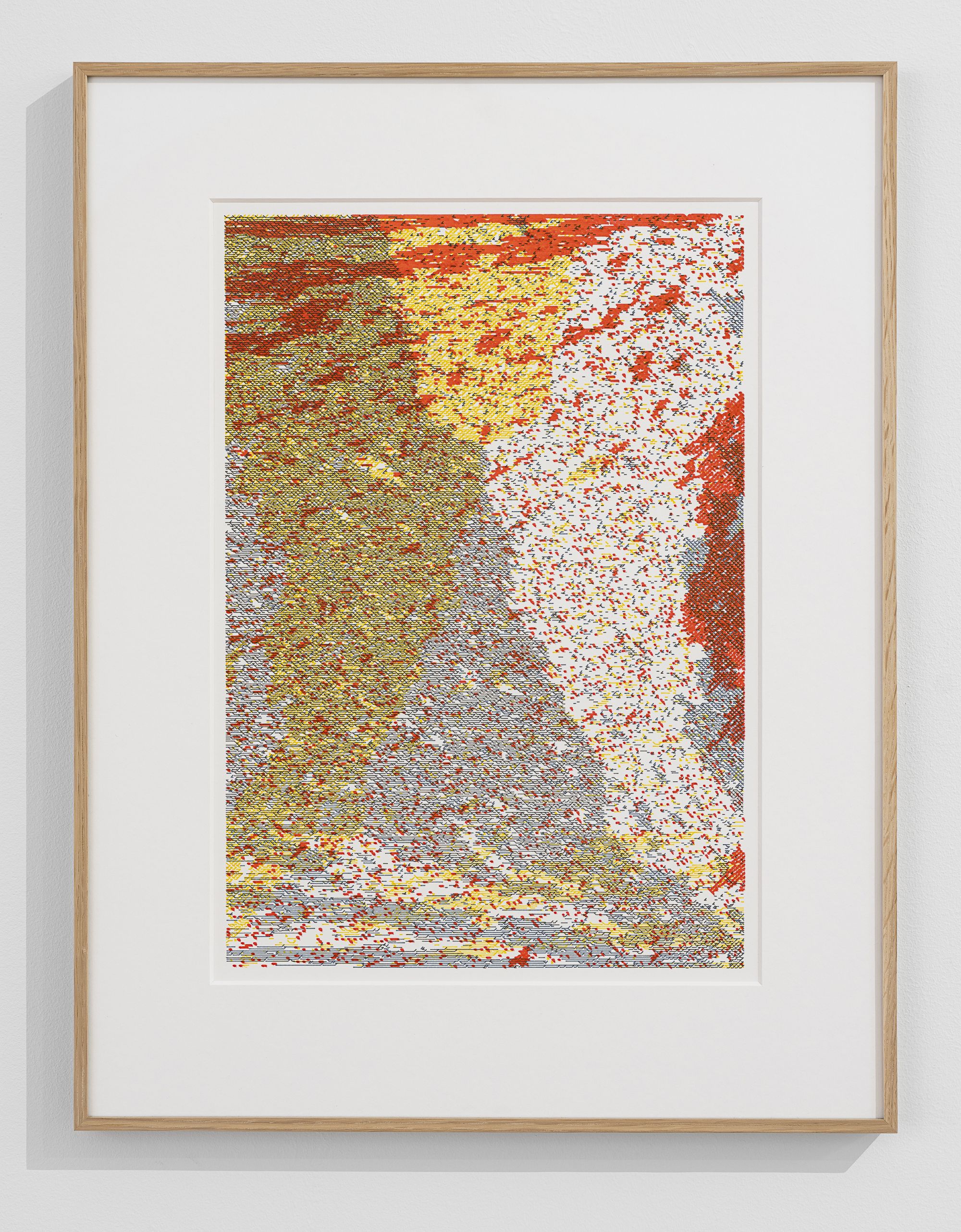
Divide splits the field into contending regions, the ruleset drawing a boundary where two probability zones meet.
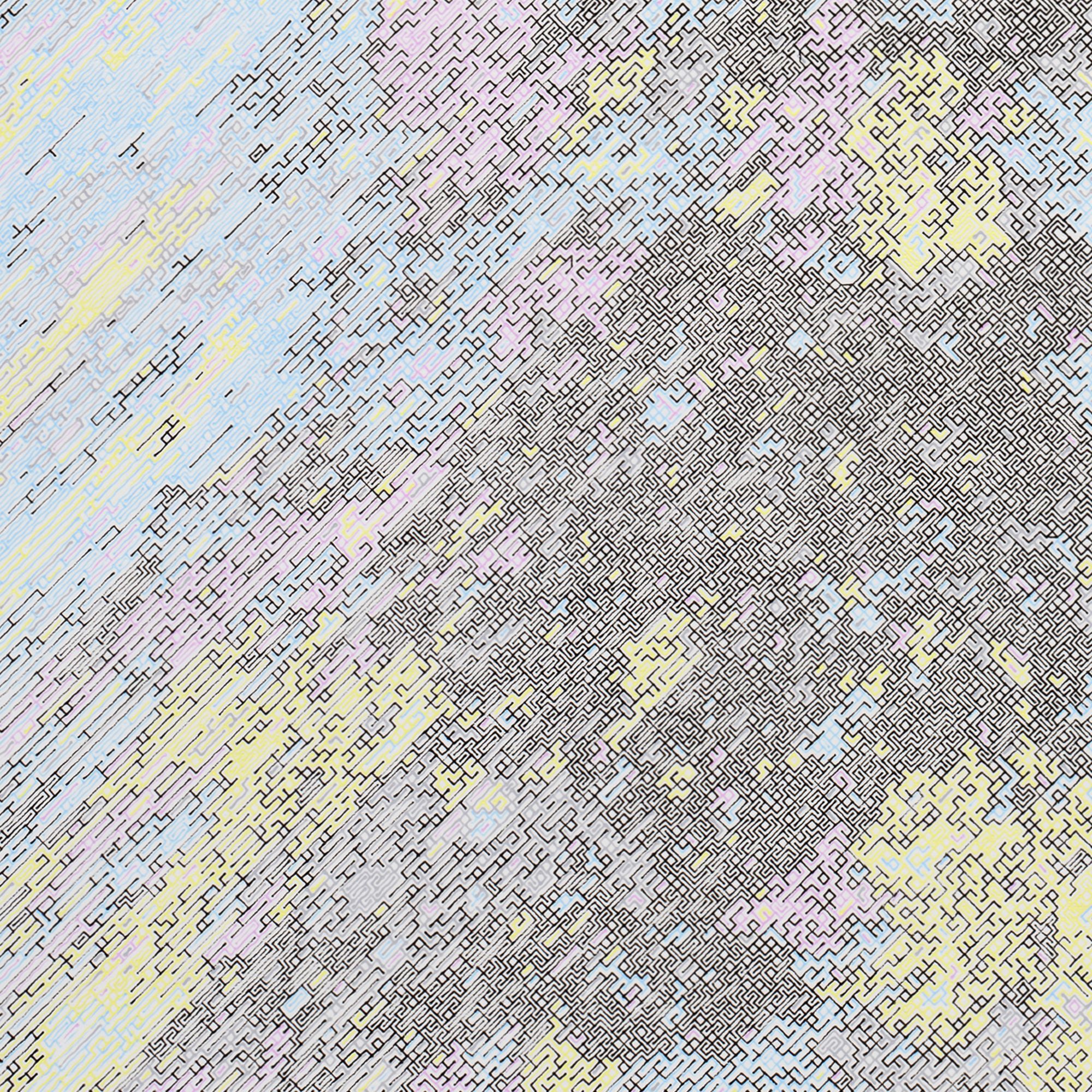
Girl/Boy Song takes its title from the Aphex Twin track — the largest of these sheets, the line field run across a full portrait format.
Works in this exhibition
| Work | Year | Medium | Dimensions | harm.work |
|---|---|---|---|---|
| Ascent | 2024 | Plotter drawing on Fabriano paper | 50.5×36.5cm | → |
| Embroidery | 2024 | Plotter drawing on Hahnemühle watercolour paper | 61×47cm | → |
| Atlas | 2024 | Plotter drawing on Hahnemühle paper | 84.1×59.4cm | → |
| Current | 2024 | Plotter drawing on Hahnemühle paper | 59.4×84.1cm | → |
| Weaving | 2024 | Plotter drawing on Hahnemühle paper | 47×61cm | → |
| Cuneiform | 2024 | Plotter drawing on Hahnemühle paper | 61×46.5cm | → |
| Scene | 2024 | Plotter drawing on carton board | 49.5×37.2cm | → |
| Valley | 2024 | Sakura fineliner on Terschelling paper | 60×47cm | → |
| Shroud | 2024 | Plotter drawing on Terschelling paper | 47×61cm | → |
| Poles | 2024 | Plotter drawing on Terschelling paper | 60×47cm | → |
| Mold | 2024 | Plotter drawing on Terschelling paper (rotated overdrawn) | 47×61cm | → |
| Helmgras | 2024 | Plotter drawing on Terschelling paper | 60×47cm | → |
| Weaving (square) | 2024 | Plotter drawing on Terschelling paper | 47×47cm | → |
| Breeze | 2024 | Plotter drawing on Terschelling paper | 47×47cm | → |
| Symmetrical Overdub | 2024 | Plotter drawing on Terschelling paper | 47×47cm | → |
| Hail | 2024 | Plotter drawing on Terschelling paper | 47×61cm | → |
| Printemps | 2024 | Plotter drawing on Terschelling paper | 47×61cm | → |
| Peaking | 2024 | Plotter drawing on Terschelling paper | 47×61cm | → |
| Pineal | 2024 | Plotter drawing on Terschelling paper | 47×61cm | → |
| Divide | 2024 | Plotter drawing on Hahnemühle paper | 47×61cm | → |
| Girl/Boy Song | 2024 | Plotter drawing on Hahnemühle paper | 59.4×84.1cm | → |
| Anni | 2024 | Generative software (4 works) | variable | → |
| Kapitulation | 2024 | Pencil drawing by hand on paper | 30×30cm | → |
| Interpolation I–IV | 2024 | Plotter drawing on millimeter paper | 44.5×32cm each | → |
| Pression des pairs | 2024 | Generative animation (after Molnár 1959) | variable | → |
Connections to existing wiki pages
- Evolutionary Logic — algorithmic archaeology as forensics: the failed random-triangle attempt → inferring Albers' invisible rules; Tauba Auerbach as fourth named precursor; the female lineage argument (weaving → grid → generative art)
- Impulse, Risk, and Method — Albers' reverse-engineering as the biographical enactment of "disassemble the system to understand it"; the aesthetic failure of random placement as the discovery method
- Randomness and Pattern — Molnár's valued imperfections as workmanship of uncertainty imposed by material constraint; Embroidery's deliberate error as the accident that reveals the path
- Process Legibility — Embroidery's kept-down pen: transition paths made visible; the back of embroidery on the front; the implementation leaking through as the image
- Senescenence — Cuneiform as the oldest grid-writing ancestor; the full temporal scope of the loom genealogy
- Assemblage Identity — "instability of the digital medium... emphasises an open system"; instability as constitutive
- Cloud Writings (2026) — Angles Morts is Cloud Writings' premiere exhibition; all Cloud Writings series works first shown here; the gender argument and precursors elaborated further in Cloud Writings
- Our Inner Child (2023) — Kapitulation as surrender to the hand; echoes the visceral turn; the open system against the moral algorithm