
Death Imitates Language
Death Imitates Language (2016–) is the series in which van den Dorpel formalised the core mechanism that would carry through to Mutant Garden and beyond: taste as fitness function. The artist's subjective selection — a micro-"like" — becomes the pressure that drives a genetic population toward meaning.
The title inverts Oscar Wilde's "Life imitates Art": death — elimination, refusal, the non-click — is what generates language. Form emerges not from addition but from subtraction.
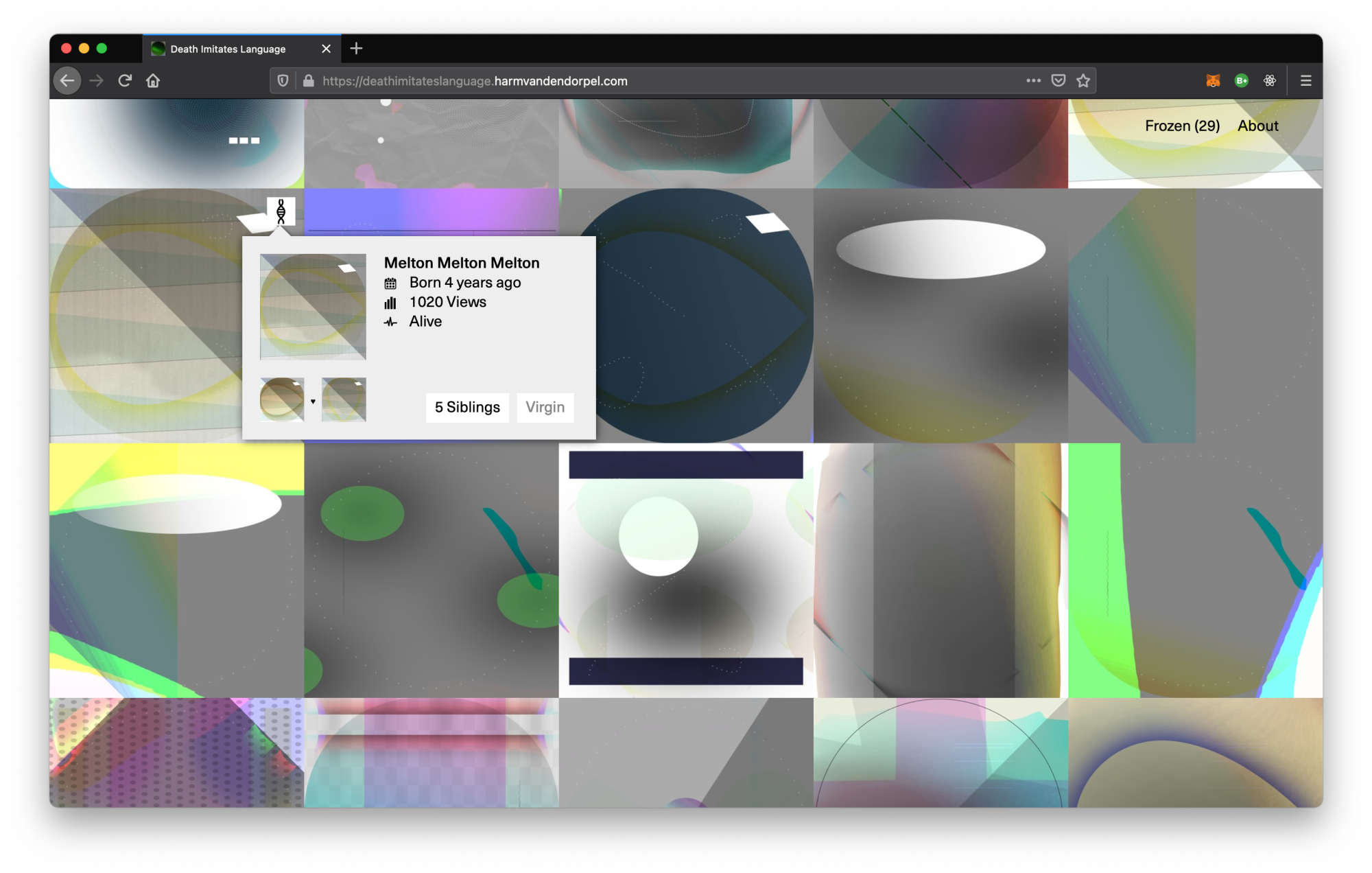
The online genealogy. The living website population: an enormous field of speculative works evolving through inherited genetic sequences and the artist's micro-feedback.
Origin: biopolitics of the algorithm
The series grew from a crisis of identity and a chance encounter. In the years leading up to 2016, van den Dorpel describes trying "more and more to be an 'artist artist', someone who fitted into the gallery space and the art markets in conventional terms." Despite some success, "it felt a bit hollow and disconnected from the Net Art which I saw myself as coming out of."
Contemplating a return to programming, he encountered a video by Vinay Gupta — "programmer, philosopher and general provocateur" — discussing how dating apps like Tinder were "responsible for essentially engineering about 10% of the dates that took place in the countries where the app was used." The thought followed: if a child was conceived in one of those short, algorithmically-mediated encounters, "that child's biology would be, in part, algorithmically determined. The biopolitics of that were quite a lot to get my head around."
The series transposes this logic into aesthetics: if an algorithm mediates which pairings survive long enough to produce offspring, what form of meaning can emerge from that process?
Mechanism: genetic sequence, micro-feedback, aging
The work "explores the development of meaning in generative aesthetics using micro feedback and a genetic algorithm." Its infrastructure:
- Population — an online genealogy containing an enormous number of speculative works, each generated by inheriting "sequences of information — a sort of DNA — from its ancestors." These genetic codes determine visual elements and their configurations.
- Selection — the artist's micro-feedback ("likes"), combined with visitor statistics, acts as a fitness signal. This is the artist's own subjectivity externalised as a formal parameter. (→ Protocol, Taste, and Systems)
- Mutation — simulated aging and visitor drift introduce variation over time, causing the population to "mutate and (arguably) improve."
- Freezing — "When creatures reach their optimal state they are 'frozen' and translated into physical objects." These wall objects are "layered in construction, partly transparent and square" — viewable from all sides.
For a technical comparison of the fitness mechanisms across van den Dorpel's evolutionary series (Death Imitates Language → Hybrid Vigor → Nested Exchange → Mutant Garden), see Evolutionary Logic.
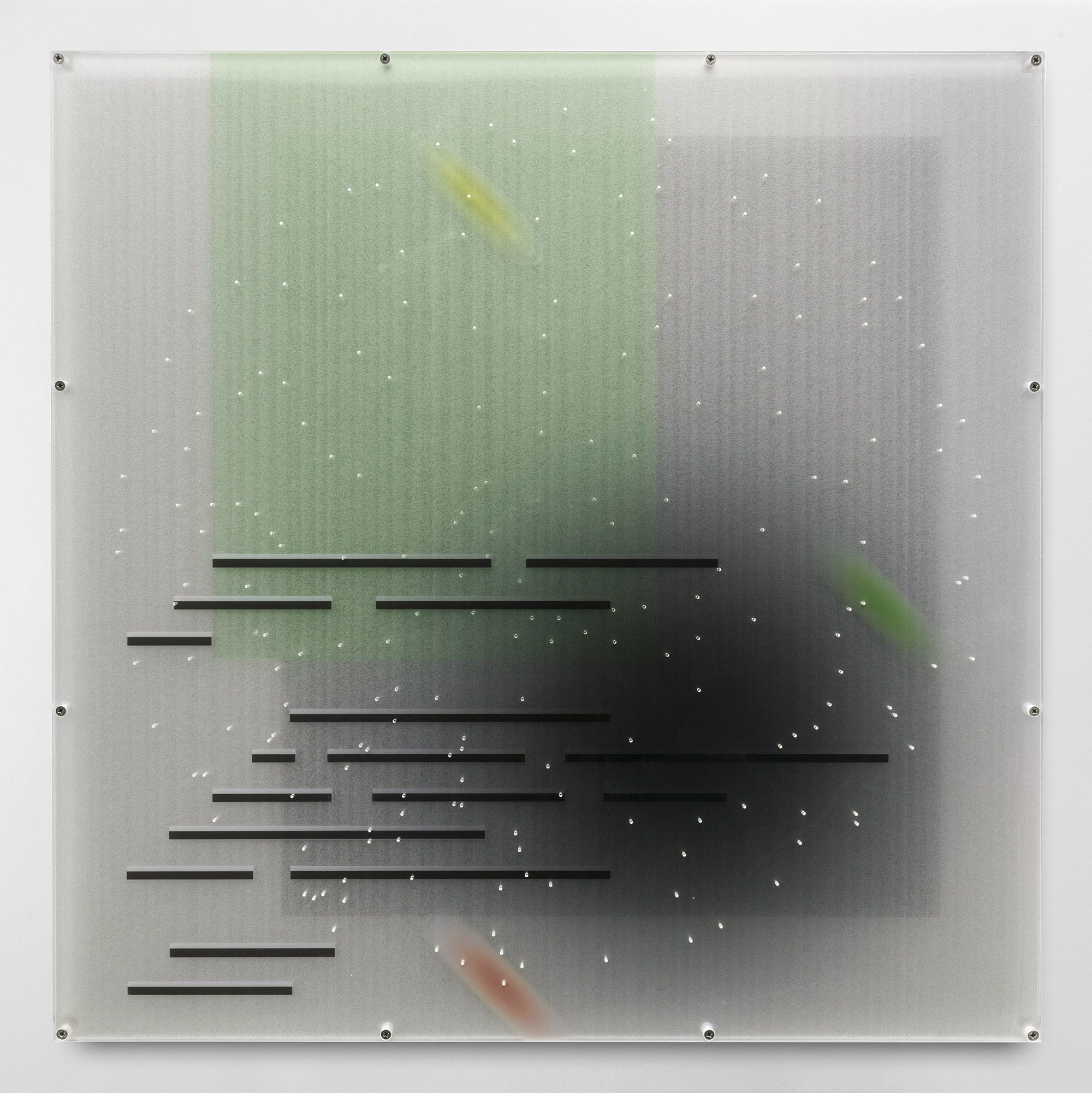
Vuwtvvyft Zcuviey Dayssuck. A specimen frozen at its optimal state and translated into a layered, partly transparent acrylic square — a moment of evolutionary time locked into matter, its three-word title encoding its own name and both parents'.
The names
The work titles — Vuwtvvyft Zcuviey Dayssuck, Shtonk Vtejuwoh Bonifac, Hatter Epot Xgeubke — are not arbitrary. Each title encodes a lineage: the three words are, in order, the work's own name, parent A's name, and parent B's name. Because every ancestor was itself named in the same format, the entire genealogical tree can be reconstructed by tracing the names backward — an archive embedded in every title.
The names themselves are drawn from a brute force password file — wordlists used in dictionary attacks against login systems. This gives them an ambiguous status: they are not invented, not natural language, and not random noise. They are a corpus of near-words, approximate-names, plausible-but-failed tokens — exactly the threshold between meaning and non-meaning that the series title names. They sit at the same position in the linguistic register that the creatures occupy in the evolutionary one: candidates that almost made it.
The structure encodes parentage; the source encodes failure. Together they mark every frozen specimen as a survivor — linguistically and genetically. They echo the naming logic of assemblage identity: identity constituted by the index, not by prior essence.
The series title reverses Wilde: death (non-selection, extinction pressure) imitates language (the emergence of distinguishable, meaningful form). Language — here — is what survives selection, not what precedes it.
Physical works
When a digital specimen is frozen, it becomes a wall object: layered acrylic or UV-printed paper, CNC-perforated, partly transparent, 100×100cm square. The physical objects preserve a moment in evolutionary time — a population optimum locked into matter.
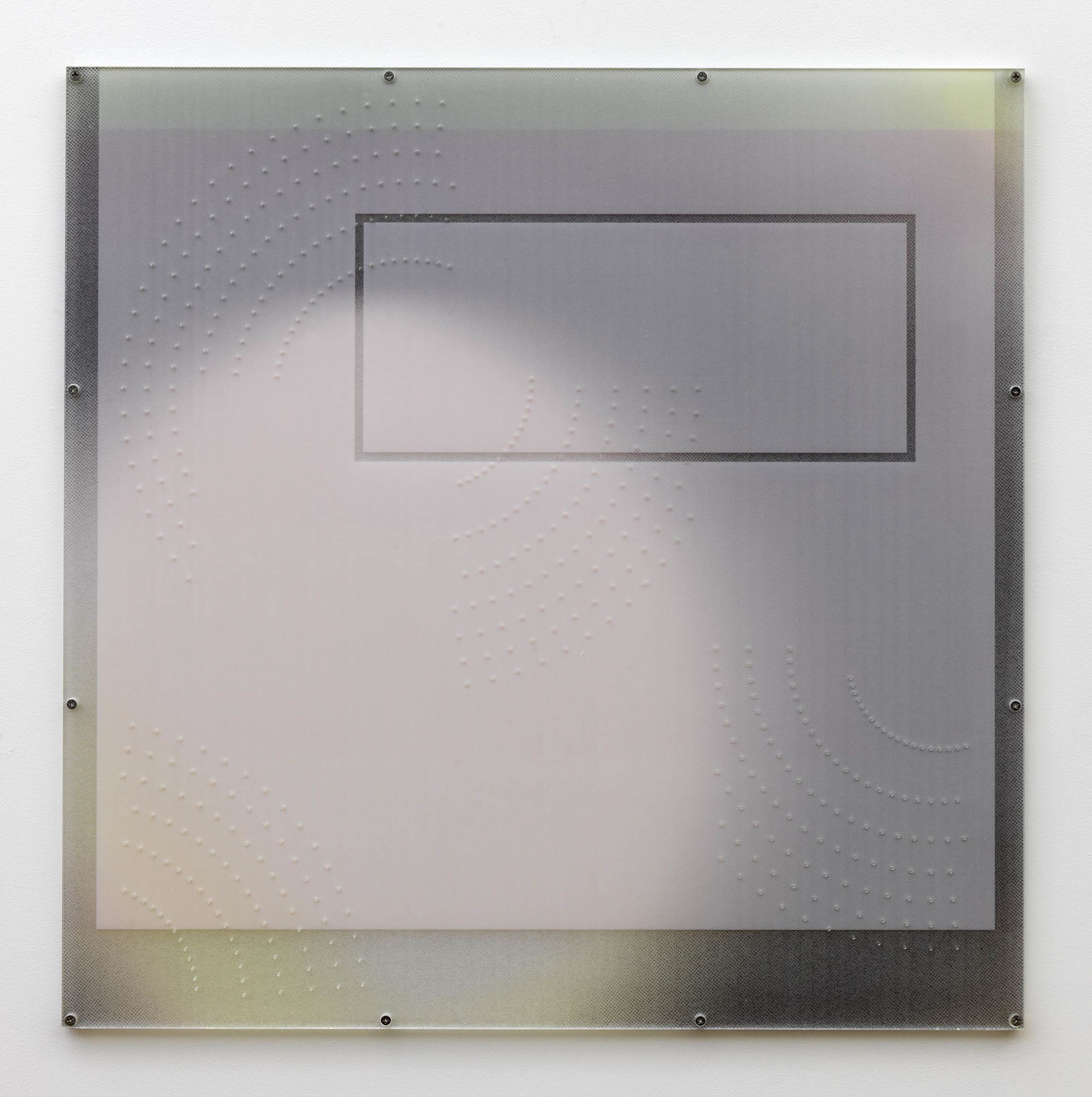
Hatter Epot Xgeubke. A frozen specimen made physical: UV print on CNC-cut, multi-layered, partly transparent acrylic — a population optimum locked into matter.
The series was recognised in Rhizome's Net Art Anthology, positioning it within the lineage of browser-based art and online living systems.
Autobreeder
Autobreeder (2016) is the non-interactive software companion: a macOS screensaver-like application that silently surfs the entire population's genealogy on loop, without input or intervention. It performs the archive as ambient viewing — the opposite of the micro-feedback mechanism that shaped the population. Where selection is active, Autobreeder is passive; it witnesses rather than judges. See also Mediation and the Archive for the logic of documentation as constitutive of the work.
Connections
- The shift from "artist artist" back to Net Art roots maps onto the "deepest impulse" framework in Impulse, Risk, and Method — the return to programming as the risk that unlocks authenticity.
- The fitness function through personal taste connects to Protocol, Taste, and Systems — taste externalised first as clicking, then as population-level protocol.
- The random generative names and the tension between randomness and emergent form extend the concerns of Randomness and Pattern.
- "Death" as selection pressure — the mechanism that creates meaning by eliminating non-meaning — is developed technically in Evolutionary Logic.
- The series is part of a lineage traced in The Generative Threshold: Dissociations (2010) → Death Imitates Language (2016) → Nested Exchange (2017) → Mutant Garden (2020) → Quantizer (2022).
- Limit Experience reads taste-as-selection-pressure through Bataille's la petite mort — the eros / death entanglement as the underlying structure of judgment-as-elimination, where the boundary between viewer and viewed dissolves in the same act that decides which specimens persist.