
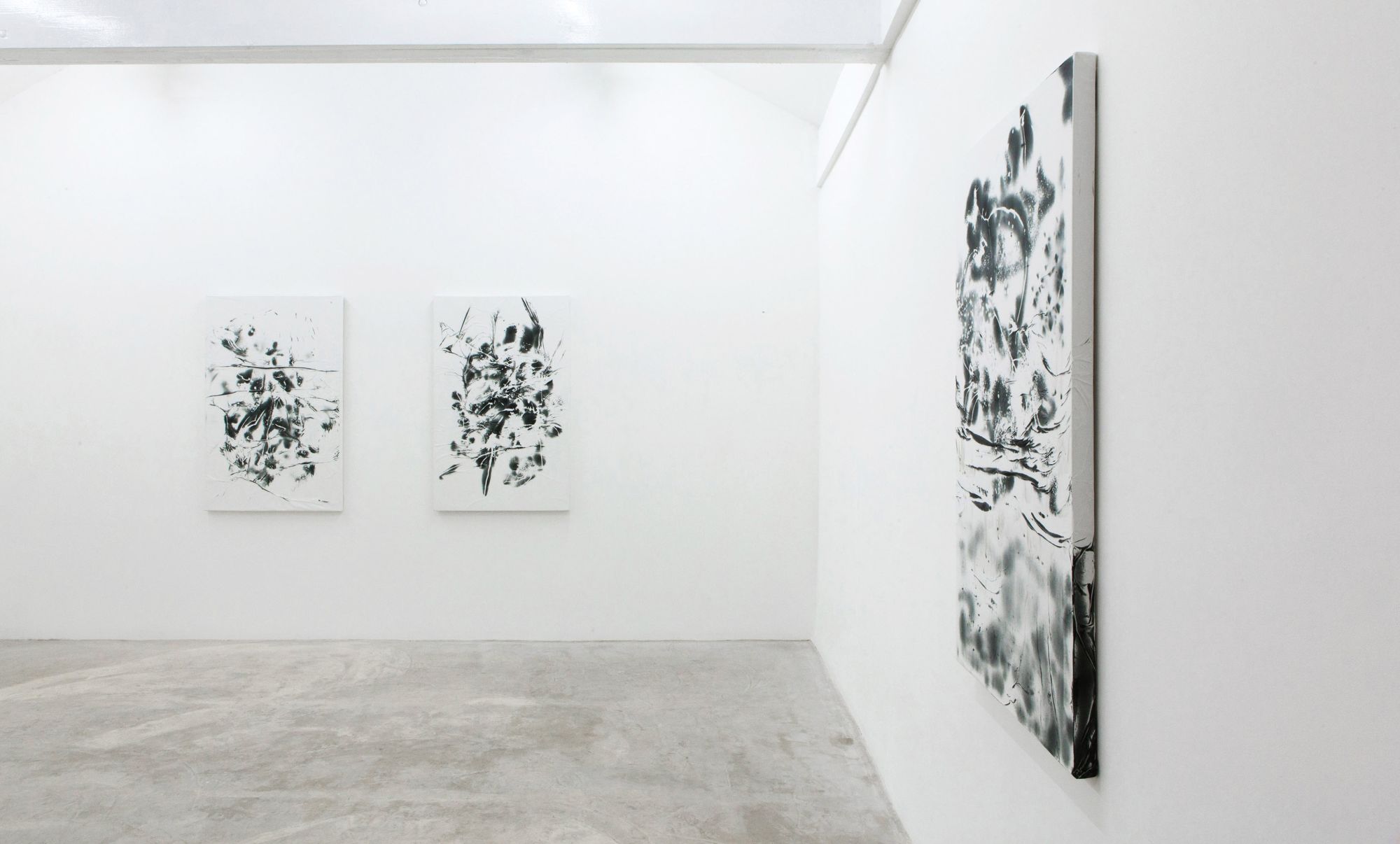
IOU — Narrative Projects, London (2015)
Solo exhibition, Narrative Projects, London, 2015.
Source: sources/ingested/IOU.md
Overview
Ten large-scale thermopaper works mounted on canvas (80×120cm each, edition of 100), accompanied by a short text that weaves together Quake, Trent Reznor, Creative Commons, Aaron Swartz, Google Reader, German receipt culture, and blockchain provenance into a single associative circuit. The works' "provenance resides in a ghostly transaction, timestamped in the supposedly perpetual blockchain, our only hope" — one of the earliest instances of blockchain-as-archival-claim in the practice.
IOU — installation. Ten large thermopaper works mounted on canvas at Narrative Projects, London — the thermosensitive surface marking through heat rather than pigment.
The title: "I Owe You" — debt and the incomplete transaction
IOU is the initialism for "I Owe You" — an informal promissory note, an acknowledgment of debt that remains open. Not a receipt, not a contract, but a note that says: something is owed between us, and it has not yet been settled.
The entire exhibition is built from thermosensitive paper — the substrate of receipts, the physical trace of completed transactions. The exhibition title names the opposite: not the completed exchange but the unclosed one. A receipt says this is paid; an IOU says this is owed. The works are made of the material of closure and named after the instrument of ongoing obligation.
Who owes whom? The title keeps this open:
- Artist to audience — I give you these works; I acknowledge my obligation to you, your attention, your interpretation. The artist as debtor to the viewer.
- Audience to artist — I offer you something (experience, thought, provocation); you owe me reception, engagement, perhaps payment. The collector who acquires an edition of 100 holds a literal IOU from the blockchain.
- Culture to its makers — the Aaron Swartz thread articulates a debt that society owes to its information creators and liberators: JSTOR costs $200/year, restricting access to tax-funded research. The debt is structural and unpaid.
- The blockchain to the artwork — "their provenance resides in a ghostly transaction, timestamped in the supposedly perpetual blockchain, our only hope." The blockchain promises to hold the provenance debt permanently — to remain a reliable IOU — but the "supposedly" already hedges. As the Tokenising Sustainability essay later confirms: the record persisted but the interface to retrieve it did not. The IOU was dishonoured.
The thermopaper receipt that "washes out" and the blockchain record that is "supposedly perpetual" are both attempts to settle the transaction — to turn an IOU into a receipt. Neither fully succeeds. The receipt fades; the ledger's interface disappears. The IOU remains open.
This gives the exhibition's pairing — ephemeral substrate + supposedly permanent blockchain — a sharper logic. The blockchain is not a solution to the thermopaper's impermanence; it is a different kind of IOU, one that claims more but still cannot fully pay what it owes. Both are instruments of a transaction that resists completion.
The open-culture commitments in the daisy chain (Creative Commons, RSS, Aaron Swartz) reframe as a politics of debt: information should circulate freely, but even in gift economies there are obligations. When Trent Reznor releases music under Creative Commons, the transaction is restructured — "I give you this without payment" — but the IOU does not disappear; it shifts form. Attention, attribution, continuation of the work are owed in return. The open-source ethic does not abolish the debt; it redistributes it.
The medium: heat as mark-making
Thermosensitive paper — the material of receipt printers, thermal fax machines, early point-of-sale technology — darkens wherever heat is applied. The artist did not print, did not paint, did not draw in any conventional sense:
"My traces are engraved with hot air and I barely touched their surface."
The marks are abundant — dense black organic clouds that fill the 80×120cm surface — but the contact was minimal. The hand that made these works was almost absent. What remains is pure thermal transfer: a record of heat, not of touch.
This inverts the usual logic of the sketch or gesture, where the density of mark corresponds to the density of contact. Here, contact produces diffusion — the hot air disperses, the mark spreads organically, forming shapes suggestive of living things (bacteria, leucocytes, ants) without depicting them.
The German receipt analogy in the text is precise:
"After handing my metal coins, I receive a thin strip of paper as receipt. The numbers are not printed with ink but heated, and when not treated carefully, they wash out, causing great despair to my tax advisor."
The receipt is ephemeral — it fades, it washes out. The IOU works are receipts scaled to canvas size, elevated from disposal-grade paper to gallery-scale material, without changing the substrate's fundamental fragility. The medium is the argument: documentation that undoes itself over time.
Minimal contact and the legible trace
"I barely touched their surface."
The formula echoes and reverses the process-legibility argument (→ process-legibility). In the plotter drawings, the process is legible because the mechanical arm's path is visible: every line is a decision made explicit. In the IOU works, the process is legible in a different sense: the diffuse thermal mark shows the behavior of heat in matter, not the behavior of a hand on a surface. The artist is further removed — air, not tool, not hand.
This is the minimal-contact limit of process-legibility. The work records a process (thermal diffusion) that was shaped but not directly executed. The result is indeterminate in a specific way: the artist set the conditions (where and how to apply heat) but the thermal spread produced the form.
The taxonomy of small objects
The ten titles were not chosen by van den Dorpel — they were generated by Wolfram Alpha's early image recognition software, which was asked to interpret the thermal marks on each sheet. The system returned these object-names as its best readings of the forms:
| Work | Domain |
|---|---|
| Bacteria | Biological — microorganism |
| Leucocyte | Biological — white blood cell |
| Ant | Biological — insect |
| Sonogram | Medical — diagnostic imaging |
| Fastener | Hardware — generic fastening device |
| Nail | Hardware — construction element |
| Pin | Hardware — small fixing element |
| Bottle Cork | Hardware/domestic — stopper |
| Instrumentation | Abstract — measurement apparatus |
| Agent | Abstract — operative entity |
The authorship of the titles belongs to an early machine vision system, not to the artist. This introduces a second layer of minimal contact: van den Dorpel barely touched the surface with heat; Wolfram Alpha barely touched the meaning with language. In both cases, the form and the name arrive through a process that is shaped but not directly executed.
The machine's readings are not arbitrary — they are responses to genuine formal properties of the thermal marks. Bacteria does not depict bacteria, but Wolfram Alpha found bacterial logic in the diffuse clustering; Sonogram carries the visual grammar of medical imaging; Nail and Pin are thin, elongated. The names are what early image recognition saw in thermal noise: pattern-finding applied to the workmanship of uncertainty.
This connects the IOU works to the computation themes that run throughout the practice, but in inverted form. Where the generative algorithm produces visual forms from code, here image recognition software reads code from visual forms — the direction of the process reversed. And where later works (→ process-legibility) argue that AI conceals its process behind seamless output, Wolfram Alpha's interpretations are conspicuously non-seamless: Agent, Instrumentation, Leucocyte — the readings are too specific, too clinical, too legible as machine guesses. The algorithm's taxonomy shows.
The titles also operate as anchors: each one constrains the unlimited field of thermal abstraction by pulling it toward a specific object-category. The title is a finding aid for the imagination — but the imagination being aided is, in the first instance, the machine's.
Hauntology and the ghostly transaction
Note 3004 (Strategies, 2010/2011) cites Jacques Derrida directly in the line: "The past haunts the present, but equally important so does the future." The concept is Derrida's hauntology — developed in Specters of Marx (1993): the specter represents a fundamental temporal disjunction, le temps est hors des gonds (time is out of joint). The ghost is neither past nor future, neither present nor absent. It holds two incompatible temporal states simultaneously.
The IOU exhibition materialises this structure exactly:
- The thermopaper receipt embodies the completed past: a transaction that happened, heat applied, mark fixed. Yet thermosensitive paper fades — the past record undoes itself, receding rather than persisting.
- The IOU embodies the unclosed future: something is owed and has not yet been settled. The obligation hangs in time between the transaction that created it and the payment that would discharge it.
Both are held in the same object. The thermopaper works are receipts (completed past) that are titled IOUs (ongoing future obligation). The object is haunted in both temporal directions — exactly as Derrida describes the specter: present neither as past-that-is-over nor as future-that-has-not-yet-arrived, but as the pressure of both on the present moment.
The blockchain provenance compounds this. The "ghostly transaction" described in the text is not accidental phrasing — it is structurally hauntological. The blockchain record is immaterial (no physical receipt), claims permanence beyond the thermopaper (future-oriented), but records a past event (the minting, the provenance timestamp). It is a specter: intangible but supposedly permanent, a past event that refuses to stop making claims on the future.
And then there is the Aaron Swartz thread — a literal ghost. Swartz died in January 2013, at 26, while the IOU works were being made. The debt the text names — what culture owes to its information liberators — is owed to someone who is dead. This is the most precise case of the hauntological IOU: the obligation is permanently open not because it has not been paid but because it cannot be paid. The creditor is gone; the debt persists as a structural claim that cannot be discharged. The IOU to Swartz haunts the present from the future that he never reached.
The temporal disjunction in Strategies' aphorism — "equally important so does the future" — is precisely what the IOU enacts: the future-obligation weighs on the present object as much as the past-transaction. The receipt and the IOU are the two faces of the same hauntological structure: the mark that records what was paid and the title that records what is still owed.
The blockchain provenance: "ghostly transaction"
"Their provenance resides in a ghostly transaction, timestamped in the supposedly perpetual blockchain, our only hope."
This is 2015. The claim — blockchain as the archive of last resort, the "only hope" for permanent provenance — is made at the earliest moment of van den Dorpel's blockchain engagement, contemporaneous with Event Listeners (2015, ascribe.io), well before the cycle documented in Tokenising Sustainability (2021). Whether IOU's blockchain provenance predated or used the same ascribe.io mechanism as Event Listeners is not established by the available sources.
The phrase "supposedly perpetual" is already qualified. Not "perpetual" but "supposedly" — the permanence is claimed, not guaranteed. And "our only hope" carries an irony that the text does not fully resolve: the thermopaper work will fade; the blockchain record is the only thing that might not. But what the blockchain records is not the work itself — it records a transaction, a provenance claim, a pointer to something that will change over time. The record is permanent; what it points to is not.
The word "ghostly" does additional work. The transaction is intangible — no physical receipt, no ink on paper, only an entry in a distributed ledger. The work is material (heat marks on thermopaper on canvas) but its legitimacy — its identity as an artwork in a specific edition — rests on something immaterial and invisible. The provenance is a ghost that haunts the physical object.
IOU's blockchain provenance is among the earliest instances of this claim in van den Dorpel's practice — contemporaneous with Event Listeners (2015, ascribe.io), which the Tokenising Sustainability essay identifies as the first blockchain minting. Retrospectively, that essay provides the correction: "although the token provenance information that ascribe stored on the immutable Bitcoin blockchain will always remain there, in practice, we have lost access to it, as their web interface to retrieve it was discontinued." The "only hope" of 2015 was partially realized and partially lost. The blockchain record persisted; the interface to retrieve it did not. See → mediation and the archive.
The daisy-chain text: associative montage as method
The IOU text does not argue linearly. It moves by lateral association:
- Quake (1996) — impressive 3D graphics; legitimized being a programmer
- Trent Reznor — Quake soundtrack → 2008 Ghosts ambient uploads on archive.org → Creative Commons
- Creative Commons — leads to Aaron Swartz
- Aaron Swartz — co-authored Creative Commons, Markdown, RSS; downloaded 4.8 million JSTOR academic papers (tax-funded research locked behind $200/year subscriptions); indicted on 13 felony counts carrying up to 35 years in prison; committed suicide at 26 in January 2013, shortly before the IOU works were made
- Google Reader shutdown — pure content, stripped of ads, incompatible with Google's model
- German cash culture — resistance to debit/credit cards; "contain the impulse"
- German thermal receipts — thin strip of thermopaper; heat-printed; washes out; "great despair to my tax advisor"
- IOU thermopaper works — "these new works, made of large sheets of thermosensitive paper... My traces are engraved with hot air and I barely touched their surface"
- Blockchain provenance — "ghostly transaction, timestamped in the supposedly perpetual blockchain, our only hope"
Each link is a genuine connection, not a forced metaphor: Creative Commons is adjacent to Aaron Swartz because he co-authored it; RSS is adjacent to Google Reader because Google Reader was the dominant RSS client; thermal receipts are adjacent to German cash culture because they are the physical trace of cash transactions; the thermopaper works are adjacent to receipts because they are made of the same material at a different scale.
The Aaron Swartz node is the emotional centre of the chain. Swartz downloaded 4.8 million academic papers from JSTOR — research largely funded by public money, locked behind institutional paywalls — and was prosecuted under the Computer Fraud and Abuse Act on thirteen felony charges carrying up to 35 years imprisonment. He died by suicide in January 2013, at 26, while the case was ongoing. The IOU works were made shortly after. The text does not editorialize: it states the facts and lets the disproportionality speak. "He would have gotten 35 years+." The debt the title names runs through Swartz directly: a society that charges $200/year for access to publicly funded research and faces those who try to liberate it with prison terms of 35 years has structured a very specific kind of IOU — one it chose not to honor.
The montage is the argument: van den Dorpel's artistic and material choices are embedded in a network of digital culture commitments — open licensing, data liberation, protocol independence from corporate gatekeepers — that share an underlying value (keeping information accessible, resisting enclosure) with the blockchain provenance claim at the text's end.
Marked by heat. Another view, with tealights — the thermopaper responding to warmth in the room, its surface a record of temperature rather than paint.
Connections to existing wiki pages
- Mediation and the Archive — the "ghostly transaction" as the earliest blockchain provenance claim; thermopaper as the ephemeral substrate whose record is supposedly permanent; retrospectively, the ascribe.io lesson applies: the blockchain record persisted but the interface to retrieve it did not; both substrate and ledger are failed IOUs
- Tokenising Sustainability (2021) — the 2021 essay is the retrospective account of the 2015 beginning; IOU and Event Listeners are the origin stories; the cycle of enthusiasm, disappointment, and re-engagement begins here; the blockchain's IOU was only partially honoured
- Process Legibility — "barely touched their surface": minimal-contact mark-making as the limit case of process legibility; the work records thermal diffusion, not the hand
- Impulse, Risk, and Method — the associative montage method: finding the work by following a chain of adjacent commitments (Quake → Creative Commons → Aaron Swartz → RSS → thermal receipts → thermopaper works)
- Assemblage Identity — work identity constituted by the assemblage of references the text articulates; each work is not just a thermal mark but a node in the network of digital culture; the IOU title names the relational, obligatory character of that network
- Randomness and Pattern — thermal diffusion as the workmanship of uncertainty: the artist sets conditions (where to apply heat) and the medium produces the form through physical process, not direct control
- Protocol, Taste, and Systems — open licensing (Creative Commons, RSS) as a restructuring of the debt relation between creator and public; not the abolition of obligation but its redistribution
- Strategies (2010/2011) — Derrida's hauntology sourced here; "the past haunts the present, but equally important so does the future" is the temporal structure the IOU materialises