
Strategies (2010/2011)
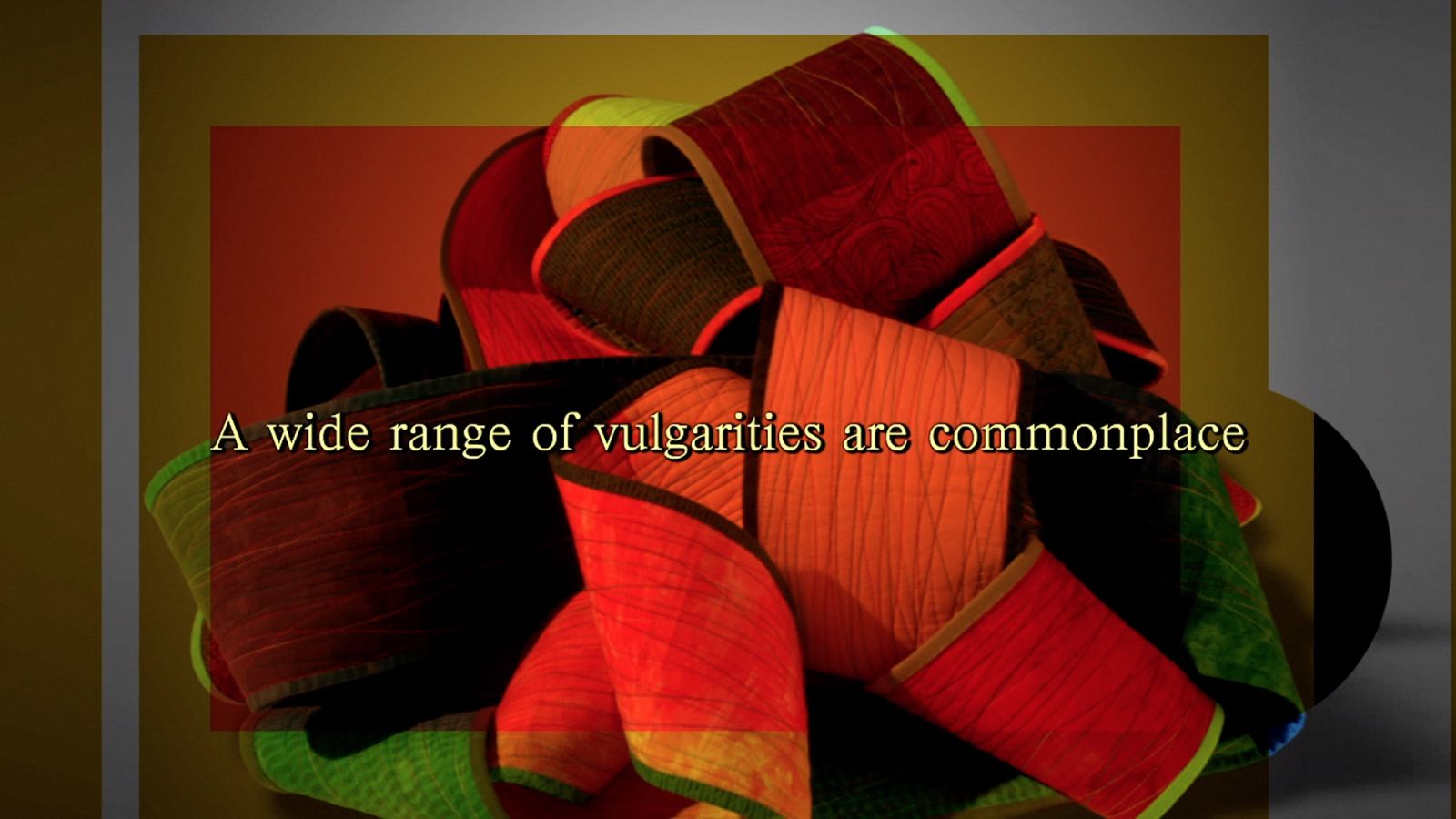
Source: sources/ingested/strategies-2011-transcript.md
harm.work: harm.work/work/strategies
The work
Strategies (2010/2011) is a video/animation created for Maps & Legends (MACRO, Rome, 2010), curated by Valentina Tanni. The harm.work description: "a sequel to Showreel, documents the process of making collages. Screenshots, images and other found footage were collected over the course of two months and combined with rewritten phrases of advice given by business experts, martial arts gurus, software developers and Jacques Derrida." The audio track was composed by van den Dorpel in 2002, unused until this work.
The full text is transcribed in note 3004. What follows is a domain-by-domain analysis of the aphorisms and their placement in the wider practice.
The collage structure: advice as genre
The work's central move is generic: it takes the form of the strategic aphorism — the authoritative condensed instruction, the rule that can be carried in the pocket — and sources it from incommensurable domains simultaneously. Business expertise, martial arts wisdom, software engineering principles, and Derridean post-structuralism are all rendered in the same imperative voice and placed in the same undifferentiated list. No source is marked; no hierarchy distinguishes the more authoritative from the less.
This is assemblage identity applied to discourse: identities defined by their associations rather than essential properties. The business aphorism and the Derrida quotation have the same status within the list; neither is the original. Each has been rewritten — the formulation is van den Dorpel's, even when the concept is not. Collage here operates at the level of intellectual authority, not just image.
The effect: "Distrust all claims for one true way" — which applies to Derrida's own discourse as much as to business advice. The list performs its own first principle.
Non-dialectical simultaneity and reverse causality
Two consecutive lines carry the work's most structurally significant claims:
"All takes place at the same time, non-dialectically"
"Seeing everything at the same time, you get the ability to reverse causality"
The first refuses the dialectical model — thesis, antithesis, synthesis, each stage sublating the previous one. Nothing is superseded; everything coexists. This is the temporal structure of dissociations.com itself: notes from 2007 and 2024 occupy the same interface, linked by the algorithm's associative logic rather than organized by chronological precedence.
The second follows as a consequence: if you see everything simultaneously, you are no longer bound by the direction of causality — you can read from effect back to cause. This is a precise description of reverse engineering (→ impulse, risk, and method): starting from the desired output and deducing the system that would produce it. The non-dialectical position, by refusing to privilege any moment as cause, makes all moments equally available as starting points for working backward.
This also connects to the Agile principle embedded a few lines later — "Welcome changing demands, even late in execution" — which refuses the waterfall model's sequential causality (requirements → design → implementation → testing, each stage gating the next) in favor of a non-linear, iterative loop where any stage can revise any other.
The future haunts the present
"The past haunts the present, but equally important so does the future"
The phrasing is Derrida's, drawn from his concept of hauntology — developed in Specters of Marx (1993). Derrida's argument: the ghost, the specter, is neither present nor absent, neither past nor future. It represents a fundamental temporal disjunction — le temps est hors des gonds, time is out of joint. The past (the specter of Marx, of unrealized communism) haunts the present not as nostalgia but as a demand that has not yet been met. But hauntology is bidirectional: the future also exerts pressure backward. What is anticipated shapes what is done now.
In the practice, this line reframes the temporal structure of making. The work is not made only in response to what came before (tradition, prior series, the archive) but equally in response to what it anticipates of itself — what it might become, what demands it might face, what contexts it does not yet know. The present act of making is haunted by its future reception, by the as-yet-unmade works that will follow, by the systems not yet designed.
Compare with 3003 (Loomer press release): "What the work is about, runs ahead of myself." The work runs ahead — the future is already exerting pressure — which is why the maker cannot catch up. The hauntological formulation names this as a structural condition of temporality itself, not just a biographical observation.
Authenticity as style
"After all, authenticity can be thought of as style too"
This is the anti-essentialist position applied to the most resistant of essentialist concepts. Authenticity is conventionally the exception to style: the authentic is what exceeds or precedes stylistic choice, what is irreducibly one's own. Van den Dorpel's move — attributed to Derrida — is to collapse this exception: authenticity is also a stylistic option, also a position one adopts, also available to imitation, rewriting, and collage.
This directly advances the assemblage identity argument: if authenticity is style, then no fixed core is prior to the aesthetic choices that express it. The "deepest impulse" (793) might itself be a stylistic formation — something cultivated, trained, historically shaped — rather than a pre-cultural given. This is not an attack on the impulse but a more honest account of its formation.
It also connects to the semiotic square: authenticity, as a stylistic option, can be located on the square. It occupies a cell — typically "Different" or "New" — rather than hovering above the grid as its ground.
Catastrophic forgetting
"Learning something new causes forgetting of older material on the basis of competition between the two"
This is a precise description of catastrophic forgetting (also called catastrophic interference), the phenomenon in connectionist neural networks first documented by McCloskey and Cohen (1989): when a neural network learns new information, the weights that encoded old information are overwritten, degrading or destroying the older memories. The new and old compete for the same representational resources.
Van den Dorpel studied artificial intelligence, and this line shows that knowledge operating in the work. It carries a specific consequence: a system that learns is a system that forgets. The more you train a network on new data, the more it loses what it previously knew. This is the technical ground for the Markov chain's philosophical interest: the Markov chain is memoryless by design — it refuses to remember, making each step depend only on the current state. It sidesteps catastrophic forgetting by never trying to remember in the first place.
The evolutionary corollary arrives a line later: "The more highly adapted an organism becomes, the less adaptable it is to any new change." Catastrophic forgetting in neural networks and over-specialization in organisms are the same structural problem at different scales: optimization for the present environment increases vulnerability to environmental change.
This pair of lines — catastrophic forgetting + over-specialization — is the theoretical ground for Stained Unravel's equilibrium/reconfiguration cycle. When the cellular automaton reaches equilibrium (maximum adaptation to its current ruleset), the rules undergo reconfiguration. The system does not persist in its most adapted state; it is deliberately destabilized, making itself less specialized and more adaptable to the next phase (→ Senescenence).
The evolutionary fitness equation
"Over time, beautiful things tend to thrive, and ugly things tend to get discarded"
This is the fitness function stated in aesthetic terms. What survives selection is what is beautiful; what is eliminated is what is ugly. This is van den Dorpel's own theory of what selection means in evolutionary art: the fitness criterion is not survival, reproductive rate, or computational complexity — it is aesthetic quality as judged by the artist. Death Imitates Language literalises this: the artist selects which organisms live and which die, and the selection criterion is aesthetic resonance. Beauty is fitness (→ evolutionary logic).
The line is also a long-term prediction: the beautiful things tend to thrive. Not guaranteed, not immediate, but directional. This is compatible with the fact that many beautiful things are temporarily discarded — the question is timescale. At the right scale, aesthetic selection pressure is real.
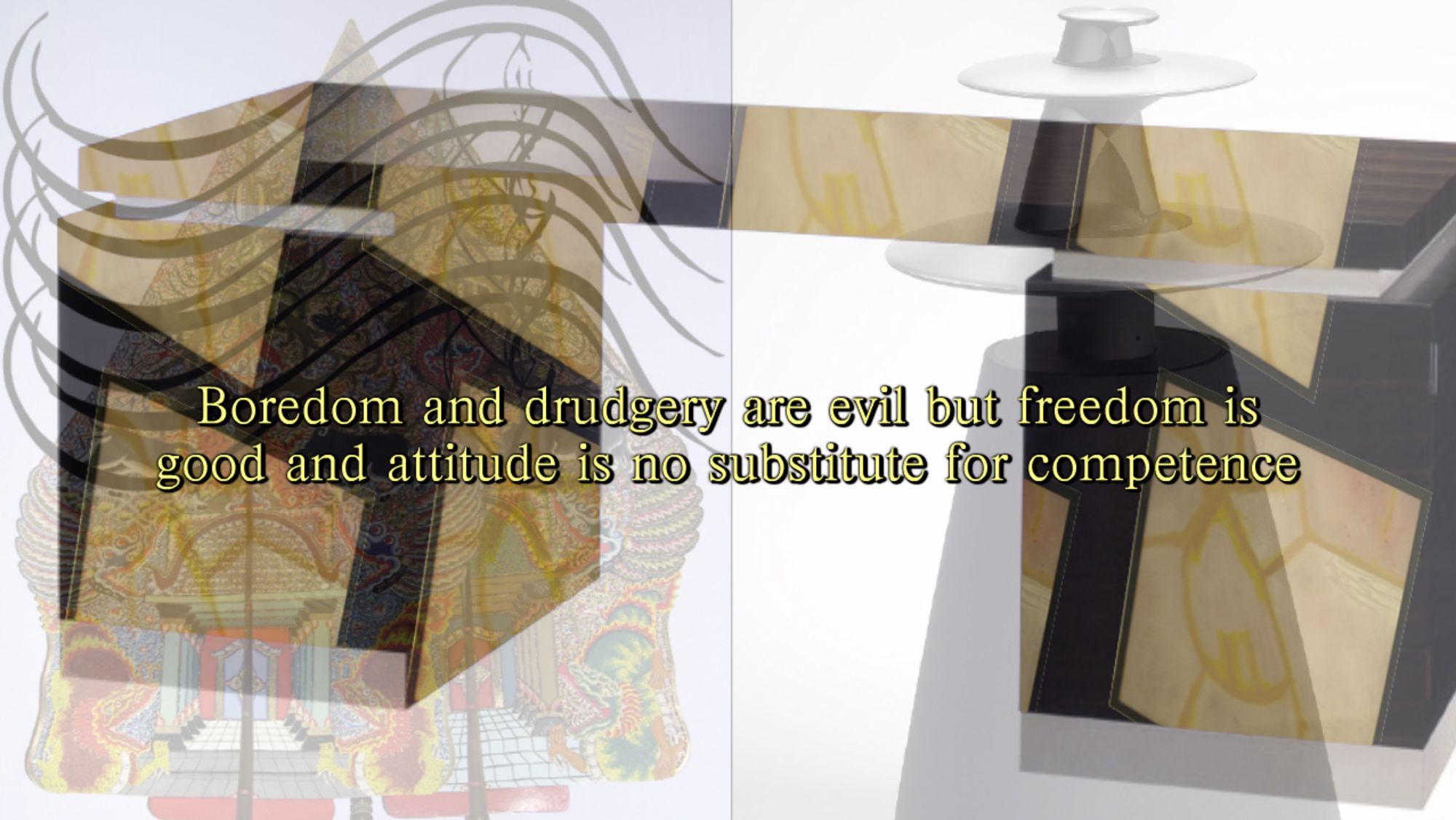
"Fail noisily and as soon as possible"
"When you must fail, fail noisely and as soon as possible"
A rewrite of Eric Raymond's open source principle and the Agile fail-fast doctrine. "Noisily" — not quietly, not hidden, but publicly, informatively. A noisy failure produces more feedback than a silent one. The failure is a signal; the louder the signal, the richer the information for the next iteration.
"As soon as possible" — don't delay failure. Let it happen early in the process so that the feedback loop is short and the cost of correction is low. This is the "release early" principle applied to failure: get to the point of failure quickly, so that the error is identified and corrected before it compounds.
Both together describe the attitude to risk that runs through the practice: failure is not the opposite of success but its productive precondition. The system that fails loudly and fast learns more than the system that avoids failure (→ impulse, risk, and method).
See also
- Impulse, Risk, and Method — reverse causality as reverse engineering; fail noisily as the risk ethic; future-haunting and discovery
- Semiotic Square — non-dialectical simultaneity; authenticity as style (a position on the square, not its ground)
- Subconscious Computation — catastrophic forgetting; the Markov chain as deliberate refusal of memory
- Evolutionary Logic — over-specialization/adaptability; beauty as fitness
- Openness — Release Early, Release Often — Agile "welcome changing demands"; "no need to solve the same problem twice"; "fail noisily"
- Senescenence — equilibrium/reconfiguration as the structural answer to over-specialization
- Assemblage Identity — authenticity as style; collage of advisory discourses
- Process Legibility — "what and how should not be kept too separate"; "attitude is no substitute for competence"
- IOU (Narrative Projects, London, 2015) — the hauntological structure ("the past haunts the present, but equally important so does the future") is materially enacted in the IOU exhibition: thermopaper receipt (completed past, fading) + IOU title (unclosed future obligation) + Aaron Swartz as literal ghost (debt that cannot be repaid)