
"Magicians Conceal, Artists Reveal"
Source: sources/ingested/art-vs-magic.md
Overview
A critical essay positioning van den Dorpel within the long history of concealment and revelation in art — from the classical doctrine ars celare artem through Impressionism, Cézanne, Cubism, Pollock, and Conceptualism, to protocol art and the contemporary condition of AI-generated imagery. The essay's central claim: the opposition between concealment and revelation is not aesthetic but ethical, and van den Dorpel inherits and radicalizes the tradition of revelation.
Key ideas
1. Ars celare artem — the classical doctrine
"For the magician — and for much of Western art history — the image is an effect, a surface whose mechanism must stay hidden to work."
The classical ideal ars celare artem ("art is to conceal art") held that supreme craft should erase its own traces: no toolmarks, no seams, no visible labor. Technique existed to disappear. The image worked by being seamless — an effect whose mechanism, if visible, would destroy the illusion.
This is not only a technical preference but an ontological claim: the image is an effect, not a record. Its power depends on the concealment of its making.
2. The modernist inversion — a historical arc
The essay traces the inversion of this doctrine through a sequence of moves:
- Impressionism: the brushstroke insisted on remaining. The surface became legible as surface — paint, not window.
- Cézanne: pentimento left visible — "the ghost of earlier decisions visible beneath later ones — making the image a record of its own becoming rather than the erasure of it." The image becomes archaeological: you can read its history in it.
- Cubism: the unified image was exposed as a "constructed lie" — showing its construction was the truer act.
- Pollock: the gesture is the content — speed, proximity, the moment of release all readable in the drip. Concealment had become "a kind of dishonesty."
- Conceptualism: LeWitt's instruction sets; Albers' insistence that "the loom's binary logic was not a constraint on the image but its very architecture."
By Conceptualism, the doctrine has been fully inverted: the logic of production is not the image's underbelly to be hidden — it is its architecture, its substance. This is precisely what the text around van den Dorpel calls protocol art.
The concept of pentimento is philosophically significant here. Pentimento (from Italian pentirsi, to repent) names the visible trace of earlier states — the underdrawing showing through the paint, the artist's changed mind readable in the work. To leave pentimento is to make the image a record of its own revision. The work does not erase its history; it carries it.
3. Van den Dorpel as inheritor and radicalization
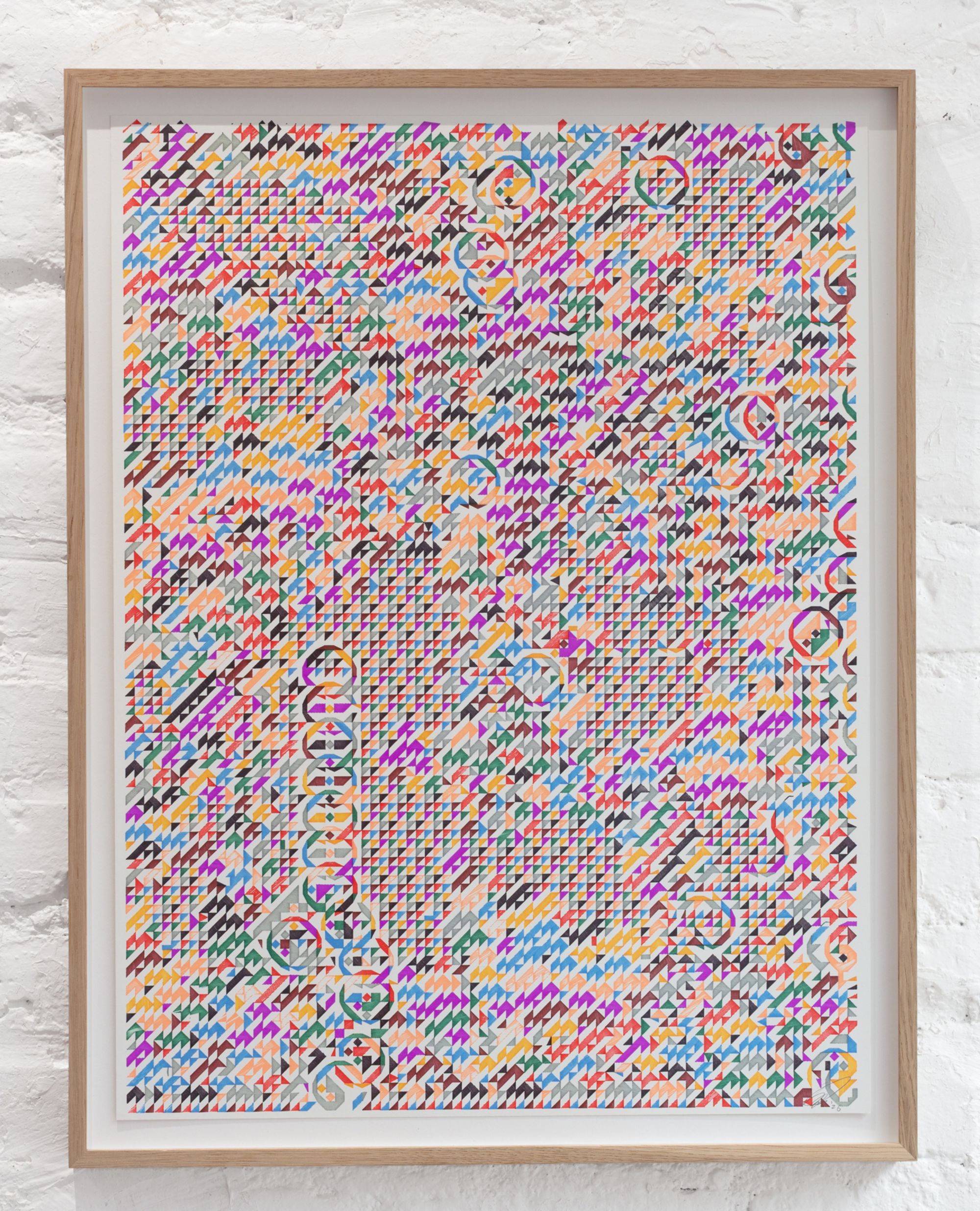
"In Stained Unravel, the cellular automaton does not produce the image and then recede from it. The rule remains in the image — its restrictions showing, its seams exposed, the history of each transformation readable in the forms left behind."
Where earlier practices left traces that could be read, the cellular automaton makes concealment structurally impossible: "the form cannot hide the logic that produced it any more than a woven cloth can hide the structure of its weave." This is radicalization not as rhetorical escalation but as structural fact. The logic is not just left visible — it cannot be removed without the image ceasing to be what it is. The image is not an effect; it is a record.
This connects to process-legibility's central claim ("the construction of an image is the image") but now gives it a historical ground: the claim is not an artistic position adopted against some neutral alternative, but the logical conclusion of a tradition that runs from Impressionism through Conceptualism.
4. AI as the perfection of concealment
"AI-generated imagery is, among other things, the perfection of concealment — ars celare artem at industrial scale. Infinite images, zero visible labor, no readable logic, no traceable decision. The output is seamless in the most literal sense: it has no history you can read."
The essay positions AI-generated imagery not as a neutral new technology but as the apotheosis of the classical doctrine. The seamlessness that Cézanne refused, that Cubism exposed, that Pollock made impossible — AI reinstates it at scale, automatically, without remainder.
This is the sharpest formulation of why van den Dorpel's anti-seamlessness position is not nostalgia but a contemporary critical stance. His systems age visibly, "according to laws they do not conceal" — directly counter to the AI image, which has no age, no law, no legible logic.
The criterion vs. code distinction follows: "what the machine cannot replicate is not the code but the criterion." The AI produces seamless images without criterion — without the specific dissatisfaction that returns the artist to revision, without the capacity to recognize when a surprise opens something and when it merely fills space.
5. The reveal as structural, not dramatic
"The reveal, in his work, is not a dramatic exposure after the fact. It is continuous, structural, built into the logic from the beginning."
This is the distinction from theatrical revelation — the magician's trick reversed. A dramatic reveal still operates within the structure of concealment: there was a secret, and now it is exposed. Van den Dorpel's revelation is not an event but a condition: the logic is always already visible in every state the work takes. There is no moment of exposure because there was no concealment. This is the ethical claim: the work is honest at every step, not honest at the end.
Connections to existing wiki pages
- Process Legibility — the essay provides the historical frame (ars celare artem → Impressionism → Conceptualism) for what that page calls "the construction is the image"; the criterion/code distinction; the AI-as-concealment argument sharpens the "against seamlessness" section
- Senescenence — Stained Unravel as the specific work analyzed; Albers' loom binary logic now situated within the longer history (Conceptualism → protocol art)
- Protocol, Taste, and Systems — protocol art as the culmination of the Impressionism → Conceptualism arc described here; Droitcour's "making protocols desirable" as continuation
- Mediation and the Archive — pentimento as a form of archival trace; the image that carries its own revision history connects to "the work = the work + its documentation"
- Subconscious Computation — AI as perfection of concealment vs. generative practice as structured exposure; the criterion as what the machine cannot replicate
- Randomness and Pattern — Pollock's gesture-as-content connects to "workmanship of uncertainty"; the legible trace of process as what separates non-arbitrary surprise from seamless generation