
Franke × van den Dorpel — Vectors, Apple Munich (2026)
Curatorial text by Margit Rosen. Event: Vectors — VO26 Special, Various Others Munich, 2026. Site: Apple European Chip Design Center, Karlstrasse, Munich. Source: sources/ingested/stained-unravel-with-herbert-franke.md.
The pairing
Three of Franke's 1980s Apple II works are installed on the historical Apple computers they were made for, alongside a new commissioned edition of van den Dorpel's Stained Unravel titled Blockade (2026) — made in response to Franke's Move (Blockade), written in Quick BASIC 4.5 on an IBM PC, 1991–94. The exhibition is Vectors — VO26 Special, a programme of Various Others, Munich's annual gallery season; the site is Apple's European Chip Design Center on Karlstrasse, where more than 2,000 engineers work on Apple's own silicon, power management, and wireless technologies. The curatorial text is by Margit Rosen.
The pairing is not decorative — it is a thesis about computational form in two registers, one of which is roughly four decades old.
Herbert W. Franke — the first medium-claim
Herbert W. Franke (1927–2022) was one of the first theorists worldwide to formulate the idea that the computer could be an artistic medium. He worked across physics, science writing, cave research, and digital art; his books and exhibitions in the 1960s through 1980s established generative and computer-based imagery as a serious aesthetic category at a moment when most of the art world treated computation as either novelty or threat.
In the early 1980s Franke began experimenting with an Apple II — the same machine sold to schools and households, not specialist hardware. His programs are typically less than thirty lines long. They generate moving structures of lines and colour fields. The limited palette, the slow drawing speed of the early CRT, the moiré effect produced by the analogue raster: Franke did not work around these. He took them as material. The constraints of the substrate were the conditions under which a new pictorial language could be developed at all.
His interest, Rosen writes, was in how visual complexity — or even beauty — could emerge from mathematical rules. The medium-claim and the beauty-claim arrive together. To say the computer is an artistic medium is, in Franke's framing, to say that something worth calling beauty can be generated by short, formally specified procedures running on consumer hardware.
Stained Unravel (Blockade) — what is different about this edition
The Stained Unravel series (2026) is a cellular-automaton system whose 23-state morphological vocabulary, positional bitmap compare, temporal colour staining, and edge merging are documented in detail elsewhere on the wiki (→ Stained Unravel for the full rule-set, and the Senescenence page for the Nguyen Wahed × Interface Gallery presentation). What is specific about Blockade is not the underlying logic — that is shared across all editions of the series — but the palette and grid, which were chosen against Franke directly. The artist's own framing of the commissioned edition is precise:
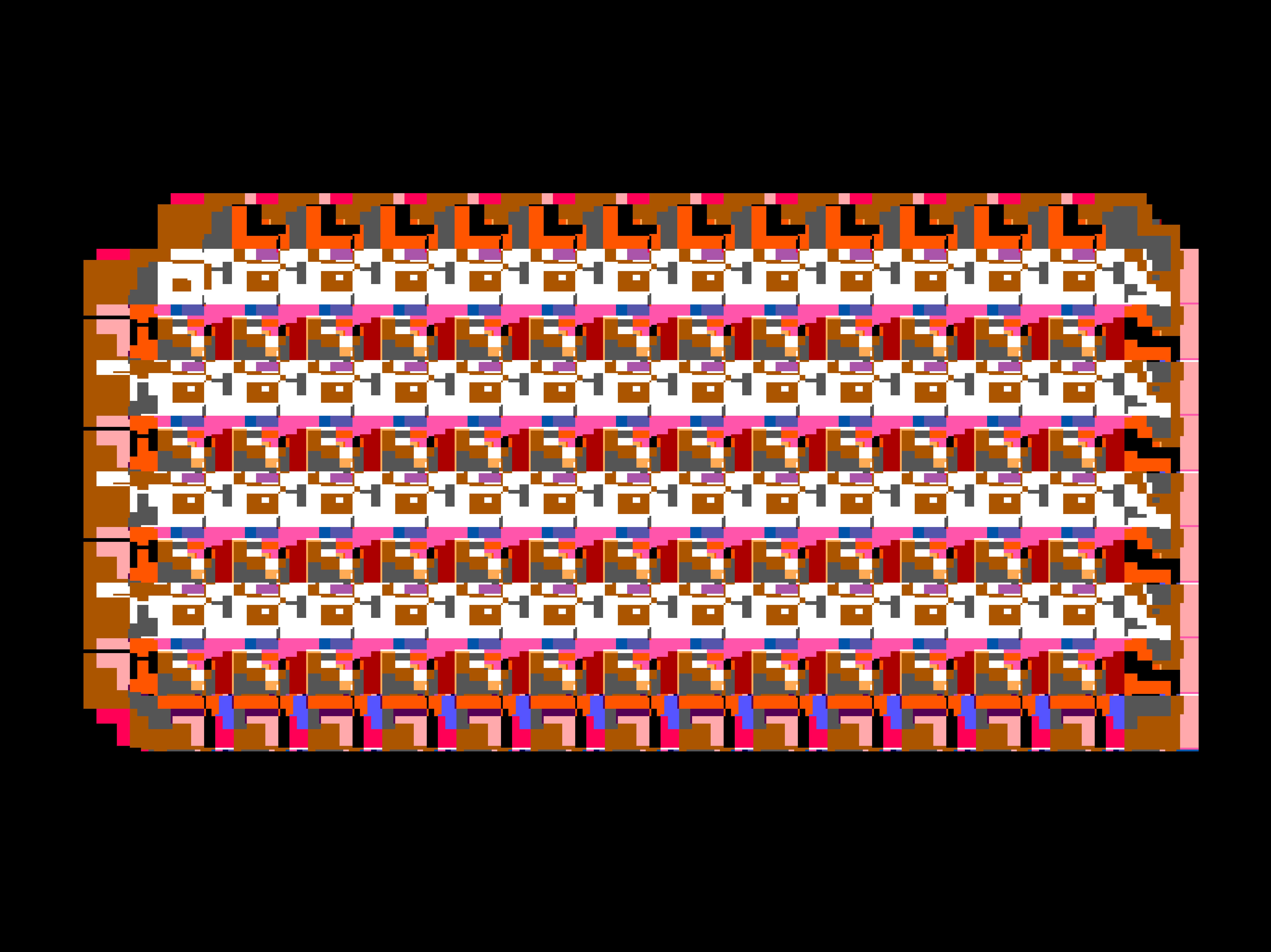
My work takes its cues from his CRT palette and square-patterned grids.
Two things are inherited from the neighbouring Franke screen and named openly. First, the CRT palette — the limited, phosphor-saturated colour set typical of early-1980s consumer displays, neither broadcast-corrected nor printer-gamut. Second, the square-patterned grid — the regular, axis-aligned cellular field that Franke's program generates by repeatedly comparing local rules on a tight rectangular array. These are exactly the two features that Stained Unravel's underlying machinery is built to accept: a palette is hand-made per edition (each of Spring, Game, Night, De Stijl, Stained, Markov's Dream, Mother of Pearl carries its own; → Stained Unravel), and the cellular grid is the substrate the entire system operates on. Blockade is therefore the edition in the series whose palette and grid are explicitly cited rather than internally derived. It is Stained Unravel in dialogue with a specific predecessor's substrate.
The title Blockade repeats Franke's own — Move (Blockade) — as a deliberate acknowledgement. The new work names itself after the old one, in the way a translation names itself after its source.
The staining mechanism. A frame from the cellular-automaton run: each cell's hue tracks how long it has held its state — colour-as-memory — playing against Franke's CRT-derived palette.
Beauty vs. aging — Rosen's distinction, sharpened
The argument has appeared in the Process Legibility page as a gloss on the Stained Unravel critical text. Rosen formulates the same distinction at Apple Munich more compactly, and grounded in two specific bodies of work:
Where Franke sought to make the beauty of mathematics visible, van den Dorpel is interested in the moment a system reaches its limit — and what unfolds from there. Colour functions as memory: it indicates how long a state holds before being displaced by the next. The image ages according to rules it does not conceal.
Read against each other, the two orientations become legible as a methodological pair, not an opposition:
| Franke | van den Dorpel | |
|---|---|---|
| Object of interest | The form the rule produces | The threshold at which the rule exhausts itself |
| Colour function | Hue of the rendered field | Record of duration — staining as memory |
| Time | Display speed (slow CRT raster) | Lifetime of a configuration (counted in iterations) |
| What complexity means | Visual richness from a few lines of code | Multi-scale persistence and decay |
| Anchor of the work | The image as it appears | The image as it is in the act of being displaced |
Franke's image is what the rule makes. Van den Dorpel's image is what the rule holds open for a limited time before the system reconfigures. The distinction belongs to senescence as a structural category (→ Senescenence): not catastrophic death but the orderly exhaustion of one form followed by the emergence of another. Move (Blockade) presents the form; Stained Unravel (Blockade) presents the system in the act of aging through it.
This is not a critique of Franke — quite the opposite. The aging-orientation is only legible because the beauty-orientation has been established; van den Dorpel's account of senescence presupposes a coherent enough form for there to be something to age. Franke and van den Dorpel work on the same axis from different points.
Colour as memory
The Stained Unravel press release and the artist's notes describe the temporal colour staining mechanism: each cell counts the number of iterations since it last changed shape; as it holds the same configuration, its colour transitions gradually between a predefined start and end colour (→ Stained Unravel, rules section; → 3000). Stability is encoded as colour change over time.
In Rosen's text this mechanism is given its sharpest single-sentence formulation: Colour functions as memory: it indicates how long a state holds before being displaced. This is a precise inversion of the standard role of colour in early computer graphics. On Franke's Apple II, colour was a property of the pixel as drawn — set, refreshed, replaced. In Stained Unravel, colour is a property of the cell's history — the longer it persists, the more deeply it stains. Same chromatic primitives, different temporal grammar.
The kinship to other memory-as-substrate moments in the practice is direct:
- The Markov's Dream Palette — a single saturated RGB palette first deployed in Markov's Window (2004), returning across two intermediate works, and re-applied to Stained Unravel itself in the Markov's Dream edition. The palette carries memory across two decades; here, in Blockade, the palette is borrowed from a predecessor a further decade earlier.
- Afterimage — persistence after stimulus, the visual register of memory in the eye.
- Mediation and the Archive — "The Work = The Work + Its Documentation" (→ 992); the work as carrier of its own history.
Blockade doubles the memory function. The cellular automaton remembers within a frame (each cell stains according to how long it has held its form). The edition itself remembers across the practice (the palette is taken from Franke; the grid is taken from Franke; the work is named after Franke's). Memory works at two scales at once.
Square-patterned grids — the loom genealogy extended
The grid running through Blockade extends the lineage that the Senescenence exhibition makes explicit: the binary logic of the weaving loom, through the Anni series (named for Anni Albers), to the cellular automaton. Stained Unravel's positional bitmap compare is structurally identical to a loom: at each intersection, exact warp positions are checked to determine what comes forward. The grid is not a presentation device but a computational substrate.
Franke's square-patterned 1980s grid sits on the same axis. His Quick BASIC code on an IBM PC and the 19th-century Jacquard loom are kin in the way the Senescenence press release names them: the binary logic of the weaving loom, to early two-dimensional pixel graphics, to the contemporary GPU (→ Senescenence, loom genealogy section). Blockade inserts Franke into that genealogy as an explicit waypoint between Albers's loom and the GPU-based cellular automaton.
The same grid is the underlying form of sacred geometry in the practice — the loom, the mandala, the stained-glass field, the heraldic shield, the cellular automaton — five rule-systems whose local decisions accumulate into transcendent form. Franke's CRT moiré is the same grid encountered as a physical artefact: the analogue raster, the phosphor mask, the interference pattern that emerges when two regular grids overlay.
Site-specificity — the Apple II returns to Apple
The exhibition closes a loop that should be named directly. Franke's working machine in the early 1980s was an Apple II. The exhibition site is the building where Apple now designs the silicon that runs its products — proprietary chip designs, power management, and wireless technologies, in Rosen's phrasing. The pioneer of computer art who used consumer Apple machines as an artistic medium is shown on those very machines, inside the lab where their silicon descendants are engineered.
This is not a sentimental gesture. The Apple II that Franke programmed was a fully exposed system: BASIC at boot, machine code accessible, the screen logic publicly documented. The chips designed at Karlstrasse are the inverse — opaque, proprietary, ringed by NDAs. Both Franke's screens and Stained Unravel's screen refuse the opacity. They show their working. Franke's programs are short enough to be read; the Stained Unravel cellular automaton is structurally incapable of concealing its rules in its output (→ Process Legibility on the cellular automaton as the structural endpoint of artists reveal). To install these transparent systems inside the lab where present-day silicon is made opaque is a position, not just a venue choice.
The release early, release often stance is grounded site-specifically here. Two generations of artists working with rules they do not conceal, shown inside a building where the rules are concealed by industrial necessity.
Connections across the practice
- Stained Unravel — the parent series; full account of the 23-state vocabulary and three mechanisms (positional bitmap compare, temporal colour staining, edge merging) that Blockade runs on. Blockade is the eighth edition; the seven preceding editions and their palettes are documented there.
- Senescenence — the April 2026 New York exhibition where the Stained Unravel series and its plotter drawings were first shown together; the loom genealogy is articulated there.
- Process Legibility — contains the original Franke comparison via the Stained Unravel critical text; the Magicians Conceal, Artists Reveal arc; the criterion vs. the code distinction. This page extends that comparison with a specific exhibition and full biographical context.
- Sacred Geometry — Franke's square grid joins the loom / mandala / stained glass / heraldry / cellular automaton family.
- The Markov's Dream Palette — palette-as-memory across the practice; Blockade extends the principle to a borrowed palette from a predecessor.
- Afterimage — the CRT moiré that Franke worked with is a near relative of the persistence-of-vision effects this page collects.
- Quantization and Dithering — the constrained colour set of early consumer displays (CGA, ZX Spectrum, Apple II) as material rather than constraint; Franke's CRT palette belongs in this discussion.
- Randomness and Pattern — minimal rules → extraordinary complexity; Franke's thirty lines and Stained Unravel's three mechanisms are both cases.
- Release Early, Release Often — the Apple II as a fully exposed system; Blockade inside the chip design lab as a site-specific re-statement.
See also
- Process Legibility — the Franke comparison in its original form (beauty vs. aging); the Stained Unravel critical text
- Stained Unravel — the parent series; the seven preceding editions; the full rule-set
- Senescenence — death as system feature; the loom genealogy; Albers → Anni → Stained Unravel
- Sacred Geometry — the grid family across rule-systems
- The Markov's Dream Palette — palette as long-range memory across the practice
- Release Early, Release Often — the open Apple II vs. the closed chip lab