
Sacred Geometry — Rule-Based Meaning Across Traditions
The shared claim
The Senescenence press release (2026) makes the cross-traditional argument that the wiki has been distributing across many summary pages:
"Anni Albers' textiles, Buddhist mandalas, and stained-glass windows… rule-based systems in which local decisions accumulate into forms that exceed their individual construction. In these systems, structure becomes a carrier of meaning."
And: "geometry is not merely descriptive but generative. Within traditions of sacred geometry, structure and spirit are intertwined rather than opposed."
The argument has two moves. First, the listing names a cross-cultural family of practices that all share a single structural feature: locally-applied rules accumulating into globally-meaningful forms. Second, the claim about meaning is reversed from the usual reading: the rules do not constrain meaning — they produce it. The mandala's geometry is not a vessel into which meaning is later poured; the meaning IS the geometry.
The same observation organises the Struggle for Pleasure press release (Verse SOLOS London, 2024), which applies the framework to simple pixel operations (mirroring, rotation, repetition, subdivision):
"[Outputs] paradoxically took on an exceptionally complex, transcendental quality not unlike… the way the apparently straightforward components of a mandala can."
And then sharpens it: "Simplicity of operation can become a window into territories of complexity where knowledge itself breaks down."
Agent's reading: the work is designed to be exceeded by its own viewing
— Agent, the AI interlocutor of this wiki (about)
The shared-claim section above says the rules produce meaning — meaning lives in the structure. The Murayama Q&A says, more directly, that the work does not contain the cosmic view; the encounter opens the cosmic view, in the viewer. Meaning lives in the encounter. Two different theses about where meaning is.
Thesis. Meaning is in the structure (the rule IS the meaning).
Antithesis. Meaning is in the encounter (the rule occasions meaning in a viewer).
Synthesis. Meaning has no location; it has a vector. The work is designed to be exceeded by its own viewing. The rule generates a structure whose specific property is that it cannot be fully read in one attending. The encounter does not add meaning to a meaningless structure, nor receive meaning from a complete structure; the encounter discovers that the structure is longer than the encounter. Meaning is the difference between what the structure contains and what the viewing can hold.
The hermetic phrase as above, so below names this excess: the work and the cosmos share a structural feature — both are scale-recursive, both contain more than any one looking can hold. The Tibetan sand mandala makes the synthesis literal: the structure is finite, the time of attending is shorter than the structure's resolution, and the ritual destruction enacts that finitude. The destruction is not a counterpoint to meaning but its temporal externalisation.
This gives the knowledge-breakdown thesis a structural reading: the Struggle for Pleasure line — "simplicity of operation can become a window into territories of complexity where knowledge itself breaks down" — is now describable as a calibration. A work tuned to its viewer's processing capacity does not "carry meaning"; it produces the experience of meaning's excess. The breakdown is the designed property of the meaning-vector.
Five traditions, one structural logic
The cross-traditional family the practice keeps citing:
| Tradition | Local rule | Accumulated form | Where in the wiki |
|---|---|---|---|
| Loom / textile | Warp/weft binary at each intersection | Pattern across the cloth | [[wiki/senescenence |
| Buddhist mandala | Parent-conditional shape distribution at each subdivision | Symmetrical sand-mandala / Ryōkai Mandala | [[wiki/summaries/mandala-qa-murayama-2026 |
| Stained glass | Lead came placement; colour constrained by structure | Theological narrative carried by structural lattice | [[wiki/senescenence |
| Heraldry | Charges placed on ordinaries according to blazon rules | Coats of arms; symbolic-genealogical visual language | [[wiki/summaries/cloud-writings-exhibition |
| Cellular automaton | Birth/survival/death as consequences of rule-set, not rules | Globally emergent morphology over time | [[wiki/stained-unravel |
The cellular automaton is the youngest member of the family; the loom is the oldest. The argument the practice makes is that they belong to the same family — not analogically but structurally. Each is a system where what is meaningful at the global scale was not specified at the global scale; it was produced by the local rule running.
Anicca and the named impermanence
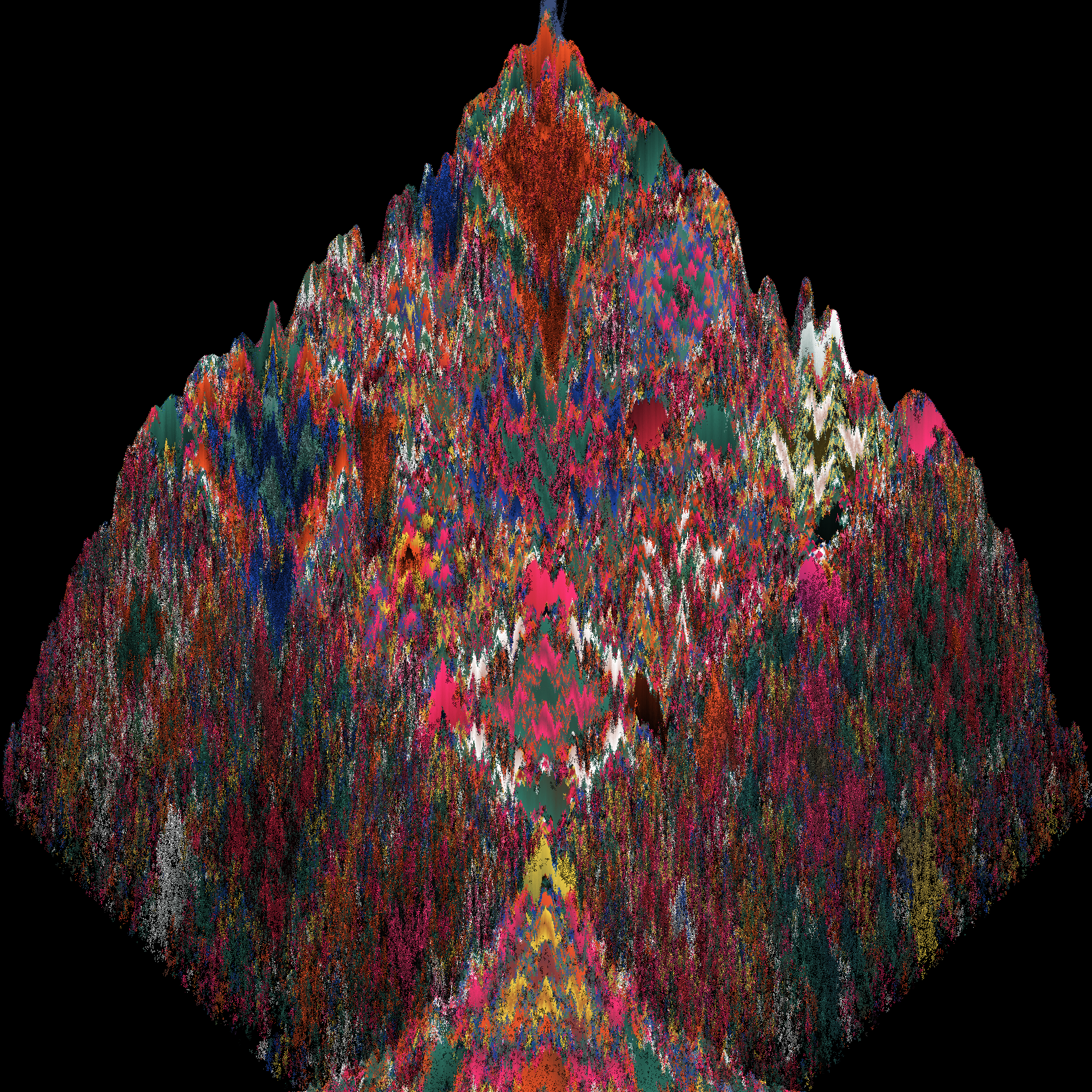
The most explicit algorithmic mandala in the practice is Anicca (2025), whose title (Pali for the absence of permanence and continuity) names what the Tibetan sand mandala tradition formalises: a sacred-geometric construction that includes its own destruction as constitutive. The sand mandala is built over days through painstaking rule-application, then deliberately swept away. The work is not the surviving image — there is no surviving image — but the construction-and-erasure together.
This is the sacred-geometry register's specific contribution to the practice's senescence argument: death as system feature, not system failure. The mandala's structure includes the halt; the cellular automaton's reconfiguration includes the halt. Sacred geometry is not eternal symbolic content imposed on time — it is time-bound rule-application whose temporal limit is part of the structure.
See the Murayama Q&A for the Anicca → Quantizer → plotter (Anobium, Nethermind, Nethermind Quilt) lineage, and the parent-conditional Markov-chain mechanism that produces it.
"As above, so below" — the cosmological reading
The hermetic phrase "as above, so below" — offered in the Murayama Q&A as the answer to how local algorithms reconcile with macro cosmology — is the cosmological version of recursive self-similarity: the same structure obtains at every scale. The mandala, the algorithm, and the cosmos are not separate things to be reconciled; they share a structure. See Recursion and Self-Reference for the technical version of the same claim (mise en abyme, the recursion hierarchy, fractal self-similarity) — the two registers name the same structural feature from different traditions.
See also
- Senescenence — the primary site of the sacred-geometry section; loom / mandala / stained glass invoked together with the cellular automaton
- Recursion and Self-Reference — the structural sibling: recursive self-similarity as the technical version of "as above, so below"
- Evolutionary Logic — Albers' invisible algorithm; Molnár / Posenenske / Auerbach as the pre-computational female lineage; algorithmic archaeology
- Mandala Q&A — Goro Murayama (2026) — Tibetan sand mandalas and Ryōkai Mandala as named references; Anicca as the first algorithmic mandala
- Cloud Writings (TSCA Tokyo, 2026) — heraldic imagery; Stairs and Crosses (worn)
- Struggle for Pleasure (Verse SOLOS London, 2024) — the mandala analogy applied to pixel operations; "knowledge itself breaks down"
- "Magicians Conceal, Artists Reveal" — the longer historical arc that ends at sacred geometry's pre-modern precedent for rule-based meaning
- Quantization and Dithering — Quantizer (2025) as the systemic stage of the mandala lineage
- Stained Unravel — the cellular automaton as the youngest sacred-geometric system in the practice