
Afterimage
An afterimage is an image that continues to appear in the eyes after a period of exposure to the original image: "afterimages occur because photochemical activity in the retina continues even when the eyes are no longer experiencing the original stimulus." The phenomenon may be normal (physiological afterimage) or pathological (palinopsia). In the positive afterimage, the original colours are preserved; in the negative afterimage — the more commonly encountered form — the complementary colours appear. Fluorescent colours are particularly potent triggers, as their intensity saturates the relevant photoreceptors rapidly and deeply.
The concept extends naturally beyond vision. An aural afterimage is the persistence of a sonic sensation after the sound has ended — most concretely, tinnitus: the ringing or buzzing that follows prolonged exposure to high-volume sound. Just as the retina continues firing after the light is gone, the auditory system continues producing signal after the acoustic stimulus ends. In both cases, the trace outlasts the cause.
Duchamp and the retinal
Marcel Duchamp famously rejected what he called "retinal art" — painting that satisfied only the eye, without engaging thought. Yet his own practice was deeply preoccupied with optical phenomena. His Rotoreliefs (1935) — cardboard discs with concentric spiral patterns, designed to be played on a gramophone — are among the most sustained investigations of retinal perception in modern art. When spun, the flat spirals produce an illusion of three-dimensional rotation and depth; when the disc is stopped, the residual retinal excitation generates an afterimage that appears to pulse or breathe. Duchamp sold these as "optical disks" at a Parisian inventors' fair, framing them explicitly as devices rather than artworks.
The contradiction is productive: by rejecting retinal art while making optical instruments, Duchamp situates perception as a mechanical fact to be interrogated rather than satisfied. The afterimage is exactly this — perception continuing past the point of stimulus, the eye running on its own.
Rotorelief (Markov's Dream #10)
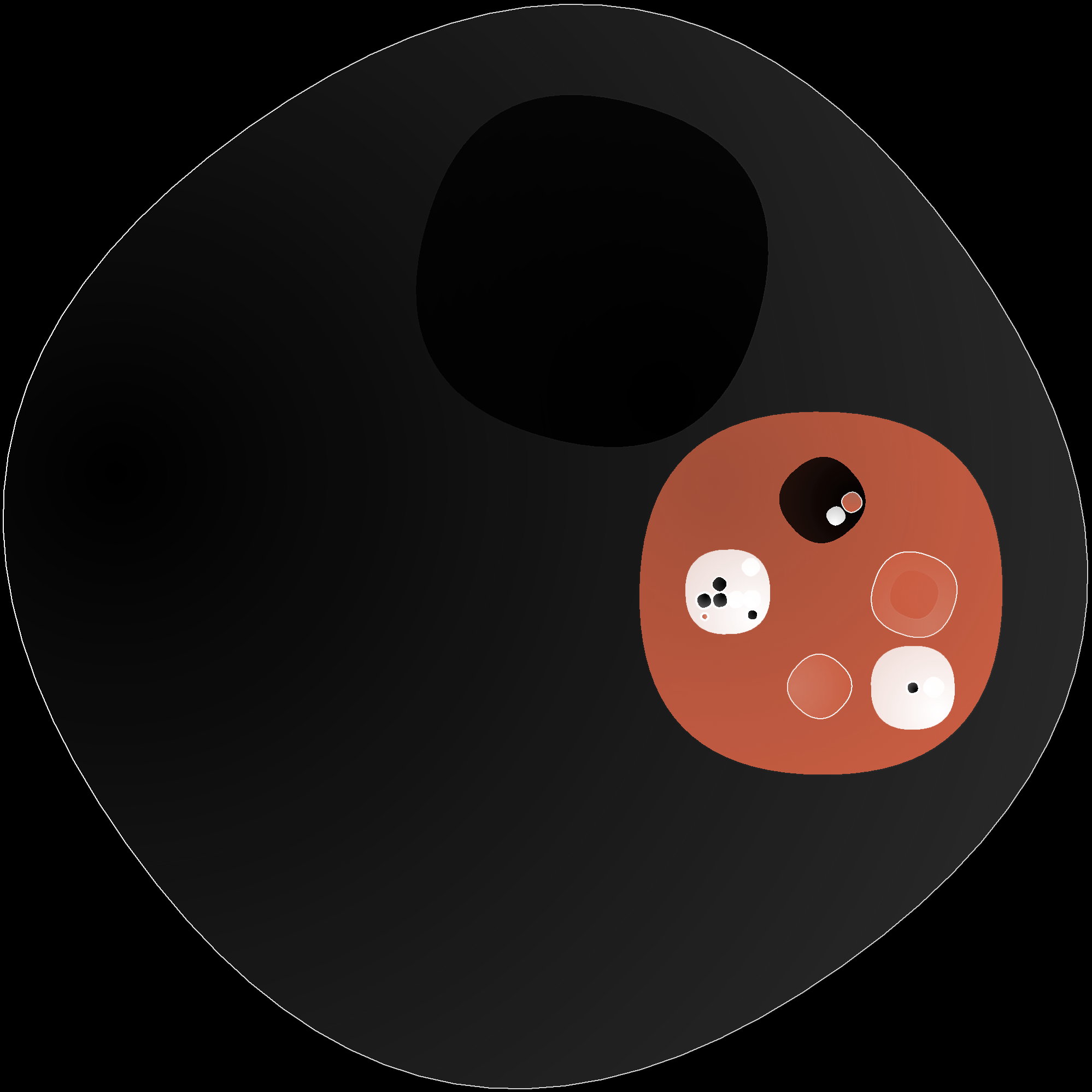
Token #10 of Markov's Dream (2022) is titled Rotorelief and carries its own description: "Inspired by the Rotorelief series by Marcel Duchamp. Using identical colours." The work has constant rotation as its defining behaviour, with solid-coloured squircles nested to a maximum depth of 4, occasional outlines, and the same hand-picked palette as the original Markov's Window (2004): pure blue, green, magenta, and a black-to-white gradient (→ The Markov's Dream Palette — A Lineage).
The "identical colours" claim operates on two levels. Literally, it refers to the palette shared between Duchamp's Rotoreliefs — which used flat, high-contrast printed colours optimised for optical interference — and the Markov's Dream series. Conceptually, it asserts a chromatic lineage from Duchamp's optical experiments directly into van den Dorpel's algorithmic work: both are instruments designed to produce perceptual effects that exceed what the static image shows.
Where Duchamp's discs required a physical gramophone to spin, Rotorelief runs in a browser, its constant rotation a software behaviour rather than a mechanical one. The afterimage is produced not in the stopped disc but in the eye that has been tracking the rotation and continues to perceive movement after looking away.
Hedphelym (Markov's Dream #9)

Token #9, Hedphelym, is named after a track by Aphex Twin (Richard D. James) — specifically from Selected Ambient Works Volume II (1994), the album that most thoroughly blurred the boundary between sound and sensation. The token's behaviour is described as "mayhem rotation & sliding" — where Rotorelief rotates with constant, controlled speed, Hedphelym rotates with ever increasing speed, at rates that push into afterimage territory.
At low rotational speed, the eye tracks the individual forms. At high speed, the forms merge: the eye can no longer follow, and what remains is a flickering composite — a retinal integration of multiple positions simultaneously. This is the optical analogue of the acoustic phenomenon in ambient and noise music: past a certain threshold of speed or volume, the individual events merge into a field, and what is perceived is no longer the event but its accumulated trace. The retinal forms that appear at high rotation speed are afterimages of the work's own motion, not the work itself.
Relieved Afterimage (Struggle for Pleasure #3)

Among the 128 tokens of the Struggle for Pleasure series (2024), token #3 carries the title attribute "Relieved Afterimage" and a fluorescent colour palette with a blast structural pattern. The title names the phenomenon directly, while the fluorescent colour choice is mechanically appropriate: highly saturated, luminous colours push photoreceptor cells toward rapid saturation, producing stronger and longer-lasting afterimages when the eye is moved away.
The "blast" structure — pixels radiating outward from a centre — echoes the radial symmetry of Duchamp's spinning discs. Where the rotation in Rotorelief generates the afterimage through movement, here the colour itself does the work: the fluorescent palette at high saturation acts as a kind of frozen blast, one that has already fired and left its trace on the viewer's retina.
Struggle for Pleasure as a series preserves its entire iterative history — each token is a frame from the algorithm's chronological unfolding (→ Struggle for Pleasure, Verse SOLOS London (2024)). Token #3 as "Relieved Afterimage" suggests that the afterimage is not only an optical effect but a structural position: the work as the trace of its own prior states, the pixel arrangement as residue of the process that generated it.
The pre-semiotic: before it meant anything (857)
Note 857 introduces the temporal inverse of the afterimage — not what persists after the stimulus ends, but what existed before meaning arrived:
"I remember what it looked like before it meant anything / what it sounded like as a child / before I understood the language of the lyrics"
This is a specific phenomenological state: hearing lyrics as pure sound, before the language was understood. The child registers the voice, the rhythm, the phoneme — but not the semantic content. The sound exists as texture before it becomes message. Once language arrives, this prior state is foreclosed: meaning interposes itself automatically, and the unmediated sound-before-language can only be recovered as memory, never re-entered directly.
The afterimage is what the visual or auditory system continues to produce after the stimulus has ended — it is temporal residue. The state in 857 is the reverse: what the system produced before categorization began — pure sensation prior to semiotic overlay. Call it the pre-image: not the trace that follows experience but the condition that precedes its articulation. The two are mirror structures around the same threshold: the moment when sensation acquires meaning.
Shoegaze deliberately tries to recreate the pre-image state in a listener who can never be pre-linguistic again. The processing chain — distortion, detuning, volume, reverb — works to strip the signal of its semantic legibility: the lyrics buried under sound, the guitar chord smeared into a frequency field rather than a named harmony. The goal is not to produce tinnitus (the afterimage, the residual ringing) but to reproduce the earlier state in which sound was heard before it meant anything. The afterimage is the evidence that something overwhelmed the system; the pre-image is the memory of before the system had categories to be overwhelmed by.
Note 920 holds the same phrase in a single sentence, without the decade-decay addition — suggesting 857 is the expanded, developed form, where the immediate sensory memory acquires its historical dimension.
The aural afterimage: shoegaze and tinnitus
Shoegaze — the early-1990s British rock genre associated with bands including My Bloody Valentine, Slowdive, and Ride — is defined by its relationship to excess: guitars so heavily processed and detuned that they dissolve into a continuous wall of distortion, vocals buried under the sonic mass, volume pushed to the threshold where the ear begins to fail. The aesthetic result is music that operates at the edge of what can be heard as discrete events; past that threshold, the sound becomes texture, and texture at sufficient volume produces aftereffects.
The specific aftereffect is tinnitus: the ringing or buzzing that persists in the ear after exposure to high-volume sound, sometimes for minutes or hours, sometimes permanently. Tinnitus is an aural afterimage — the auditory system still firing after the source has stopped, producing signal from its own overload rather than from external input. Shoegaze musicians were famously cavalier about this risk: the volume was part of the practice, and the afterimage it left — the ringing you carried home — was arguably part of the work.
The Verse interview (2024) introduces shoegaze as a structural analogy for Struggle for Pleasure: "the found image as signal source for a processing chain that converts figuration into texture" (→ Verse Twitter Spaces Interview (2024)). The shoegaze reference is not only aesthetic — it is a model for what happens when a source signal is processed beyond recognition, when figuration dissolves into sensation, and when the sensation outlasts the signal.
Loveless (Struggle for Pleasure #51)

Token #51 of Struggle for Pleasure carries the title "Loveless" — the title of My Bloody Valentine's 1991 album, the canonical record of the shoegaze genre. Loveless is the work that most fully realised the shoegaze aesthetic: its guitars are detuned, heavily chorused, and layered until pitch becomes smeared, its vocals treated as another texture in the wall of sound. The album required over two years and nearly bankrupted its label to make; the production process itself became the subject. The result was music that permanently altered hearing — listeners frequently reported tinnitus after the concerts that supported it.
Token #51's attributes — duotone colour palette and cloud structure — are consonant with the reference. A duotone palette reduces the colour vocabulary to two extremes, all other values derived from their interaction; a cloud structure disperses pixels into soft, atmospheric masses without hard edges. Both resist the sharp resolution of individual elements: the image, like the album, operates at the level of field and texture rather than discrete point or note.
The Swallow, Only Shallow NFT series (exhibited alongside Struggle for Pleasure at Verse SOLOS London, 2024) takes its title from the opening track of Loveless — the series is named for the same album, making explicit that shoegaze is not an incidental reference but a structural model for an entire body of work.
Rotorelief as bridge
Rotorelief (Markov's Dream #10) connects both registers. As an optical work in Duchamp's lineage, it belongs to the history of visual afterimage. But as a continuously rotating algorithmic work — whose motion at high speed produces the same dissolution of form into field that shoegaze produces in sound — it operates at the boundary where the visual logic of rotation-past-legibility and the sonic logic of volume-past-hearing meet. Both produce a trace: retinal persistence in one case, tinnitus in the other. Both are evidence that the perceptual system was pushed past its operating envelope. The afterimage — visual or aural — is what registers that something happened.
See also
- The Markov's Dream Palette — A Lineage — the palette shared between Duchamp's Rotoreliefs and Markov's Dream series; constructivist lineage
- Struggle for Pleasure, Verse SOLOS London (2024) — shoegaze as structural model; the pixel as signal processed into texture
- Verse Twitter Spaces Interview (2024) — shoegaze as explicit structural analogy; "music as the highest form"
- Randomness and Pattern — the dissolution of figure into field; workmanship of uncertainty
- Process Legibility — the iterative trace as the work; construction visible in the image