
Meditative Labour — Hand, Plotter, Code, Prompt
In the order they were made, these four drawings step across the boundary between the hand and the machine. Kapitulation is wholly hand-drawn — pencil on paper, no plotter touched it. Beads, Beads II, and Beads III are hybrids: the plotter lays the outlines; the artist fills the cells by hand, with coloured pencils for the first two, with graphite for the last. The making-order matters. The hand that surrendered alone to the page in Kapitulation returned, in Beads III, after the plotter had passed.
Kapitulation was first shown in Angles Morts (LOHAUS SOMINSKY, 2024) as the only pure hand-drawing in a show otherwise composed of plotter works. The three Beads — I, II, III — were then presented together two years later in Cloud Writings (Takuro Someya Contemporary Art, Tokyo, 2026), the artist's first solo exhibition in Japan. The exhibition text is the place where the artist first names the hand-colouring as "a rich and meditative commitment for me." Read together, the four drawings span the two exhibitions: Kapitulation opens the question of the hand alone in 2024; the three Beads answer it in 2025 in a different register, with the plotter back in the field but the hand still doing the slow filling.
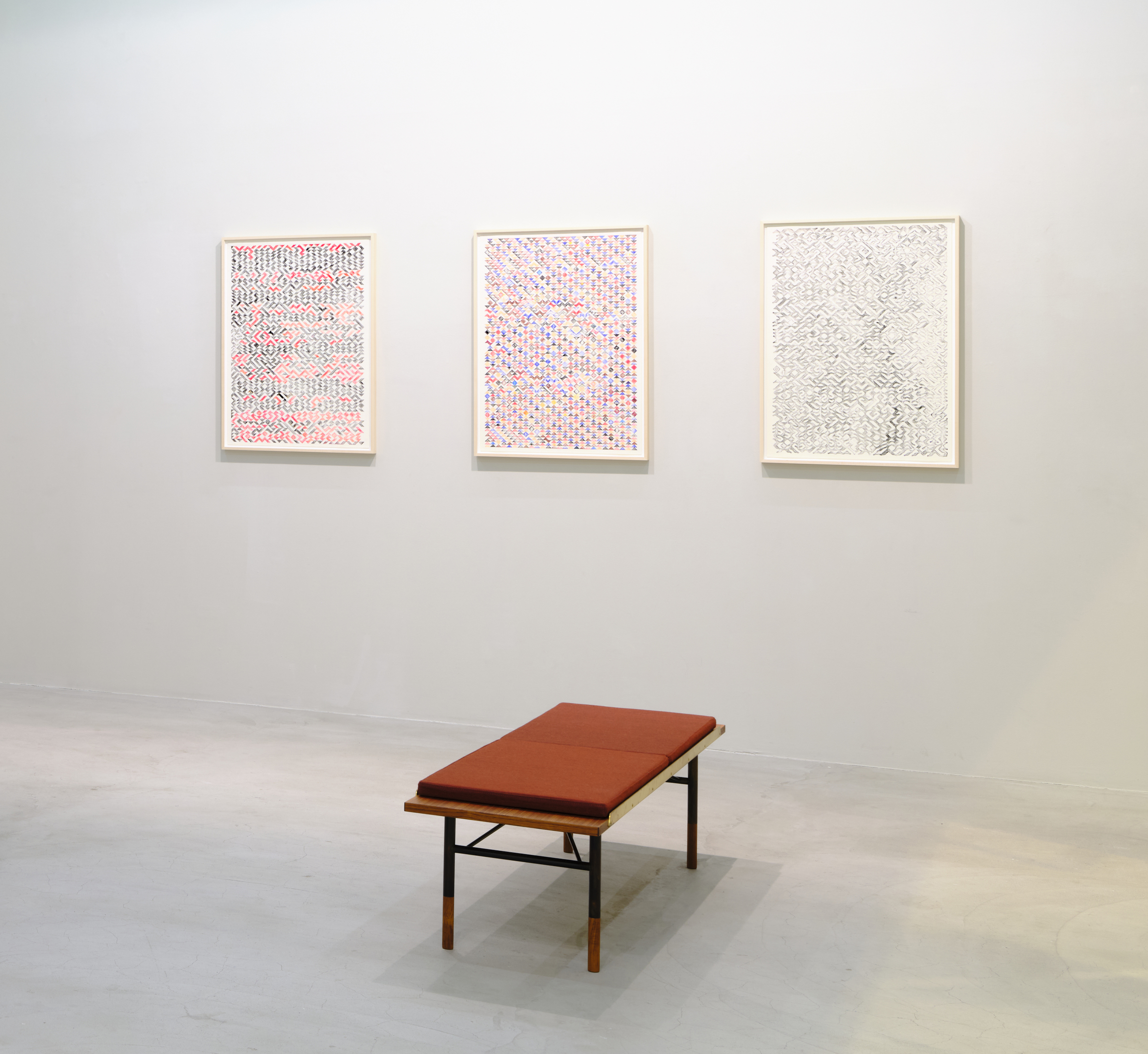
The three Beads, hung together. The installation view stages the sequence side by side — Beads II (compressed graphite/coral/pink), Beads (the broadest palette), and Beads III (pure graphite on the corner-rounded vector) — the high-chroma centre flanked by the compressed palette and the monochrome.
The four works
Kapitulation (2024) — pure hand
A square pencil drawing — interlocking chevrons and right-angled meanders, hatched inside small triangular wedges. No colour, no machine. The palette is the paper-white and the soft greys of graphite under varying pressure. The title, capitulation, names the gesture: a deliberate laying-down of the algorithm in front of the page. The work belongs to the Angles Morts exhibition (LOHAUS SOMINSKY, 2024) — see Angles Morts for its position there as the single pure hand-drawing among plotter works.
Beads (2025) — plotter outlines, coloured-pencil fills
The first hybrid, and the first of the three Beads shown together at Cloud Writings (TSCA Tokyo, 2026). The plotter lays an interlocking lattice of triangles and diamonds — the underlying geometry of the Anni generative system, named for Anni Albers and her loom-as-binary-computer practice (→ loom genealogy). The artist then fills each small cell by hand with coloured pencils. The palette here is the broadest of the four: a beige/peach that reads as the paper warmed by graphite, a coral-red, a cobalt blue, dark browns and blacks, with isolated yellow accents. The bead etymology — Old English gebed, prayer — is not decorative; counting beads is a technology of slow attention, and filling the cells one at a time is its drawn equivalent.
Beads II (2025) — palette compression, vertical rhythm
A different generative output, denser, more zigzag than diamond. The palette compresses sharply: graphite-grey and warm black dominate, punctuated by coral-red and a paler pink in horizontal bands. Whole rows read as woven striations — the grid almost becomes a textile sample. With fewer colours the labour reads more clearly as labour: each red zigzag is an individual decision applied through the same gesture, again and again, across the field.
Beads III (2025) — same vector, algorithmically rounded; graphite only
Beads III is plotted from the same source vector file as Beads II, with one programmatic transformation applied before plotting: the outlines are algorithmically rounded. Where Beads II keeps the angular chevrons and right-angle joins of the original Anni geometry, Beads III runs the same vertices through a corner-smoothing pass — every angle becomes an arc, every zigzag a continuous S-curve. The underlying topology is identical; only the curvature changes. The rounding is not a stylistic adjustment. It is the search for an organic dimension — a deliberate move out of the purely geometric register that the rest of the sequence (and the Bauhaus-era vocabulary the works quote) inhabits. The right angle, the chevron, the diamond all read as constructed; the arc and the S-curve read as grown. Smoothing the corners is the algorithm reaching for the biological. Two further variables move alongside the rounding: the hand-fill medium drops from coloured pencils to pure graphite, and the palette compresses to paper-white and the spectrum of graphite — the same range as Kapitulation. The fills run from near-white to dense charcoal, varying with pressure. The four-work sequence ends where it began — back at the pencil — but with the plotter having entered and structured the field in the meantime.
What the colour analysis shows
Read across the four, the palette tells the story of the experiment. Kapitulation and Beads III bracket the sequence in graphite alone. Beads opens up the full coloured-pencil range — peach, coral, cobalt, brown, black, yellow — six or seven hues that draw as much from the underlying Anni palette as from a watercolour box. Beads II compresses that down to roughly three (graphite, coral-red, pale pink) and lets the grain of repetition do more of the visual work. Beads III cuts colour entirely on the same plotted vector that carried Beads II. The arc is towards subtraction: the hand keeps doing more, the palette keeps doing less.
The making-order corresponds to a deepening commitment to the hand alone. Kapitulation was the surrender; the Beads series was the experiment of inviting the machine back in to outline the field; Beads III keeps the machine's outlines but drops the colour, returning the hand to the same monochrome graphite it had used in the surrender. The plotter was not abandoned, but the colour was — as if what mattered, on returning, was the gesture itself rather than the chromatic decision. That the II → III step is performed on the same source vector makes the point sharply: the algorithm did one small smoothing operation on the geometry, and everything else that changed lives inside the slow hand layer — graphite instead of pencils, monochrome instead of coral/pink.
The rounding pass also opens a second axis across the sequence, alongside subtraction of colour: the search for an organic dimension that breaks the purely geometric vocabulary. Kapitulation, Beads, and Beads II all sit firmly in the angular-grid register inherited from Bauhaus geometric abstraction; Beads III is the first work in the sequence in which the algorithm itself reaches for the curvilinear. The organic enters from two sides at once: the machine softens its right angles into arcs, and the hand re-enters at the slowest, most pressure-variable register (graphite under the wrist). Both moves point away from the constructed and toward the grown.
The impulse is not new in the practice. It is most explicitly visible in Algues Artificielles (2016–2022, with the 2017 series as a key year): seaweed observation → digital genome → convergent breeding under a fitness function — biomorphic forms produced by an algorithmic system rather than copied from biology. The 2017 Algues Artificielles generation is, in retrospect, a much earlier statement of the same desire: to escape the strict orthogonality of the geometric grid and let the algorithm produce something that looks grown.
The same year carries a still earlier and more literal version of the impulse: the Automated Drawings series of botanical plotter works, including Papaver Somniferum (2017) and Untitled Flower (2017). These are not algorithmically-bred organisms but plotter renderings of plants — poppy heads, leaves, stems — drawn directly. The harm.work caption for Papaver Somniferum describes it as an "occasionally manually interrupted plotter drawing." This is the precise technical phrase that names a third mode of hand-machine cooperation, distinct from anything in the Beads sequence: the plot is fully algorithmic, but the artist pauses the plotter at intervals to change pens or pencils — blue ballpoint for the leaves, dense black for the stems, orange and yellow accents — so that the finished drawing layers tools the plotter could never have selected on its own.
So 2017 emerges as a doubly significant year for the organic-vs-geometric question in the practice: at the algorithmic level, Algues Artificielles lets the rule-based system itself produce biomorphic shapes; at the plotter level, Papaver Somniferum and Untitled Flower take the literal organic subject (plants) and let the machine draw it under hand-orchestrated tool changes. Both moves point away from the strictly geometric register the practice is otherwise built in. Beads III's corner-rounding, eight years later, restates the same desire on a different substrate (a Bauhaus-quoting plotter drawing rather than a botanical study or a generative breeding system) and at a much smaller scale (a single smoothing operation on existing vertices rather than a whole evolved organism, or a whole drawn plant), but the underlying question — what organic forms can be produced under software, what curvature and irregularity look like when they emerge from rule-based systems rather than from biology directly — is the same. The artist collects this sustained research thread on the are.na channel Organic Software Forms. Its visible span in the practice is longer than 2017: the earliest statement is Field (2008, ported fully on-chain in 2023), where loading spinners repeated in a grid stop reading as interface elements and "become something like flowers. Or wind turbines" — the organic arriving neither by breeding (Algues Artificielles) nor by drawing plants (Papaver Somniferum) but by recontextualisation of a functional geometric sign (→ randomness and pattern under The organic/geometric continuum; the work returns in The spinner section below). Field (2008) and Beads III (2025) sit at the two ends of the thread's visible span so far.
Anachronism — quoting a closed moment
There is a second register in which the four drawings have to be read. As objects, they are anachronisms. The geometric vocabulary they work in — interlocking triangles and diamonds, angular meanders, modular cells repeated across a field — is the visual language of a closed historical moment: the geometric abstraction of the Bauhaus and its surroundings in the 1910s–1930s. Anni Albers's weavings, Sophie Taeuber-Arp's textile compositions, the De Stijl/Constructivist grid, the Bauhaus weaving workshop's modular logics — all of this had its moment, was historically situated, and ended. The 2024–2025 drawings do not invent a new geometric abstraction. They inhabit one that closed roughly a century ago.
This is consistent with the practice's self-named methodology of algorithmic archaeology (→ Cloud Writings, section 1): researching pre-computational systematic practitioners — Albers, Vera Molnár, Charlotte Posenenske — and developing contemporary algorithms inspired by their historical ones. The Anni generative system is named for Albers; the Beads drawings render it onto paper through the plotter; the colour-pencil fills then complete the citation by performing it, by hand, in the slow register the original work was made in. The drawing is not a tribute and not a pastiche: it is an algorithmic descendant of a closed practice, brought back to the same material conditions (paper, pencil, coloured pencil, the hand on the cell) under which it would have been made the first time.
The anachronism is part of the labour argument, not a separate point. The slow hand-fill is not only the labour the upstream workflow has been losing (see below). It is also the labour appropriate to the period that the geometric vocabulary belongs to. To inhabit a Bauhaus-era visual language without reinstating its mode of making would be to keep only the look and discard the time. The hand-filling restores what would otherwise be a stylistic quotation to the duration its source was once produced in — not as historical re-enactment, but as the recognition that a closed period of art has its own irreducible tempo, and that quoting its forms responsibly means moving at something close to its speed.
Weaving as a labour-form
The cited lineage for grid-based work in this practice is weaving — explicitly so. The Angles Morts catalogue argues a structural continuity from textile craft (warp/weft, binary over/under) through systematic grid-based art to contemporary generative practice, and names this as the reason for the dominance of female artists in the field (→ Angles Morts; loom genealogy). The argument is not metaphorical: the loom is a binary computer; Jacquard's punch-card system is the direct ancestor of the computer punch-card; Albers understood weaving as structural thought.
What weaving carries that the generative algorithm tends to lose is time-as-content. A woven cloth is, among other things, a record of the hours that produced it. Each pick of the shuttle is a decision; the whole is the accumulation of those decisions in the order they were made. You cannot produce the cloth faster than the loom moves. Time is not an input to the cloth — it is part of what the cloth is.
Generative art is often read as the medium that strips that out. The algorithm computes a vast field of cells in seconds; the plotter draws it across an afternoon; the time inside the work has been cut loose from the time of the work. Hand-filling the Beads cells re-attaches them: the outline took the plotter an afternoon; the colour took the hand days. The labour reappears in the surface as the warmth and irregularity of the pressure, the slight wandering of the pencil within the plotted shape. The cloth-time of weaving returns as the fill-time of colouring.
Programming as the loom of code
But the contrast is not so clean. The practice that produced the algorithm in the first place was itself, for thirty years, a very repetitive activity. The Stained Unravel text describes "the craft of coding" as "as repetitive and meditative as weaving" — both built form from "the patient application of local rules" (→ process legibility). Writing the Anni algorithm by hand — typing the loops, naming the cells, refining the rule-set across many revisions — was not a momentary act of authorship. It was a long, patient, line-by-line accumulation that, at its own scale and in its own register, has the same texture as weaving.
Read this way, the boundary between Kapitulation and the generative work is less sharp than the obvious one between hand and machine. The algorithm was not a shortcut around labour; it was a different shape of labour, deferred from the page to the editor, from the wrist to the keyboard, from the pencil to the typed character. The mark on paper was fast; the work that produced the system that produced the mark was slow.
The prompted loom — what is now disappearing
That second loom — the loom of code — is itself now thinning out. The Stained Unravel text addresses this directly: van den Dorpel uses Claude Code (an AI coding agent) as a collaborator, and the typed line-by-line accumulation that thirty years of practice was built on is being replaced by prompting (→ process legibility under The criterion vs. the code). What was once an afternoon of typing collapses into a paragraph of natural language. The text frames this as a Copernican displacement: "if a craft built over thirty years can be approximated, accelerated, even extended by a machine, what exactly was the craft?"
The reframe in that text is that what the AI cannot replicate is not the code but the criterion — the specific dissatisfaction that sends the work back to revision. That distinction holds at the level of judgement. But it has a consequence the text leaves implicit: with the typing displaced, the second meditative loom (the slow keyboard-loom of writing the code) is shrinking too. What used to take days of patient repetition now takes minutes of prompt-formulation. The labour that mattered is increasingly only the labour of judging what the model produced, not the labour of making it.
In that context, the Beads fills read differently. They are not nostalgic — the plotter is still there, the algorithm is still there, the Anni generative system is still doing what it does. What the hand-filling restores is exactly the kind of slow, gesture-by-gesture, can't-be-prompted labour that prompting has just removed from the upstream half of the workflow. The colour pencil on the cell is the irreducible thing. The model cannot go faster than the wrist; the wrist cannot be skipped. The artist's report — that it was a surprisingly satisfying, meditative activity — is the empirical confirmation: when the loom of code thinned, the loom of the hand thickened.
What remains as labour
Three loci of labour have been at play in this practice, in order of decreasing duration:
- The keyboard-loom — writing the algorithm. Thirty years of accumulation. Now compressing rapidly under LLM-assisted programming.
- The plotter-loom — the algorithm's slow mechanical inscription onto paper. Still operating; still time-bearing, though the time is the machine's, not the hand's.
- The hand-loom — colouring or shading the plotted cells one at a time. Slow in the unmediated, biological sense; not compressible.
Across the practice, the hand and the plotter cooperate in (at least) three distinct modes. Kapitulation (2024) is pure hand: the plotter is absent. Beads I/II/III (2025) are machine-then-hand: the plotter completes its run first, then the hand fills the cells in a separate later pass. Papaver Somniferum and Untitled Flower (2017) are an earlier and different arrangement — hand-interrupted machine: the plot is fully algorithmic, but the hand pauses the plotter at intervals to swap pens or pencils, interleaving the two timelines inside a single drawing run. The interruption mode is structurally distinct from the fill mode: in the Beads, the hand inhabits a layer the machine has already left; in Papaver, the hand and the machine take turns inside the same layer. Both are ways of refusing to let the plotter run unattended; they refuse it in different rhythms.
The four drawings on this page sample the hand-loom in its post-plot fill register. Kapitulation runs at full hand-loom from start to finish. Beads I, II, III hand the outline to the plotter and keep the cell-by-cell fill for the wrist. As the keyboard-loom thins out under prompting, the share of total labour that lives in the hand-loom — whether as later fill or as live interruption — grows. Not as a stylistic decision but as a structural one: it is what cannot be displaced.
There is an honest reading in which this is also the most conservative kind of labour. Filling triangles by hand is not technically demanding; it is not, in any classical sense, virtuoso. Its value is durational and meditative — the count of beads, the count of warp-picks, the count of cells. What it preserves, in the total economy of how the work was made, is a piece of time that the artist's body had to be present for. In a workflow where increasingly large portions of the upstream are handled by systems, the cell on the page is one of the things that still takes as long as it takes.
A fourth mode — the recorded gesture
A different kind of hand-labour has been operating in parallel to all of this in the practice for nearly a decade: drawing on a laptop touchpad, with the finger movement and its speed recorded as data and then replayed in time by a piece of software. Where the Beads hand-fill is a one-pass act that ends when the cell is filled, the touchpad drawing is a recording — the gesture is captured as time-stamped trajectory, and the work afterwards consists of playing that trajectory back, often interleaved with others, often at varying tempos.
The clearest instance is Fernand (2022), commissioned for and shown at the Kröller-Müller Museum (Otterlo, NL). Twenty-five touchpad drawings, each based on a work by Fernand Léger, are layered and replayed in ever-changing order. Léger's figural-biomorphic vocabulary — the curvilinear black contours, the overlapping flat colour fields — passes through the artist's finger on a trackpad and is then re-emitted by a software loop. The gestures are organic by nature (a finger sliding across a glass surface produces a curve before it can produce a corner); the result reads as a moving, recombining painting. As an algorithmic-archaeology gesture this is structurally the same move the Anni/Beads lineage makes for Albers: take a closed early-modernist practice and run it through a contemporary algorithmic engine. Fernand does it for Léger.
Fernand's software is itself derived from an earlier work, Monaco Mix (2016, NFT-issued 2018) — described as "a full screen software piece, infinitely reconstructing the temporal development of a selection of touchpad drawings." There is one important difference: in Monaco Mix the touchpad drawings were not the artist's. They were drawn by Rita Vitorelli; van den Dorpel programmed the playback system. So the Monaco Mix/Fernand lineage proves something the Beads sequence can only suggest: the labour of the hand, in this mode, is separable from the labour of the system. The hand and the algorithm are still cooperating, but they can come from two different people. Vitorelli supplies the gestures; van den Dorpel supplies the engine. Six years later the engine is reused with the artist's own hand and a different historical reference (Léger), confirming the structure: the hand-labour is the one piece of the workflow that has to be performed by some human body, but it does not have to be the same one that wrote the code.
This adds a fourth mode to the three already named, with a distinct temporal logic of its own:
| Mode | Example works | Hand–machine relation | What is preserved of hand-time |
|---|---|---|---|
| Pure hand | Kapitulation (2024) | Plotter absent | The whole drawing-time is hand-time |
| Hand-interrupted machine | Papaver Somniferum, Untitled Flower (2017) | Plotter pauses for hand-driven tool swaps | Interleaved — hand-time inside machine-time |
| Machine-then-hand | Beads I/II/III (2025) | Plotter completes, hand fills the cells | Hand-time as a separate later layer |
| Recorded gesture | Fernand (2022); Monaco Mix (2016, with Rita Vitorelli) | Hand records, machine replays | Hand-time captured as data and re-played, indefinitely |
The fourth mode is also the one in which the time-as-content argument from the weaving section becomes most literal. The cloth records its hours in the order of its picks; the touchpad drawing records its seconds in the order — and at the speed — of the finger's movement. The replay returns those seconds. The gesture's tempo is not lost in the digital translation; it becomes the work's principal axis. In this sense the recorded-gesture mode is structurally as old-fashioned as the hand-fill mode: both refuse to discard the duration of the human body. They differ in whether that duration is performed once and left as a trace (the Beads fill) or captured once and re-emitted forever (Fernand).
The spinner — time that cannot be suspended
One work in the practice addresses this page's subject — the time of labour — from the opposite direction, and it does so through the interface's own icon for time. The text accompanying Field ✲ (2008/2023) contains the most direct philosophical statement about waiting in the corpus:
"Spinners are shown when UX designers want to make clear that you need to wait for something. I came to realise in particular now in my early 40s, that one cannot suspend being. The separation between productive time, and time supposedly 'on hold' is entirely based on my own perception and interpretation. I am free."
Field ✲ (2008/2023). Originally a 2008 Flash work, ported in 2023 to a fully on-chain Ethereum piece: six tokens, each a grid of animated loading spinners generated entirely from the smart contract (→ Field (2008/2023); mediation and the archive for the archival argument). The spinner is the interface's sign for time on hold — a rotation whose only message is wait, something is happening elsewhere, your time does not count right now. Gridded, the spinners lose that function and read as flowers or wind turbines (see the organic dimension above); freed of the frame that made them signs of suspension, they simply turn.
There is a real tension between Field's claim and the argument this page has been building. The labour argument values time-as-content: the hand-fill matters because it "still takes as long as it takes," a piece of duration the artist's body had to be present for — and it acquires that value against the thinning of the keyboard-loom, the compression of days of typing into minutes of prompting. Implicit in this is a hierarchy of time: full, present, productive hand-time set against the thin time of waiting — for the plotter to finish its pass, for the model to return its completion. Field denies exactly that hierarchy: the separation between productive time and time on hold is "entirely based on my own perception and interpretation." One cannot suspend being. If Field is right, there is no thin time for the hand-fill to be rescued from.
Agent's reading: undivided time
The two positions meet in the bead. The page's own etymology already carries the synthesis: gebed, prayer — counting beads is a technology of slow attention that is neither production nor waiting. The hand-fill's value was never that it is productive slow time as opposed to idle time; it is that inside it the productive/idle frame stops applying. The cell is filled when it is filled; nothing is being waited for; nothing is being produced ahead of schedule. That is the same freedom Field announces from the other side — "I am free" — reached not by labouring but by looking at the very icon of waiting until it flowered. The spinner in the grid and the pencil in the cell are one discovery made in opposite materials: rotation without arrival, filling without deadline. What the thinning of the keyboard-loom actually threatens, on this reading, is not duration as such but undivided time — time not yet split into the productive and the on-hold. The hand-loom preserves it by occupation; Field preserves it by dissolving the split in perception. Both refuse the spinner's original message: that being can be put on hold.
See also
- Angles Morts (2024) — Kapitulation as surrender to the hand; the female lineage argument (weaving → grid → generative); the structural reading of the loom
- Cloud Writings (2026) — Beads I/II/III as exhibited works; "some drawings I made partially by hand, which was a rich and meditative commitment for me"; the bead/prayer etymology
- Senescenence — loom genealogy in full (weaving → punch-card → pixel → GPU); mandala/sacred-geometry register; hand-drawing as meditative
- Process Legibility — the criterion vs. the code; "the craft of coding is as repetitive and meditative as weaving"; the Copernican displacement of the artist by AI-assisted programming
- Randomness and Pattern — workmanship of uncertainty; the labour of disciplined unpredictability accumulated over time
- Algues Artificielles — the earlier (2016–2022) statement of the organic-vs-geometric desire, via fitness-function breeding of seaweed-derived genomes
- Field (2008/2023) — the spinner grid: earliest statement of the organic-software-forms thread (2008); "one cannot suspend being" as the counter-position to the labour argument, resolved above as undivided time
- Papaver Somniferum and Untitled Flower (2017) — the Automated Drawings botanical plotter works; the hand-interrupted plotter mode
- Fernand (2022, Kröller-Müller Museum commission) and Monaco Mix (2016, with Rita Vitorelli) — the recorded-gesture mode: hand-time captured as data and replayed, separable across two collaborators
- Works Overview — full chronology of Kapitulation, Beads I/II/III, Anni series at harm.work