
Context Switch — Galerie Noah Klink, Berlin (2022)
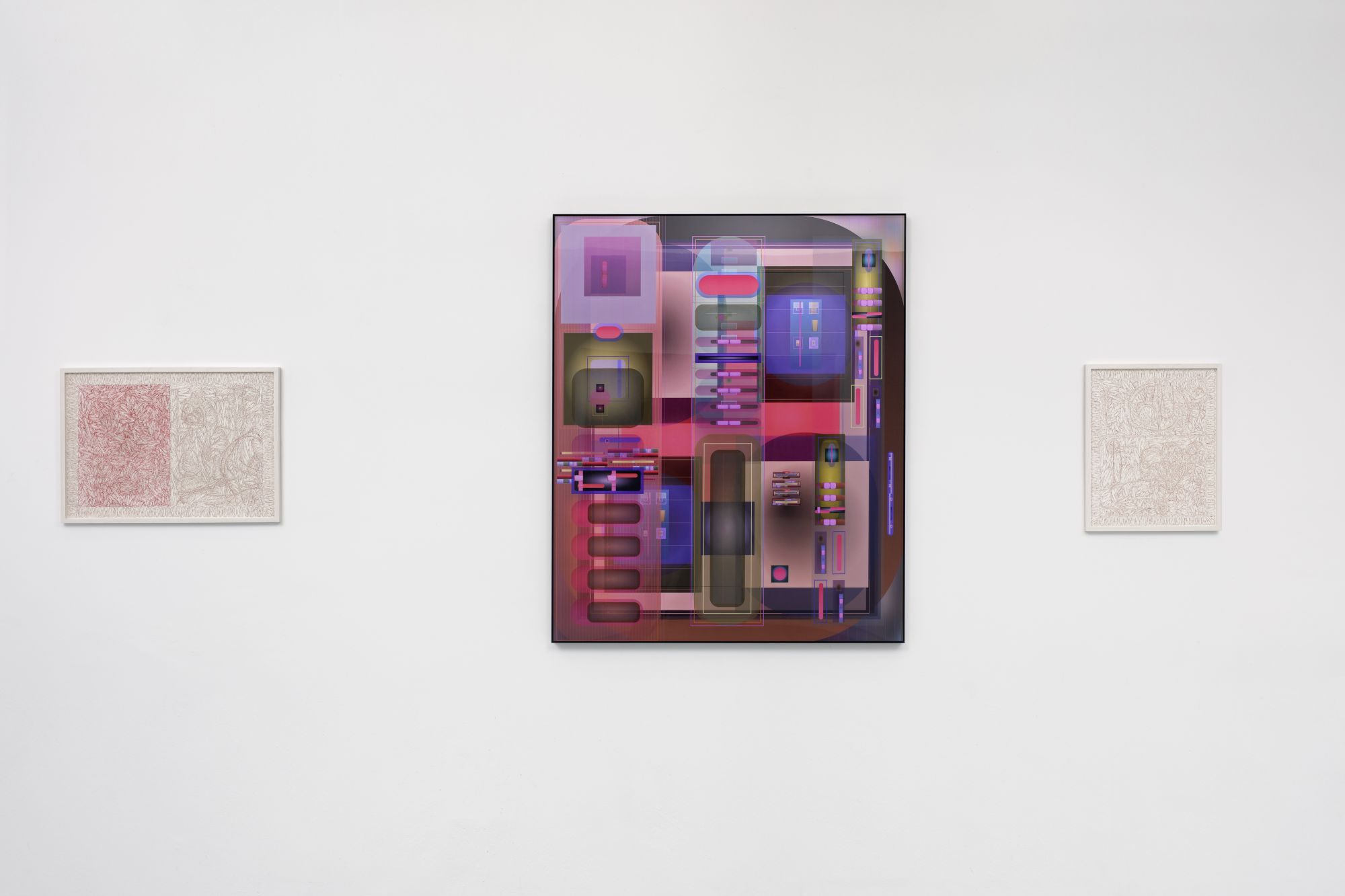
Context Switch — installation. The duo show with Achraf Touloub at Galerie Noah Klink; the programming term names its theme — the cognitive cost of attention-switching that the works are staged to resist.
The Exhibition
Context Switch was the duo exhibition by Harm van den Dorpel and Achraf Touloub at Galerie Noah Klink, Kulmer Straße 17, Berlin, running from November 12, 2022 to January 29, 2023. The title is a programming term — context switching refers to the operating system's saving of one process's state to load another's — already setting up the show's thematic concern with digital cognition and its impositions on attention.
Two texts frame the exhibition: Nora Enning's curatorial essay distributed by the gallery (full text at sources/ingested/context-switch-noahklink-essay.md), and Adina Glickstein's review in Artforum (November 2022, at sources/ingested/artforum-cryptoart-review-2022.md). Both grapple with the same dialogue between van den Dorpel's algorithmic / optical works and Touloub's analog watercolour and oil practice — but along different axes.
Nora Enning's Curatorial Frame (Galerie Noah Klink)
Enning opens with two grounding citations: a 2016 study (Yang et al.) on the longevity-promoting effects of human connection, and the pre-Socratic Greek doctrine that "identified change as the only constant in life, as everything evolves at all times in relation to each other." Both Touloub and van den Dorpel are framed as exploring "generative connections between humans and their surroundings" — a phrase that carries weight in van den Dorpel's case because generative is also the technical term for his algorithmic methodology.
Resistance to single-glance comprehension. "Observation has always been of the highest sensory demand if one wants to recognize every subtlety. And yet this is impossible in one single glance." Enning identifies a shared formal strategy: van den Dorpel's "vivid changes in colour and structure… make unchanging observation impossible simply by their design"; Touloub's "repetitive concentration of form, in which one knows how to lose oneself and, in its density, can never fully be grasped." Both works require "constant movement and change in front of the artworks" while ensuring viewers "will ultimately fail to comprehend them in their entirety." Comprehension as asymptote — the work proposes a horizon it will not let you cross.
Touloub: representation as connection to primordial time. Touloub "explores concepts of representation as a way to connect to primordial times by creating different figurative motifs to implement concepts of archaic and traditional arts into modern presentation schemes." The "eternally lasting form repetitions" reflect on connection itself — what binds and what recurs across long timescales.
Van den Dorpel: digitisation, connectivity, anonymity. "In the age of digitisation, there seems to be no way of not being connected through some digital network. Being invisible nearly becomes impossible, yet one's anonymity remains." Van den Dorpel's algorithms are framed as a response: a place "out of time and space" where one finds "not only one's personal story and viewpoint, but to initiate connections solely out of the mind." The double bind of platform life — visibility unavoidable, identity dissolved — is named directly.
The closing thesis. "To distinguish the digital from the supposedly tangible no longer seems contemporary, as they now seem to complement each other and merge almost seamlessly. The completion and perfection of an artwork are not defined by its material nature. The hierarchy of material-aesthetic reception is deliberately broken up and the work of art is recognized solely as such. What counts even more than the artwork itself is the intention behind it. One cannot only perceive the hapticity or pattern but far more the initial intention as a dematerialised concept – the flux of life."
This is the strongest curatorial articulation in the corpus of intention as dematerialised concept. It connects to the "criterion vs. code" distinction articulated in process-legibility: what the artist contributes is judgment about what counts, not the executing matter — a position that holds across photographic aluminium, plotter ink, and screen pixels alike.
Adina Glickstein in Artforum (November 2022)
Glickstein describes van den Dorpel as "an OG in Berlin's cryptoart scene" whose work generates geometric patterns through technological means.
Van den Dorpel's Light Exposure Prints
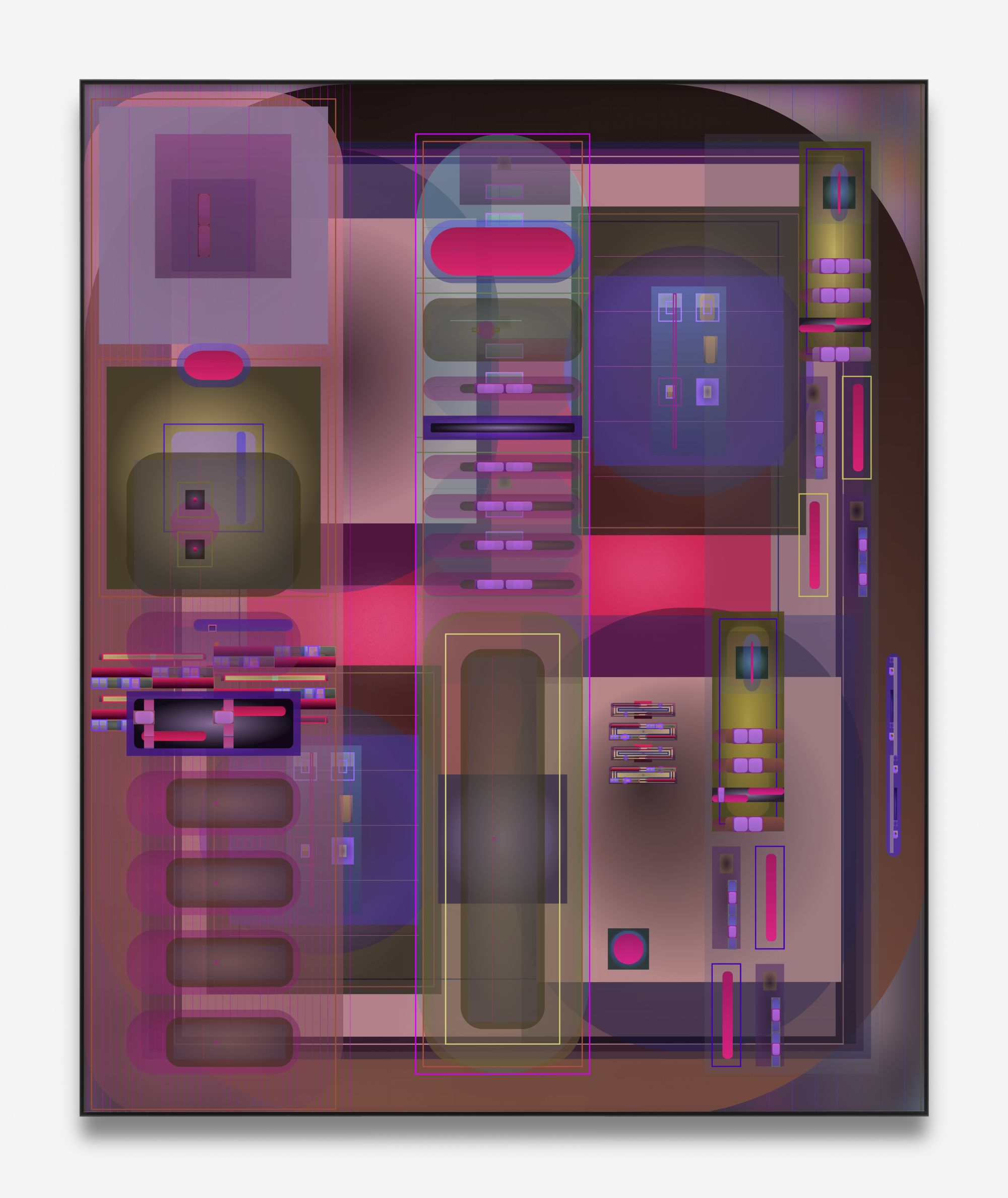
Modular Mind. Nested squircles produced by light exposure on photographic aluminium — organic geometry, each print unique, the soft bevels recalling a user interface's contours.
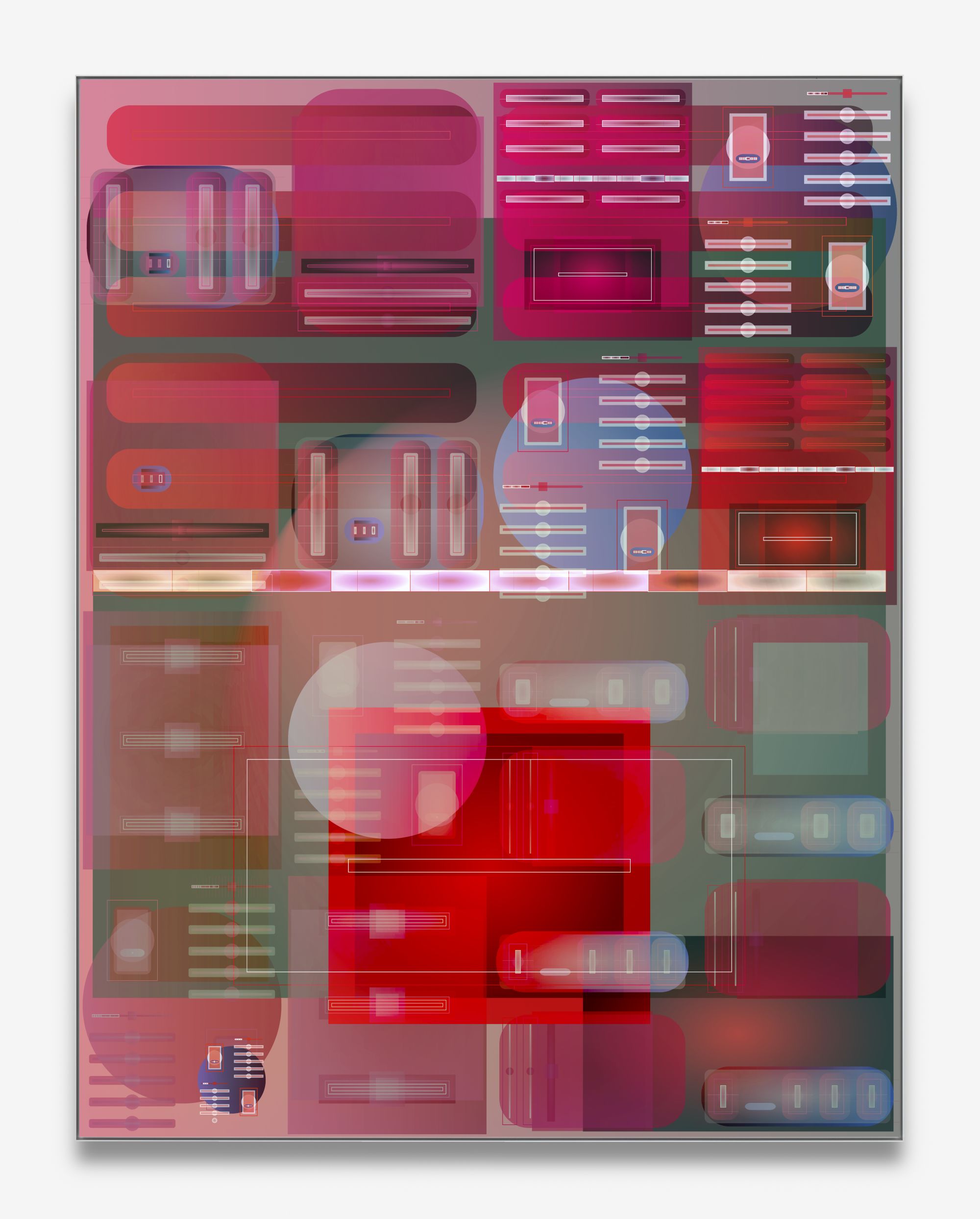
Both employ nested squircles "recalling the gentle contours of a user interface" — connecting to the broader trajectory of UI aesthetics as interface ideology. The prints bear "organic geometry, internally harmonious and each one unique," like snowflakes; they "register moments in time, fixed in place by technological means."
Mutant Garden Autobreeder — Algorithmic Animation
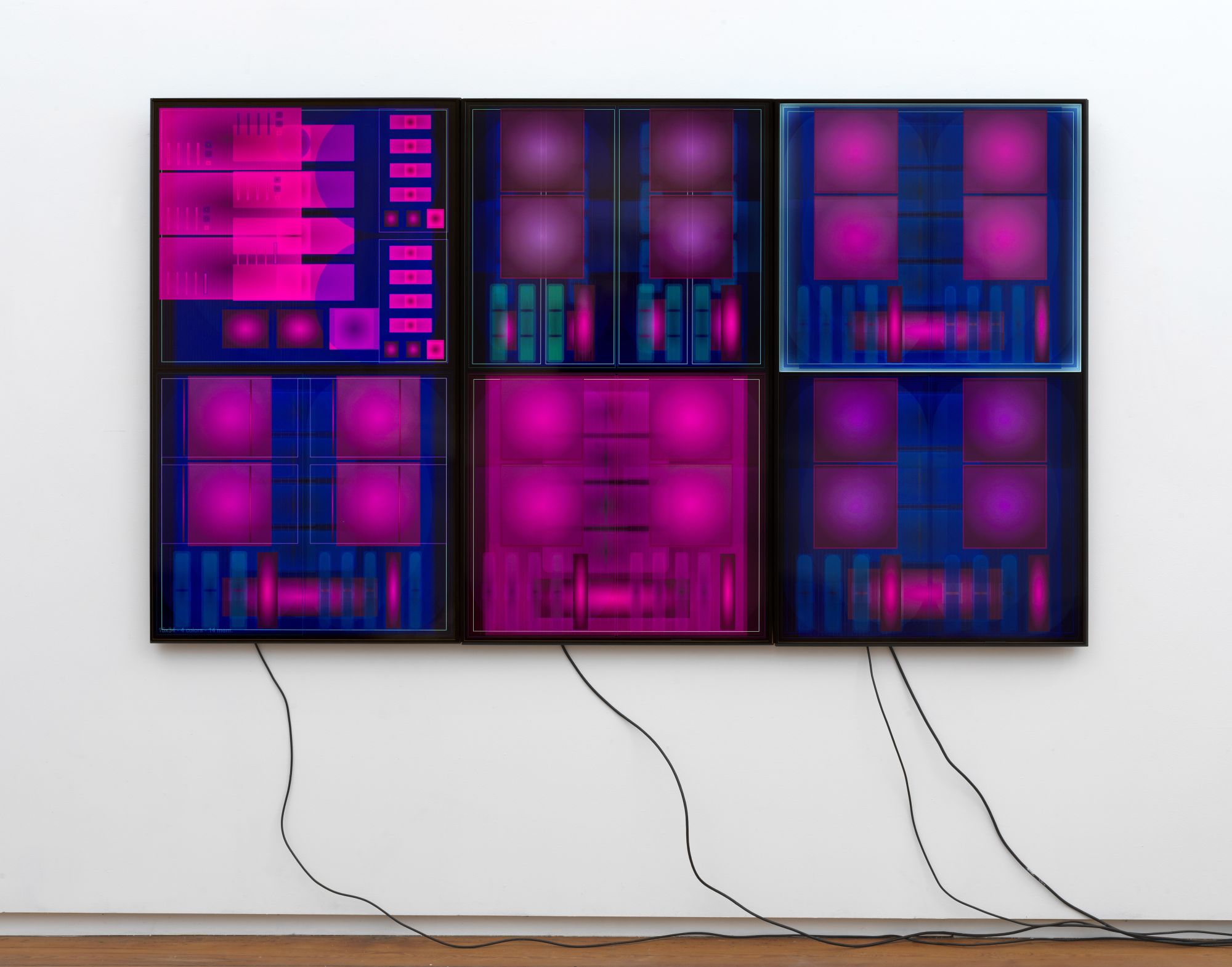
In the back of the gallery, Mutant Garden Autobreeder (2021) plays on an LED screen — "a grid of infinite, algorithmically generated animations" that "iterates hypnotically." This is the software component of the Mutant Garden practice, distinct from the light prints' optical/physical generation, though both produce kindred nested geometric language.
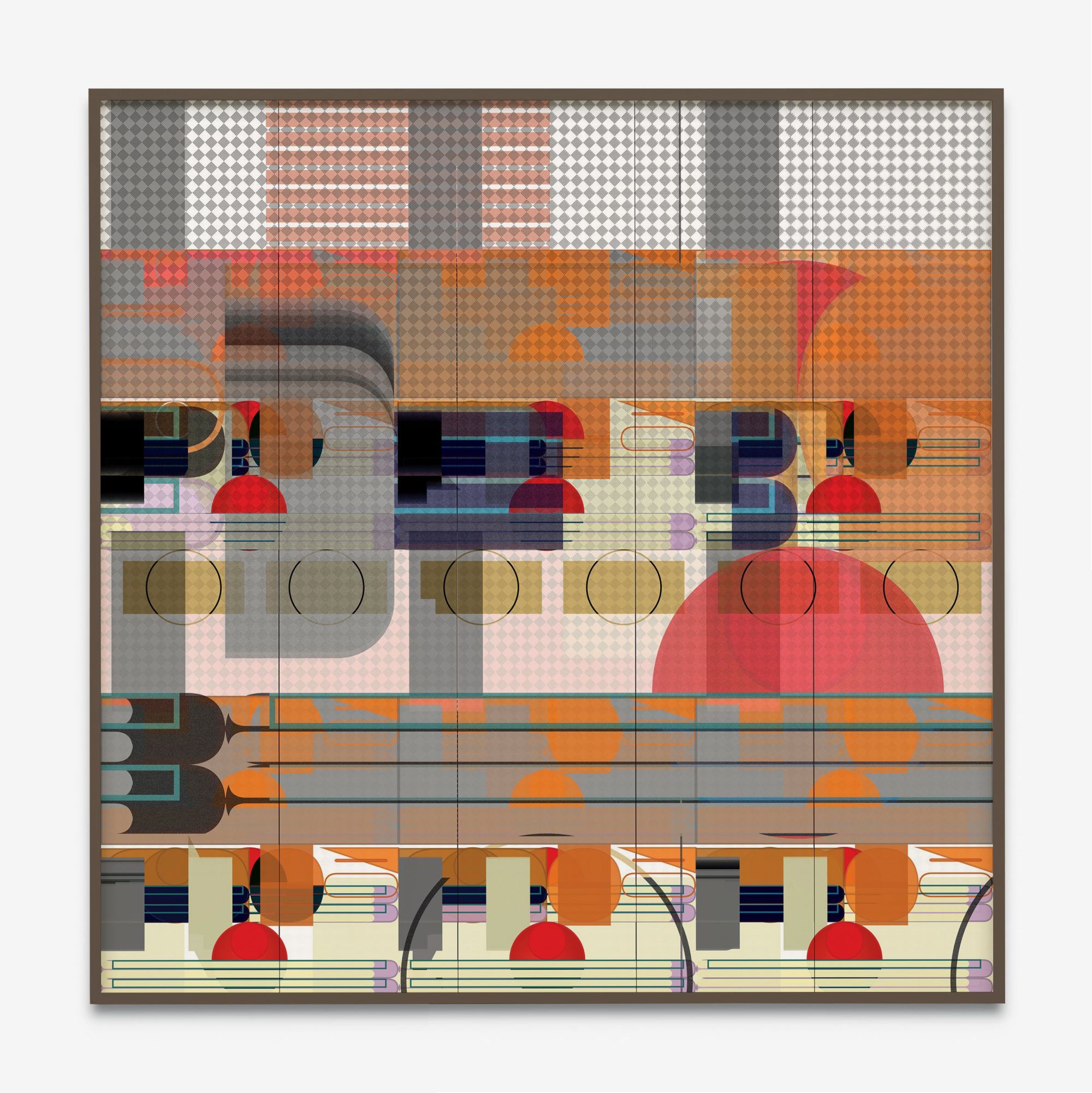
Eventide Paramour. A light-print specimen from the same Mutant Garden lineage — the physical, optically generated counterpart to the Autobreeder's endless on-screen breeding.
Typographic Trace and the Drawings
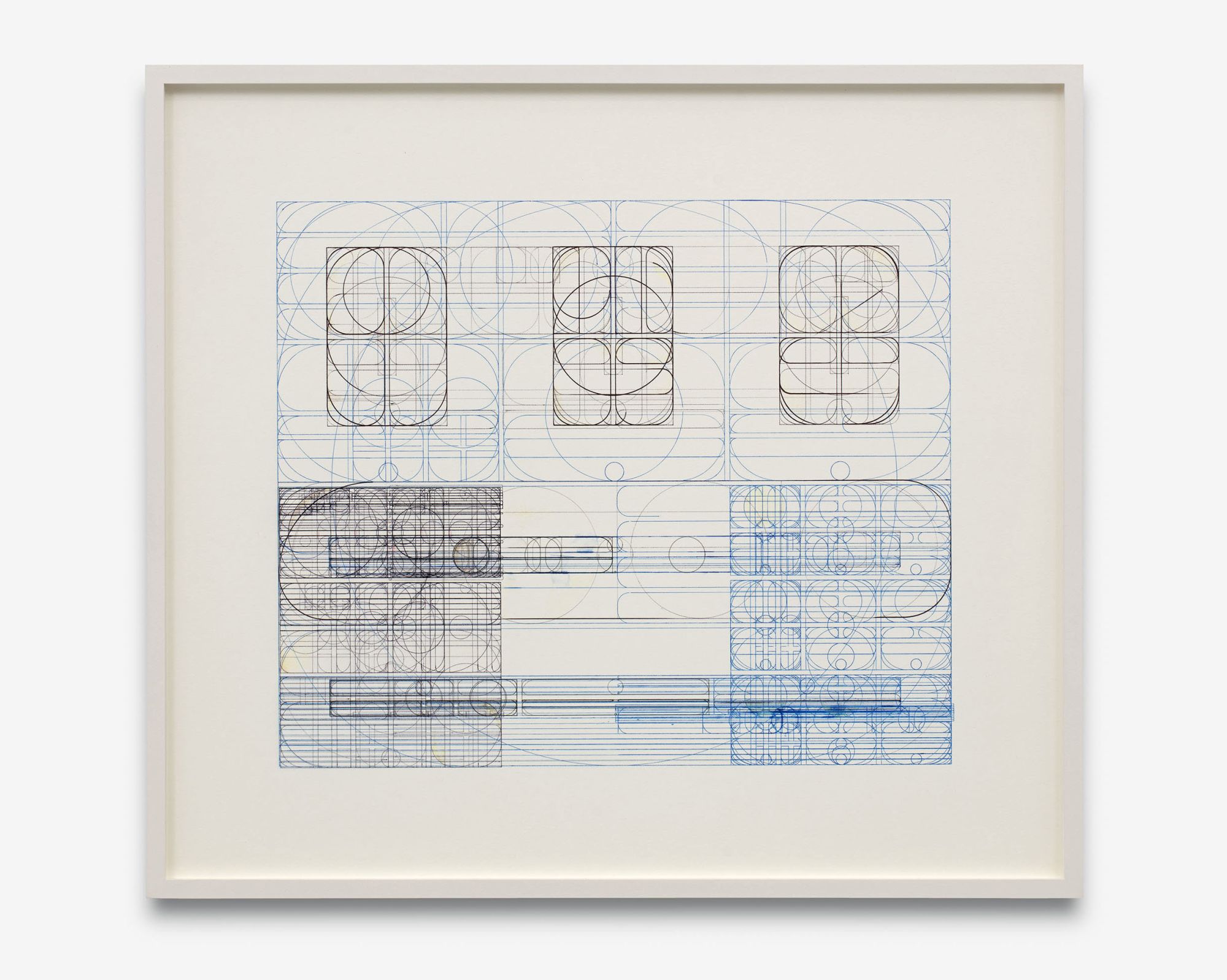
Two earlier Automated Drawings — Uttered Modality (2018) and either Diaphragm (2018) or Lazy, Eager, Last, Final (2018) — were also shown, alongside the Death Imitates Language wall object Big Pablo Ferenc Zatlas (2021). The eighteen-piece span (works from 2018, 2021, and 2022) places the new light exposure works in conversation with the practice's broader genetic-algorithmic and plotter-drawing lineage.
Touloub's Works
Achraf Touloub showed a mix of watercolour-and-acrylic on paper, oil on canvas, and untitled works. Specific Glickstein highlights:
- Egregore rising (2022) — title conjures "the onset of a Twitter swarm, with its gesture toward emergent groupthink"
- Discord venue (2020, watercolor/acrylic on paper) — named after the crypto-trader platform; conjures "gm" and "fresh alpha" in the chat
Other Touloub works in the show: Sight scenario II (2020), The Arrivals III (2021, oil on canvas), 1999 (2022), Untitled (electric garden) (2020). Glickstein describes them as "so intricate that they might be described as data-rich, with tight twirls of miniscule petals expanding outward to the borders of the frame."
Conceptual Coherence — Reading Both Texts Together
The two texts — Enning's curatorial essay and Glickstein's review — pose the same structural argument from opposite directions:
| Enning | Glickstein | |
|---|---|---|
| Frame | Pre-Socratic change-is-the-only-constant; longevity science | Cryptoart scene; doomscroll critique |
| Touloub's content | "Primordial times" via figurative repetition | Twitter swarms, Discord platform vocabulary |
| Van den Dorpel's content | Digital network as inescapable; anonymity preserved | UI squircles; nested geometry |
| Resolution | Digital and tangible merge seamlessly; intention is the work | Both artists make digital culture meditative, where there is "room to breathe" |
Enning argues that the digital/tangible distinction is being dissolved by the practices; Glickstein argues that the practices use that dissolution to recover contemplative attention from the platform-economy. Together they bracket the show's thesis from both ends — what is dissolving and what is being recovered through the dissolution.
The binary analogy (Glickstein). "One artist works in zeroes and ones; the other, in the opposition between line and negative space; mark versus blankness here becomes its own kind of binary code." This collapses the apparent media difference into a shared underlying logic — both work with minimal elements (on/off, mark/space, pixel/void) generating complex wholes. It is the formal counterpart to Enning's intention-supersedes-material claim.
Meditation and asymptotic comprehension. Glickstein names the work "meditative"; Enning specifies what the meditation does — it holds the viewer in constant movement before a work that will never be fully comprehended. The meditation is not stillness but sustained, undefeatable attention. This is the cognitive opposite of the context switch: instead of jumping between processes, the viewer holds one process open indefinitely.
The title as concept. Context Switch is the cognitive cost of constant attention-switching, the central condition of platform culture. The exhibition stages the term as a problem: by holding still in front of work that resists single-glance comprehension, the viewer is forced out of the rapid context switching that defines the doomscroll, into a single sustained — and incomplete — attention.
Related Concepts
- The Squircle — Impure Geometry and the Ideology of Interface — Blush Array II and Modular Mind as optical materializations
- Process Legibility — Enning's "intention as dematerialised concept" as a curatorial articulation of the criterion-vs-code distinction
- Randomness and Pattern — data-rich complexity from simple operations
- Senescenence — mandala as sacred geometry; meditation; "primordial times"
- Mediation and the Archive — light exposure as recording; technological fixing of pattern
- Protocol, Taste, and Systems — anonymity preserved in the network as an aesthetic-political condition Enning names