
The Squircle — Impure Geometry and the Ideology of Interface
The form
The squircle is a superellipse: a curve described by the equation |x/a|ⁿ + |y/b|ⁿ = 1. When n = 2, the equation produces a circle. As n increases, the curve swells toward a rectangle. At n = 4 — or in Apple's implementation, a carefully tuned Bézier approximation where the curvature transitions even more continuously — you get the squircle: a shape with approximately straight sides and strongly rounded corners, simultaneously recalling both the circle and the square without fully committing to either.
Gabriel Lamé described this family of curves in the nineteenth century. The Danish polymath Piet Hein popularised the superellipse in 1959, when Stockholm commissioned him to design a public square at Sergels Torg: neither circular (wasteful of space) nor rectangular (visually harsh), but something in between. The squircle began as a civic compromise, a shape chosen because neither of the pure options was acceptable. Its origin is negotiation, not discovery.
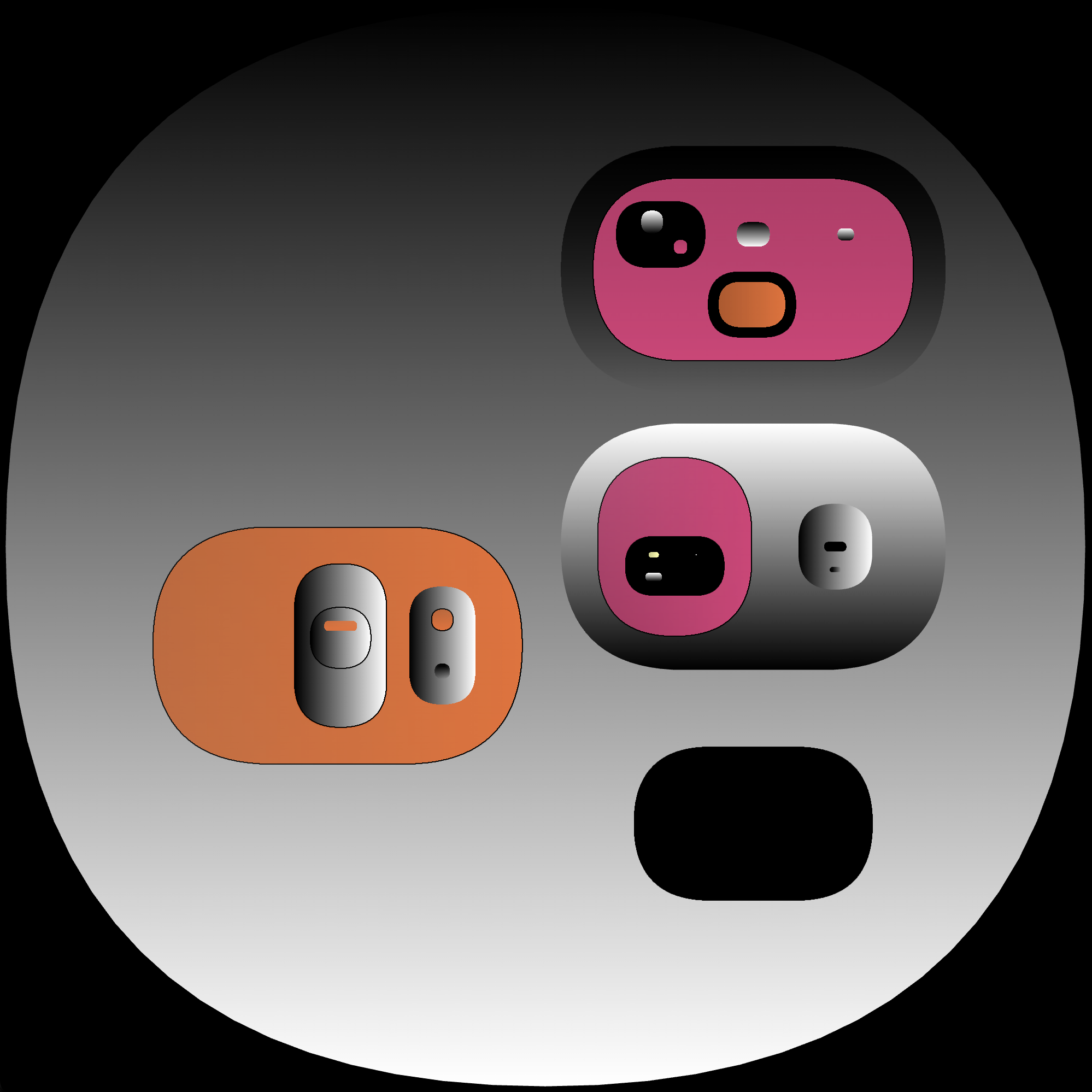
Markov's Dream #12. Squircles nested inside a squircle container — the rounded square recursing into itself, the same probabilistic logic as Markov's Window now wearing the interface's own form.
Mathematical impurity
"Mathematicians hate it." (→ Spike #70)
The circle is defined by a single intrinsic relationship: every point equidistant from the centre. The square is defined by right angles and equal sides. Each is determined completely by one rule. The squircle requires a parameter — n — that has no intrinsic justification. Why 4 and not 3.5 or 5? The answer is not mathematical but perceptual: because 4 looks right to the people who designed the iPhone. The form is calibrated to a corporate aesthetic judgment, not derived from any geometric necessity.
This is what makes it impure in the mathematical sense. A pure form is self-justifying — its properties follow from its definition. An impure form borrows from multiple definitions without fully satisfying any. The squircle is neither the circle's perfection nor the square's rigor. It is a controlled departure from both, chosen for what it feels like rather than what it is.
The humanising ideology
Apple adopted the squircle as the standard shape for iOS app icons from iOS 7 (2013) onward. The design rationale was explicit: rounded corners feel warmer, more organic, more human. Hard corners belong to industrial machinery; rounded forms belong to natural objects — river stones, handled tools, the human palm. By rounding the square, the interface signals approachability. The machine presents itself as having been softened for you.
This ideology maps the machine/human distinction onto geometry: sharp = cold = industrial; rounded = warm = natural. The squircle is the shape in which capitalism represents itself as care.
The Markov's Dream about text identifies the mechanism precisely: "computing evolved from text-based tool interfaces to graphically-oriented corporate platforms with limited user agency. These platforms employ rounded edges and organic aesthetics to create metaphorical human connections while constraining creative freedom." The warmth is inversely correlated with agency. The more inviting the container, the less you can do inside it. Rounded corners are the aesthetic of interpassivity: a form that receives you, holds you, but does not open.
Malevich's square inverted
Kazimir Malevich's Black Square (1915) is the canonical pure geometric form in art history: a black square on white ground, asserting that painting could be entirely self-referential, freed from the obligation to represent anything outside itself. The square was the claim of autonomy — the refusal of embeddedness.
The squircle is the square's ideological inversion. Where Malevich's square refuses the social, the squircle performs immersion in it. Where the square claims: this is art, sufficient unto itself, the squircle claims: this is technology, shaped to your hand. Both make their argument through geometry. The square argues by being nothing but itself. The squircle argues by appearing to have been adjusted for you.
The political claim in the Spike #70 interview follows from this: "To intervene in contemporary life means to operate on the level of user interface design, because that's where we spend most of our time now when we consume culture." The squircle is the terrain. It cannot be escaped by working at the level of the pure square — Malevich's move — because the pure square no longer controls the surface where most encounters with images happen. The intervention must happen inside the squircle's formal vocabulary.
Sacred geometry as the language of capitalism
Sacred geometry — the golden ratio, Platonic solids, mandalas, the geometric patterns of Islamic architecture — operates by presenting mathematical form as cosmically significant. Certain proportions are not invented but discovered; they encode divine order, the structure of creation, the language in which God or nature wrote the world. The practitioner who works with sacred geometry does not design but reveals.
The squircle operates by an analogous move, but for a secular and commercial context. The soft corner is presented not as a design choice but as a natural fit — the shape that corresponds to how humans actually are. Apple did not invent the squircle; Apple discovered that this is what the human hand expects to hold. The form is naturalised: it feels right because it is right, because it matches some pre-existing human geometry.
Both sacred geometry and squircle ideology work by the same operation: they take a constructed form and present it as found. They take a historical, political, economic choice — what proportions the cathedral should use, what curvature the app icon should have — and reframe it as necessity. "Of course the rose window follows these proportions — the universe is structured this way." "Of course the icon is a squircle — humans are naturally this shape."
The difference is in whose interests the naturalization serves. Sacred geometry served religious institutions, and through them the consolidation of symbolic authority in the medieval church. Squircle ideology serves consumer capitalism, and through it the normalisation of the interface as the primary environment of cultural consumption. In both cases, geometry becomes a language that conceals the interests it encodes by presenting them as cosmic or natural givens.
The squircle is not the geometry of transcendence but of comfort — which is, in capitalism's visual economy, the same thing. The transcendent form and the comfortable form both make the same claim: this is how things should be, and therefore: there is no alternative.
The squircle made physical
Several works from the Death Imitates Language (2016–) and Nested Exchange (2017–) series were fabricated as wall objects: UV prints on CNC-machined multi-layered acrylic glass, 100 × 100 × 3–4 cm, bolted directly to the wall. Each is a square panel — the acrylic glass is square — holding a large squircle as its printed subject. The outer container is a square; the image inside it is a rounded square. The panel presents the squircle as a specimen, framed.
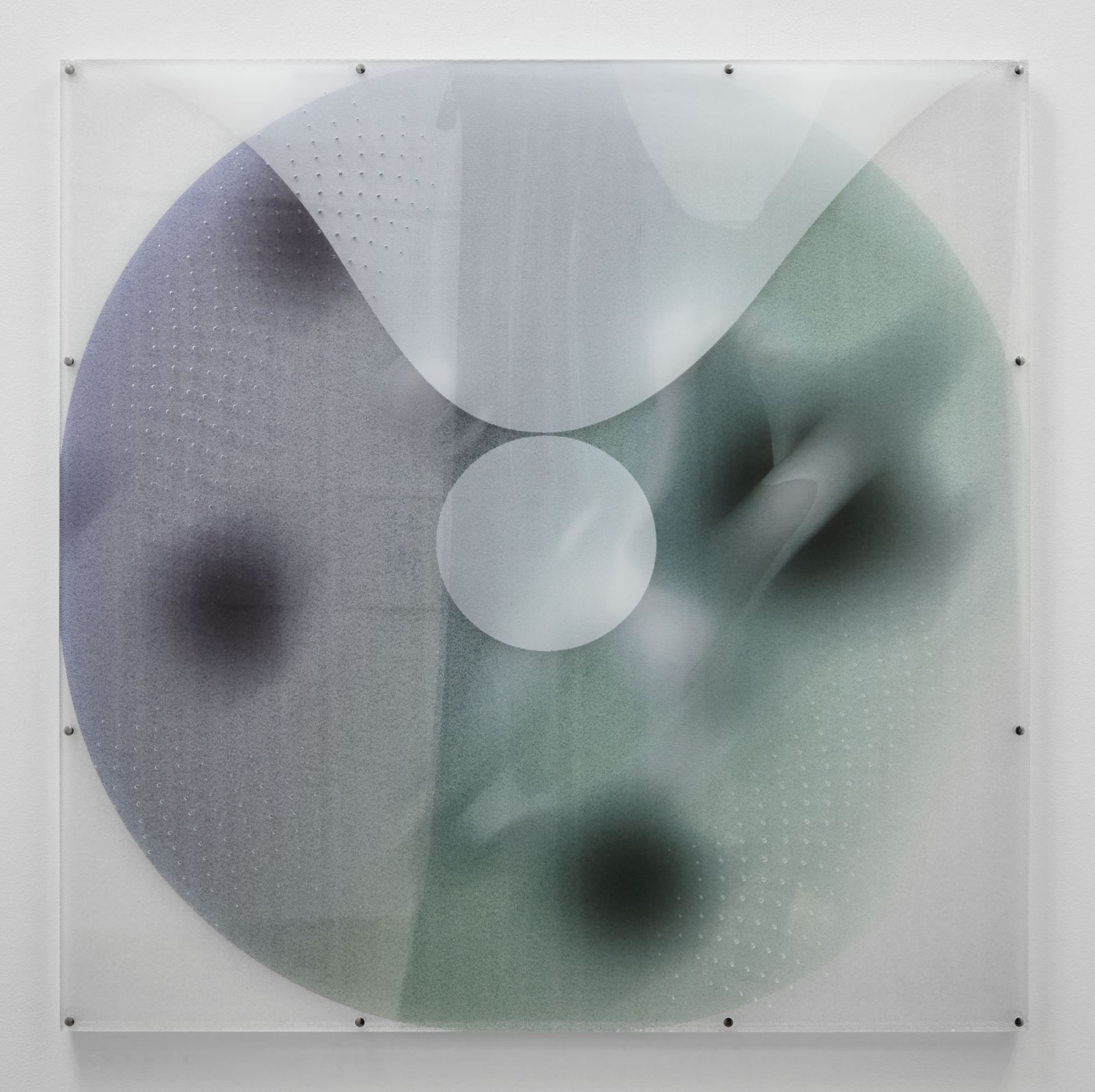
Juancar Zolim Juancar. A square acrylic panel carrying a printed squircle as its subject — the app-icon shape framed as a specimen: squircle as organism, square as frame.
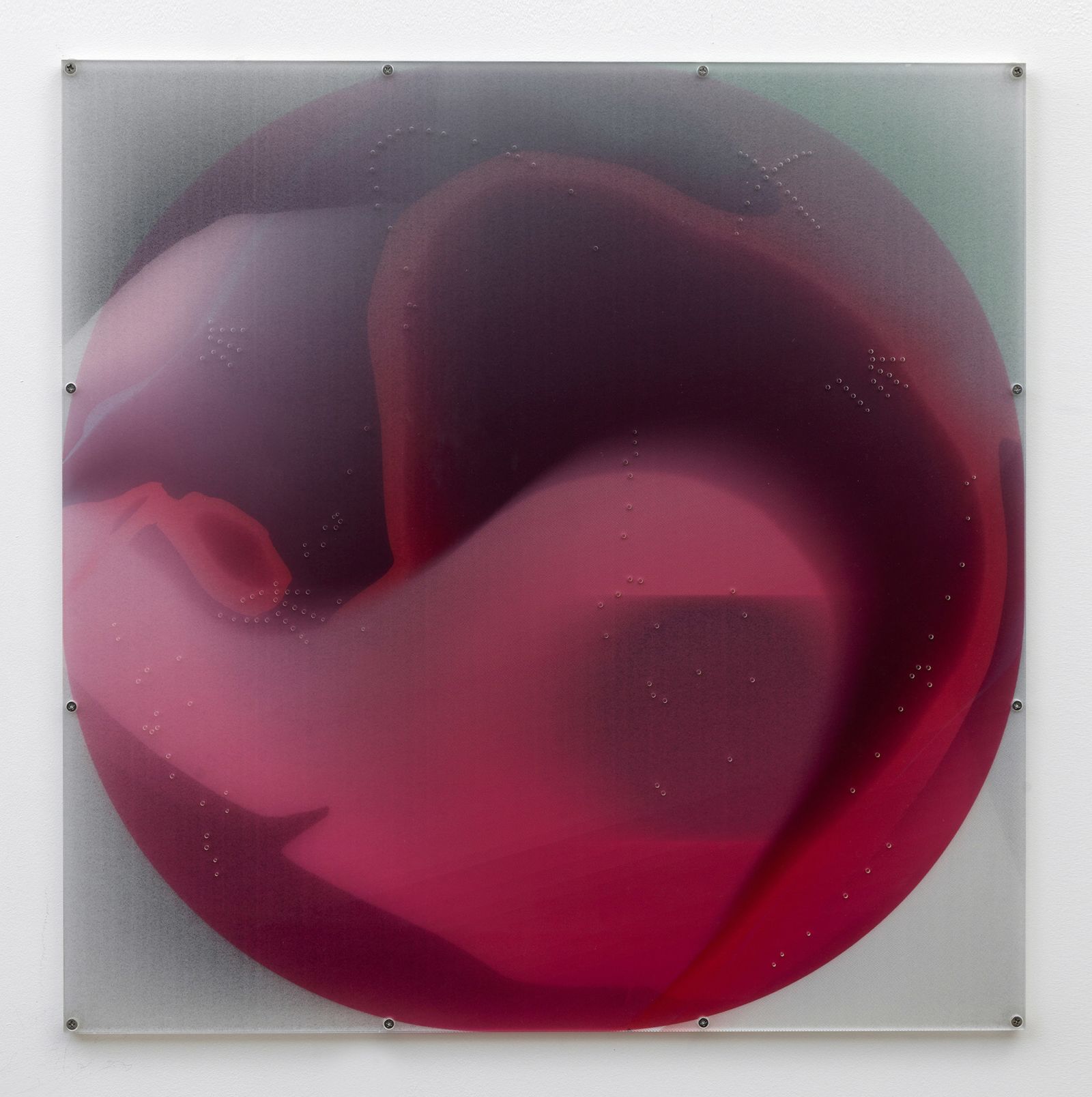
Vvgdamn Pipikaka Yozdczmi. The same square-framing-squircle logic, here with packaging foil left permanently between the acrylic layers — the seal that should have been peeled kept as the work.
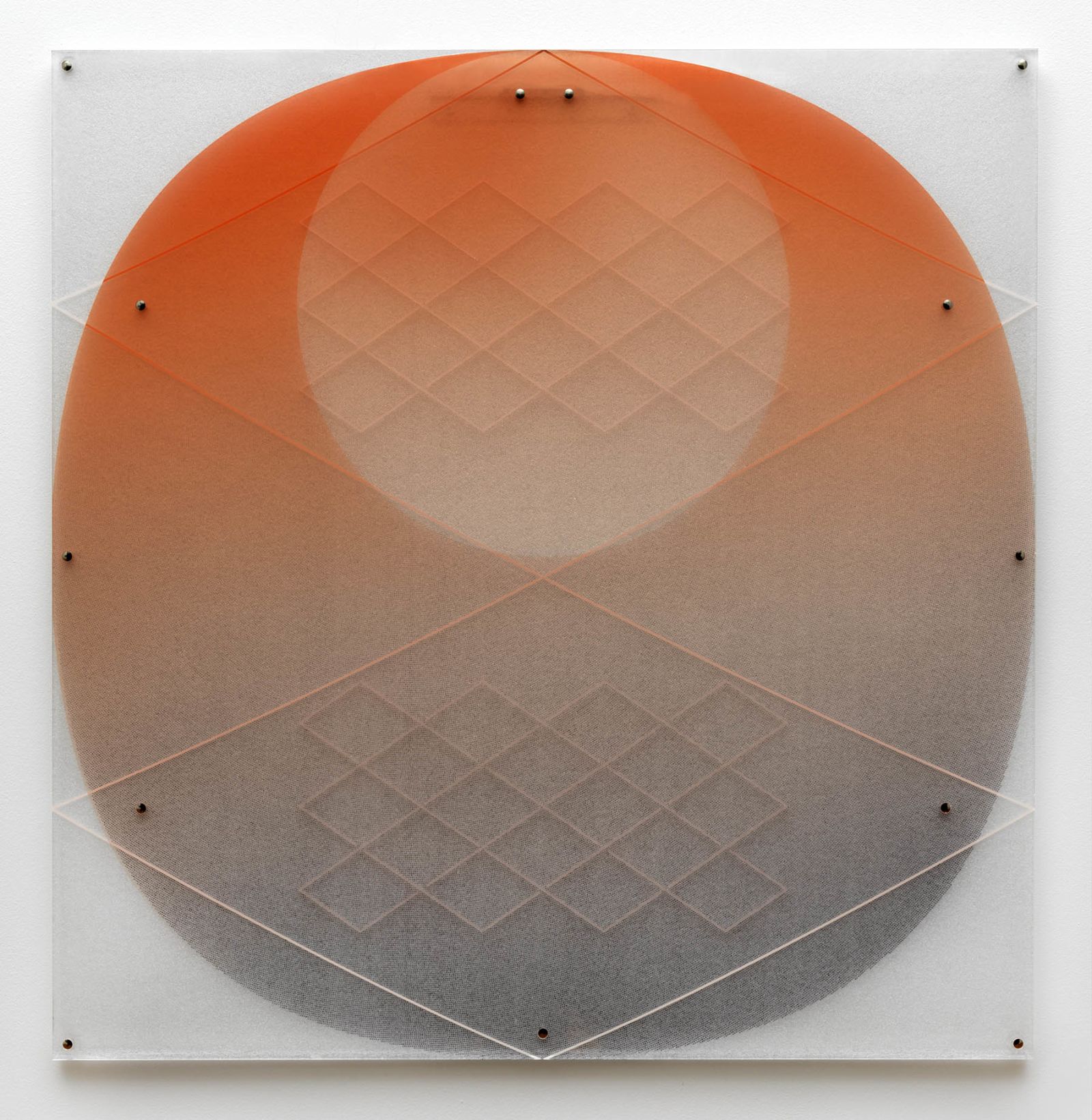
Lammer Asbestos. A Nested Exchange specimen bred by the hipster algorithm to be maximally unlike every other — the squircle once more printed on a square acrylic panel and bolted to the wall as a framed organism.
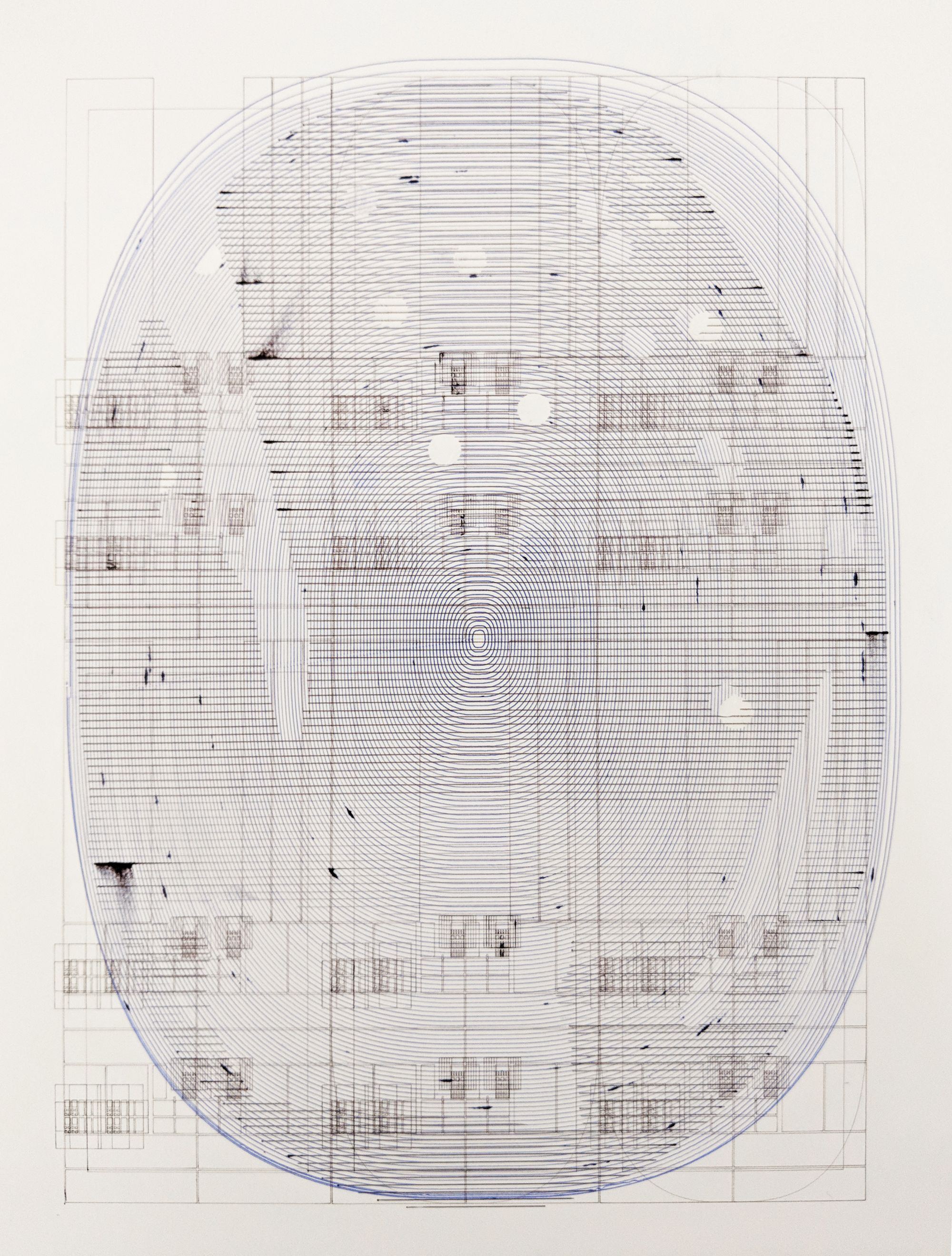
A parallel materialisation takes a different route. Fingerprinting (2018), from the Automated Drawings series, is a pencil and pen plotter drawing — a hybrid in which a machine traces forms on paper while the hand also leaves marks. The title names the most irreducibly personal human identifier: the fingerprint is the mark of a body, the guarantee of individuality. Here it is produced automatically. The plotter performs the personal just as the squircle performs the organic: the warmth is real in effect and constructed in origin.
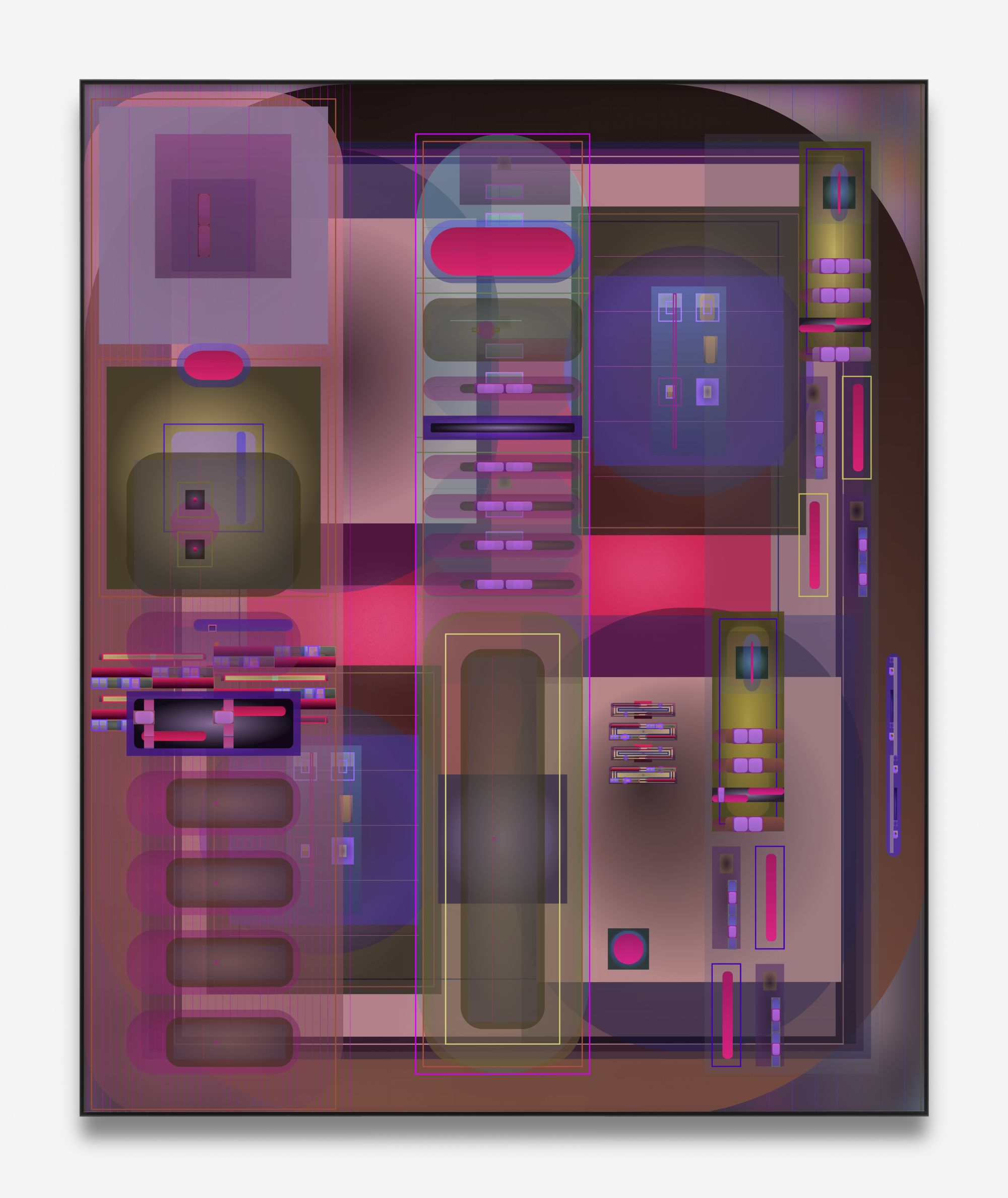
A third pathway materializes the squircle through optical and photographic processes. Blush Array II and Modular Mind (both 2022) are light exposure prints on photographic aluminium, each unique edition with mounted acrylic glass framing, 100 × 130cm. Both were shown in Context Switch, the duo exhibition with Achraf Touloub at Galerie Noah Klink, Berlin (November 2022 – January 2023). These works generate nested squircles through exposure, producing what Adina Glickstein described as "organic geometry, internally harmonious and each one unique" with "soft beveled edges recalling the gentle contours of a user interface." (→ Context Switch review, Artforum) The nested squircles emerge not from algorithmic output or hand-drawn assembly, but from the physical interaction of light with photographic paper — a fourth material substrate for the form that both algorithm and interface depend on.
The move from screen to wall object is significant. In the screen context, the squircle is infrastructure — the invisible container for content, the shape you do not notice because it is everywhere. Printed at 100 × 100cm in UV ink on layered acrylic, it becomes visible as a form, something to look at rather than through. The acrylic material echoes the screen — it is translucent, slightly reflective, bolted to the wall like a monitor — but it does not update. It holds one state, permanently.
The square panel framing the squircle inside it also makes the geometric relationship literal: the square is the module, the grid unit, the neutral container; the squircle is what happens to the square when it is processed through an aesthetic system that values warmth over purity. Each panel is a square that has been given a squircle to carry. The tension between container and content is the same tension as between the Malevich square and the Apple icon — presented here as an object you can stand in front of.
The icon that becomes the thing
The squircle is primarily encountered as an app icon: a small rounded square tile on a screen, standing in front of software. It is a signifier — it represents the application without being it. You tap the icon to reach the program. The icon is a threshold, a promise, a container for something that lies behind it. Its function is to disappear into the act of pointing.
In Death Imitates Language and Nested Exchange, the squircle has nowhere else to point. The large acrylic panels hold squircles that are not icons for anything — there is no software behind the tile, no app to launch. The squircle is the destination, not the departure point. What normally functions as a sign for something else has been made into the thing itself. What was a threshold is now a surface.
This inversion is reinforced by the works' material construction. Vvgdamn Pipikaka Yozdczmi incorporates packaging foil between the layered acrylic sheets — and this foil is present across the series. Packaging foil is the protective film applied to consumer electronics before sale: it covers screens, seals cartridge ports, protects drum units during transit. It exists specifically to be removed before the device can function. The act of peeling it is the ritual of first use, the moment the device passes from new to yours. Manufacturers now deliberately engineer the peel — optimising the film's adhesion, sound, and resistance — because it has become an emotionally resonant threshold. The object was sealed; now it is activated.
In the acrylic works, the foil is not removed. It stays between the layers, permanently partially obstructing the underlying printed surface. The work is held in the state of the new — sealed, not yet activated, not yet entered. The squircle icon that normally dissolves into the act of launching something here holds the viewer at the surface indefinitely. The seal that should have been torn away is the work.
Occupation rather than refusal
Markov's Dream (2022) responds to the squircle not by rejecting it but by occupying it — a move that Giorgio Agamben would call profanation: not destroying the sacred form but returning it to common use, stripping it of its consecrated separateness (→ 1266). The work replaces the pure geometric squares of Markov's Window (2004) with rounded squares: "replacing pure geometric forms with impure circles or rounded squares." The same recursive logic, the same palette — but now operating inside the formal vocabulary of the era's dominant interface.
This is not capitulation. The squircle in Markov's Dream carries the same colours that the pure square of 2004 carried; it operates by the same probabilistic Markov logic. What changes is the formal skin, which is precisely the point: the form that corporate computing uses to simulate warmth is borrowed, inhabited, and made to carry a different content. The intervention is at the level of the interface because that is where the ideology is — not in explicit messages but in the silently naturalised shapes through which culture is consumed.
Mutant Garden (2019–) continues the occupation: the generative organisms are composed of squircle-based modules, their evolutionary fitness determined by complexity rather than by the preferences the squircle-interface normally optimises for (retention, purchase, return). The squircle as the unit of life rather than consumption.
See also
- "The Squircle of Life," Spike #70 — source of the "mathematicians hate it" observation; the squircle as the interview's central formal object; intervening at the level of UI
- Context Switch — Artforum Review (Galerie Noah Klink, Berlin, 2022) — Blush Array II and Modular Mind as optical/photographic materializations of nested squircles; the soft UI-like bevels emerging through light exposure
- The Markov's Dream Palette — the palette that crosses from square to squircle across Markov's Window → Markov's Dream; impure circles carrying pure colours
- Evolutionary Logic — Mutant Garden's squircle-based organisms; complexity-as-fitness vs. interface-optimised behaviour
- Protocol, Taste, and Systems — the squircle as the aesthetic protocol of the platform era; taste formalised as interface design
- Recursion and Self-Reference — the squircle recursing into itself (Markov's Dream token #12); nested containers all sharing the same impure form
- The Semiotic Square — the squircle as the shape that refuses the clean oppositions (square/circle, pure/impure) the semiotic square maps; the mixed term made dominant