
The Grid — Krauss, the Loom and the Screen
Since 2019 many of van den Dorpel's works have been built on a grid. That February he started an are.na channel, Modular Aesthetic Systems, described as "characters, alphabets, grids, modularity, zoom", and its first works of his own are the Colour Configuration pairs of March 2019 (1, 2) (sources/ingested/arena-modular-aesthetic-systems.md). A channel from 2018, To Exhaust a Possibility Space, already set variants of one form side by side, from Bernd and Hilla Becher's water towers to Markov's Window (sources/ingested/arena-to-exhaust-a-possibility-space.md). The grid works on screen are Colour Configurations, Field, Anni, Pression des pairs, Stained Unravel and Interruptions. On paper they include Rasterbild and Rasterbild II, Rag, Swath, Thresh, Diagonal Fault, Vesper, Tract and Leaky Abstraction.
This page reads them against Rosalind Krauss's essay "Grids" (October 9, 1979), the standard account of what the grid meant to modernism (sources/ingested/krauss-grids-1979.md). The wiki has met the essay once before: Anna Kipke uses it to read the graph paper of Emma Kunz, paraphrasing Krauss's grid as one that "opens a back door to belief" (→ sources/ingested/kipke-politiken-der-innerlichkeit-2021.md).
From nesting to the grid
The artist describes the turn to the grid as a change of structure (November 2026): "A major transition in my practice was the move from nesting, embeddedness and compositing, as in Mutant Garden (Seeder) and Nested Exchange, to grids, as in many of my more recent works. I think the move happened because nesting implies a hierarchical document, with a schema, types and modules. I gradually got interested in the grid through textiles, art history, weavers, pixels, relationships and GPU shaders."
Nesting in the earlier work
Nesting is the structure of the earlier generative work. In Nested Exchange (2017–2019) the specimens "are configured in nested recursive 'tree' structures similar to those used in the first iterations of Chomskyan linguistics" (series text, harm.work; → Nested Exchange). Mutant Garden (2019–) builds its compositions from layers of rectangles and rounded squares, each placed inside another. Markov's Window (2004) and Venster (2024) subdivide a square into smaller squares, recursively (→ Recursion). In each of these a part is defined by its parent: it sits inside something and takes its place from it, the way an element sits in a document whose schema says what may contain what.
His own filing did not keep the two structures apart. In September 2022 he opened a channel called Alternating grids (x/y) and put three Nested Exchange works in it: Fissured Petrolling Mridangam, Cussos Unfence Thermographers and Seul (1, 2, 3). Next to them he placed a screenprint by Larry Poons from the portfolio X + X (1964) (block), two entries on Charlotte Posenenske, his own Field, and Damon Zucconi's abacus work Counting Frame (2022) (block). The channel has no description. Read alongside the Nested Exchange works, its title describes one way a tree turns into a grid. Cut a rectangle across x, cut each part across y, and keep alternating down the levels: the cells that result line up in rows and columns.
The Mutant Garden Seeder site lists the mutations of one mutant as tiles in a grid. Inside each tile the composition is nested: rectangles inside rectangles inside a rounded square. The interface is a grid, and the work in each tile is a tree.
Arrays on the wall
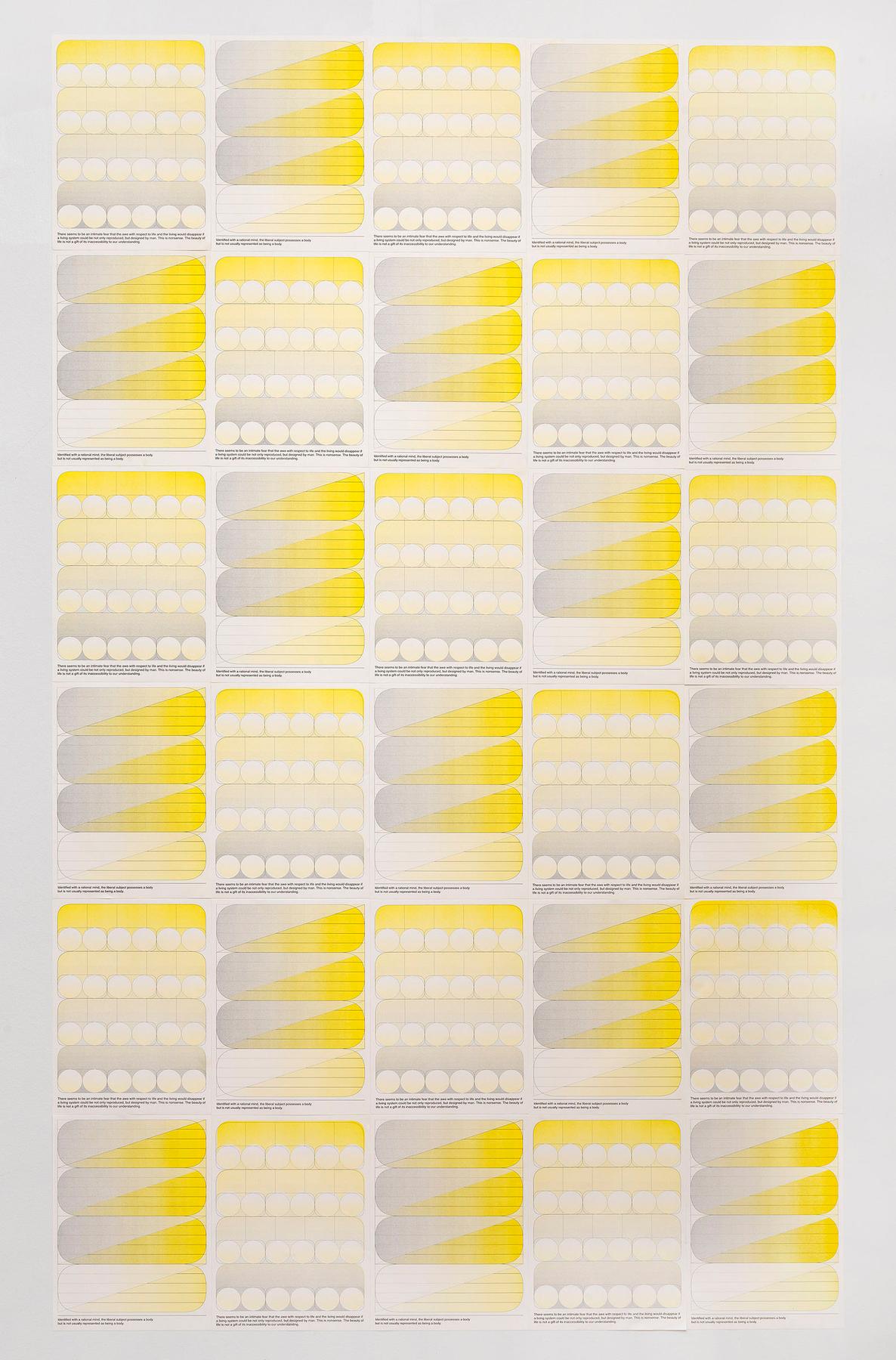
The same arrangement was on the wall a year before the grid channel opened. On 22 April 2018 van den Dorpel started a channel called Arrays. It begins with a note on the word's origin, "from Old French arei (noun), areer (verb), based on Latin ad- ‘towards’ + a Germanic base meaning ‘prepare’" (block), and two works of his own that he captioned as arrays: Intimate Fear, Rational Mind and Intimate Fear, Sensu Strictu (90 × 336 cm, block).
In the first, thirty posters hang in six rows of five, and two designs alternate like the squares of a chessboard. In one design four rounded bands each carry a row of circles. In the other the bands are crossed by diagonal wedges of yellow and grey. Each poster prints one sentence, and the title takes a phrase from each. One reads "There seems to be an intimate fear that the awe with respect to life and the living would disappear if a living system could be not only reproduced, but designed by man". The other reads "Identified with a rational mind, the liberal subject possesses a body but is not usually represented as being a body", close to a sentence in N. Katherine Hayles's How We Became Posthuman (1999). Each poster is nested, with circles inside bands inside a rounded frame, and the wall is a grid of posters.
Cells without parents
A grid has no parents. Each cell is set by its neighbours, the same rule applies everywhere, and no cell contains another. Krauss calls the grid's order "that of pure relationship", and relationships is one of the artist's own reasons for turning to it. It is also how a graphics card computes. A shader runs one function for every pixel at once, over a grid of cells that do not contain one another; Entfaltung runs entirely on the GPU in this way, and the Senescenence press release traces a line from "the binary logic of the weaving loom, to early two-dimensional pixel graphics, to the contemporary GPU" (→ Senescenence). Mutant Garden already had a grid inside it, out of sight. Cartesian genetic programming "represents a computer program as a two-dimensional grid: nodes and layers" (series text, harm.work), so its programs were grids that drew nested pictures. In Colour Configurations the grid reached the image as well.
Dating the change
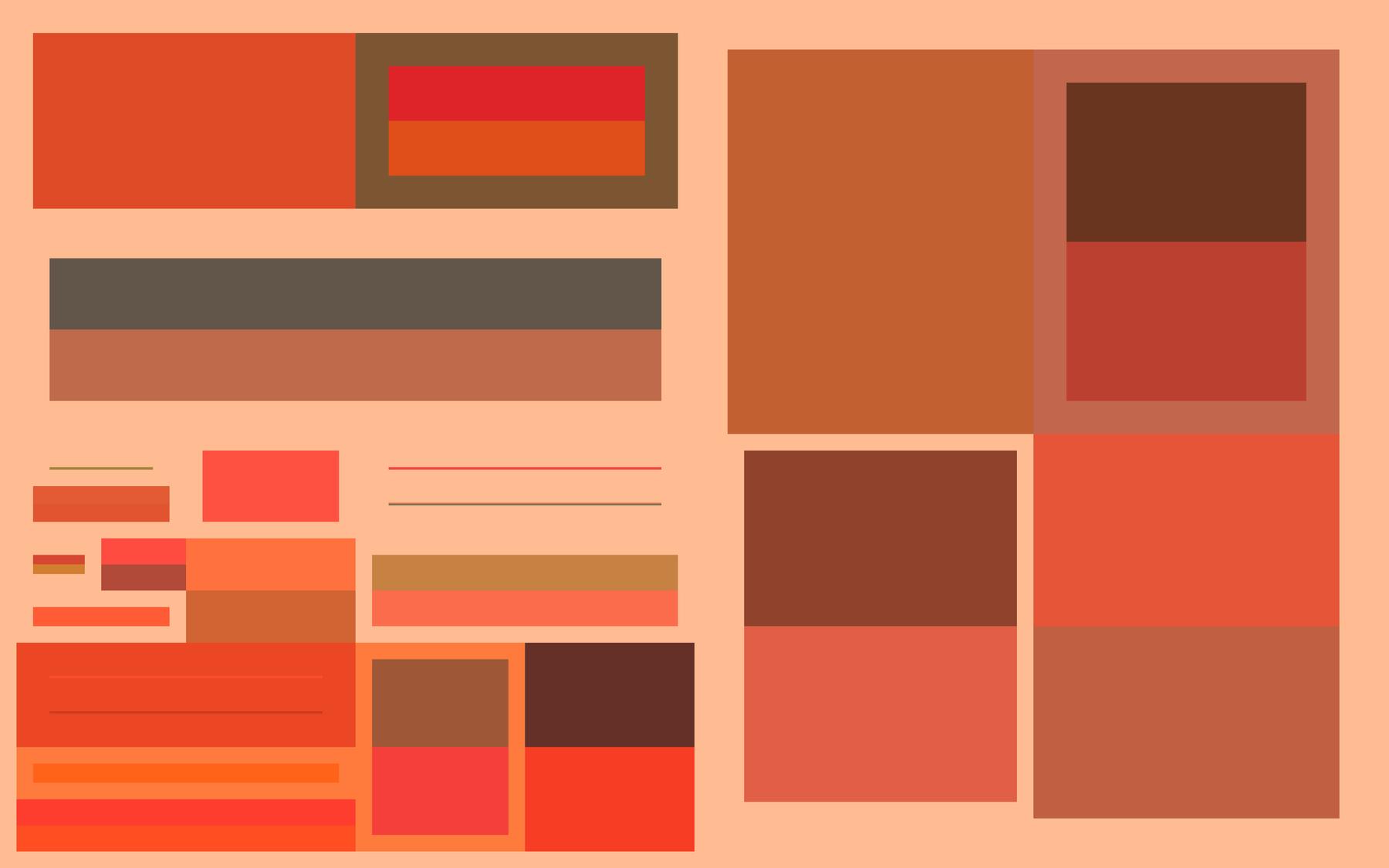
The are.na record dates the change. From November 2017 van den Dorpel kept a channel called Nesting, filled with screenshots of his work whose filenames begin on 30 September 2017. On 18 March 2019 he added the Wikipedia article on hierarchy, linked at its section on the containment hierarchy (block). That is the structure he gave in 2026 as his reason for leaving nesting. On 26 March he filed the screenshot above under Nesting with the caption "Cartesian genetic programming". The next block number, 3942475, is the first Colour Configuration Pair, which went into Modular Aesthetic Systems with the same caption. In the screenshot the field splits into a left half and a right half, the halves split into bands and blocks, and several blocks sit inside a border of another colour: the program is a grid, and the picture it draws is nested. The Nesting channel received no more work of his own after that week.
Nesting and grid combined
With Entfaltung (2026) the artist sees the two structures combined: "With the new Emma Kunz series, the embeddedness of nesting and the repetition of the grid seem to have found an amalgamation, made possible by the mathematical skills that programming with language models opened up to me." The drawings show both at once. Tabula I sets thirty figures in a grid, and inside each figure a fan splits into a ring of kites. Variance puts nine flower-like figures from one generator in three rows of three and transforms them together. Wending nests a square inside a square, the masons' ad quadratum, and mirrors the whole on both axes. In the tokens a nested construction, slivers inside faces inside a figure, is repeated by symmetry across three axes (→ Entfaltung; Entfaltung on Paper).
The algorithms and their works
The works run on a small number of grid algorithms. Each was written once and then used across screen works and drawings.
| Algorithm | The cell | On screen | On paper |
|---|---|---|---|
| Cartesian genetic programming | a function node in a grid of nodes; the program itself is the grid | Colour Configurations (2019–2022); Mutant Garden (2019–) | — |
| Spinner field | a loading spinner, one per 70 px of window | Field (2008/2023) | — |
| Anni | a triangle that turns with its neighbours, scanned like a weave | Anni (2024), Anni (unravel) (2025), Anni (sync) (2026) | Beads I–III (2025) |
| Pression des pairs | a rotating line whose orientation depends on the cells already written | Pression des pairs (2024); Interruptions (2026), which runs the line on the Stained Unravel rule engine | Vermis, Current, Atlas, Girl/Boy Song, Even Flow (2024); Sediment (2025); Tract (2026), among others |
| Stained Unravel | a four-point polygon in one of 23 shapes, set by exact neighbour positions (→ 3001, 3000) | Stained Unravel (2026) | Thresh, Diagonal Fault, Vesper (2026) |
The table separates the program from its outputs because the practice does. One algorithm produces animations, tokens and plotter drawings, and a drawing often comes with the token or source file it was plotted from.
Krauss's grid
Krauss gives the grid two functions. In space it declares the work autonomous: "antinatural, antimimetic, antireal. It is what art looks like when it turns its back on nature." It maps the surface of the picture onto itself, "a transfer in which nothing changes place". In time it declares modernity. The grid is "ubiquitous in the art of our century, while appearing nowhere, nowhere at all, in the art of the last one", and with it cubism, De Stijl, Mondrian and Malevich "landed in the present, and everything else was declared to be the past."
Its long life comes from working as a myth. "The grid's mythic power is that it makes us able to think we are dealing with materialism (or sometimes science, or logic) while at the same time it provides us with a release into belief (or illusion, or fiction)." Krauss traces it to two nineteenth-century sources, the grids that illustrated treatises on the physiology of seeing and the symbolist window, at once transparent and a mirror. She distinguishes centrifugal grids, which present the work as a fragment of an endless field, from centripetal ones, which turn the frame inward. And she ends on its stillness: "development is precisely what the grid resists"; it is "a paradigm or model for the antidevelopmental, the antinarrative, the antihistorical."
The works keep the grid and change four of these terms.
From the window to the loom
Krauss looks for the grid's ancestry in painting, perspective, optics and the window. The loom does not appear. Neither does the Jacquard machine (1804), which ran the pattern of a woven grid from punched cards, a grid made in the nineteenth century to carry instructions. Her Albers is, by every sign, Josef: she names only "Albers", whose later work she describes as not developmental, which fits the painter of the Homage to the Square. The practice's Albers is Anni, the weaver.
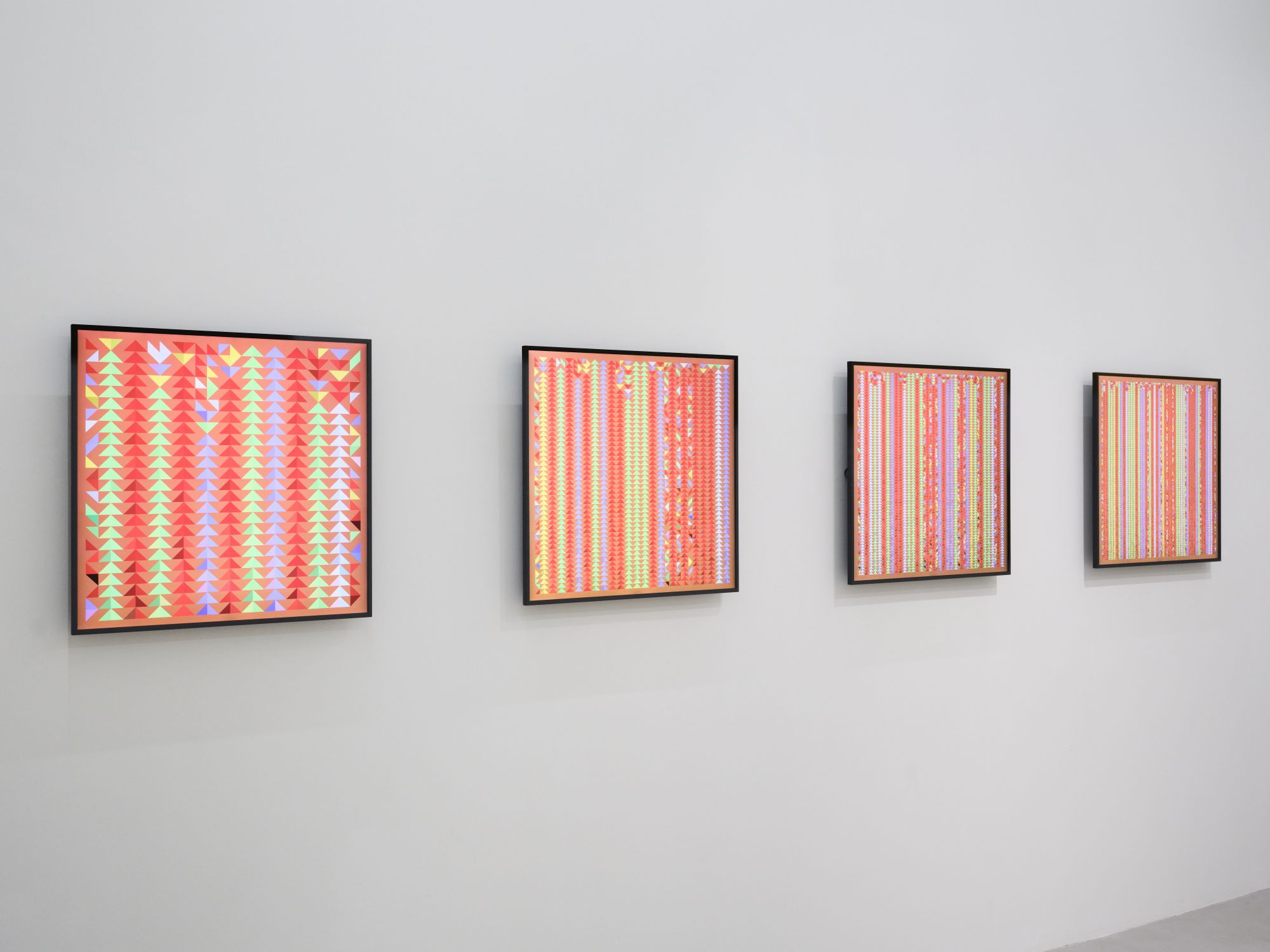
The same Anni grid runs on four screens at four resolutions, 1, 2, 4 and 6. At a set interval all four rebuild from top to bottom under the same rules and palette. The Anni animations began from Anni Albers's Study for Camino Real (1967). Their grid "scans from top left to bottom right, referring to the process of weaving, or writing text", the same words the artist uses for Pression des pairs.
In the practice the grid comes from making, where for Krauss it comes from seeing. A woven grid is made row by row, one decision per cell, and a procedure of that kind can be written as code (→ Senescenence, The grid family; Algorithmic Archaeology, Antiquity).
The are.na channel collects this other ancestry: Anni Albers (Second Movement I–VI, 1978), the Bauhaus weaver Benita Koch-Otte (Projet pour un tapis, 1922), Sumerian cuneiform pressed into clay, Tauba Auerbach's Shadow Weave. Several of these are women, and weaving was mostly women's work, which is the blind spot the exhibition Angles Morts (2024) named (→ Angles Morts). Emma Kunz grew up among hand-weavers before she drew on graph paper. In August 2026, while working on Entfaltung, the artist added a page on Lenore Tawney's drawings to his are.na channel on Kunz (block). Tawney was a weaver, and the page lists "graph-paper drawings" among her works on paper: the loom and the graph paper in one practice.
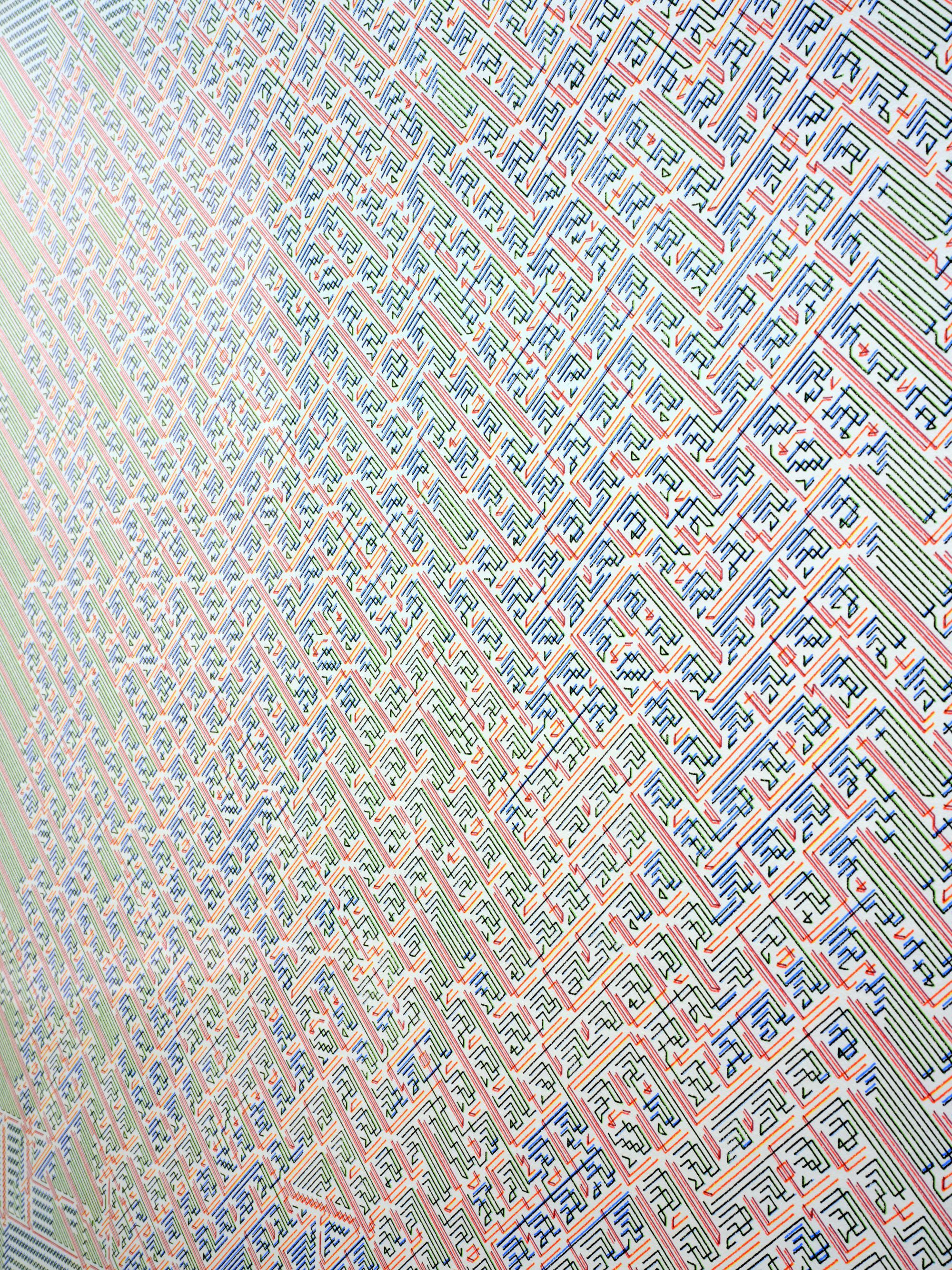
Short stepped strokes in a few pen colours repeat cell by cell along the diagonal, so that the sheet reads as a woven repeat. The title is the word for a scrap of cloth.
The grid that develops
Krauss's grid does not develop, and she counts that as no loss: there is "no necessary connection between good art and change". In the practice the grid is the state of a running process, and change is the work.
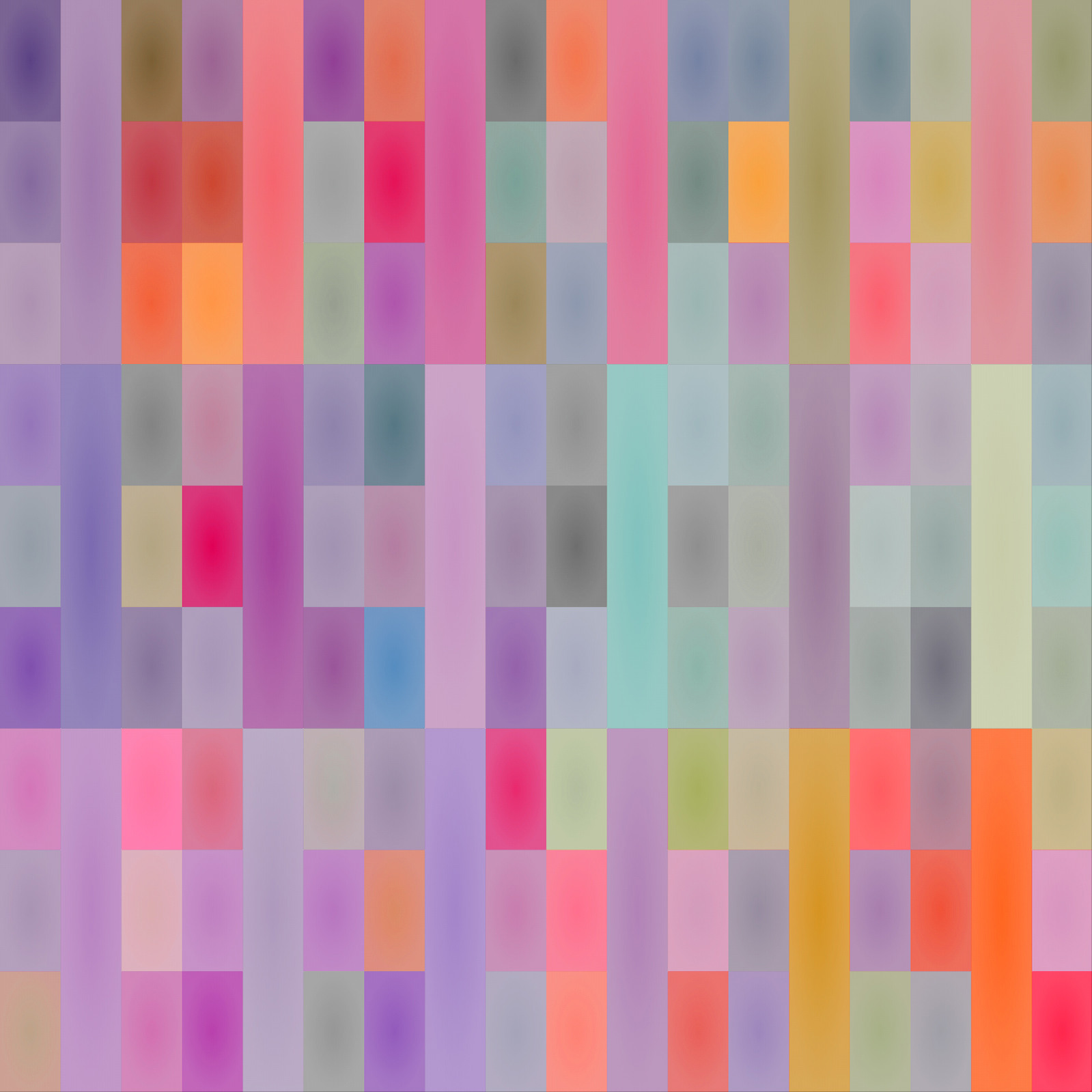
A grid of soft colour cells in columns of uneven width, one of five tokens made "with an early implementation of Cartesian genetic programming" (harm.work). Colour Configurations is the first grid work in the are.na channel, and its grid exists twice. The image is a grid of colour fields. The program that made it is a grid too, a grid of function nodes that mutation rewires and selection keeps or discards (→ Evolutionary Logic). The same algorithm breeds the specimens of Mutant Garden. Here the grid is the genome, and its whole purpose is to change.
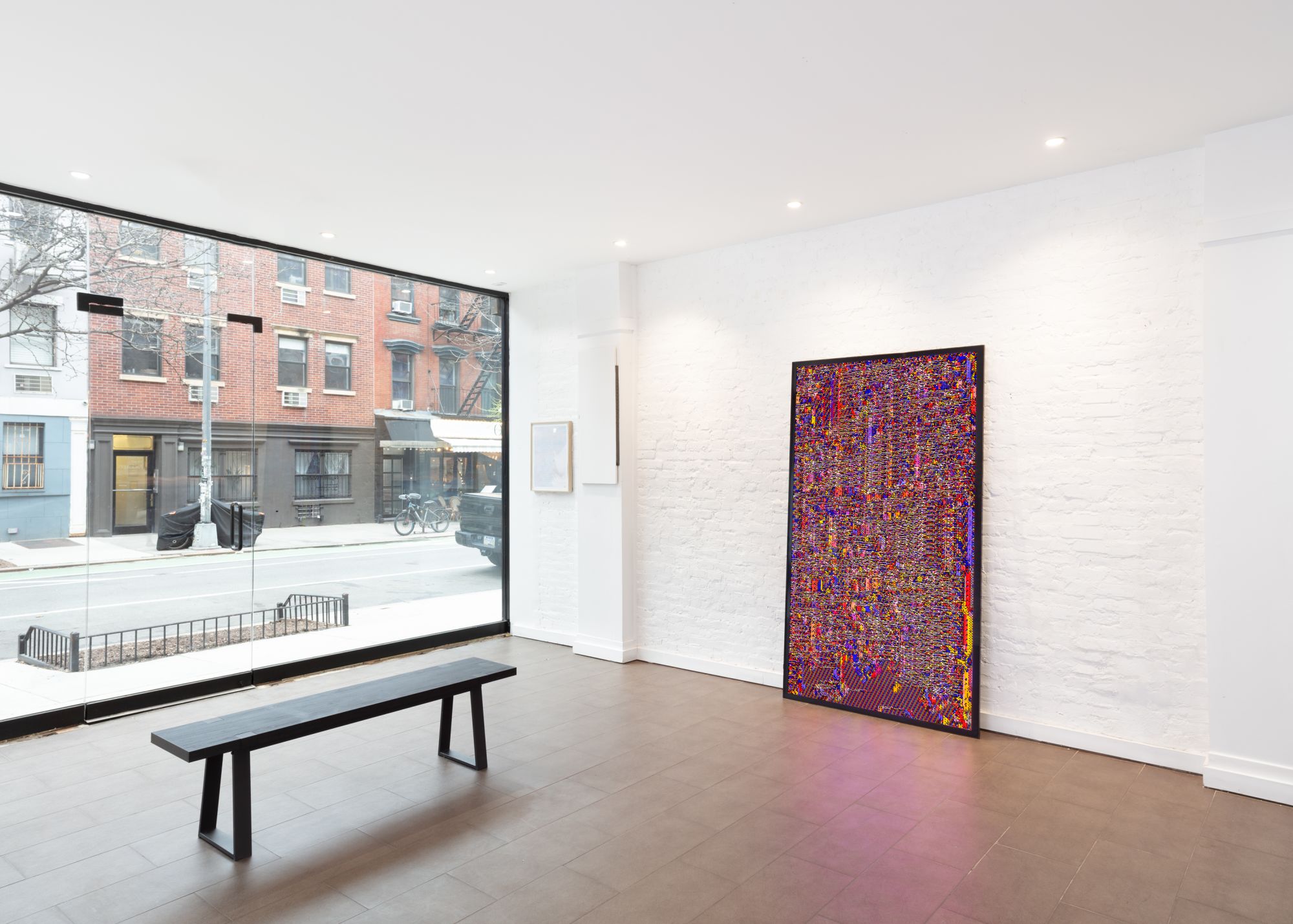
A tall portrait screen leans against the brick wall of the gallery, filled with small cells of purple, red, orange, yellow and blue on a dark ground; a framed drawing hangs near the street window. Stained Unravel (2026) is a cellular automaton. Each cell takes one of 23 shapes, and the first rule that matches its neighbours' exact positions sets its next shape (→ 3000, 3001). Cells grow, merge and die, and "death is not failure but the system's natural feature" (→ Stained Unravel). Anni (unravel) (2025) runs a weave backwards: it "begins in a pristine crystalline state" and decays.
Interruptions (2026) hands Vera Molnár's field of short line segments to the Stained Unravel rule engine. Some of its cells turn toward the mean orientation of their neighbours, so the field relaxes into streams and fans, "the way iron filings settle on a magnetic field or a fluid solver resolves into streamlines" (harm.work). Krauss saw centrifugal grids dissolve the surface "into perceptual flicker or implied motion". Here the motion is real.
Agent's reading: the rule repeats, the state develops
Thesis (Krauss). The grid is "a paradigm or model for the antidevelopmental, the antinarrative, the antihistorical". Once it appears it "seems quite resistant to change", as in the mature careers of Mondrian and Albers.
Antithesis (the works). The grid is a process with a history: a genome that evolves, cells that are born and die, a weave that unravels, a field that flows.
Synthesis. Both are right about different parts of the work. The rule of a cellular automaton never changes: one local rule, applied at every cell and at every step. In that sense it is as fixed as Mondrian's grid. What changes is the state the rule produces, step after step. So the higher concept is the rule repeats, the state develops: in computation the grid's stillness sits in the rule, and the image is free to change. Mondrian repeated one rule across a quarter of a century of canvases. A cellular automaton repeats one rule thousands of times a second, and at that speed the repetition looks like growth.
Van den Dorpel had saved a sentence on this two days before he opened the grid channel. On 22 February 2019 he typed into his Nesting channel, under the title "surprises": "even perfect knowledge of individual decision rules does not always allow us to predict macroscopic structure. We get macro-surprises despite complete micro-knowledge. (Epstein 1999: 48)" (block). The source is the agent-based modeller Joshua M. Epstein.
On paper: the grid stopped
The plotter drawings take one state out of the process and fix it. On paper the grid is still again, as Krauss describes it, but it is a still taken from something that moved.
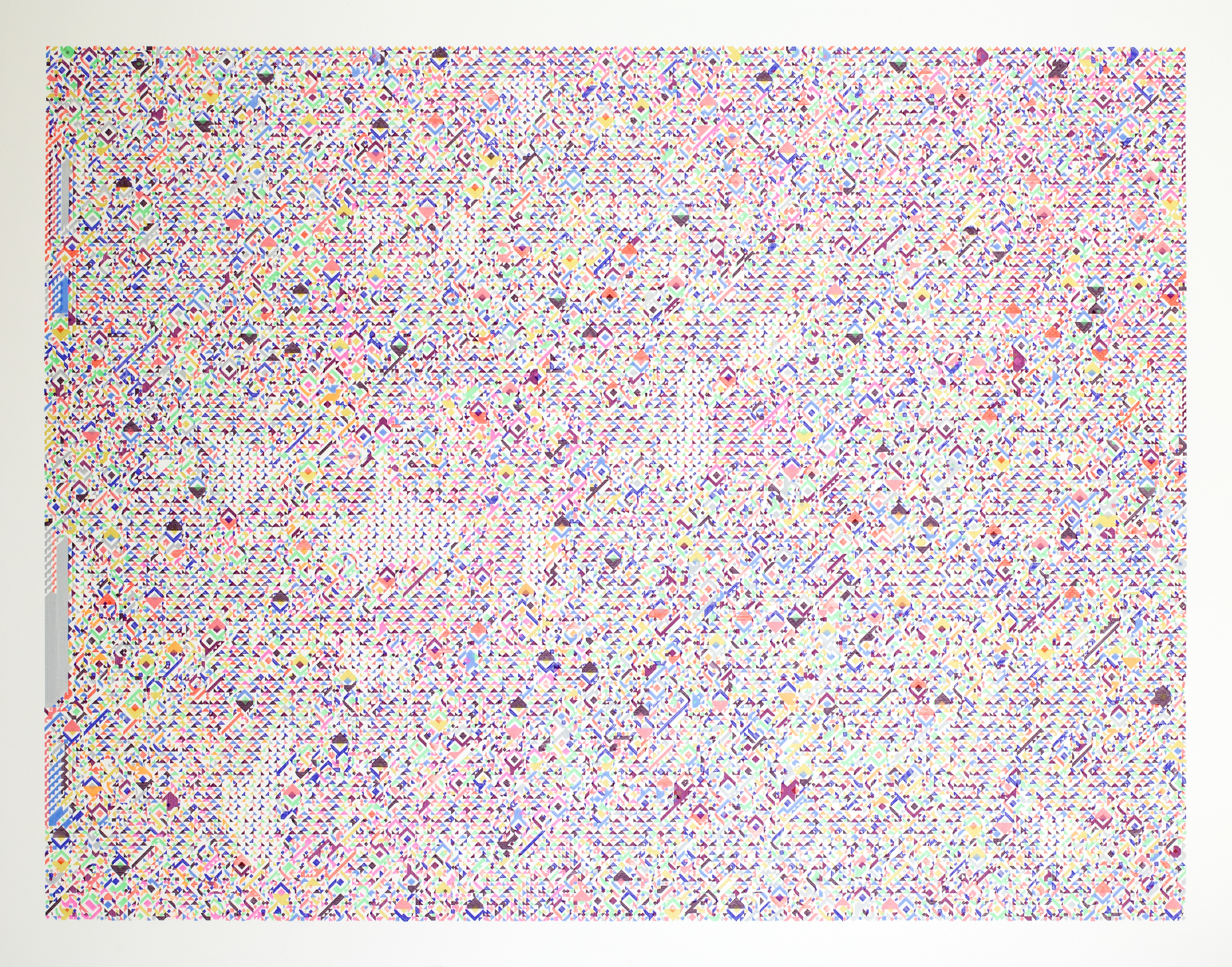
Made with the Stained Unravel algorithm and sold with its source token. The sheet is a field of small cells, each one of the automaton's shapes, plotted in many pen colours with no area left empty.
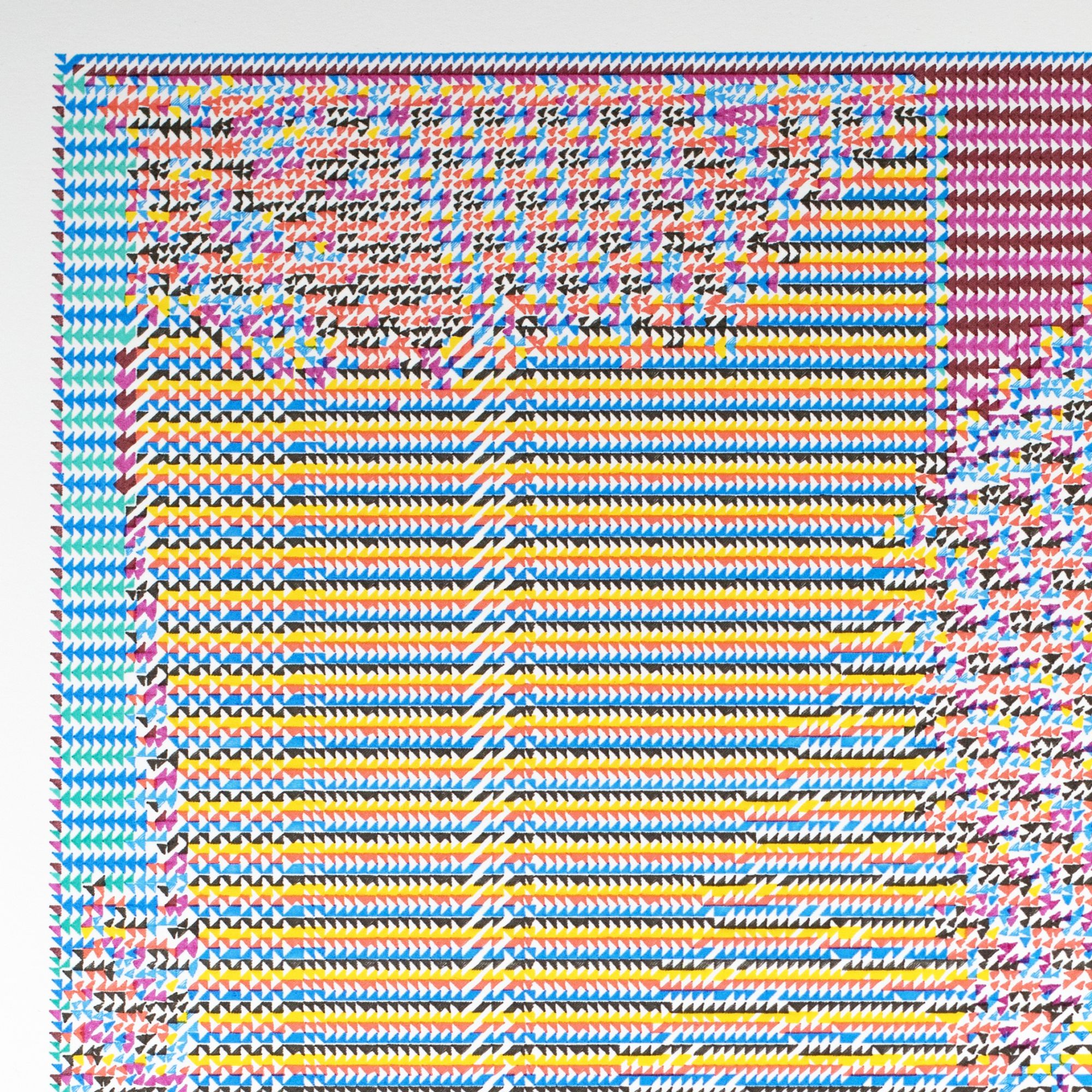
Also a Stained Unravel output. Horizontal bands of cells fill most of the sheet, and a diagonal break runs across them where one region of the automaton meets another.
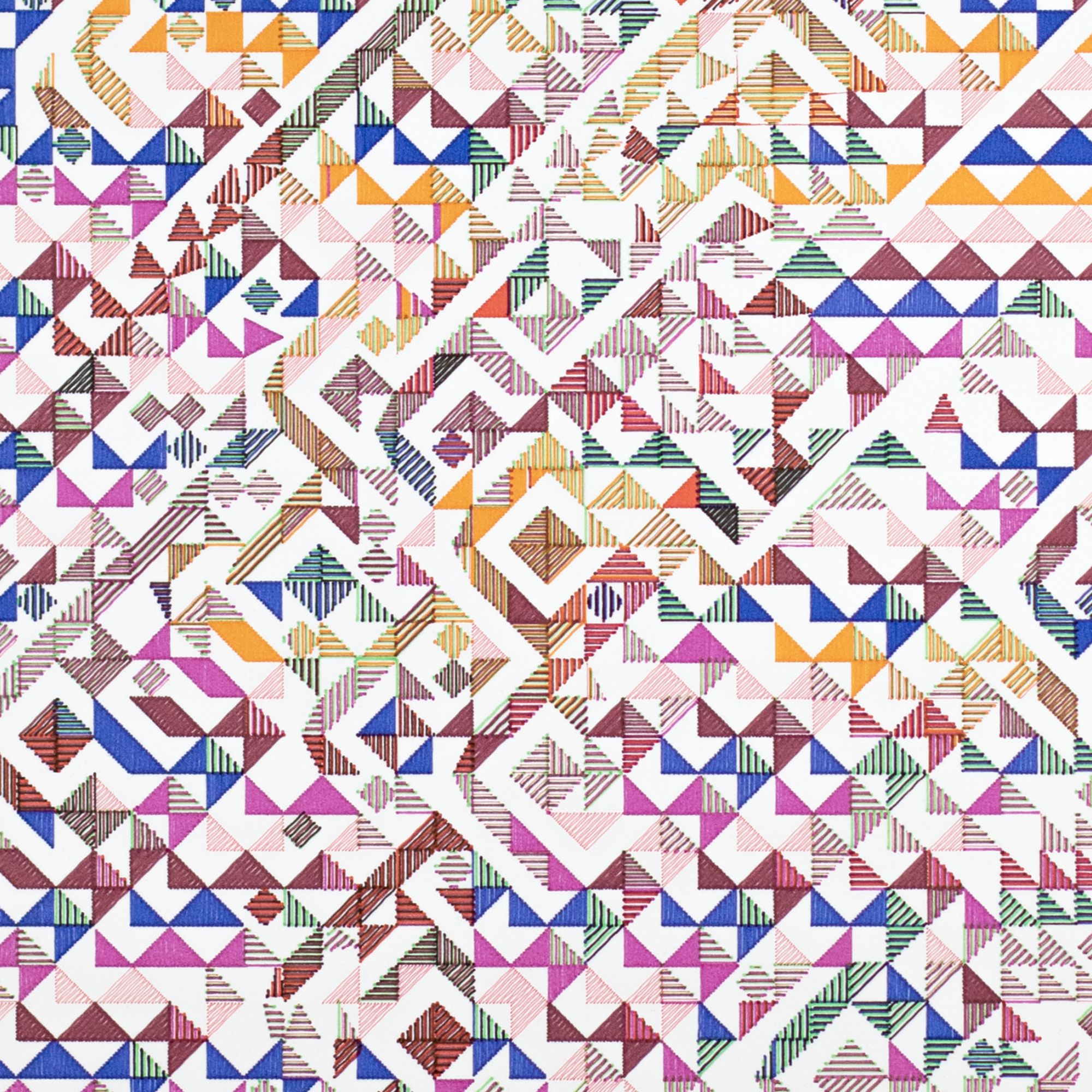
Triangles, half-cells and diagonal strokes, each cell hatched by the pen, so that the automaton's 23-shape vocabulary can be read at the scale of the sheet.
In Pression des pairs (2024), a generative animation, each cell is one line, horizontal, vertical or diagonal. The program rewrites the grid in reading order, and each cell's orientation is drawn by weighted chance from four cells already written to its left and above (→ Interruptions). The work began from Molnár's Quatre éléments distribués au hasard (1959).
Pression des pairs has a larger family on paper. The plotter drawings Vermis, Current, Atlas and Girl/Boy Song (all 2024), Sediment (2025) and Tract (2026) run its rotating-line algorithm. In Atlas "the probability of downward diagonal streams increases towards the bottom side of the drawing, creating the impression of curvature, as if hovering a planet."
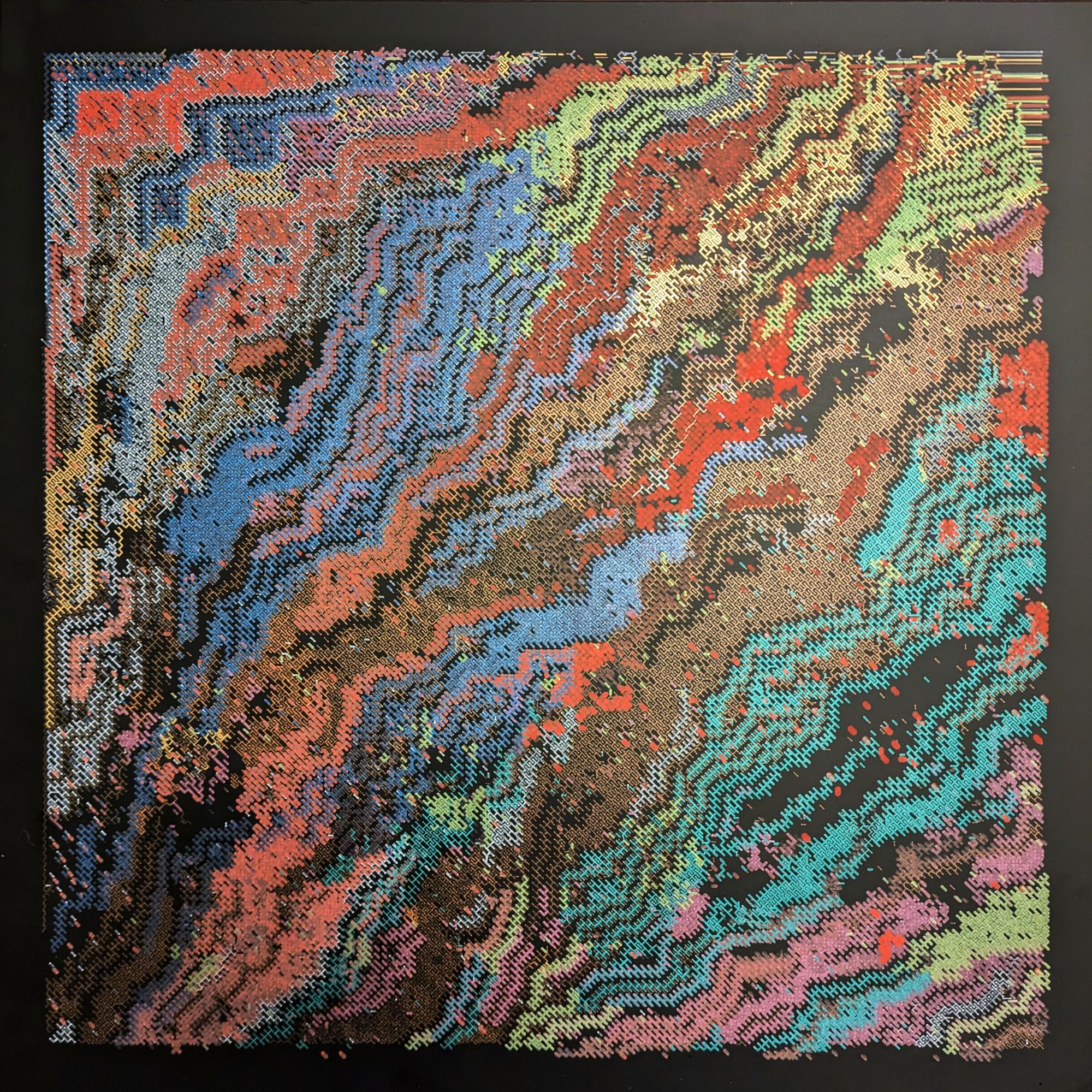
Even Flow (2024) draws the Pression des pairs algorithm in permanent marker on black PVC. The line cells gather into wavy diagonal bands of colour across the square, the orientation of each set by the cells drawn before it. harm.work shows the "Original vector source file" beside the photograph of the sheet.
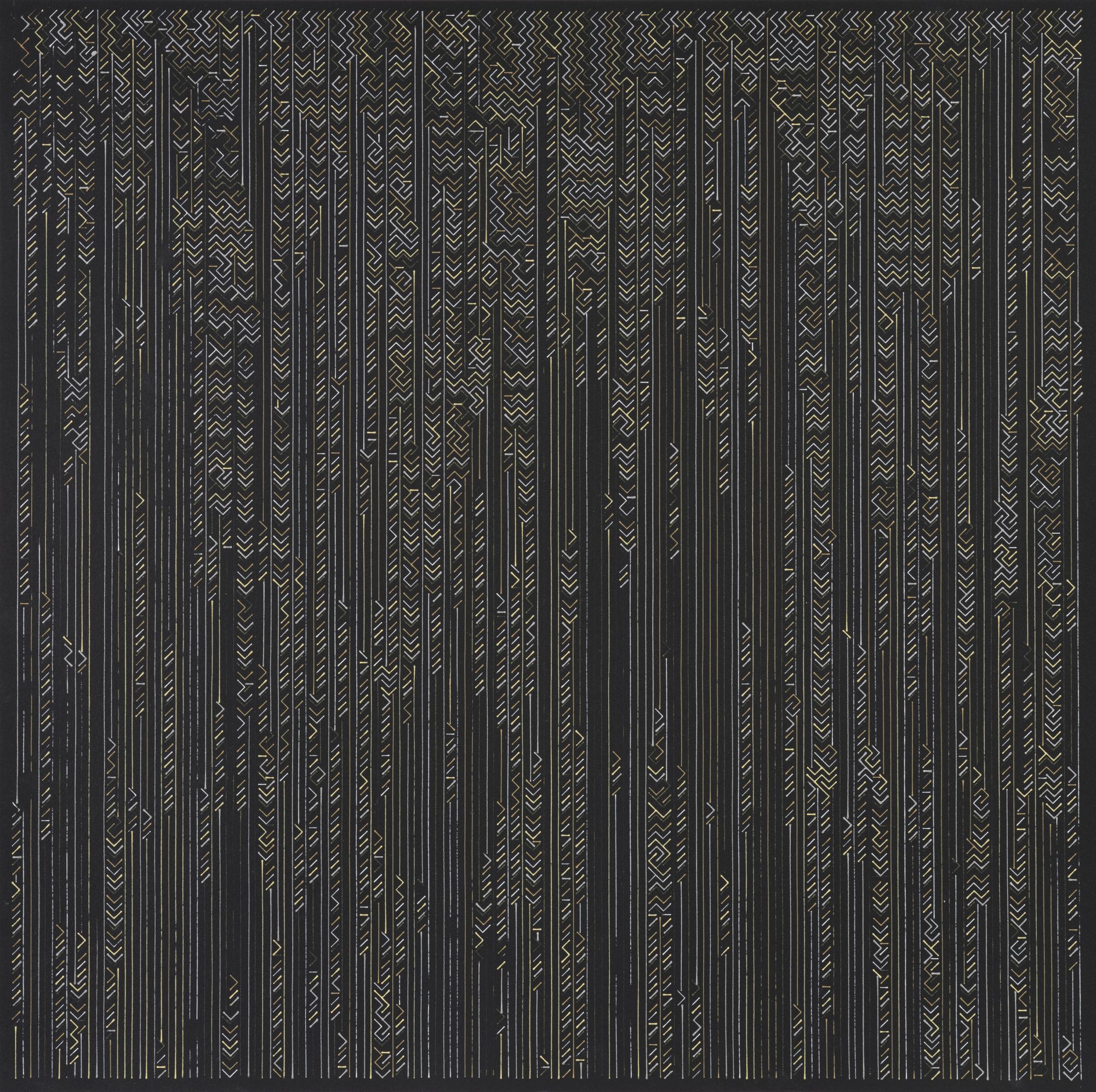
Gouden Regen (2024) is a smaller square of single strokes, drawn by the plotter in gold, silver and bronze ink on black paper. Almost every cell is a vertical line, so the sheet reads as hanging threads; where diagonals occur, two neighbours meet in a chevron pointing down, and the chevrons gather in columns. The title is the Dutch name of the laburnum, goudenregen, "golden rain", whose yellow flowers hang in long trailing clusters; harm.work shows a photograph of the tree, a Laburnum × watereri 'Vossii', beside the drawing. Like Even Flow, it is a grid of line cells, drawn by the Cloud Writings program (the artist, November 2026), but nearly all of them point one way, and the grid becomes a downward fall.
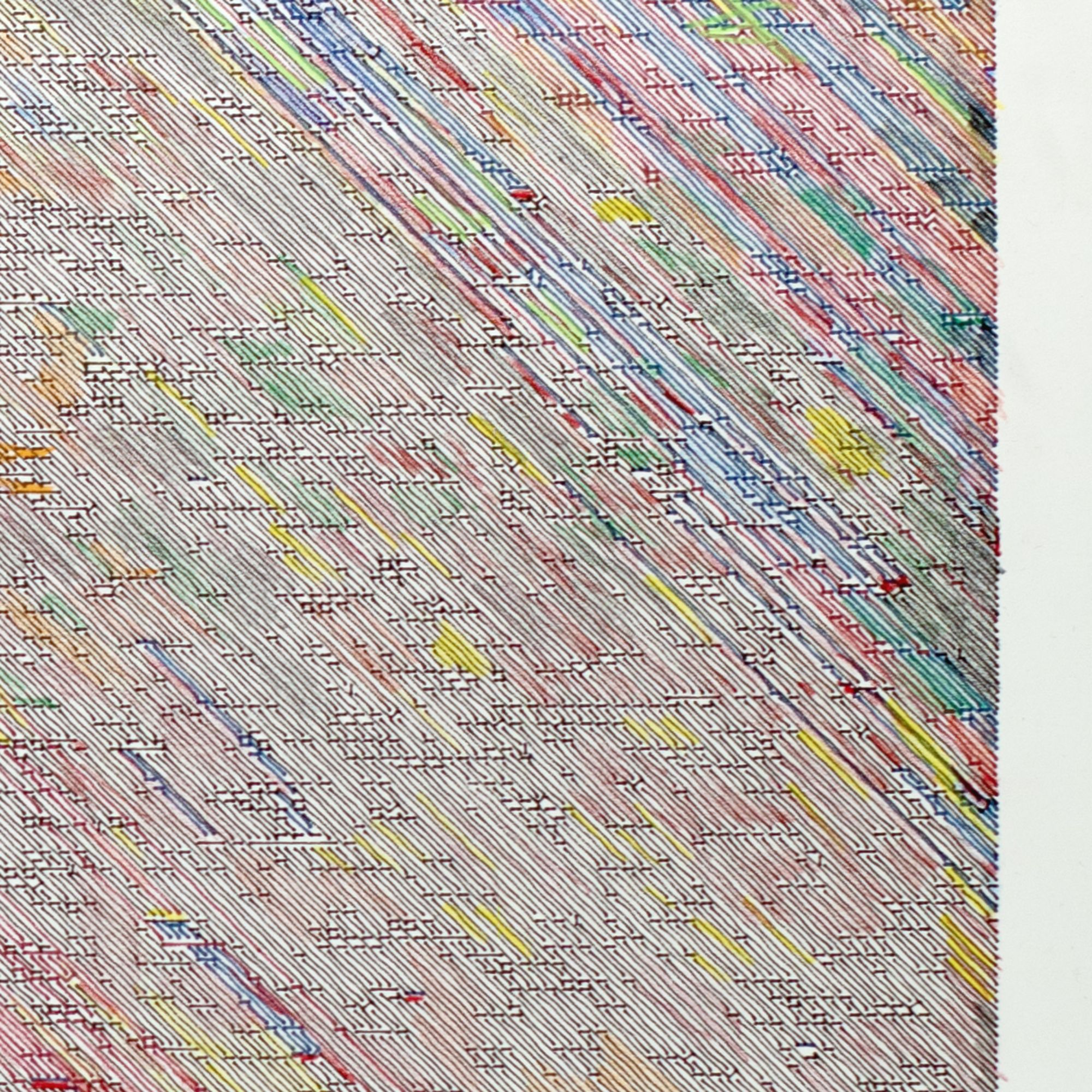
The same algorithm at its densest: rotating-line cells so small and many that they read as diagonal streaks of colour across the sheet. The artist adds pencil by hand, and calls the drawing a hybrid (→ Early Plotter Drawings).
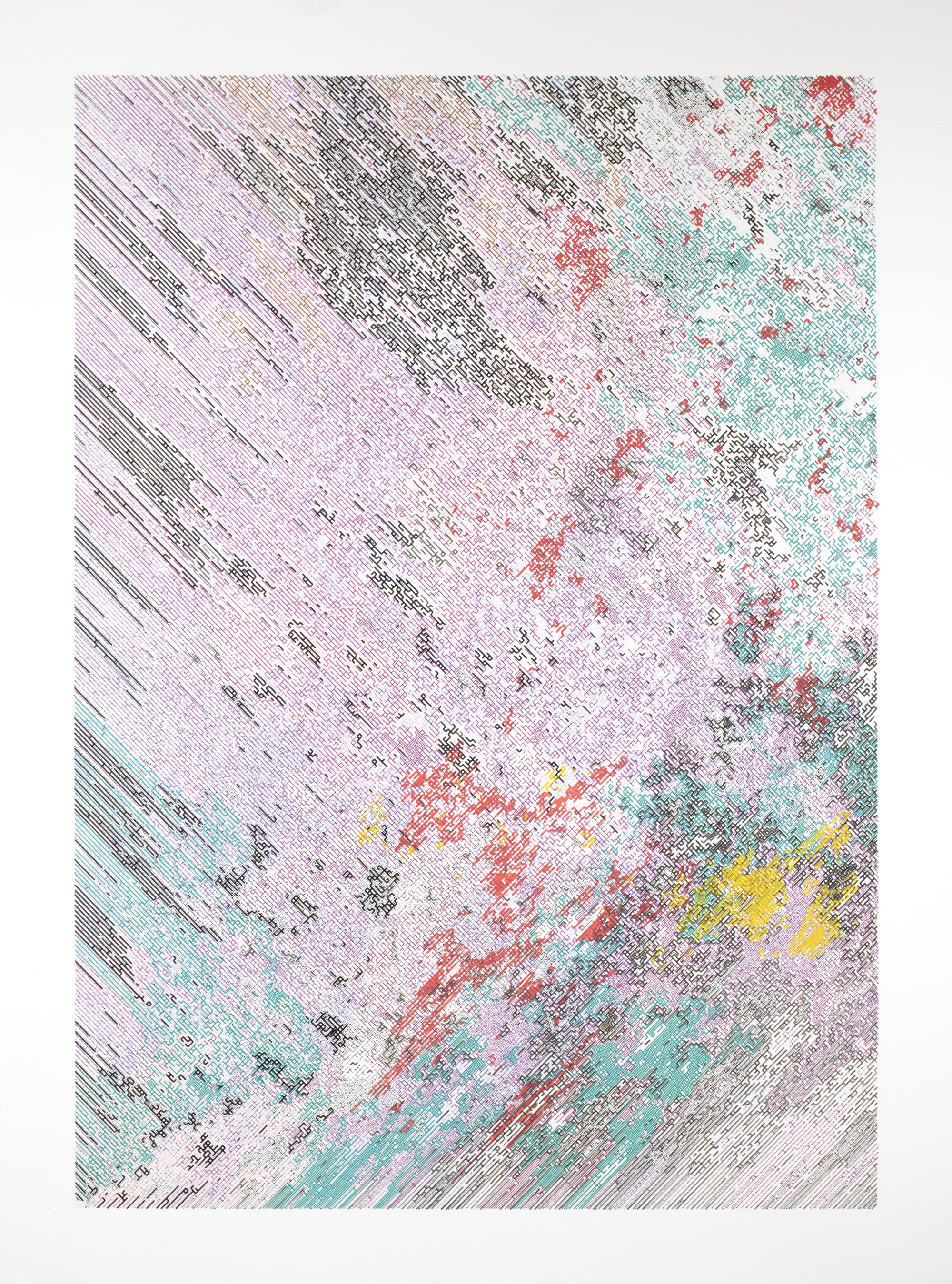
A fine-celled field in pen and marker in which regions of colour drift diagonally across the sheet and break up at their edges. Drawings like this one, Tract and Sediment are where a simple grid rule arrives at forms that look geological (→ Randomness and Pattern).
The imperfect mirror
The artist describes a related interest (November 2026): "The mirroring in Symmetrical Overdub also shows my interest in symmetry in images, where the mirrored side is not an identical mirror but a variation with changes. This happens in many of my works, in particular in Entfaltung and Beads. Working on drawings by hand always produces it. When programming, asymmetry requires intention."
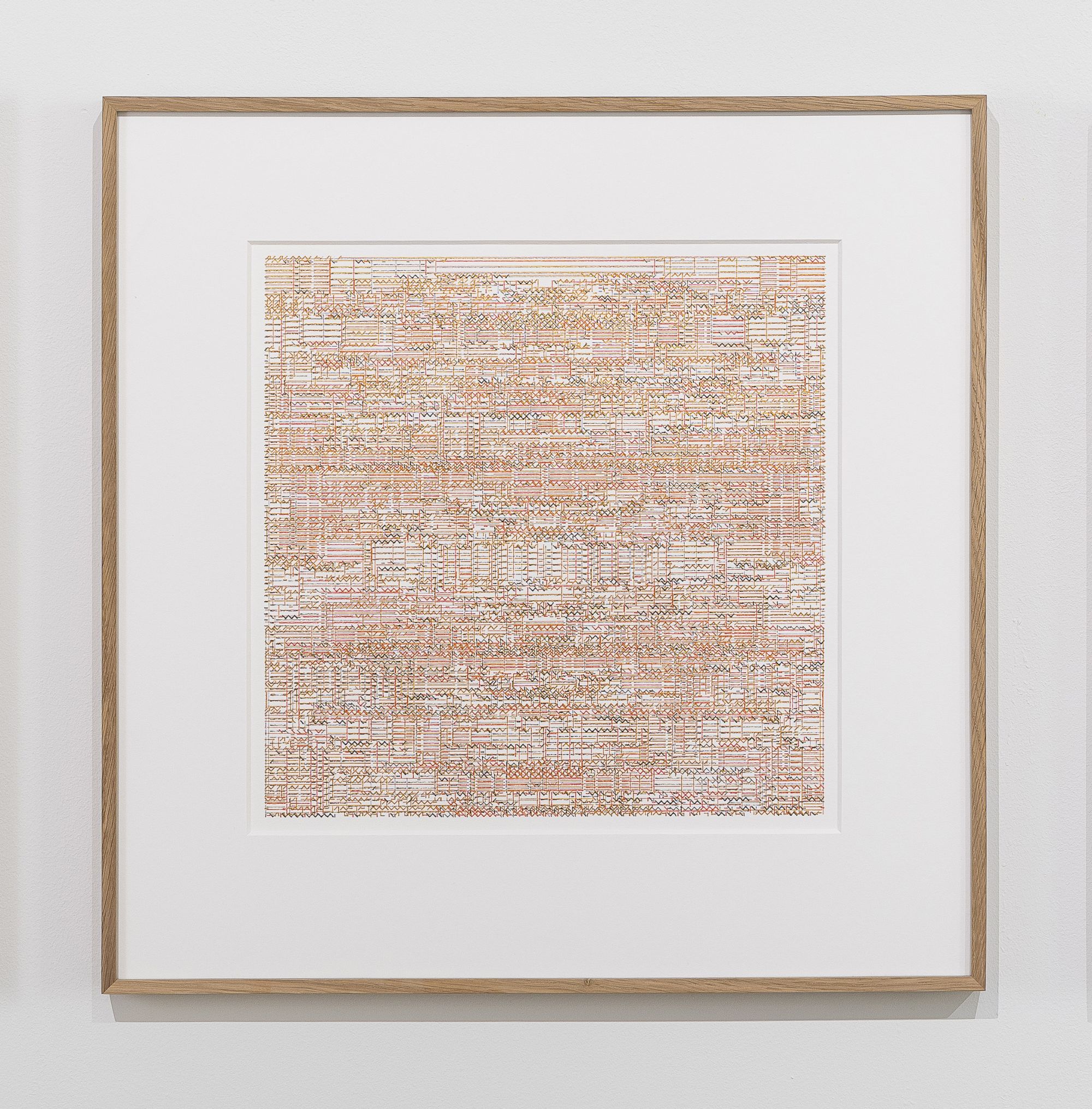
A square field of short horizontal strokes, zigzags and vertical ticks in several pen colours, shown in Angles Morts (2024). The plotter drew the field, then drew it again over itself, mirrored across the vertical axis through the middle of the sheet; in sound recording an overdub is a second take recorded over the first. Every pair of marks therefore meets on both sides of the axis, but a mark that lies underneath on one side lies on top on the other, so the two halves match without being identical. The drawing belongs to a group of plotter drawings on Terschelling paper that the artist annotated in his are.na channel: Shroud is "mirrored overdrawn, creating a mild symmetry", Mold "rotated overdrawn".
On 14 May 2024 he gave Shroud and Symmetrical Overdub a channel of their own, Shrouds / Rorschach, together with a photograph of the Shroud of Turin (block). Both images in the title are mirrors made by contact. A Rorschach blot is ink pressed between the halves of a folded sheet, so the two sides match in outline and differ in every detail. The shroud is a cloth that bears a faint imprint of the front and back of a body.
A mirror is the grid's repetition carried across an axis, and the two media reach the imperfect mirror from opposite sides. A program copies exactly: the reflected half is identical unless code is written to change it. By hand no copy is identical, and the second side always differs from the first. Symmetrical Overdub takes a third route: the program mirrors exactly, and the order in which the ink is laid down makes the halves differ.
In the Entfaltung drawings the plotter draws constructions that are mirrored exactly, on one or both axes, and the hand fill makes the two halves differ (→ Entfaltung on Paper). Beads plots the Anni grid and colours its cells by hand, so that repeats of the same motif come out differently (→ Meditative Labour). The tokens reach it through the viewer: their symmetry is a setting that shows exactly at the ninety-degree snap, and from any oblique angle the same figure looks irregular (→ Entfaltung). The practice's older name for what the hand adds is the "workmanship of uncertainty" of note 609, a variant of David Pye's "workmanship of risk" (The Nature and Art of Workmanship, 1968) (→ Randomness and Pattern), and it is close to the small imperfections the artist values in Vera Molnár's work, left by the labour of translating a program onto paper (→ Algorithmic Archaeology).
The edge is the screen
For Krauss the centrifugal grid "extends, in all directions, to infinity", so the work is "a tiny piece arbitrarily cropped from an infinitely larger fabric". On a screen the crop is set by the viewer's device.
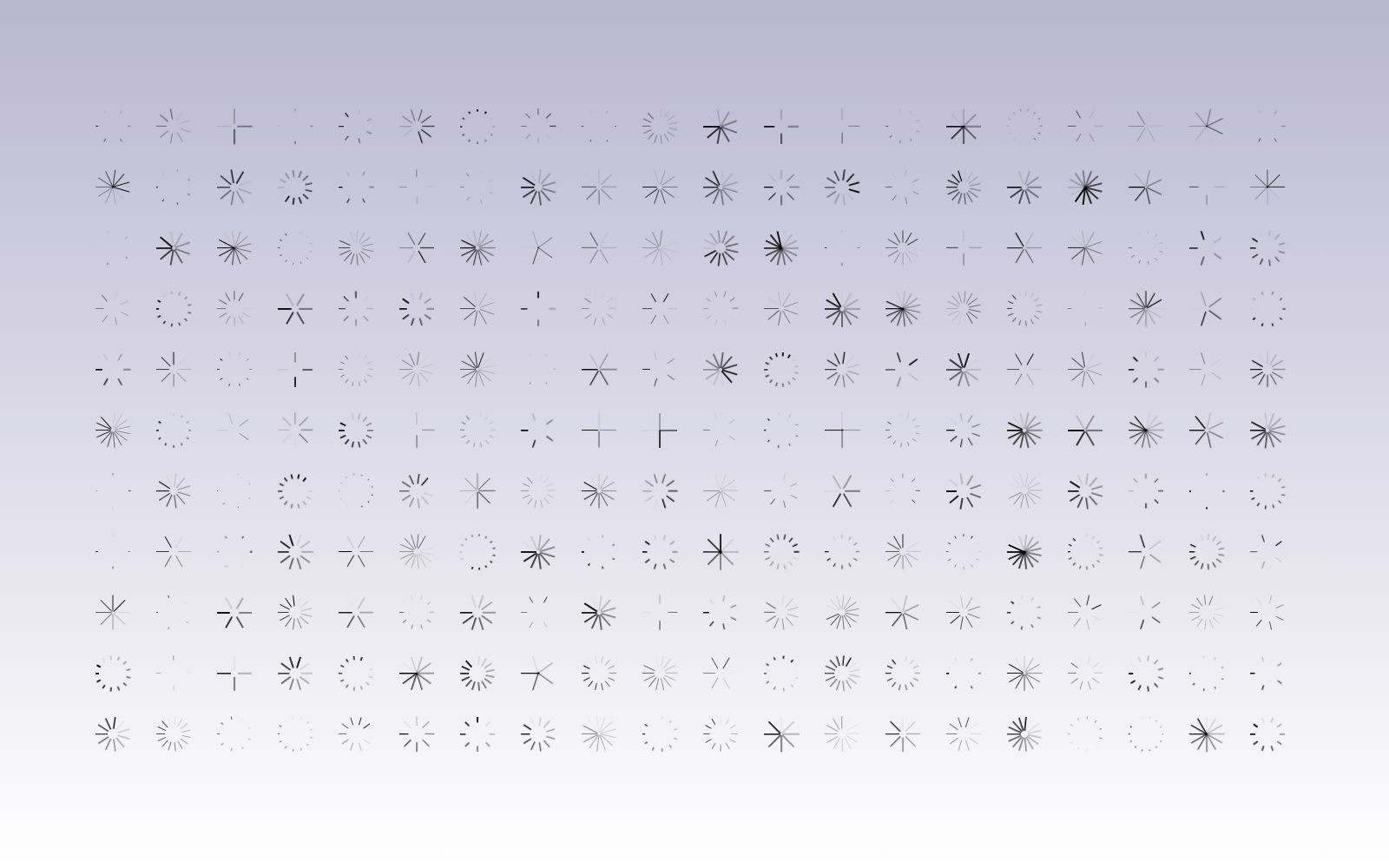
Field places a spinner every 70 pixels, keeps a margin of a tenth of the window's shorter side, and builds the grid again whenever the window is resized. In a 1600 × 1000 window token 2 shows 220 spinners, 20 by 11, each with its own number of spokes and speed. Its token image on a marketplace shows nine. The grid of Stained Unravel sets one column per 4 to 7 pixels of screen width, that of Interruptions one per 7 to 12 (→ Interruptions), so a phone shows fewer cells than a projection. Anni (sync) turns the same idea into an installation: one grid at four resolutions side by side, the "zoom" of the channel's description. Krauss's centrifugal grid implied a world beyond the frame. These grids go exactly as far as the screen and are recomputed at its edge.
The artist named this extent himself, in his text on Field: "The first time I put spinners in a two-dimensional grid, it struck me that they become something like flowers. Or wind turbines. We find ourselves in a large open field: a field without boundaries" (harm.work/writing/field-2008-2023). He had noted the phrase as a possible show title in December 2020, from Candia Morgan's paper "Language and Mathematics: A Field Without Boundaries" (sources/ingested/arena-show-titles.md), and the 2026 statement on the Entfaltung drawings uses the phrase for drawing and programming themselves (→ Entfaltung on Paper).
Rasterbild: the edge drawn
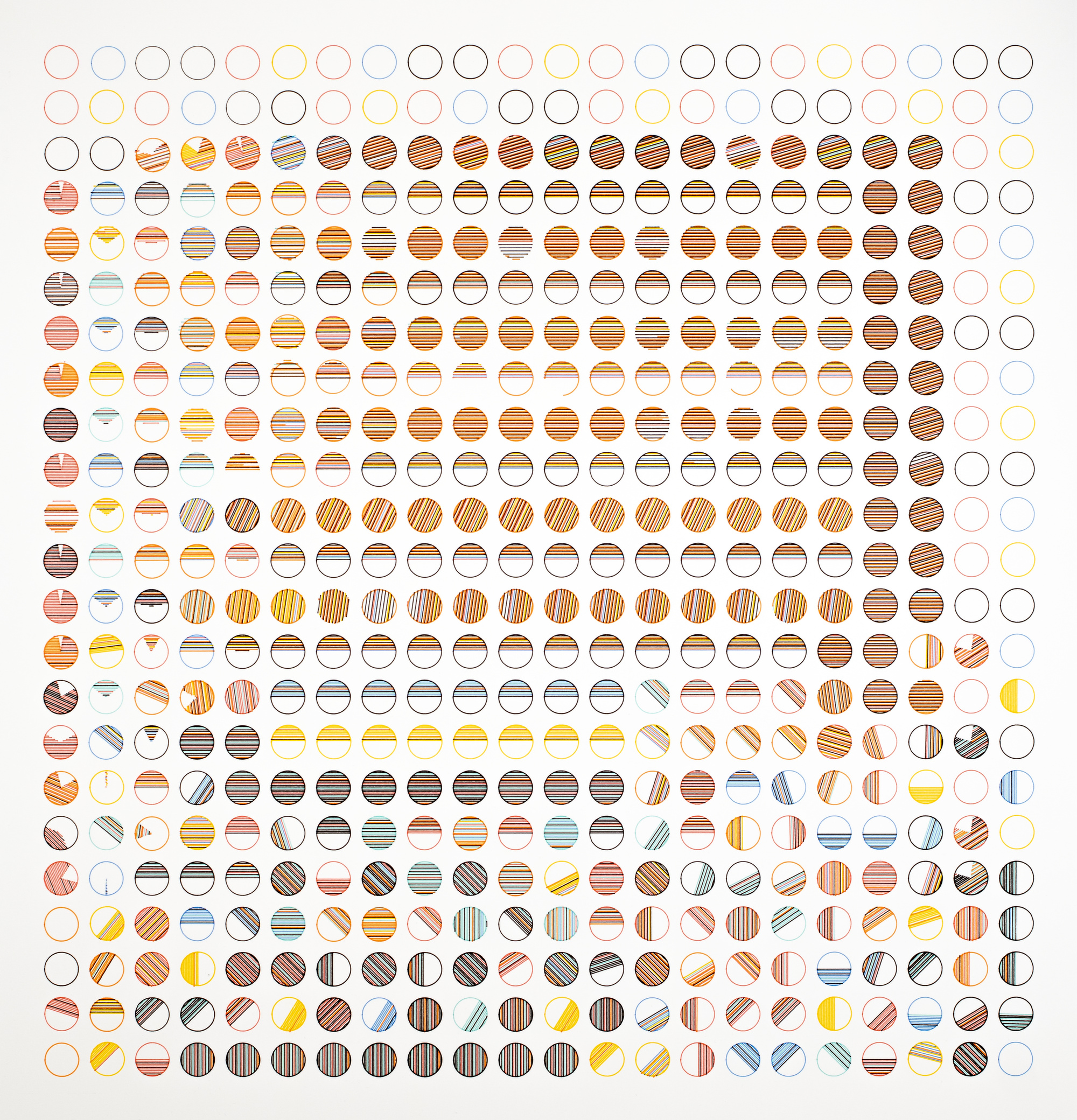
On paper the edge is drawn. Rasterbild sets circles in rows and columns. Each circle is filled with parallel lines at its own angle, some only halfway, and the outermost circles are left empty, drawn as outlines. The grid is shown to its limit while the fill stays inside: Krauss's centripetal grid, with the frame carried into the work. The title is German for "grid picture", the name Charlotte Posenenske gave to her own grid paintings of 1956–57, two of which are in the are.na channel (1, 2). The drawing comes with an Arweave source token. Posenenske went on to make modular series that others could assemble. Krauss does not mention her; her nearest case is Sol LeWitt, whose "modules and lattices" she files under the centrifugal grid, and LeWitt appears twice in the artist's own notes (→ 426, 675).
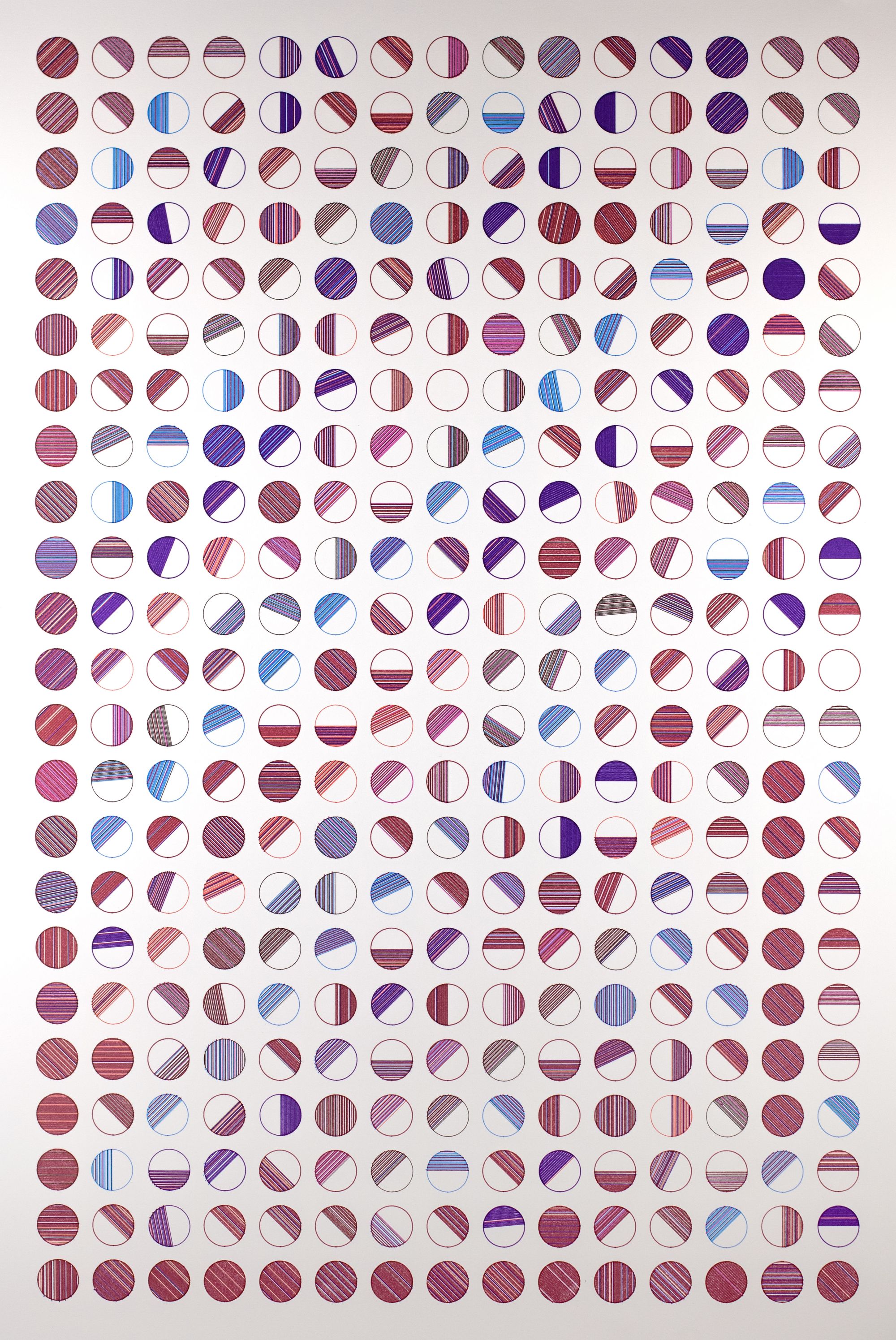
A second sheet draws the edge another way. Rasterbild II (2026) is upright, fifteen columns by twenty-three rows of circles in reds, pinks, violets and blues. It has no border of empty outlines. Instead the left column and the bottom row are filled solid, so two sides of the grid are marked and the other two run to the paper's edge.
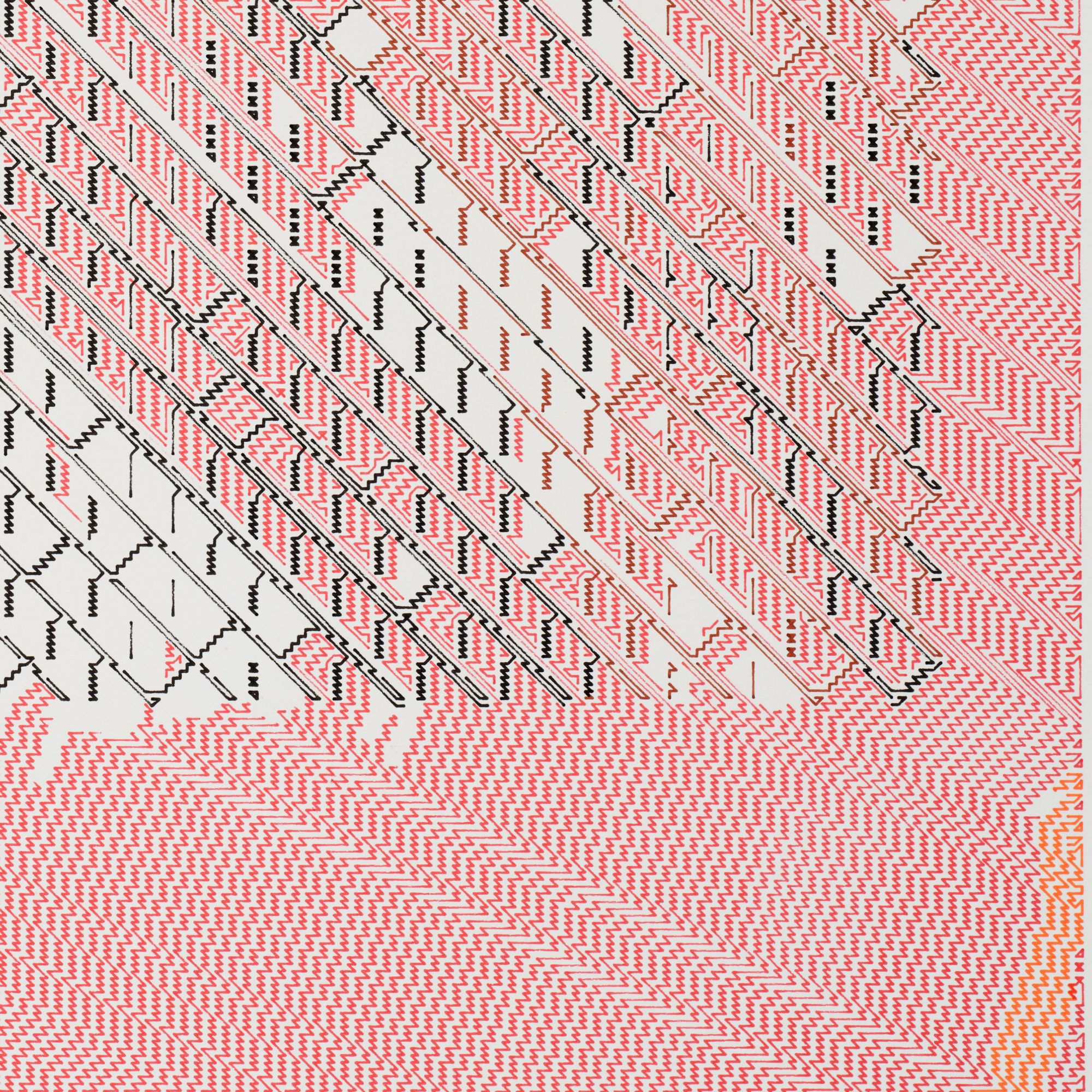
A lattice of diagonal cells sits inside a field of parallel fineliner lines that runs on to the edge of the sheet. The title is a software term for an abstraction that lets its implementation show (→ Process Legibility).
The grid as interface
Krauss published "Grids" in the summer of 1979. That autumn VisiCalc, the first spreadsheet program for personal computers, went on sale: a grid of cells as a working tool. The graphical interfaces of the Xerox Star (1981) and the Macintosh (1984) followed. Since then the grid has been the default of the screen: the pixel raster, the icon grid of a phone, the feed, the tiled page of a marketplace. Krauss's essay could not include this. The works are made inside it.
Field takes an interface sign and changes its use. "Spinners are shown when UX designers want to make clear that you need to wait for something", the artist writes, and the grid turns them into flowers, wind turbines, a field (→ Field). The text also gives the reason the work matters to him: "one cannot suspend being. The separation between productive time, and time supposedly 'on hold' is entirely based on my own perception and interpretation." The work takes the most functional grid there is, the interface, and turns it into a picture. The marketplace then returns Field to the interface grid, as a three-by-three thumbnail on a tile in a grid of tiles.
The window, Krauss's second source, runs through the practice as well: Markov's Window (2004) and Venster (2024, Dutch for window), whose frames imply a composition that continues past them (→ The Lozenge). Dutch uses one word, venster, for the window in a wall and the window on a screen. The squircle, the shape of the app icon in the phone's grid, has its own page (→ The Squircle).
Historical significance
Krauss's grid declared modernity by cutting off the past: with it, "everything else was declared to be the past." Van den Dorpel uses the grid the other way round. In the announcement of Entfaltung (2026) he states the aim: "I want to embed my work within this historical lineage, freeing digital art from technological novelty" (harm.work). His grids lead back to the loom, to cuneiform, to Anni Albers, Posenenske and Molnár, and to the computer programs of the 1950s that already drew on a grid of cells, such as Christopher Strachey's draughts program (1952), which the are.na channel collects.
Read against Krauss, the works make three corrections to the history she gave. The grid's ancestry includes the loom and the women who worked it. The grid can carry time, and in computation it does so through the repetition Krauss thought kept it still. And after 1979 the grid left painting and became the surface of every screen, and these works are made in that grid and look back through it.
See also
- sources/ingested/krauss-grids-1979.md — Rosalind Krauss, "Grids" (1979), digest with page references
- sources/ingested/arena-modular-aesthetic-systems.md — the artist's are.na channel on grids and modularity, 2019–
- Senescenence — the grid family: Anni Albers, Anni, Stained Unravel; the loom as ancestor of the GPU
- Algorithmic Archaeology — the grid as the oldest algorithm; the timeline from the loom to the language model
- Interruptions — the Pression des pairs lineage, its grids and rules, measured from code
- Stained Unravel — the cellular automaton, its 23 shapes and its rules
- Evolutionary Logic — Cartesian genetic programming, the program as a grid of nodes
- Colour Configurations — the five CGP images of 2019, the halves of the first pairs in the channel
- Anni — the software after Anni Albers, its four tokens, Anni (unravel), Anni (sync) and Beads
- Field — the spinner grid and the time "on hold"
- The Lozenge and The Squircle — the window, the platform square, the icon
- Sacred Geometry — the loom, the mandala and stained glass as rule-based grids
- Angles Morts — weaving, women's work and the blind spots of the history of generative art