
Interruptions
Five unique, fully on-chain tokens on Ethereum mainnet, October 2026. Presets, code and measurements: sources/ingested/interruptions-token-data.md.
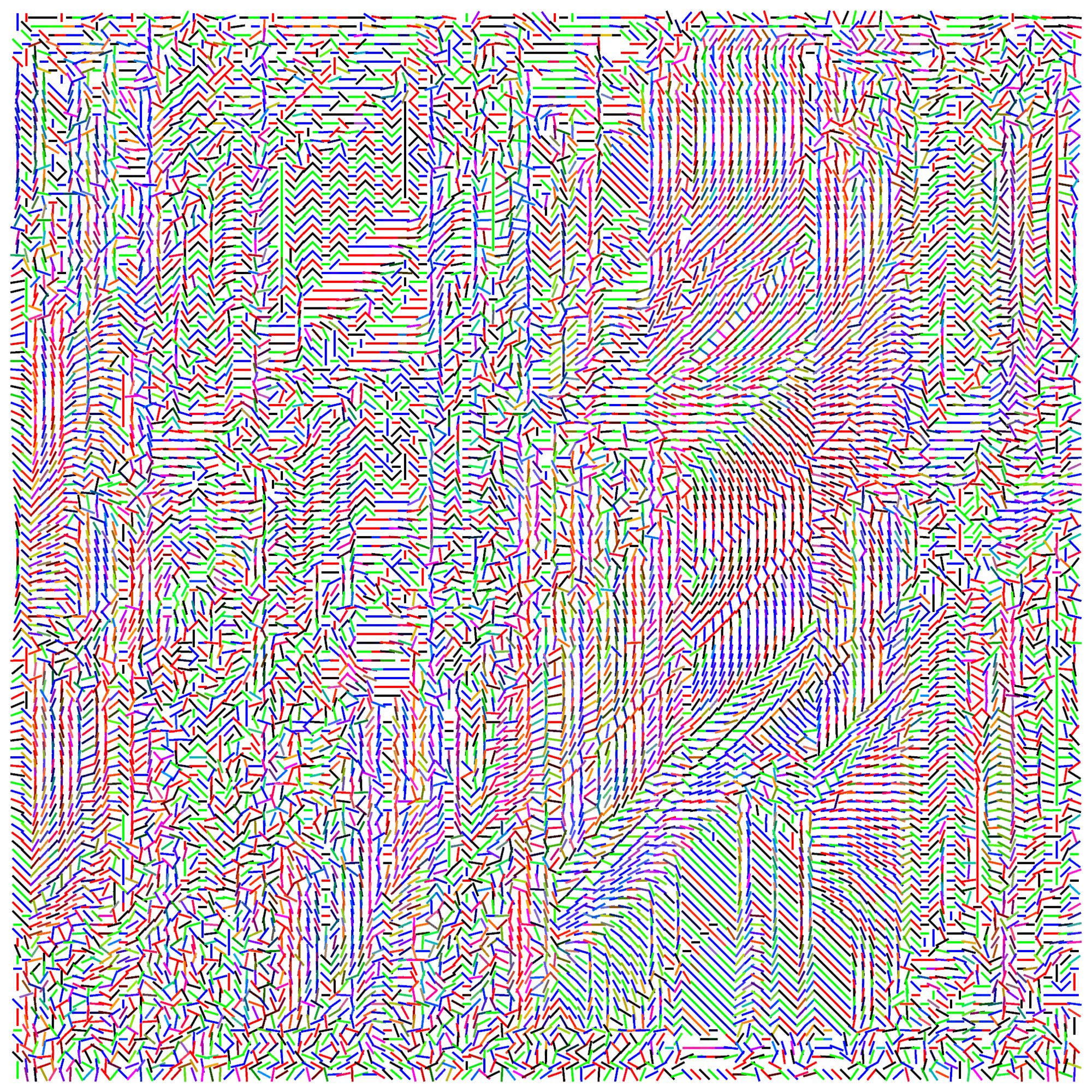
Interruptions is a grid of line segments, one per cell, each of which can turn. It combines three earlier works: the field of Vera Molnár's Interruptions (1968–69), the rotating line of Pression des pairs (2024), and the rule engine of Stained Unravel (2026). That engine compares neighbours on exact positions, merges touching cells into groups of one colour, and shifts a cell's colour the longer it stays unchanged (→ 3000).
The new element is a cell that reads its neighbours' angles. Some cells turn, frame by frame, toward the average orientation of the cells around them, and regions of such cells settle into streams and fans. Two other states take a cell out of the grid's logic: one spins on the spot, the other sticks at a random angle. According to the artist, no earlier cell-based grid work in the practice lets a cell respond to its neighbours' rotation. In the two predecessors whose code was read for this page, a neighbour counts only by its state.
The token images on this page are single frames of animations.
Three sources
Vera Molnár, Interruptions (1968–69). Molnár's Interruptions are computer drawings of a square field of short line segments of equal length, each turned at a random angle, with segments removed at random so that gaps open in the field. Algorithmic Archaeology places her in the practice's lineage, and the 2024 exhibition Angles Morts showed van den Dorpel beside her. The same field was the starting point of the plotter drawing Sediment (2025), which added one rule: touching segments form a group of one colour (→ Early Plotter Drawings). In the 2026 series the gap is a cell state. An empty cell shrinks its segment to nothing.
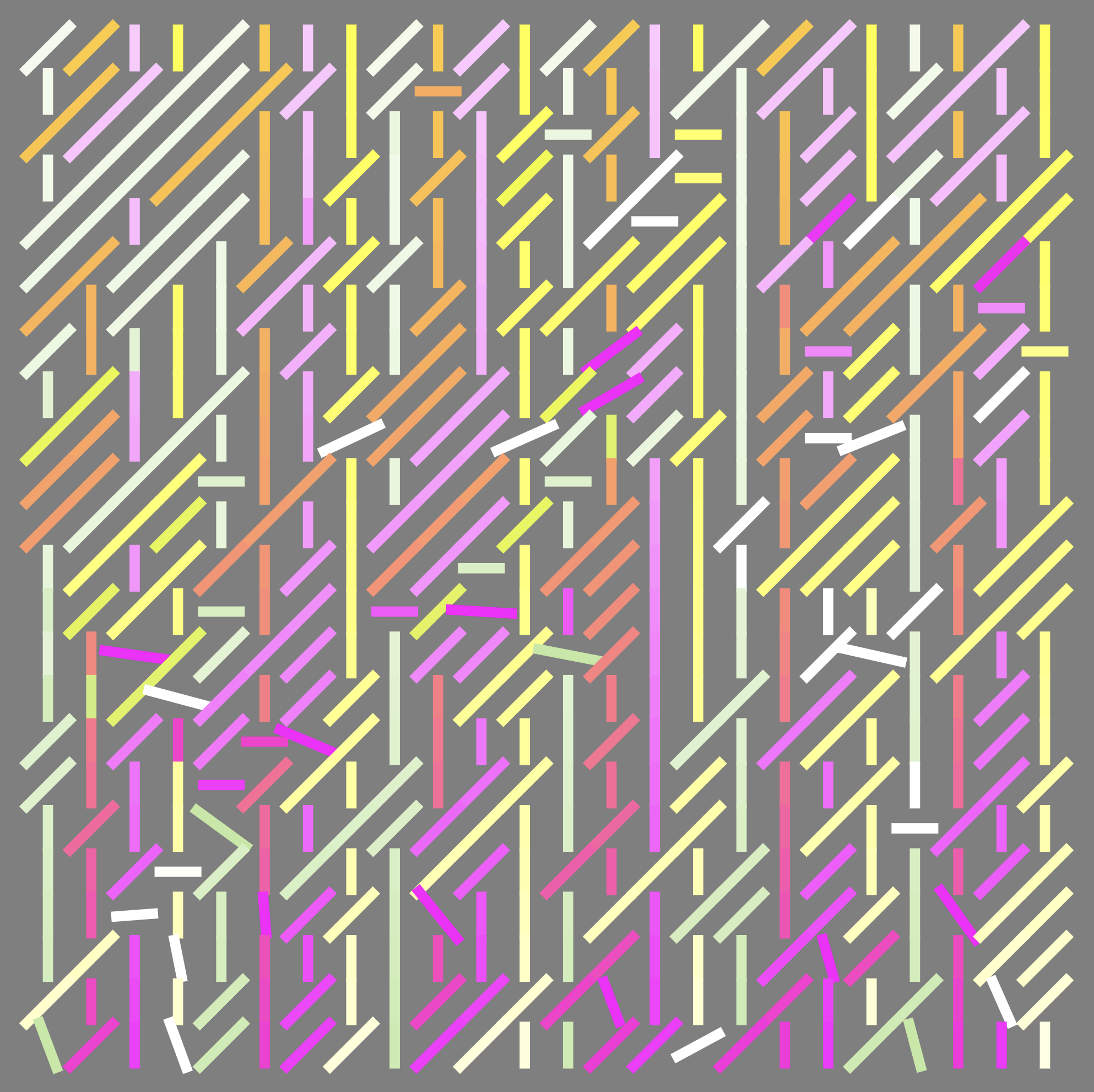
Pression des pairs (2024). A generative animation after Molnár's Quatre éléments distribués au hasard (1959), shown in Angles Morts. Its cell is the rotating line. The grid has 24 or 32 columns and five states, all of them orientations: horizontal, vertical and the two diagonals, with no empty cell. The program rewrites the grid in reading order, two cells per frame, and draws each cell's orientation by weighted chance from rules that read four cells already written: two to its left, one above, one above-right. The token description calls this a cellular automaton combined with a Markov chain. When a line finishes turning it takes its group's colour, and lines that continue one another, or meet in a chevron, form one group. The still shows thick segments on grey, mostly rising diagonals and verticals in pale yellow, orange, pink and pale green, with a few white and magenta segments caught mid-turn between the four orientations. The colours are drawn on each load from a base of six: black, white, pale green, red, yellow and magenta.
The title promises more than the 2024 code does. There the peers change the odds of a cell's next orientation, and no cell turns toward them. The literal pull arrives in 2026.
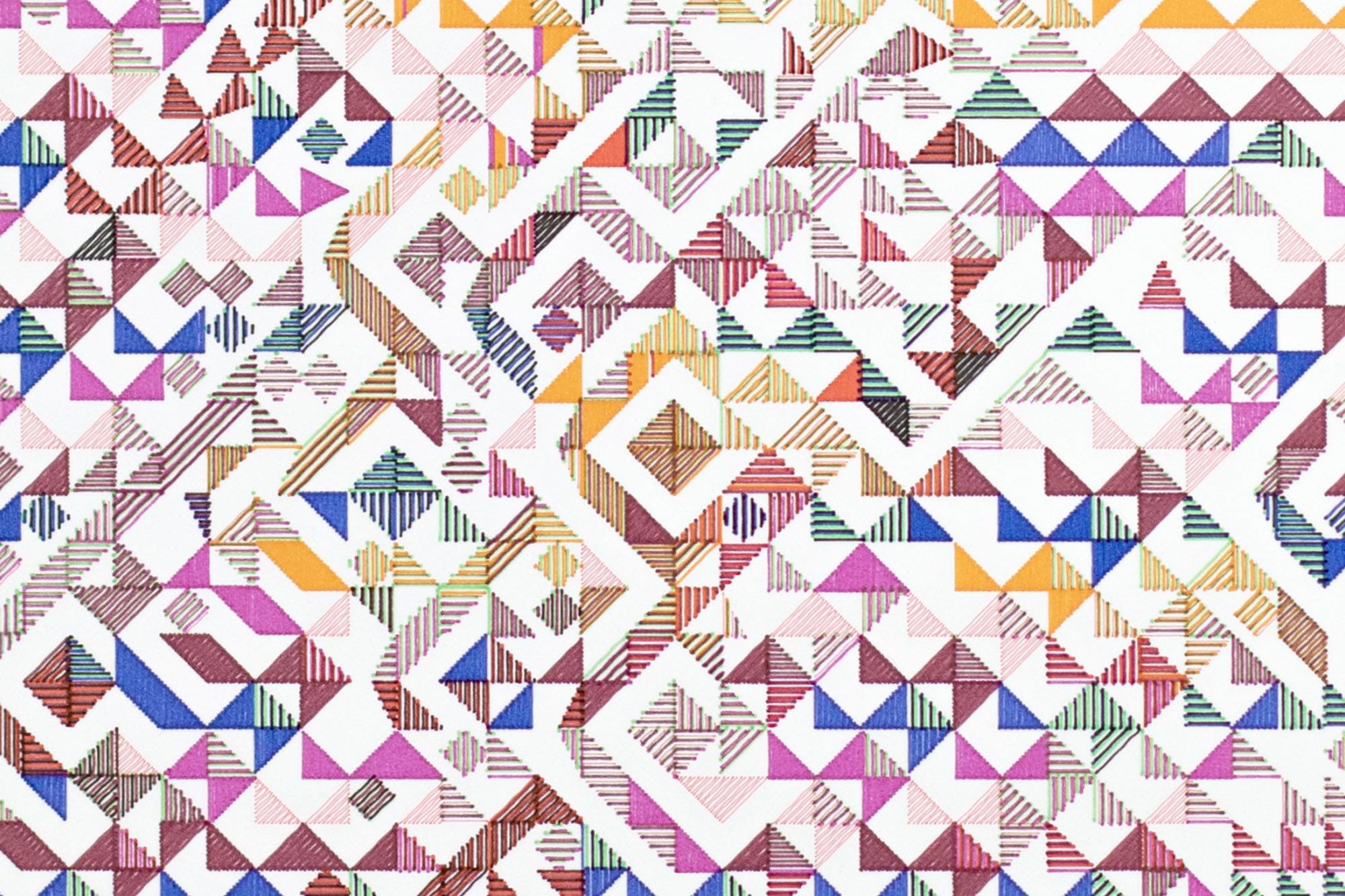
Stained Unravel (2026). The drawing detail shows the vocabulary Interruptions gives up: corner triangles, flat triangles and diamonds, three of the 23 shapes a Stained Unravel cell can take (→ 3001), here hatched in coloured ink. In the animated works each cell is a four-point polygon morphing between these shapes. Rules compare neighbours on exact positions, and the first rule that matches sets the cell's next shape (→ 3000). Curated rule-sets alternate with random ones, and the rules are replaced when the field reaches equilibrium. Touching cells merge into groups of one colour, and a cell's colour moves along a gradient the longer it keeps its shape. Interruptions keeps all of this and swaps the polygon for the line.
| Pression des pairs (2024) | Stained Unravel (2026) | Interruptions (2026) | |
|---|---|---|---|
| Cell | rotating line | four-point polygon | rotating line |
| States | 5 orientations | 23 shapes, one of them empty | 9: empty, 4 orientations, 4 behaviours |
| Next state | weighted chance from four cells to the left and above | first matching rule on exact neighbour positions | first matching rule on exact neighbour positions |
| Rule-sets | generated on each load | curated pool and random sets | 165 curated, and random sets |
| Colour | group colour, applied when a turn completes | group colour, shifted by time at rest | as Stained Unravel; switched off in the two monochrome tokens |
| Grid | 24 or 32 columns | one column per 4–7 CSS px of screen width | one column per 7–12 CSS px of screen width |
The nine states
| State | What the segment does |
|---|---|
| Empty | shrinks to nothing, leaving a gap |
Diagonal \ | lies on the falling diagonal |
Diagonal / | lies on the rising diagonal |
| Horizontal | lies flat |
| Vertical | stands upright |
| Spinning | rotates continuously in one direction, at half the normal turning speed |
| Stuck | turns to a random angle and stays there |
| Following | turns, every frame, toward the mean orientation of its neighbours |
| Following and linking | follows, and also joins end to end with a neighbour that continues its line |
Diagonal segments are longer than the cell's diagonal (√2 + 0.26 cell widths), so neighbouring diagonals overlap at the corners and read as one continuous stroke. Horizontals and verticals are exactly one cell long and meet end to end. A cell adopts a new state only after the automaton has proposed it three steps in a row, which damps flicker. At every step one cell, chosen at random, is set to a random state, so even a settled field is disturbed once per step.
The spinning and stuck states are the "detached" cells. Both ignore their neighbours until the automaton gives them another state, and neither changes colour while it stays detached.
Following cells and the diffusion equation
A following cell looks at six neighbours: above, below, left, right, top-left and bottom-right. That is the neighbourhood of a hexagonal grid laid onto a square one. A line has no head or tail, so 10° and 190° are the same line. The code therefore doubles each neighbour's angle, sums the results as vectors, and halves the angle of the sum, which is the standard way to average orientations. Empty neighbours are left out, so a gap does not pull on the field.
Taking the average of your neighbours, over and over, is how numerical solvers approximate the diffusion (heat) equation. Run over a region of following cells, it relaxes the orientations toward the smoothest arrangement that agrees with the cells around the region's edge. In Interruptions that edge is made of the cells that do not follow: fixed orientations and stuck lines. The following cells between them bend into the arcs and fans that carry one fixed angle over into another. A spinning cell is an edge that moves. The followers next to it turn with it, the next ring follows those, and the disturbance travels outward. Turning speed is capped, so the field always lags slightly behind its own targets and can be seen flowing toward them.
The linking state turns flow into streamlines. A linking cell looks along its own line and joins, end to end, one neighbour on each side whose angle lies within 30° of its own (20° if the neighbour is a fixed orientation). Linked cells join one group and take one colour, so a stream reads as a single coloured strand.
The collection text compares the result to iron filings settling on a magnetic field and to a fluid solver resolving into streamlines, and states that "a grid of discrete local rules, run fine enough, approximates what a differential equation describes". The code bears this out for the two following states. The other seven are set by rules and take no average.
Ornament and flow
The collection text names two registers. In one, "every cell reads as a stamped ornament, close to Truchet tiling or to a woven repeat"; in the other, segments flow into streams and fans. They correspond to the two families of state. Fixed orientations come from positional rules, so wherever a rule's pattern of neighbours matches, the same orientation appears and motifs repeat like tiles. Streams need following cells. The flow register is also where these works stop looking constructed and start looking grown, the continuum the artist draws between the geometric and the organic (→ Randomness and Pattern; see also the artist's are.na channel Organic Software Forms).
Which register a moment shows depends on the active rule-set. 81 of the 165 curated rule-sets never produce a following cell. Almost all following cells come from three families, named avg, fuzz and avgfuzz in the code: in avgfuzz 43% of rule results are following cells, while the 19 symmetry rule-sets produce none. Spinning and stuck cells are rare in the curated sets, at 1.1% and 0.8% of results. Random rule-sets draw their results across all nine states, giving about 19% following, 12.5% spinning and 12.5% stuck. A token's rule source therefore decides how often lines come loose. Peer Pressure and Nocturne use only curated rule-sets, Interruptions only random ones, and Monochrome and Projection each use both, half the time each. A rule-set is replaced after 250 steps, or sooner when fewer than one cell in five thousand changed in the last step.
Colour
Segments that continue one another join a group: a diagonal along its diagonal, horizontal runs, vertical runs, chevrons where the two diagonals meet, and the linked chains of following cells. A group's colour is the palette entry picked by the position where the group starts. Which group gets which colour is arbitrary, but every segment in a group shares it. A segment commits to a new group colour only after three steps. While it rests, its colour then moves along its gradient, from start colour toward end colour, the longer it keeps its orientation. It reaches the end after 1.7 to 3.3 seconds, depending on the token. Spinning, stuck and plain following cells do not change colour this way.
When a palette is a single colour with equal ends, the program switches off staining, the colour gate and grouping altogether. Monochrome and Projection run this way, as a bare field of lines.
The renderer then stretches the range between the darkest and lightest cell colours toward full black and full white and multiplies saturation by a per-token factor. The stored palette is therefore not quite what appears on screen. Interruptions stores its green as rgb(30,138,0), and its image shows that green near rgb(0,255,0).
The five tokens
Timings are for a 60 Hz screen. Cell width is in CSS pixels; the number of columns is the screen width divided by it. Image measurements are taken from the 2000 × 2000 px token images, one frame each.
| Token | Ground | Gradients | Rule-sets | Cell width | Automaton steps per second | Quarter turn | Rest to end of gradient |
|---|---|---|---|---|---|---|---|
| Peer Pressure | grey | 7 | curated | 12 px | 7.5 | 0.87 s | 1.7 s |
| Interruptions | white | 4, three flat | random | 8 px | 20 | 0.65 s | 2.5 s |
| Monochrome | white | 1, flat | both | 7 px | 10 | 1.3 s | none |
| Projection | black | 1, flat | both | 7 px | 10 | 1.3 s | none |
| Nocturne | black | 6, one flat | curated | 12 px | 15 | 0.87 s | 3.3 s |
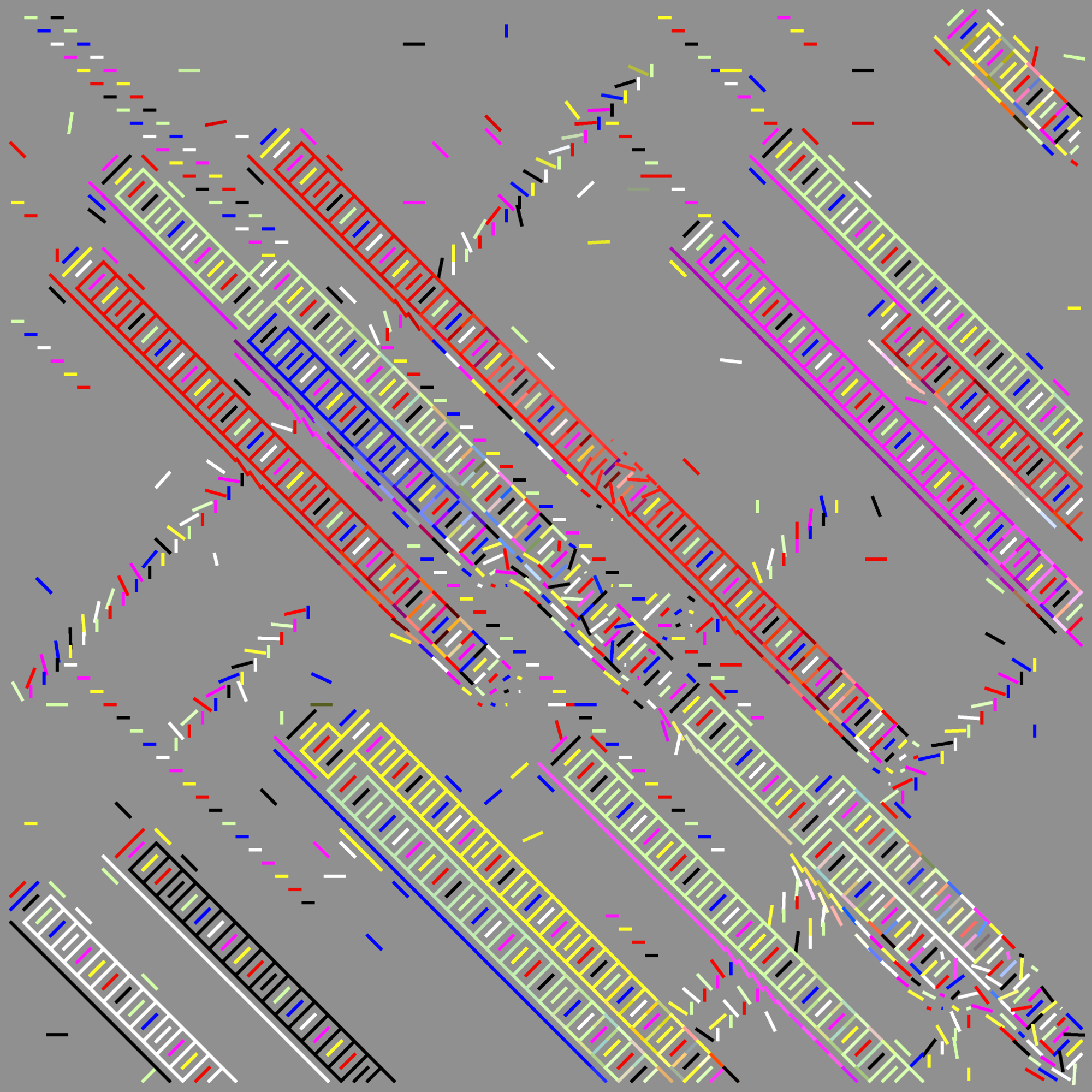
Peer Pressure.
Its name translates Pression des pairs, and its palette rebuilds the 2024 one. Grey ground, rgb(144,144,144). Seven gradients: khaki to yellow, light grey to pale green, magenta to a bluer magenta, near-black to black, blue-white to white, red to brick, and azure to pure blue. The six colours Pression des pairs drew from all return as one end of a gradient. Black, white, yellow and pale green are where gradients end; red and magenta are where they start. Blue is new. Four of the seven gradients end on a purer colour than they start from (khaki to yellow, azure to blue, blue-white to white, near-black to black), so in this token a segment's colour gets cleaner the longer it rests. Red goes the other way and ages to brick.
It is the slowest token: 7.5 automaton steps a second, with a new rule-set at most every 33 seconds, and only curated rule-sets. The frame is the sparsest of the five, with line on 15% of it. Long ladders run from upper left to lower right, each made of two parallel rails closed at the ends, with short rungs in other colours between them, like a meander band repeated along the diagonal. Each rail is a single group and keeps one colour along its whole length. Between the ladders the grey is open, crossed by staircases of short horizontal dashes and a few chains of segments climbing from lower left to upper right. Nearly the whole frame is in the ornament register. Yellow, which this palette reaches only with age, makes up 19% of the saturated pixels; red is 36%, magenta 25% and blue 17%.
Interruptions (token 2, pictured at the top of this page).
White ground. Four gradients: blue, red and black with identical start and end, and a green that barely moves (rgb(30,138,0) to rgb(9,133,0)). Colour in this token marks group membership and nothing else, since a segment that rests does not visibly change. The renderer lifts the stored green to near rgb(0,255,0), so on screen the palette is red, green and blue, the three additive primaries, plus black, on white.
It is the only token that never uses curated rules, which makes it the token where spinning and stuck cells are most common. It is also the fastest: 20 steps a second, a new rule-set at least every 12.5 seconds, and a quarter turn in 0.65 seconds. Line covers 42.5% of the frame, the densest of the light-ground tokens. It is the only token with no dominant direction: horizontal, vertical and both diagonals each take between 23% and 28% of the measured stroke length. The left half is texture made of short runs of horizontals and verticals, chevrons where diagonals meet, and segments at every angle in between. In the right half following cells have taken over. Broad arcs of parallel segments sweep across, with a whorl of concentric curves right of centre and fans below it. Both registers appear in the same frame.
About a fifth of the saturated pixels are colours the palette does not contain: magenta 9.4%, violet 6.1% and orange 5.5%. They are whole segments, since the share of their pixels lying inside a segment rather than on its edge is close to that of red, blue and green. These are segments caught between group colours. A segment easing from red to blue passes through violet and magenta, and one easing from red to green passes through orange; the renderer's stretch saturates the mixtures. In a palette that records no rest time, these in-between colours are the one place where time shows.
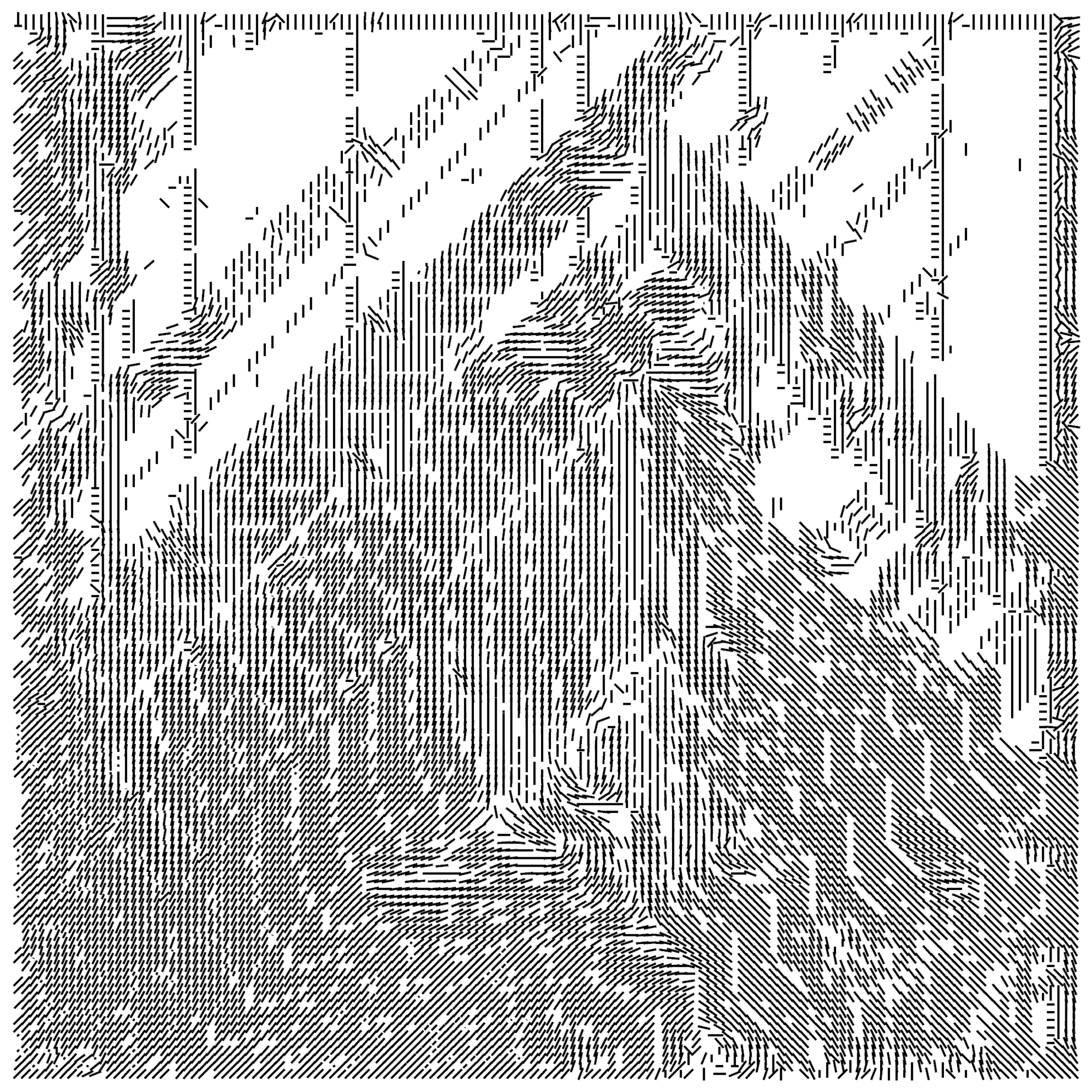
Monochrome.
Black on white, in a single colour, so the program runs without groups or staining. Its settings match Projection's in everything except colour: the finest grid of the series (7 px cells), the slowest turning (1.3 seconds for a quarter turn), 10 steps a second, and curated and random rule-sets half the time each.
Line covers 34.5% of the frame. The upper half is mostly open, with large voids crossed by vertical columns of short horizontal ticks and by rows of short verticals stepping up from lower left to upper right. The lower part is dense hatching in vertical bands and diagonal fields, with fans where the hatching bends from one direction into another. It reads like engraving. With black segments of one length on white and open gaps, it is the token that looks closest to Molnár's sheets.
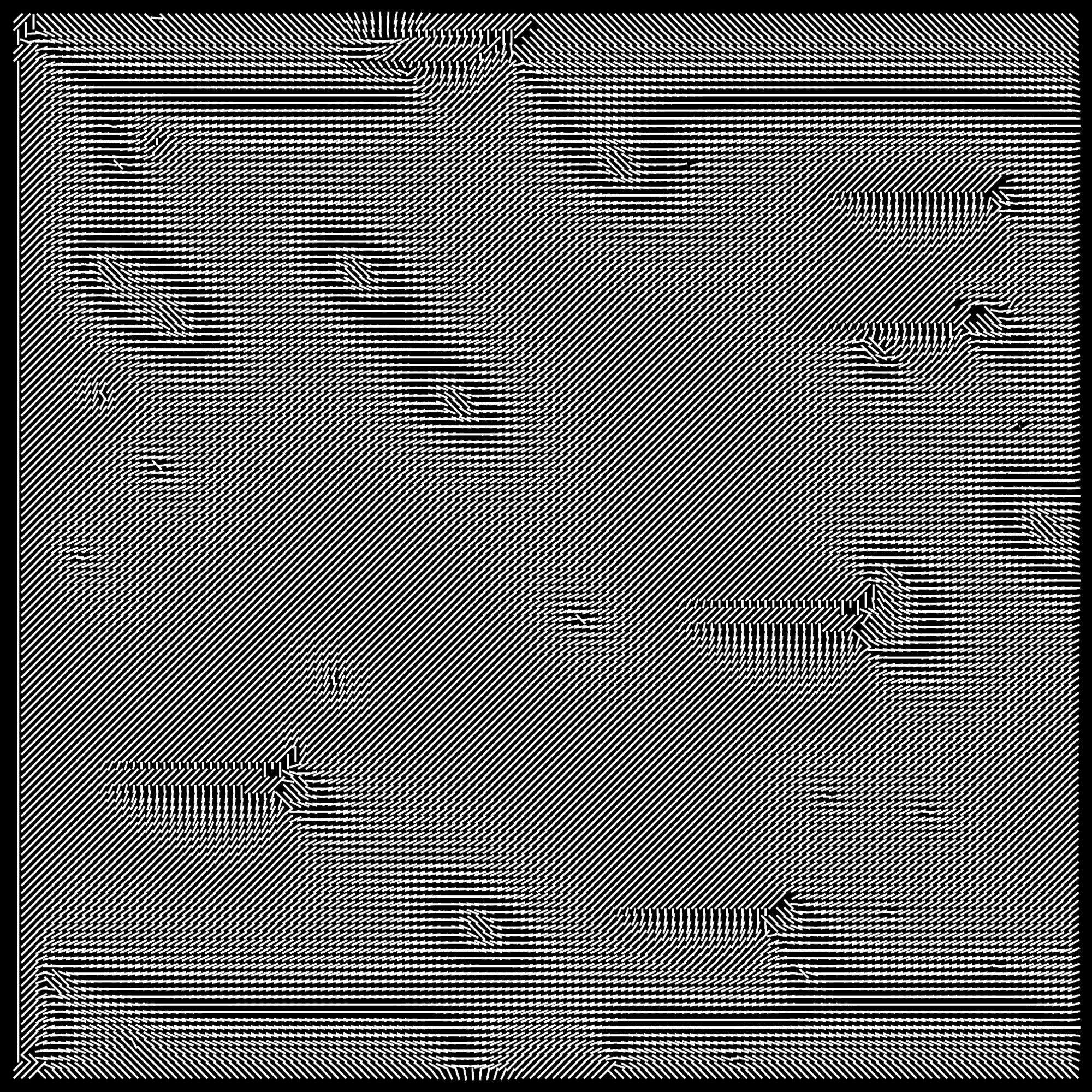
Projection.
White on black: Monochrome inverted, with the same settings. It is the densest frame of the five, with line on 52.4% of it. Most of the hatching runs from lower left to upper right (59% of the measured stroke length), with bands of horizontals along the top and bottom edges. Scattered across the field are knots: a short row of vertical segments trails from a point, and the diagonals around it bend aside, like a comet and its tail. At reduced size the parallel hatching beats against the pixel grid and produces moiré. The name fits the polarity, since on black only the segments give off light, as with a projector.
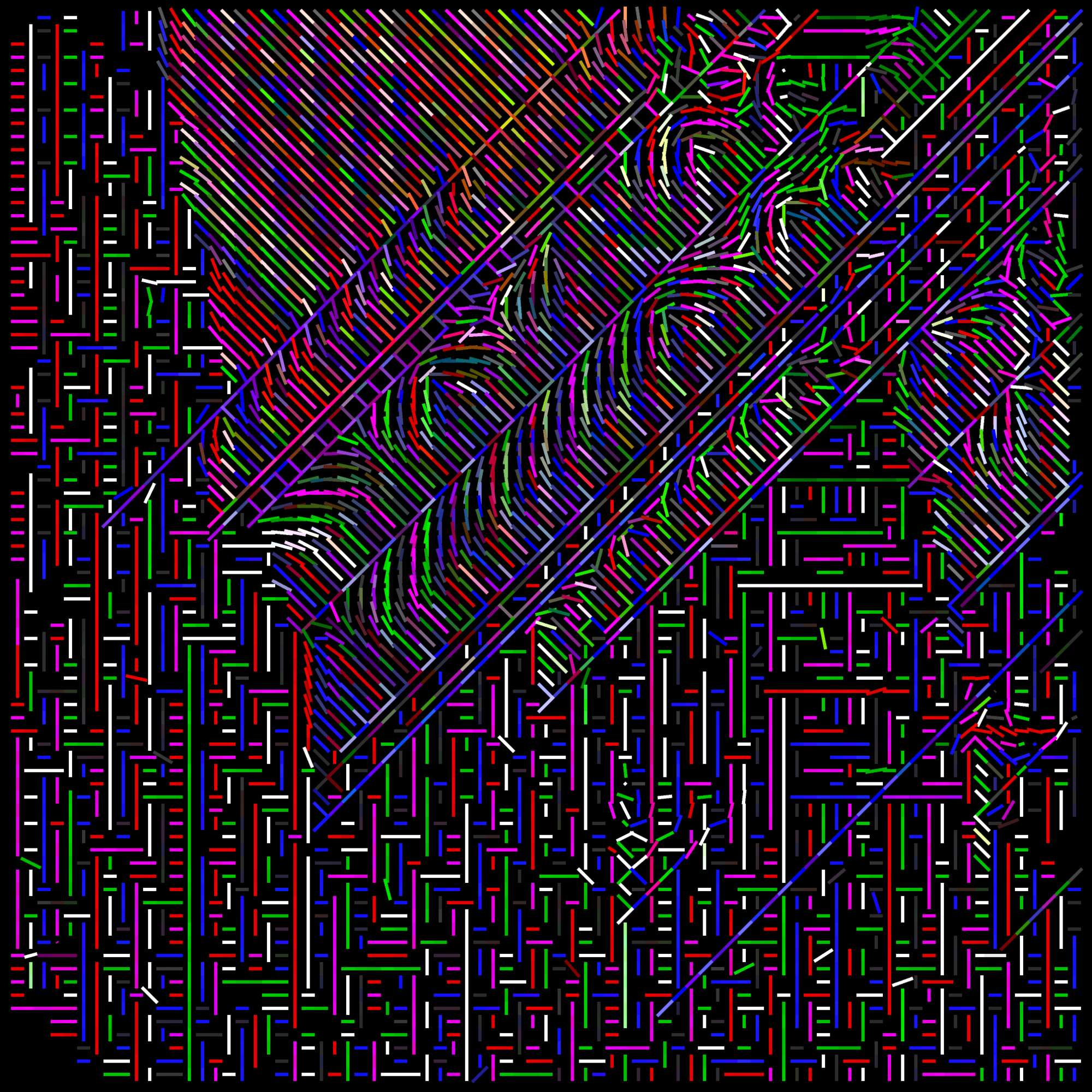
Nocturne.
Black ground. Six gradients: brown to red, yellow to green, blue to light blue, light magenta to magenta, a flat white, and light grey to dark grey. Every channel value is 0, 82, 173, 175 or 255. These lie within five units of 0, 85, 170 and 255, the levels of the 16-colour IBM PC palette (CGA and EGA), and each of the eleven colours matches one of its sixteen. With the black ground, twelve appear; cyan, light cyan, light green and light red are left out. Two gradients only switch the palette's intensity level (blue to light blue, light magenta to magenta), one runs from light grey to dark grey, and two cross hues, brown to red and yellow to green. Stained Unravel (Blockade), made in response to Herbert W. Franke's IBM PC work Move (Blockade), uses the exact IBM PC blue, rgb(0,0,170) (→ Franke × van den Dorpel). Nocturne's values are offset from the standard ones by three to five units throughout.
Nocturne uses curated rule-sets only and runs at 15 steps a second on 12 px cells. Line covers 29.4% of the frame, in three zones. The lower half and the left edge hold horizontals and verticals only, in red, green, blue, magenta, white and grey: the ornament register in its plainest form. The upper-left corner is a block of dense parallel diagonals running from upper left to lower right, in mixed colours, many of them between palette entries. Through the middle run long rails from lower left to upper right, each a single stroke across much of the sheet. Rows of arcs curl between the rails where following cells bend from one rail's angle to the next. Yellow makes up 0.5% of the saturated pixels and the orange-brown 1.1%, against 20.8% for green and 21.9% for red. Yellow and brown are birth colours, and green and red are where their gradients end. In this frame almost every segment born yellow or brown had already rested long enough to move along its gradient.
What the five show together
The five presets share one program. Their frames range from 15% to 52% line, and from one dominant direction (Projection, 59% of stroke length on one diagonal) to none (Interruptions). Palette, rule source and tempo account for only part of that range. Monochrome and Projection have identical settings apart from colour. Yet one frame is a third line and opens into voids at the top, and the other is half line and nearly closed. The difference comes from which rule-sets were active, and for how long, when each frame was taken. Interruptions and Nocturne show that the range extends within a single frame too, with ornament on one side and flow on the other.
See also
- Stained Unravel — the rule engine, grouping and staining that Interruptions runs on; the 23-shape vocabulary; seven palettes and the Museum Proof Blockade
- Early Plotter Drawings — Sediment (2025), Molnár's field with the grouping rule, on paper
- Algorithmic Archaeology — Molnár in the lineage of rule-based practice before and with the computer
- Angles Morts — with Vera Molnár (2024) — the exhibition that showed Pression des pairs
- Randomness and Pattern — Molnár's constrained imperfections; the geometric and the organic on one continuum
- Franke × van den Dorpel — Vectors, Apple Munich (2026) — the IBM PC palette behind Blockade
- Colour — the hand-made palettes across the practice
- The Grid — Pression des pairs and its drawings among the practice's grid algorithms; fluid dynamics as the grid that develops