
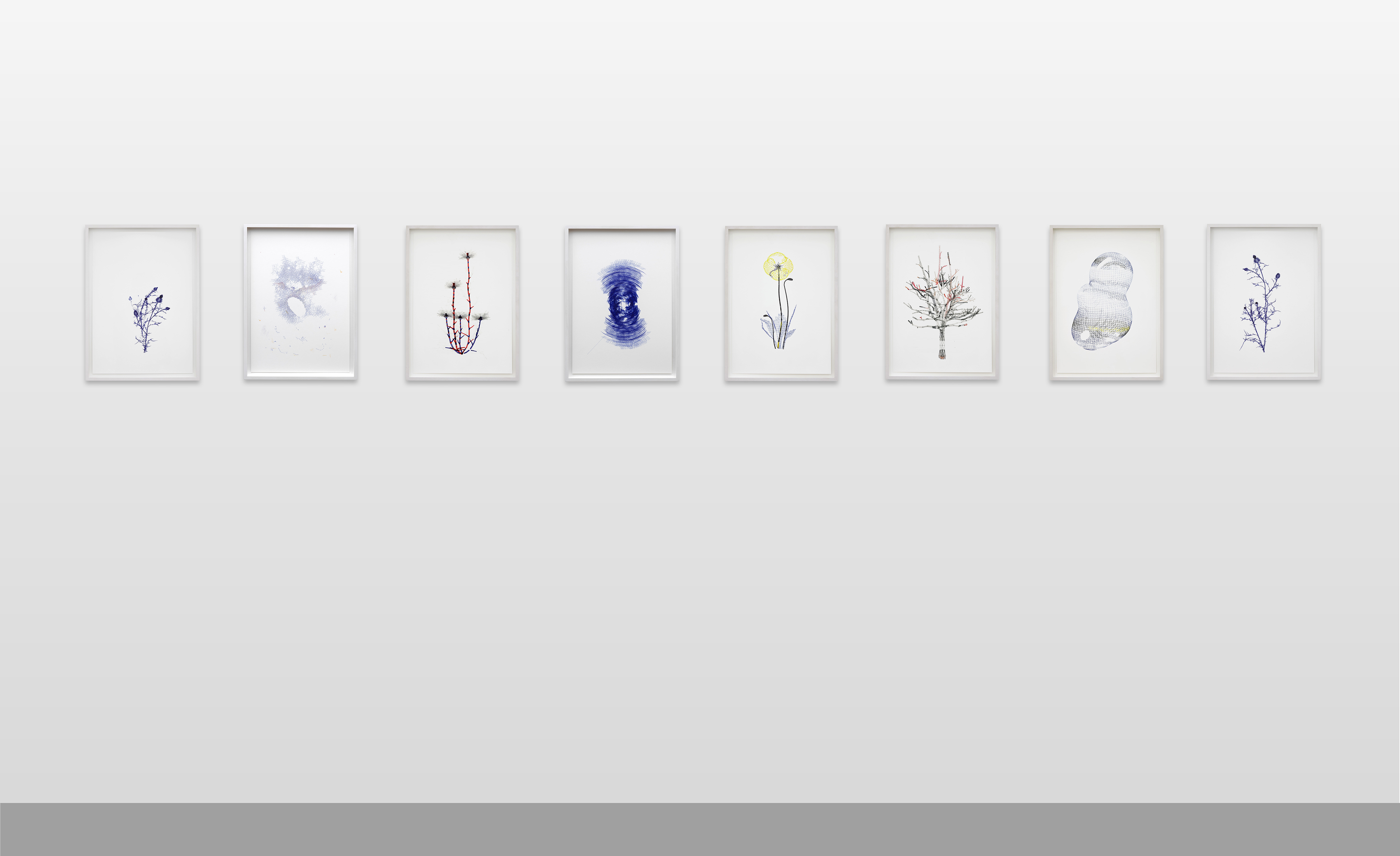
Early Plotter Drawings
A note for Lohaus Gallery on the works on paper in the summer show Summer: Sur Real Real (2026) — what they are, how they were made, and how they group together. Eight of these early drawings are on display; two larger new works are held in stock at the gallery. This is not a survey of my whole plotter practice; it focuses on the set selected for this show, with a few related works brought in where they sharpen the point.
All of these are plotter drawings: the image is not printed but drawn, by a pen plotter that grips an ordinary pen, ballpoint or pencil and moves it across the sheet exactly as a hand would, one continuous path at a time. The line is real ink laid down by a real nib under mechanical control. This matters for how they read up close — there is pressure, ink pooling, and the slight bite of the pen into the surface, none of which a print has. All of the works are drawn on heavy watercolour paper.
Crucially, these are not "press print and walk away" pieces. The plotter is a collaborator I interrupt: I stop it mid-drawing to change pen colour, I let it run a path and then add marks by hand, I replace a worn pen with whatever is nearest, and sometimes I cut into the vector file before it ever reaches the paper. Each sheet therefore carries a record of decisions made during the drawing, not only before it.
Because they are drawn — and because I interrupt them as they are drawn — these works are unique. I could never reproduce the same drawing more than once, even running the identical source file: the pen pressure, the ink flow, the exact moment I stop to change a colour or add a mark by hand all fall differently each time. The source file can be rerun; the drawing cannot be repeated.
Two families, plus two new large works
Eight early drawings (2017–2018) are the historical core — now nearly a decade old. They split into two groups:
- Botanical — traced from 3D-rendered models, frequently open-source assets originally built for 3D games. The plotter follows the wireframe and contour lines of a digital plant: Untitled Flower, Thistle (left), Thistle (right), A tree, Papaver Somniferum.
- Geometric / abstract — built from constructed 3D geometry or generative line fields rather than plant models: Metaballs ⁱⁱ, Diaphragm, Uttered Modality.
Two new drawings (2026) — Diagonal Fault and Vesper — are the largest of the group and are held in stock at the gallery rather than hung. They plot outputs of my Stained Unravel algorithm and each comes with its source NFT.
The larger observation: organic and geometric on one continuum
Before the individual works, the thread that runs through all of them — and through much of my other work: the algorithms and mathematics that produce geometric, systematic, schematic imagery are not radically opposed to nature. The organic and the geometric are not two camps; they sit on a single continuum of complexity. The botanical drawings make this literal — a plant exists in the work only as a mesh of straight line segments, yet it reads as a plant — but the point is more general: run a very simple rule far enough and its output begins to look organic, weathered, grown rather than constructed.
Botanical drawings (2017)
These begin as 3D models of plants — often open-source meshes made for game engines — whose edges and contours are exported as vector lines and handed to the plotter. The result sits oddly between a botanical plate and a wireframe: organic subject, machine-legible geometry.
Untitled Flower. Traced from a 3D source model of a dandelion — Pusteblume in German, the seed-head "blow-flower." During the single drawing pass I paused the plotter to swap pen colours; this is why the stems shift colour from segment to segment. The fluffy, parachute-like wings that carry the seeds — the pappus — are drawn in pencil.
Thistle (left). Alongside the plotted line I also drew some parts and lines by hand.
Thistle (right). The companion to Thistle (left) — the two come from the same source.
A tree. Traced from a 3D source model, somewhat inspired by the photographs of Karl Blossfeldt. I paused the plotter to change pen colour during the pass, giving the branches their shifts of hue.
Papaver Somniferum. Traced from a 3D source model. As with the other botanicals, the pen colour was changed by hand mid-drawing.
Geometric / abstract drawings (2017–2018)
Metaballs ⁱⁱ. Built from a 3D structure made in Cinema 4D; the exported vector lines were then edited in Illustrator, where I cut openings into the form — hence the oval void at the lower left and the empty, unfilled stroke at the top left. The yellow band is a pen replacement made mid-drawing. The wireframe shell recalls Vladimir Tatlin and Buckminster Fuller — a lineage I take up directly in Geodesic Dome Patent Drawing (Fig. 14) (2022), an algorithmic animation of figure 14 of Fuller's 1965 geodesic-dome patent.
Geodesic Dome Patent Drawing (Fig. 14). The wireframe-shell lineage of Metaballs ⁱⁱ taken up directly: figure 14 of Fuller's patent redrawn as an algorithmic animation, machine geometry reanimating a mid-century engineering diagram.
Diaphragm. This took many hours: the pen passed over the same areas again and again until the ballpoint began to eat into the paper, leaving a dense, burnished texture that is wholly specific to the machine — nothing a hand would make. Ballpoint is an everyday, administrative ink, rarely used for art, which is part of its appeal here. It is also the last drawing the original plotter ever made: partway through, the machine "decided" it had died and drove the pen straight back to the origin at the lower left without raising it — the long stray diagonal line is that final move. It forced me to buy a new, larger plotter.
Uttered Modality. The plotted structure was generated by an L-system — the same generative method behind my work Event Listeners. Of all the works this carries the most hand: many small, intuitive marks added by me in pencil and pen over the plotted lines, plus pen-colour changes made during the drawing. These small additions evoke microbes and microbiology — a teeming, cellular register at the edge of the plotted form.
The two new works (2026) — in stock, not on the wall
These are the largest sheets and the most recent. Both plot an output of my Stained Unravel algorithm and ship with the source NFT.
Diagonal Fault. Based on an output of the Stained Unravel algorithm; comes with a source NFT. Drawn with coloured-ink fineliners.
Vesper. Created with the Stained Unravel algorithm; comes with its source NFT. Drawn with coloured-ink fineliners, and the largest sheet of the group.
Quick reference
| Work | Year | Group | Medium | Size | Defining detail |
|---|---|---|---|---|---|
| Untitled Flower | 2017 | Botanical | pen & pencil | 42×30cm | colour-shifting stems from mid-pass pen swaps |
| Thistle (left) | 2017 | Botanical | plotter drawing | 46×34cm | from 3D model; parts and lines also drawn by hand |
| Thistle (right) | 2017 | Botanical | plotter drawing | 46×34cm | from 3D model; companion to Thistle (left) |
| A tree | 2017 | Botanical | pen & pencil | 30×42cm | after Karl Blossfeldt; pen-colour changes |
| Papaver Somniferum | 2017 | Botanical | ballpoint & pencil | 46×34cm | manual pen-colour interruptions |
| Metaballs ⁱⁱ | 2017 | Geometric | ballpoint & pencil | 40×30cm | Cinema 4D mesh; Illustrator cut-outs; yellow pen replacement |
| Diaphragm | 2018 | Geometric | ballpoint | 30×40cm | last drawing of the old plotter; ink bitten into paper |
| Uttered Modality | 2018 | Geometric | ballpoint & pencil | 40×30cm | L-system structure; most hand-added intuitive marks |
| Diagonal Fault | 2026 | New | coloured-ink fineliner | 47×60cm | Stained Unravel output + source NFT |
| Vesper | 2026 | New | coloured-ink fineliner | 65×90cm | Stained Unravel output + source NFT; largest |
Additional reference: the continuum in larger works (not in the show)
The works below are not part of the gallery selection and are not held in stock for this show. They are gathered here only as further illustration of the observation above — that a very simple rule, run far enough, arrives at organic, geological-looking form.
Several larger works push the same observation from the other direction, starting not from a plant but from a minimal rule and arriving at textures, swaths and geological structures that feel entirely natural. This connects directly to the compression/decompression argument on the pattern and randomness page: minimal input, maximal complexity at the level of the mark.
Sediment (2025) takes a highly granular grid of short connecting line segments, departing from Vera Molnár's Interruptions (begun late 1960s), and adds a single rule — when neighbouring segments touch they form a group sharing one colour — until the field settles into something that reads like sedimentary strata.
Atlas (2024) lets the probability of downward diagonal streams increase towards the bottom of the sheet, and that one gradient bends the whole field into an apparent curvature, like the surface of a hovering planet.
Current (2024) organises a field of directional marks into flows and eddies that read as water or wind though it is only a rule over line orientation — its title also pointing to rivers in typography, the vertical channels of white space that accidentally align down through a block of set text.
Tract (2026), the most recent, runs the same simple-rule logic into a dense, terrain-like expanse — and carries the hand forward into the newer work: the back-and-forth between mechanical line drawing and hand drawing in pencil that defines the early sheets returns here, which is why I now call Tract a hybrid.