
The Lozenge — Modernist Tilted Geometry
The lozenge — a square tipped onto its corner, with corners pointing up, down, left, right — is not a neutral form. It defamiliarises the square (the most stable, "default" shape in art) and forces the viewer to see it as a chosen form rather than a given. It activates the corners, which become the most prominent features rather than dead zones. It implies that the composition continues beyond the frame: the frame becomes an aperture rather than a container, an explicitly recursive move (the form contains a reference to what extends beyond it; → Recursion and Self-Reference). And it carries an implicit citation of Mondriaan — and, behind Mondriaan, Malevich's Black Square of 1915 as the foundational reduction of painting to the square as archetype. Any artist deploying the lozenge now is positioning themselves in relation to high modernism's claims about abstraction, universality, and the metaphysics of form, whether to extend those claims, interrogate them, or play with them.
Three artists, three uses
Mondriaan — the lozenge as metaphysical move
Mondriaan invented the tableau-losange in the 1920s as a metaphysical move rooted in Theosophy and Neoplasticism. His doctrine forbade the diagonal in the pictorial vocabulary: only strict horizontal and vertical lines were admitted as the universal structural elements of reality (verticality = active/spiritual; horizontality = passive/material). The diagonal was too dynamic, too tied to natural appearance — and the question of the diagonal was the proximate cause of his break with Theo van Doesburg, who introduced diagonals in his Counter-Compositions.
The lozenge is Mondriaan's elegant resolution of this constraint: rotate the canvas 45° and the frame gives him a diagonal envelope while the grid inside remains strictly horizontal and vertical, the no-diagonals rule unbroken. The lozenge is therefore not a "dynamic" gesture in Mondriaan's hands — it is the most static of all possible solutions to the problem of how to admit the diagonal without painting a diagonal: the frame absorbs the dynamism so the interior can keep its purity. Mondriaan rotates the canvas to access the universal grid behind appearances; the lozenge is, in his hands, the metaphysical answer.
Dibbets — the lozenge as epistemological pressure-test
Jan Dibbets uses the lozenge to do epistemological work where Mondriaan had used it to access the universal. In Perspective Corrections (1967–69), shapes laid on the ground are physically distorted so that, photographed from a specific angle, they read as perfect orthogonal forms in the image plane. A square photographed at an angle becomes a trapezoid; a trapezoid drawn correctly can read as a square. The implication is precise: the square is a mental construct we project onto the world, not a property of the world; what looks like pure geometry is a perceptual negotiation.
In Collage (1973, Tate; photographs and graphite on paper), in Shutters, in his colour studies and architectural photo-works, the diamond/trapezoid presentation foregrounds this same condition: the shape you see is not the shape that exists, only the shape produced by the angle of viewing. Where Mondriaan rotates the canvas to access the universal grid, Dibbets rotates the format to question whether the universal is perceptually available at all. There is a clear ironic dialogue with Mondriaan as Dutch predecessor — Dibbets is very conscious of that lineage — the Theosophist's metaphysical hunger for the universal grid recast as a perceptual problem about what the eye can be made to see. The lozenge becomes, in Dibbets, the form of the question Mondriaan thought it was the answer to.
Van den Dorpel — the lozenge as algorithmic citation and on-chain trait
Van den Dorpel inherits both the Mondriaan metaphysical citation and the Dibbets epistemological pressure-test, deploying the lozenge as a form that grafts modernist seriousness onto generative and networked practice while continuing Dibbets' question about what is perceptually given versus algorithmically constructed. The lozenge appears in three works across twenty years:
Markov's Window (2004)
Markov's Window is the earliest instance. Its work-text explicitly names Mondriaan as the comparand — "Whereas Mondriaan might have made many studies and versions to reach one single best possible composition, this work instead embraces perpetual change" — and stipulates that the composition's seed square "might rotate 45°," the lozenge as a permutation generated by a probabilistic rule.
Strictly speaking, this internal 45° rotation is closer to van Doesburg's Counter-Compositions than to Mondriaan's lozenge: the rotation happens inside the frame, introducing diagonal forms into the composition rather than rotating the whole canvas, which is precisely the gesture that broke Mondriaan and Doesburg apart. The Markov chain becomes the formal mechanism that allows both positions of the dispute to coexist: in any given state, the seed square may be in the orthogonal Mondriaan position or the rotated Doesburg position; the work is the probability distribution over the disputed terrain.
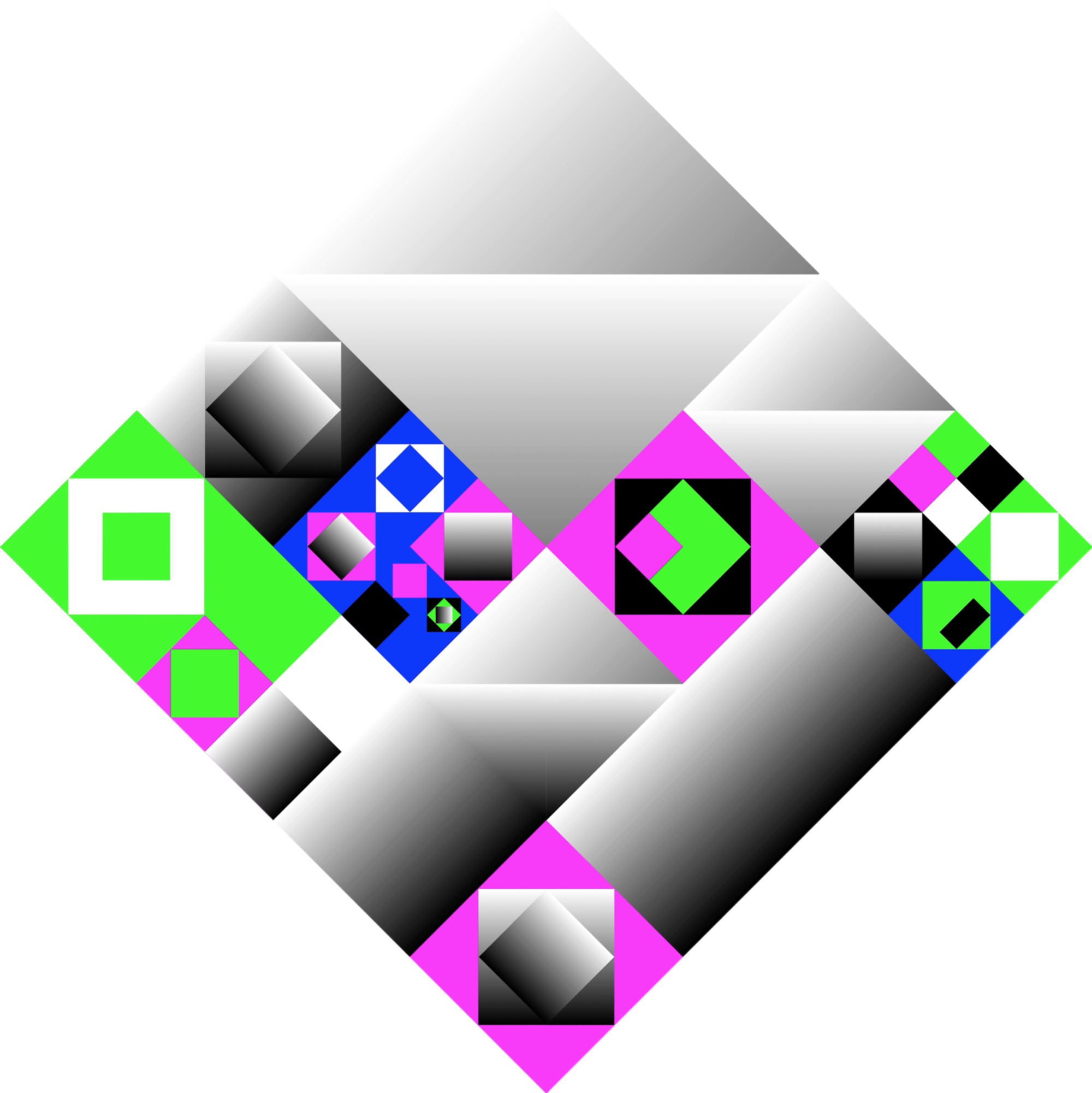
Markov's Window. The earliest instance: a memoryless stochastic system of subdividing, recolouring and 45°-rotating squares — the seed square's rotation letting the Mondriaan and Doesburg positions coexist as states of one probability distribution.
Venster (2024)
Venster is the explicit twenty-year sequel: 100 fully generative, on-chain, animated SVG compositions released in collaboration with Bright Moments, described in the artist's own words as "a new version of Markov's Window from 2004, but now fully on-chain." The compositions are generative animated recursive SVG files calculated by Solidity code. Different colour palettes, blending modes, and filters thicken the painterly surface.
The retitling is part of the work's continuity logic. Venster is the Dutch word for window — so Venster (2024) is, at the level of the noun, Markov's Window (2004) re-uttered in the artist's mother tongue. The two titles name the same object across twenty years and one language: not a translation appended to an existing work, but a re-utterance that takes the original's English noun back into Dutch. The register also shifts. Modern Dutch has two everyday words for window — raam (the common, domestic word) and venster (the older, more architectural and literary register, the word used for church windows, casements, and figurative apertures like het venster van de ziel, "the window of the soul"). Choosing venster over raam is a deliberate selection of the more formal, architectural register — the word that carries the frame-as-aperture sense rather than the everyday house-window sense. This matches the work itself: each composition is literally a window onto a Solidity-computed generative space, recomputed on every viewing — an aperture in the architectural and recursive sense developed below, not a domestic pane.
Venster makes the lozenge a categorical trait — an explicit generative root that the collection allows the user to filter by, alongside square (cover), triangles (diagonal split), and the affective traits classic / optimistic / melancholic. The lozenge is no longer an emergent state of the Markov chain (as in 2004) but a curated population of the generative space — a category that the artist has built into the work as something the viewer can ask for. This is the lozenge's transition from chance event to taxonomic class — and, in the on-chain context, from screen rendering to deterministic, verifiable composition recomputable on every viewing.
A short artist's writing accompanying the collection — Venster (2024) — develops the consequence of "recomputable on every viewing" by registering that contemporary browsers (Chrome, Firefox, Safari) render the same SVG differently even when the on-chain Solidity adheres to the W3C specification, and that forcing identical rendering across the off-chain display stack would burn more gas than the rendering itself. The decision recorded in the writing is to "deem the varying SVG interpretations a feature of the artwork" and to identify the work with the on-chain score rather than any specific performance of it: "perhaps there is not one single canonical rendering, but all are subjective temporal performances of one and the same score." In April 2026 the collection acquired a dedicated home at venster.harm.work, where the 100 minted tokens are joined by the entire seed space as a navigable territory filtered by the same three trait axes (root / feel / complexity).
Endless Knot (2024)
Endless Knot — Sakura fineliner plotter drawing on Hahnemühle watercolour paper, 63×69cm — arrives at the same 45° geometry through inherited Tibetan Buddhist iconography rather than algorithmic permutation.
The work is structured throughout by 45° angles — every crossing, every segment of the lattice runs diagonally to the picture frame, and the iconographic envelope inside the rectangular paper traces a lozenge. Endless Knot straddles the Mondriaan/Doesburg fault line in a single object: relative to the rectangular paper, the lattice is everywhere diagonal (the Doesburg side, diagonals introduced into the composition); relative to the inscribed lozenge envelope itself, the same lattice reads as horizontal and vertical (the Mondriaan side, the rotated frame absorbing the dynamism so the interior reads as orthogonal). Which side the work occupies depends on which frame of reference one takes; the inherited Buddhist iconography turns out to encode, as a single geometric form, the European modernist argument that broke Mondriaan and Doesburg apart.
The Buddhist content of the work and its connection to saṃsāra / recursion-without-halt is developed in the recursion page (under Iconographic: the Endless Knot — samsara as recursion without halt) and in the Our Inner Child summary (under Endless Knot (2024) — the Buddhist iconography of the same predicament).
Convergence
The three van den Dorpel works approach the lozenge from different sides — Markov's Window through Markov-chain permutation (Counter-Composition-style internal rotation), Venster through generative-trait taxonomy on-chain, Endless Knot through inherited Buddhist iconography — and converge on a tilted-geometry lineage running through Dibbets to Mondriaan. Behind them stands Malevich's Black Square as the foundational square-as-archetype.
The shared windowness of Markov's Window, Venster, and the lozenge's frame-as-aperture is exact: a bounded form whose composition is implied to continue past it. Venster makes the metaphor structural — the work is literally a window into a Solidity-computed generative space, recomputed on each viewing.
Contemporary stake — the lozenge against the responsive square
The square is no longer just the modernist archetype: it is the archetypal social media post, the platform-default whose aspect ratio is fluid and responsive — content reflowed and recropped into 1:1, 4:5, 9:16 as the platform requires. In that environment, deploying the lozenge is no longer only a citation of Mondriaan's metaphysics; it is also a refusal of the responsive square. The lozenge cannot be reflowed without losing its meaning — its 45° rotation is the work, not a layer that can be auto-cropped away. It insists on a particular orientation against the platform's default isotropy.
This contemporary stake links to the squircle argument: the platform pressure on geometric form is real, and works in the practice respond by making form load-bearing in ways the platform cannot strip out. Where the squircle critique is about occupying the platform-default form to expose its ideological work, the lozenge is about refusing the platform-default's responsive isotropy — two different operations on the same problem.
Connection to recursion
The lozenge is recursive in a precise sense developed in Recursion and Self-Reference: the frame is an aperture, not a container; the composition is implied to continue past the frame; the form contains a reference to what extends beyond it. This is the same structure as recursion's self-referential definition: the frame includes (by implication) what is outside the frame, just as the recursive definition includes a reference to itself.
In Venster the recursion is explicit at multiple levels: each composition is a recursive SVG (subdivisions referencing the same shape vocabulary at smaller scales); the on-chain Solidity code that calculates the composition is itself a deterministic recursion; the work is the on-chain successor to a 2004 Flash work that already used the Markov chain's recursive subdivision. Endless Knot makes the connection iconographic: the Tibetan endless knot is the symbol of saṃsāra, the unbounded cycle 876 describes structurally as recursion-without-halt.
See also
- Recursion and Self-Reference — the structural concept the lozenge enacts visually; the Endless Knot / saṃsāra iconography as the Buddhist version of recursion-without-halt
- The Squircle — the other geometric-form intervention in the practice; occupying the platform-default rather than refusing it
- Our Inner Child (2023) — Mondriaan as "compressor" in the compression / decompression argument; the modernist-lineage thread elsewhere in the corpus
- Protocol, Taste, and Systems — Markov's Window (2004) and the memoryless stochastic system; "Markov melancholia"
- The Markov's Dream Palette — the palette continuity across Markov's Window (2004) and its successors
- Venster — the writing (2024) — the artist's accompanying text; cross-browser SVG variation as constitutive; "subjective temporal performances of one and the same score"; the April 2026 dedicated site at venster.harm.work