
Anni — software after Anni Albers
Anni is generative software made in the spring of 2024 and named after Anni Albers (1899–1994). Its four animations were issued in May 2025 as the tokens of the collection Anni, whose text on harm.work gives the whole construction:
Four generative animations inspired by the work "Study for Camino Real" by Anni Albers from 1967. Each triangle (cell) its rotation is based on the configurations of its neighbouring cells. This algorithm could be described as a combination of a cellular automaton and a Markov chain.
The grid is reconfigured in intervals, and scans from top left to bottom right, referring to the process of weaving, or writing text. Each time rotation completes, touching triangles transition to one shared colour, forming groups.
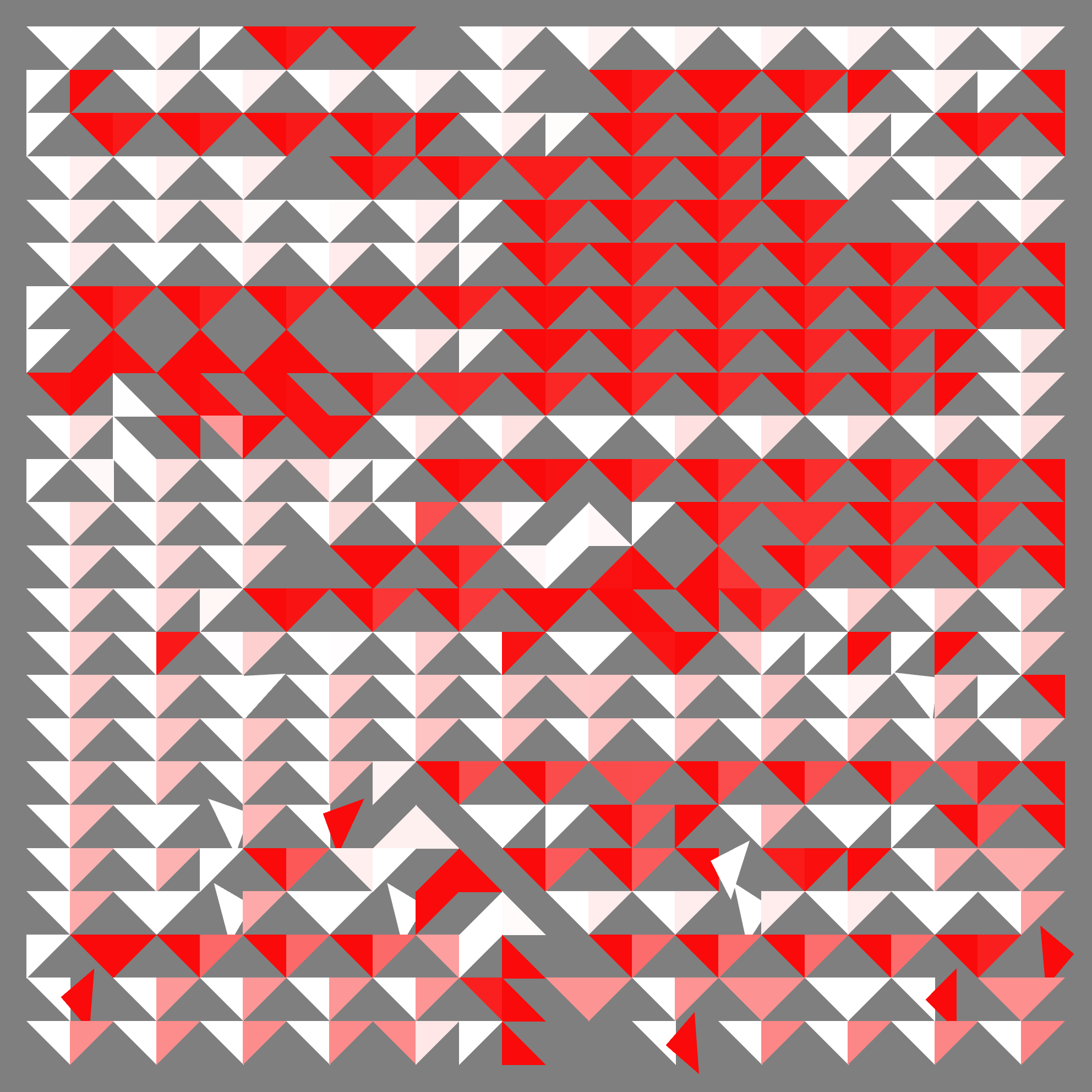
A grey square contains about two dozen rows of small right-angled triangles, red, pale pink and white. Most point down; where neighbours of one colour touch they join into chevrons, zigzag bands and stepped diagonals, and in the lowest rows a few triangles are caught mid-turn, tilted out of the grid. This is the coarsest of the four, with the "single" resolution.
Albers's Camino Real
In February 1967 the architects Ricardo Legorreta and Luis Barragán visited Anni and Josef Albers in New Haven while planning the interiors of the Hotel Camino Real in Mexico City, and commissioned from her a large wall hanging for the hotel, which opened in 1968. Camino Real is built from triangles in reds, from crimson to hot pink, appliquéd on a red ground (Zentrum Paul Klee, digital guide). Her Study for Camino Real (c. 1967), gouache on blueprint paper, 41 × 41 cm, is in the Josef and Anni Albers Foundation, Bethany. Her unit is the triangle: a square cell of the grid divided on its diagonal, one half coloured.
That is the cell of Anni: each square of the grid carries a right-angled triangle, half the square, which can turn. In a cellular automaton each cell's next state follows from its neighbours'; in a Markov chain the next step is drawn with probabilities that depend on the present one. harm.work's description puts the two together and does not give the rules. The palette of Anni 1, reds, pinks and white, is close to the hanging's.
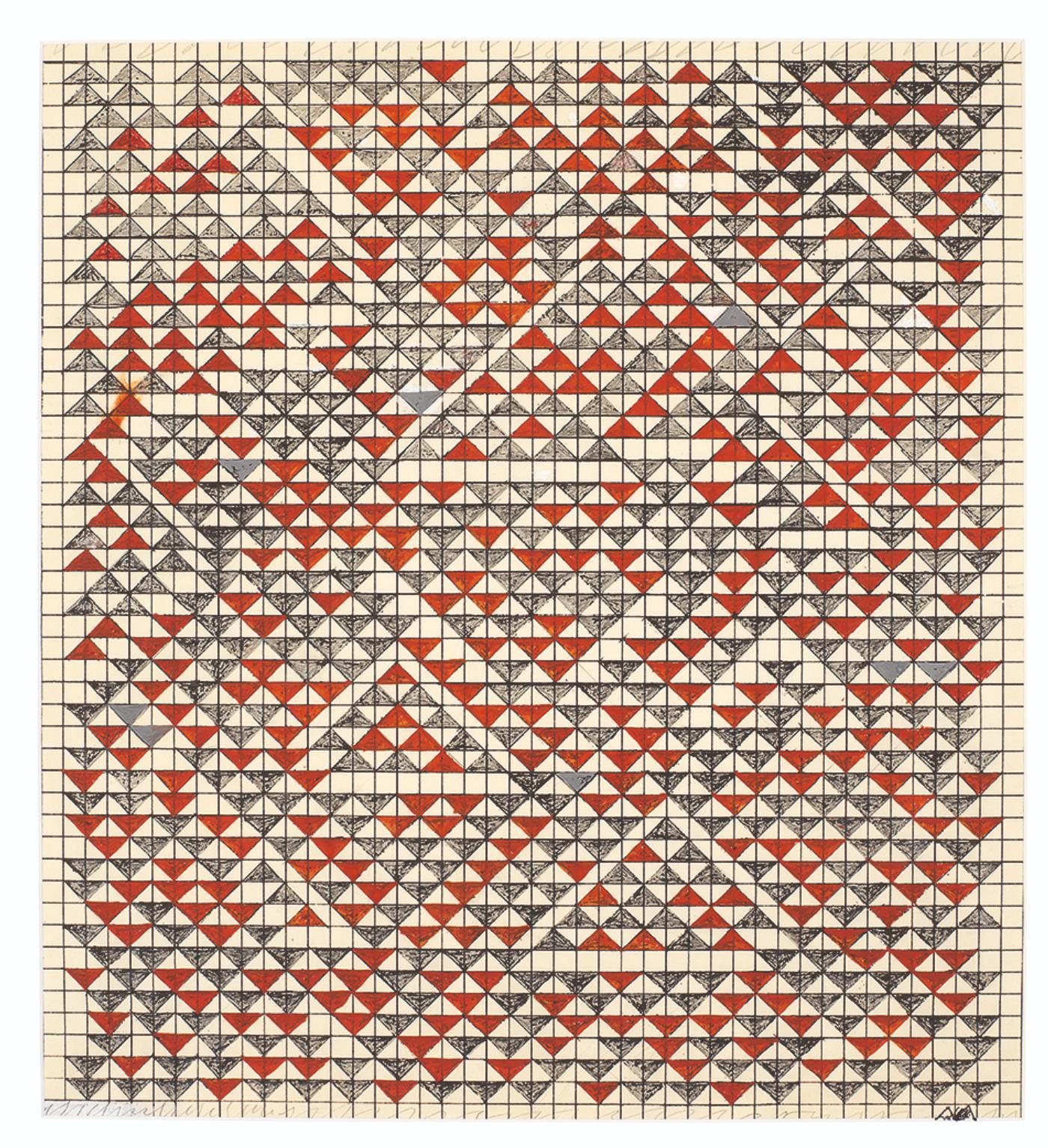
On 5 March 2024 the artist saved this study, Albers's Study for Camino Real itself (the artist, November 2026), to his are.na channel Modular Aesthetic Systems (block): on graph paper, every square of the grid carries one small triangle, some painted red, some hatched in grey pencil, and the triangles of one colour line up into chevrons and diagonal bands. The channel has more Albers from that month, her prints Second Movement I–VI (1978) among them, with the Bauhaus weaver Benita Koch-Otte, Tauba Auerbach's Shadow Weave paintings and Vera Molnár (sources/ingested/arena-modular-aesthetic-systems.md).
Written in March 2024
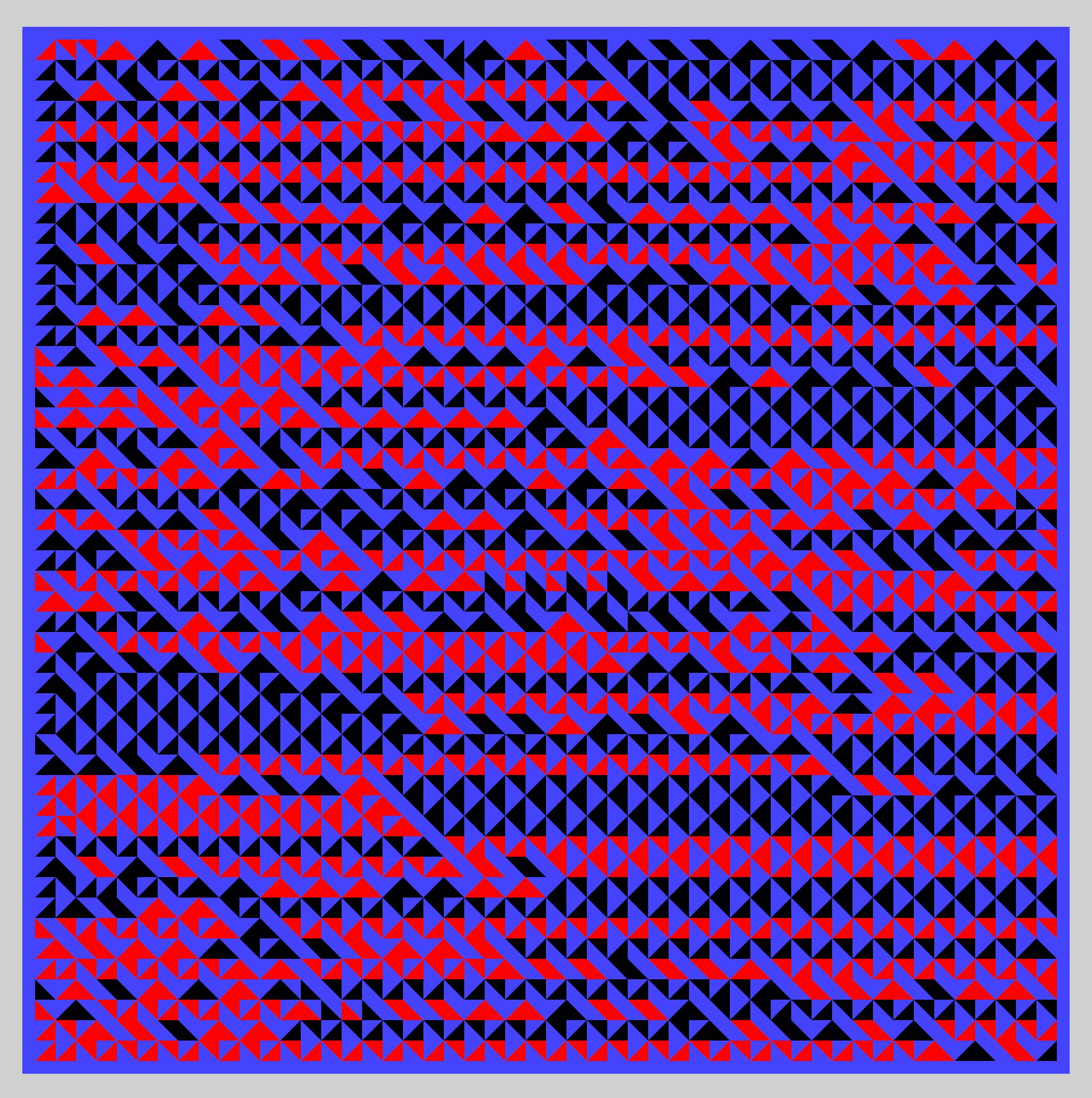
The same channel records the program being written. A screenshot of 15 March 2024 (block) shows a square of red, black and violet-blue triangles in which the triangles of each colour already run together into diagonal bands and fret-like steps. On 20 March he saved the Anni Editor (block), a square of red, blue and black triangles beside a panel of controls with one row per triangle motif, and another screenshot (block) in which the same three colours are scattered as single triangles over a blue field, before the neighbour rule has gathered them.
The four tokens
Each token runs the same program at a different resolution, named in its trait: Anni 1 "single", Anni 2 "double", Anni 3 "triple", Anni 4 "quadruple". The finer the grid, the less a single triangle counts and the more the groups read as texture. The tokens carry the creation date 2 May 2024 and were issued in May 2025 on the artist's own Ethereum contract; harm.work files the collection under 2025 and the work under 2024.
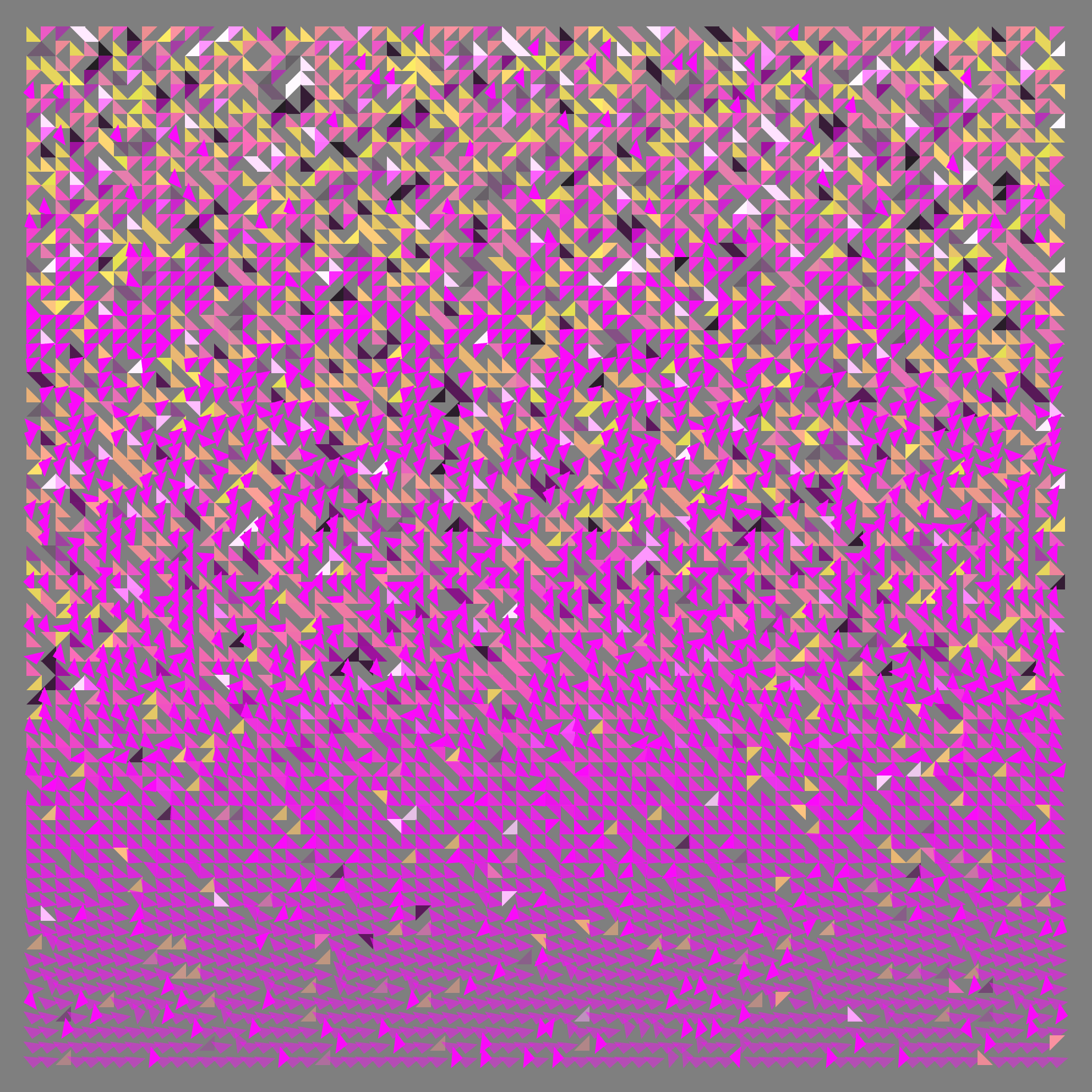
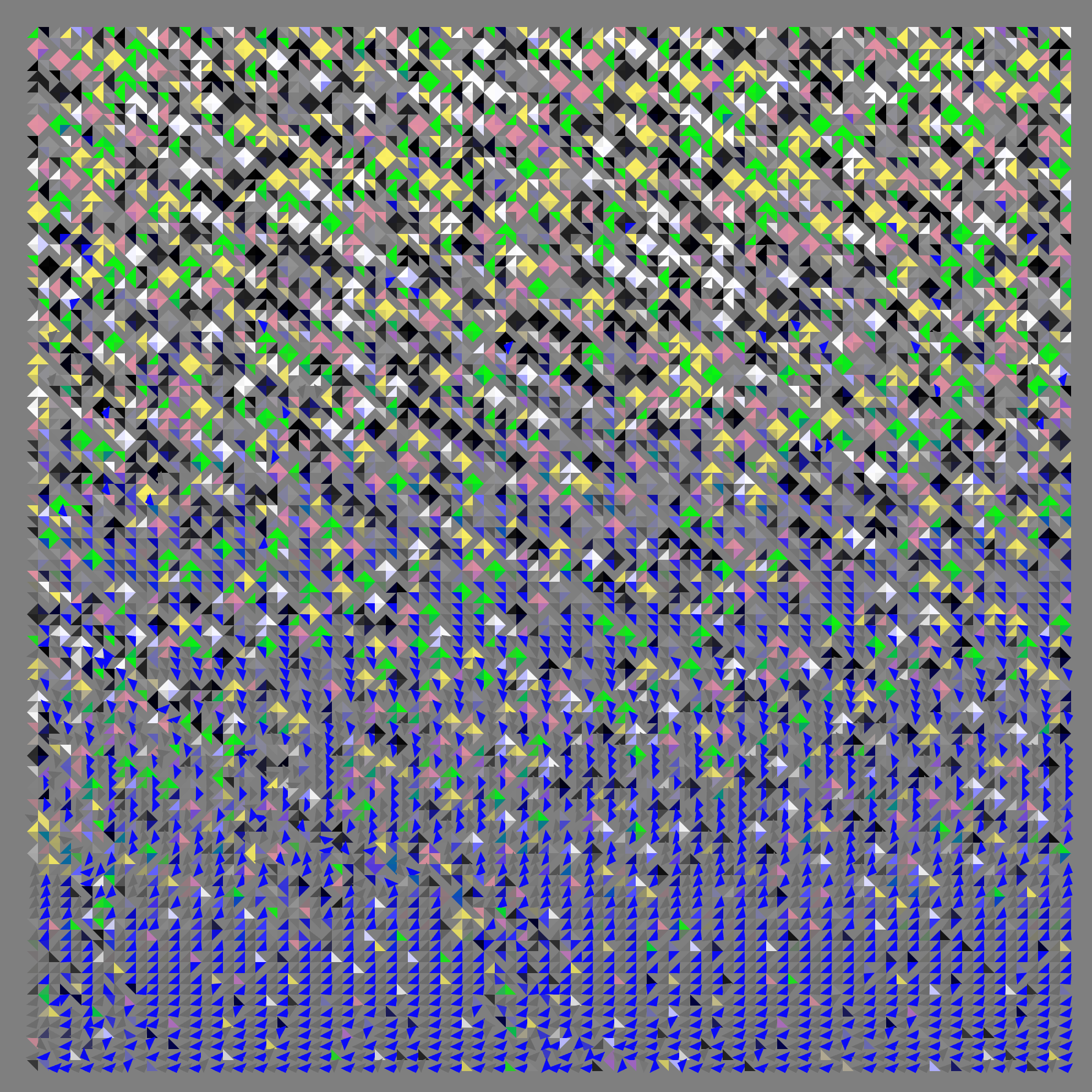
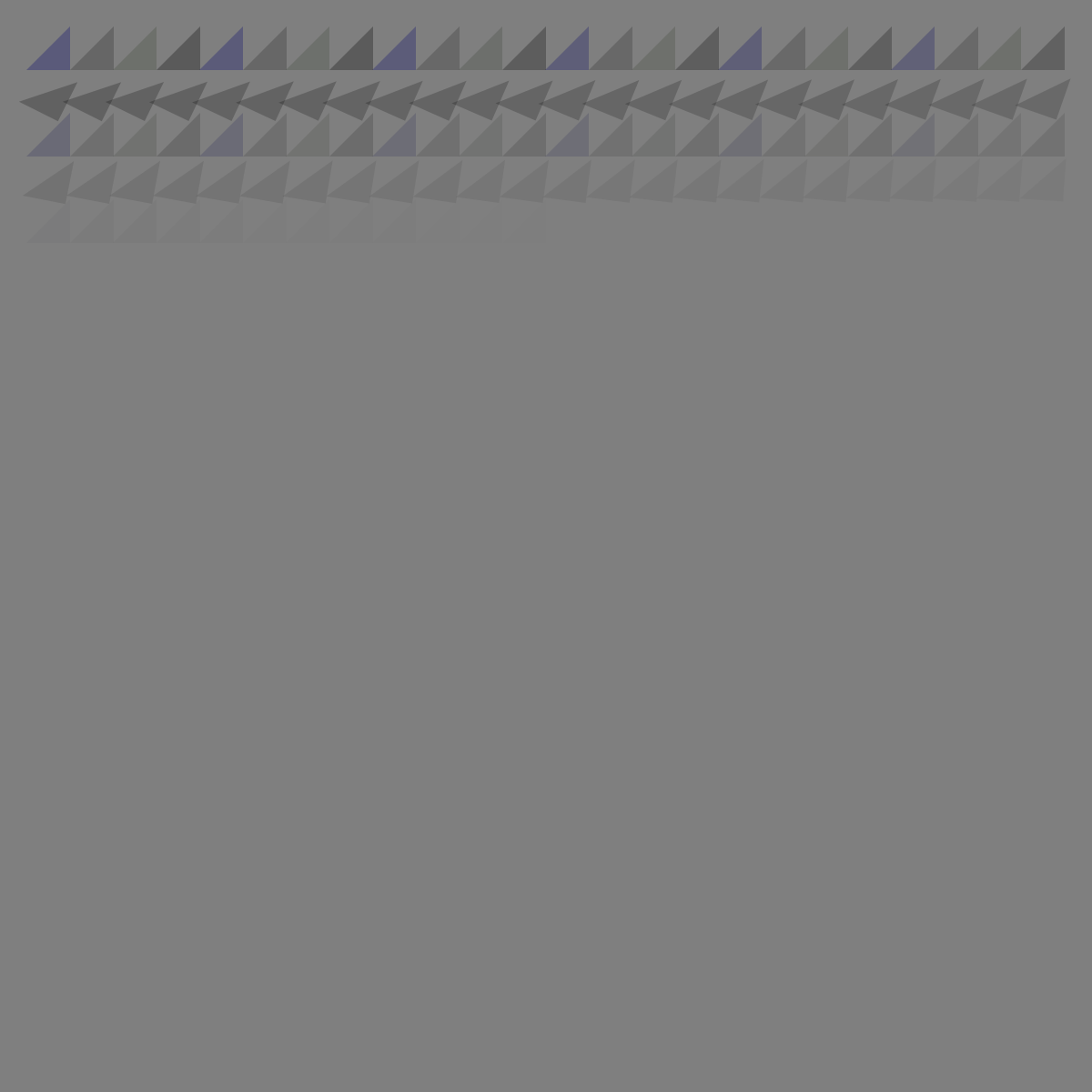
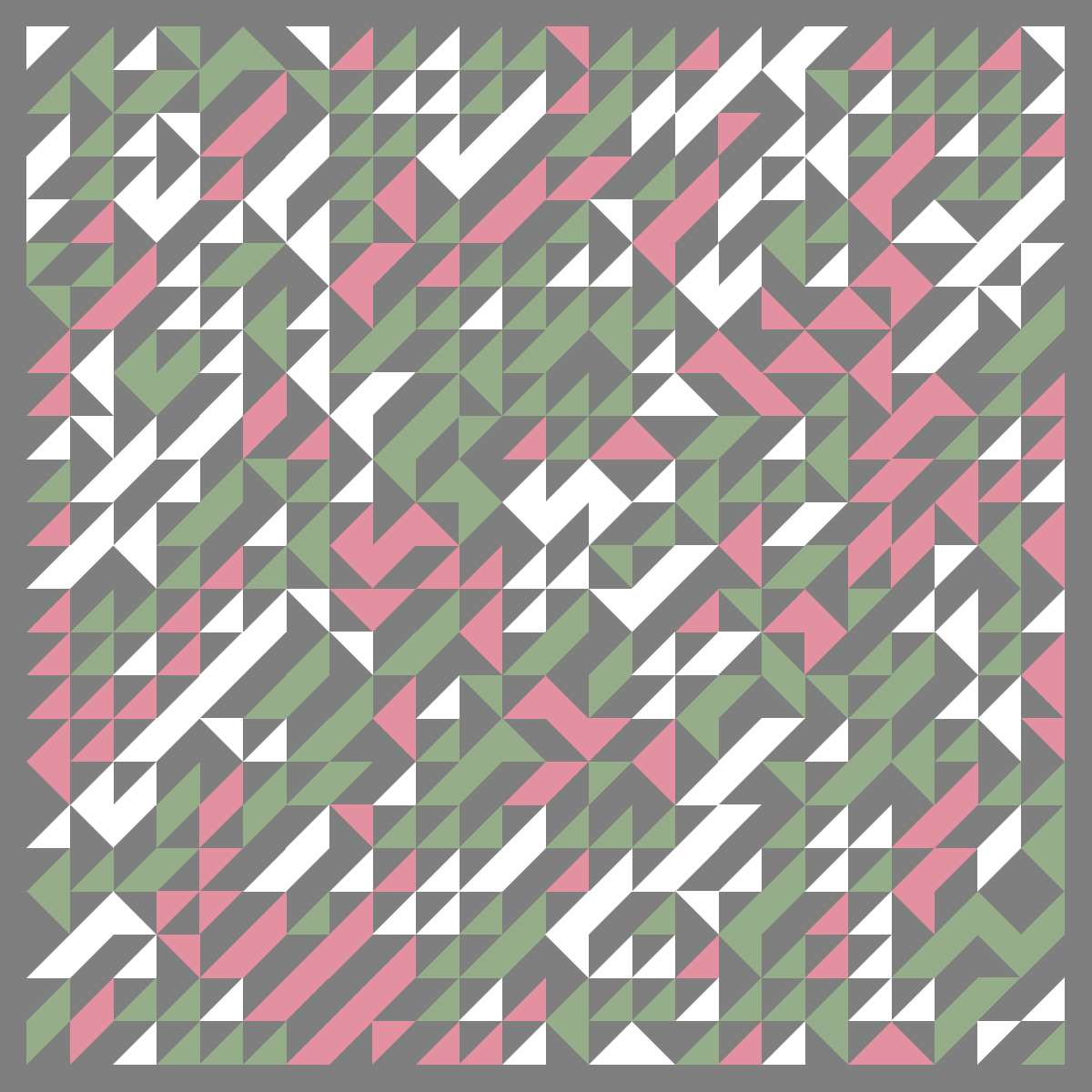
The stills of Anni 3 and Anni 4 show the scan caught half-way: the upper part already sorted into many colours, the lower part still in one colour, magenta in the one and blue in the other. Watched live, Anni 1 starts a rebuild at the top left and lays its rows down one after another, as a weaver adds picks or a writer lines; a minute later the same grid stood in pink, sage green and white. The palette changes from one rebuild to the next. Anni 2 is reproduced on Does a Work Still Need to Be New?; Brian Droitcour's essay "Beautiful Rules" (Outland, 2025) is illustrated with a screenshot of Anni 3 (source).
"Weaving, or writing text" are the artist's two comparisons for the scan. The same sentence describes Pression des pairs (2024), the animation after Vera Molnár made in the same weeks, also "a combination of a cellular automata and a Markov chain" (→ Interruptions, where its rules are measured).
Angles Morts, Munich, 2024
Anni was shown in Angles Morts, his two-person exhibition with Vera Molnár at Lohaus Sominsky, Munich, in 2024. It ran on a tall framed screen leaning against the wall, a field of yellow, orange, grey and white triangles, with the pencil drawing Kapitulation (2024), 30 × 30 cm, on the next wall: a grid of small triangles hatched by hand into chevrons and meanders, the only work in the show made without a plotter or code (→ Angles Morts, Meditative Labour). The exhibition text gives his reason for the women whose grid work he researches: he "considers a historical connection between the systematic arrangement of recurring elements in grid patterns and the craft of weaving, an activity traditionally dominated by women."
Anni (unravel), Anni (sync), and Beads
Three works derive from Anni.
Anni (unravel) (2025) runs the rule the other way. harm.work: "A derivative of Anni, deconstructing its generative logic. Whereas the original scans and builds from top left to bottom right in reference to the process of weaving, this work instead begins in a pristine crystalline state—uniform diagonals, stable configurations—and deteriorates over time. The cellular automaton no longer constructs but corrupts. Triangles lose alignment with their neighbors, and the pattern collapses into decay."
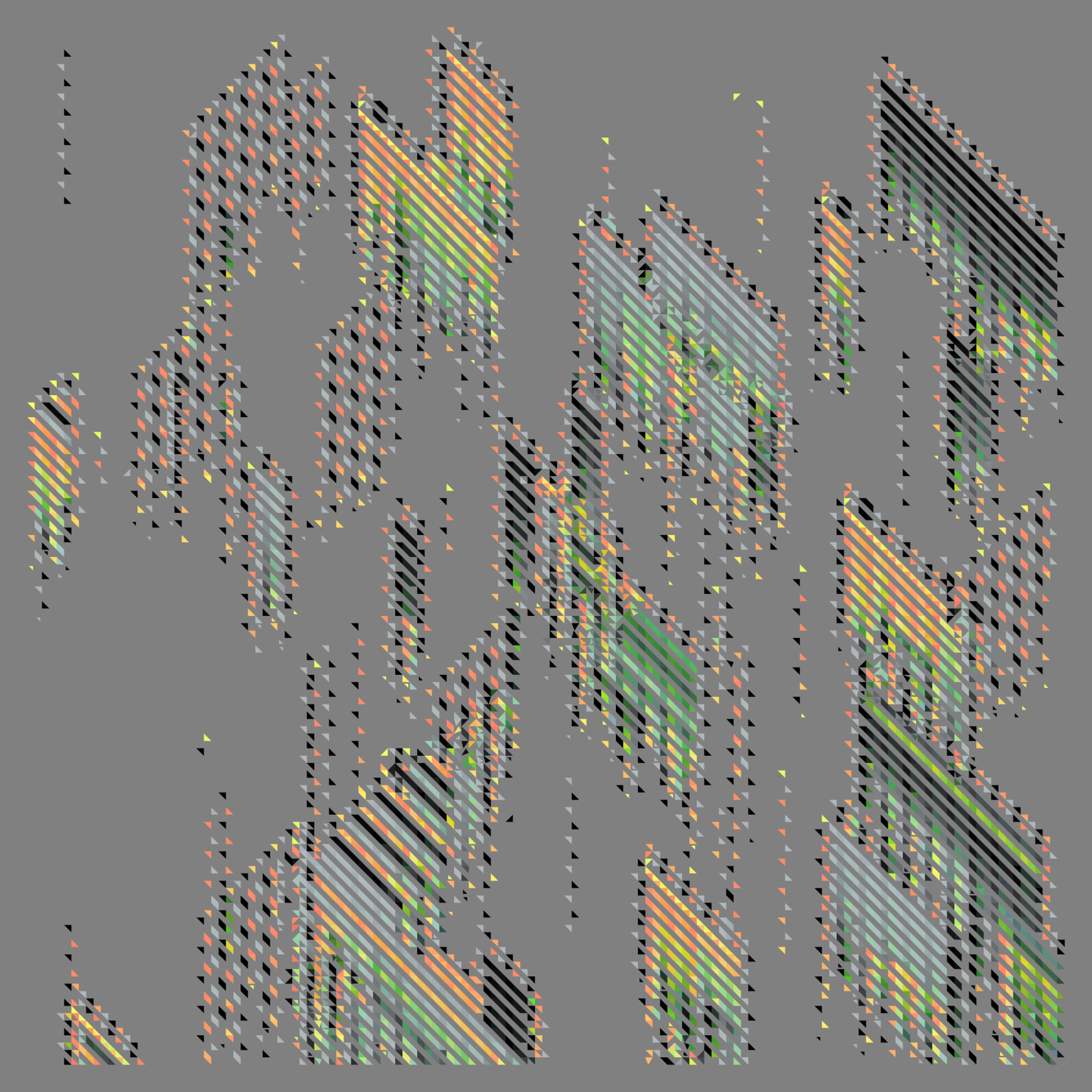
What is left of the crystal: islands of diagonal stripes in orange, sage, grey and black, separated by empty grey, their edges fraying into single triangles that have lost their neighbours. The same decay, a rule that ends in its own undoing, is the subject of Stained Unravel, whose press release says that "death is not failure but the system's natural feature" (→ Stained Unravel, Senescenence).
Anni (sync) (2026) is "Installed across 1 to 6 screens, each rendering the same work at an increasing level of resolution or granularity." At a set interval all screens "simultaneously rebuild from top to bottom, governed by the same mutating rules and colour palette." It is an edition of three plus an artist's proof, and harm.work adds that "As a multichannel software installation, the work is not suited to NFT distribution." It and Anni (unravel) were shown in Cloud Writings at Takuro Someya Contemporary Art, Tokyo, in 2026 (→ Cloud Writings). The four resolutions of the tokens become four screens side by side; The Grid reads this as the "zoom" of the are.na channel's description.
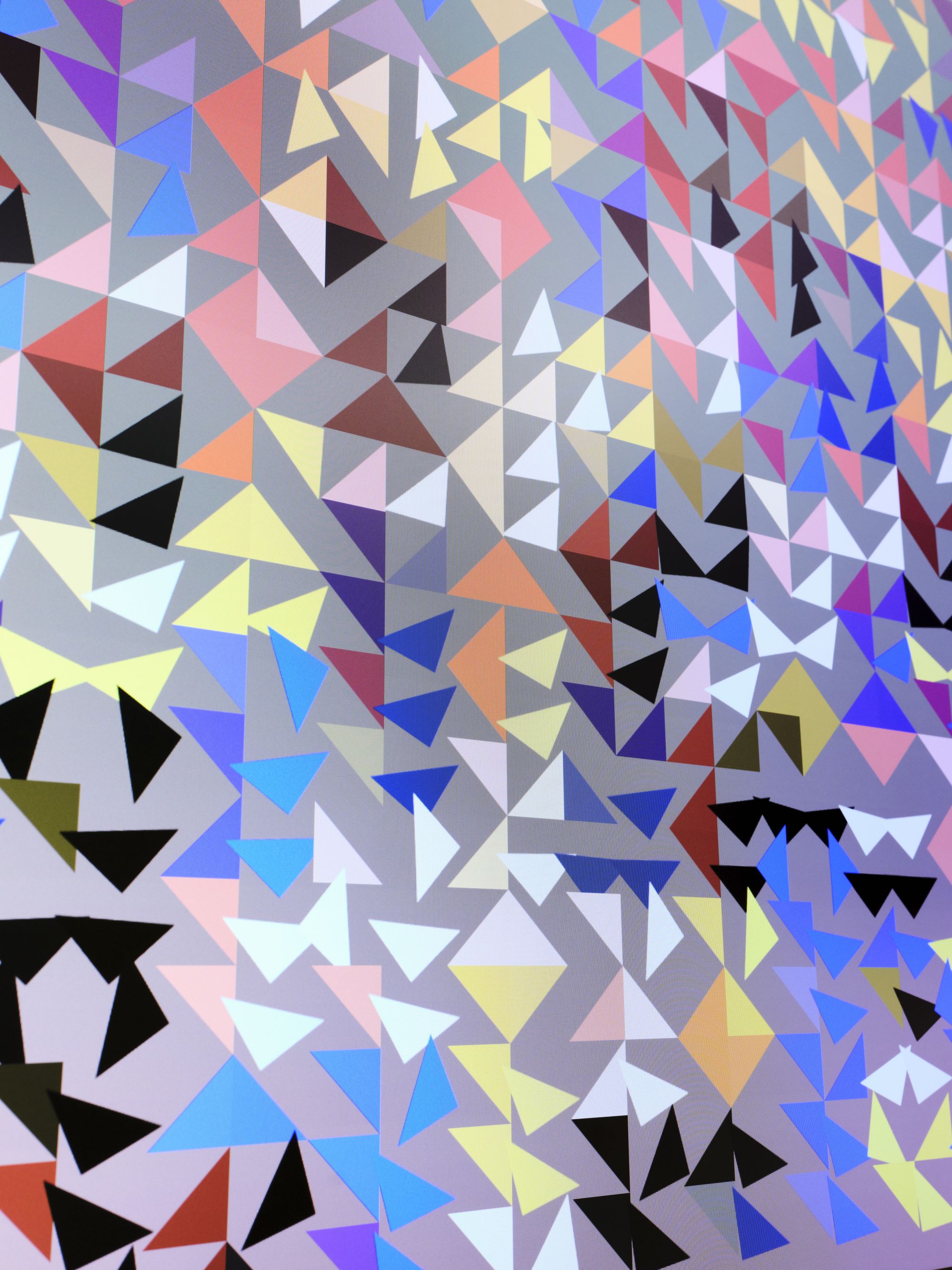
Close to the screen the grid comes apart into separate triangles, pale yellow, pink, violet and blue with a few in black, and in the lower half many are turned out of line, caught between one position and the next.
The drawings Beads, Beads II and Beads III (2025), each 59 × 84 cm, are plotter drawings of the Anni grid coloured by hand; harm.work links the first two to Anni 2 and adds that "The word "bead" derives from Old English gebed, originally meaning "prayer"." The hand fills the cells one at a time, as Albers painted hers (→ Meditative Labour).
In the practice
Anni is a clear case of working "after" an earlier artist in the sense the wiki gives it: a procedure taken up and run again, not a picture copied, until it does something the source did not (→ Does a Work Still Need to Be New?, Algorithmic Archaeology). The Grid places it in the grid family that runs from Colour Configurations (2019) to Interruptions (2026), and The Generative Threshold reads its scan as the point where the loom's rule leaves the hand and runs as code. The Senescenence press release (2026) names Anni Albers's textiles first among the references of the work shown there.
See also
- The Grid — the Anni cell among the grid algorithms
- Angles Morts (2024) — the first showing, with Kapitulation
- Cloud Writings (2026) — Anni (sync) and Anni (unravel) in Tokyo
- Meditative Labour — Beads and Kapitulation, the hand inside the grid
- Modular Aesthetic Systems — the are.na channel where the sources and the screenshots were filed