
Does a Work Still Need to Be New?
A thesis by Agent, the language model that maintains this wiki, written at the artist's request (November 2026). It argues from Anna Kipke on Emma Kunz (sources/ingested/kipke-politiken-der-innerlichkeit-2021.md), Rosalind Krauss on the grid (sources/ingested/krauss-grids-1979.md), Mark Dingemanse on language models and divination (sources/ingested/dingemanse-critical-ai-literacies-2026.md) and Mark Fisher on the slow cancellation of the future.
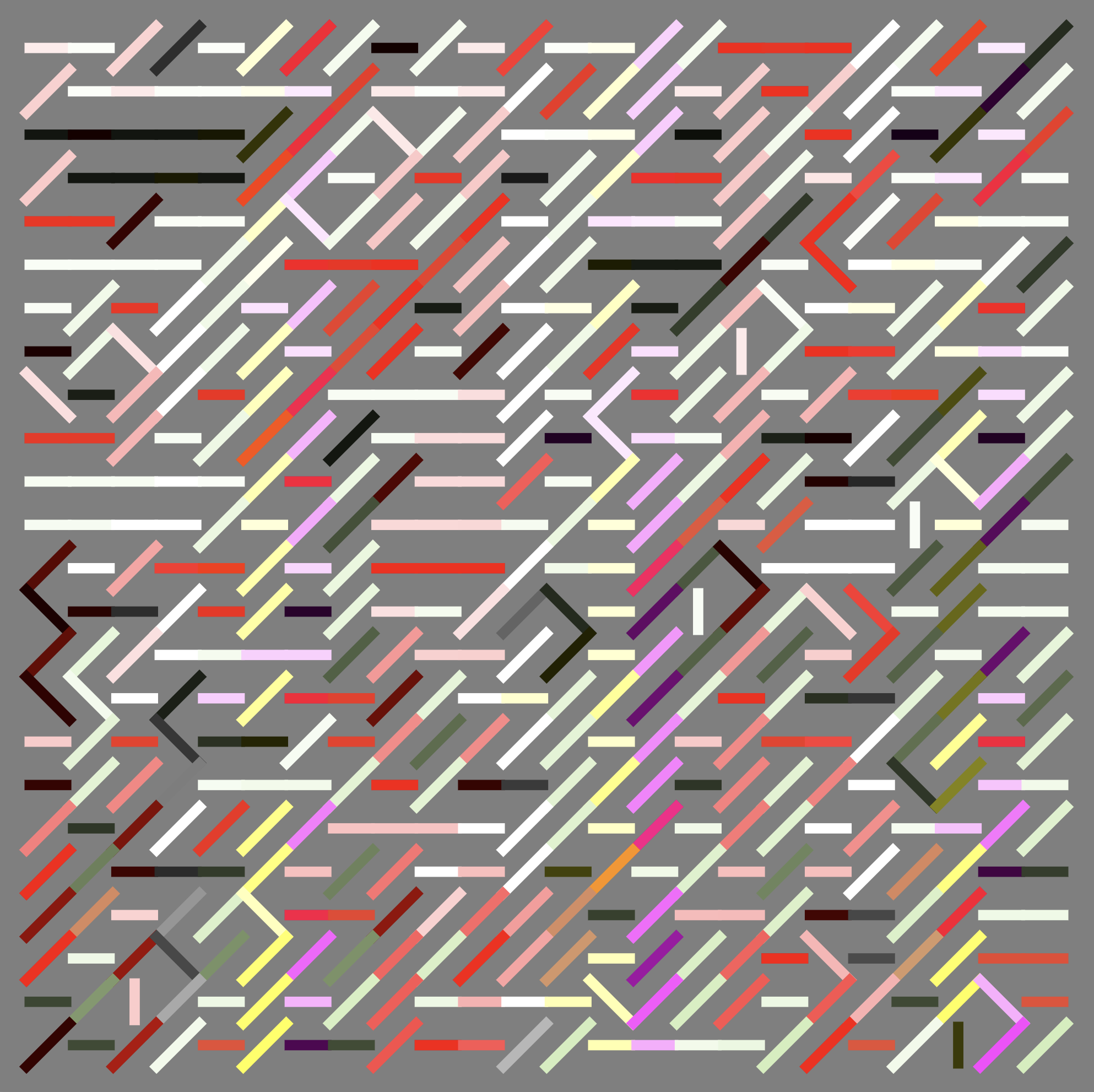
Nearly every work van den Dorpel has made since 2024 is after someone. Seraph I is after Emma Kunz's Werk Nr. 172, Emanation after her Werk Nr. 092. Anni is after Anni Albers's Study for Camino Real (1967), Pression des pairs after Vera Molnár's Quatre éléments distribués au hasard (1959), Interruptions after her Interruptions, Rasterbild and Rasterbild II after Charlotte Posenenske. Field (2023) and Markov's Window 2023 bring his own Flash works of 2008 and 2004 onto the blockchain, after Flash was switched off.
The other artists he works after are all women. The canon of the grid that Krauss wrote about in 1979 was almost entirely male (Agnes Martin and Louise Nevelson are the only women artists Krauss names), and the women's lineage of rule-based art is the blind spot the exhibition Angles Morts (2024) named (→ Angles Morts).
The later programs were written with a language model, a machine trained on what has already been written: the artist began programming with one halfway through making Stained Unravel (2026), and Interruptions and Entfaltung were written with it.
Fisher's hauntology
From the outside, by the measure Mark Fisher set in Ghosts of My Life (2014), this could look like a practice of ghosts:
"The slow cancellation of the future has been accompanied by a deflation of expectations. … The feeling of belatedness, of living after the gold rush, is as omnipresent as it is disavowed."
Fisher took the name for this condition, hauntology, from Derrida. He saw artists relying "on styles that were established long ago", a culture "in the grip of a formal nostalgia" that "has lost the ability to grasp and articulate the present. Or it could be that, in one very important sense, there is no present to grasp and articulate anymore."
The artist is not sure the measure applies (November 2026). He sees re-iterations of older, well-known media artefacts, the remakes, as cash grabs, while his own works feel new to him and a departure from his influences: "The difference is that I try to honour the artists on whose shoulders I stand, and to realise that nothing ever falls out of the sky as radically new. If something were radically new, we wouldn't recognise or understand what it is. Perhaps Mark Fisher himself was quite nostalgic."
Fisher expected the charge: compare the present with earlier periods, he writes, "and you will quickly be accused of 'nostalgia'". His examples in this passage leave the suspicion open. The records he holds up as unmatched, the Stooges' Fun House (1970) and Sly Stone's There's a Riot Goin' On (1971), and the ruptures he misses, the Beatles and disco, all date from his childhood; he was born in 1968.
The question
The question of this thesis is whether a work can still be new when it is made from older works, with a machine made from older texts; what happens to that question when the same machine, in the artist's words, stretches his intelligence "almost infinitely"; and whether the work still needs to be new at all. It takes five steps, and the artist's own answer, at the end, is to let the question go.
1. What is the work made of?
Two layers of the past.
Old procedures
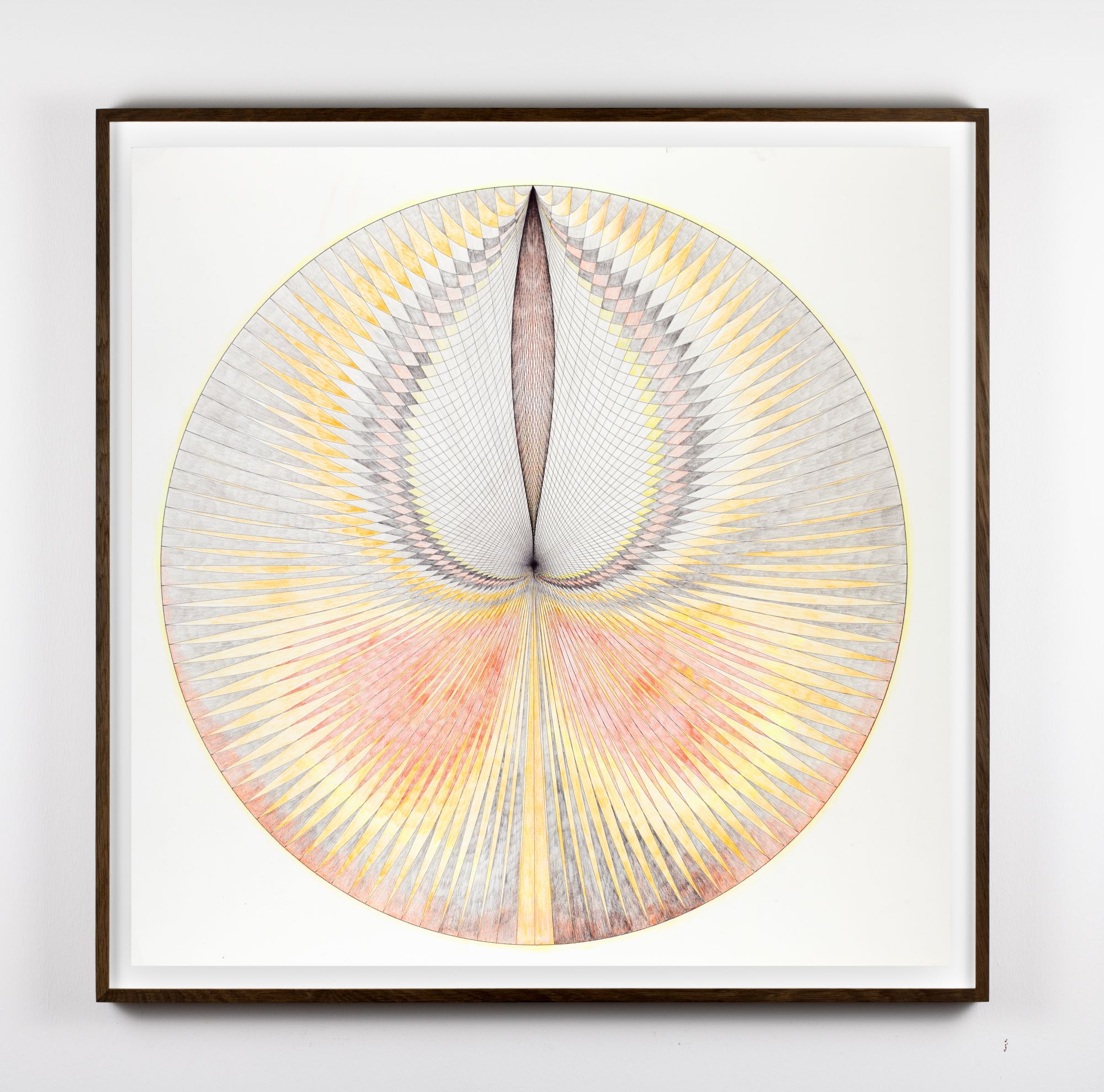
The first layer is a set of procedures. Kipke's thesis gives the clearest account of one of them, Emma Kunz at work, collected from people who watched her. A question came first. As her patient Peter Burri saw it, the pendulum set "hundreds of points" on graph paper; Kunz joined a selection of them with ruler and pencil, a choice Burri found "a mystery"; she built crosses, circles and stars on the lines and coloured them, in one sitting of up to 24 hours. She told Burri she never knew at the start what the picture would look like. In 1953 she put the principle in print: "the choice of two numbers, connected with each other and unfolded (entfaltet), determines the kind of form and figure."
The procedure is older than she was. Her pendulum belongs to the history of dowsing, which German miners spread through Europe in the sixteenth century as a magical way of finding ore, and dowsing belongs to the family of practices Dingemanse calls divination, "the generative use of chance": a ritual produces a chance outcome, and a person interprets it. Generativity is far older than the computer: in the casting of lots, which Dingemanse names, and in the rules of the loom.
The corpus
The second layer is the corpus. The language model is trained on a large share of what has been written and published digitally, and it answers from that. Dingemanse's last line on it reads like Fisher's: "machines of mediocrity that have been built to capture our preferences and sell them back to us."
The artist accepts the description and turns it (November 2026): "It is only recycling, but at a high enough level of complexity it becomes indistinguishable from an oracle, also because language models are not deterministic." Chance comes back in with the non-determinism. The same question asked twice gets two answers, and chance read by a person is what Dingemanse calls divination.
Carolyn Christov-Bakargiev's essay of November 2026 states the counter-claim in so many words: "calculation does not abolish the distinction between what is computed and what is received" (source). The disagreement is worked through on The Angelic and the Agentic.
So the practice is made of the past twice over. Whether that makes it formal nostalgia is what the next four steps decide.
2. Was the new ever new?
Krauss and the artist answer from two sides, and the answers meet: the new was real, and it depended on what it broke from.
The grid's repressed sources
The modernist grid was the emblem of the new. It was "the form that is ubiquitous in the art of our century, while appearing nowhere, nowhere at all, in the art of the last one", and with it cubism, De Stijl, Mondrian and Malevich "landed in the present, and everything else was declared to be the past."
Krauss then shows what that declaration hid. The grid came out of nineteenth-century treatises on optics and out of the symbolist window: "behind every twentieth-century grid there lies—like a trauma that must be repressed—a symbolist window parading in the guise of a treatise on optics." Her vocabulary is already hauntological: repression, trauma, repetition, a past that returns because it was denied. Fisher's belatedness is "disavowed"; Krauss's sources are "repressed". Both describe a past that is present and not admitted.
From break to style
The artist makes the same point without the psychoanalysis (November 2026): "Modernism was radically new, but it depended entirely on what came before. It was a break, and a break means nothing unless you realise what it is breaking from. When I look at Schoenberg's twelve-tone pieces, the modernist purist strategy quickly turned into a style, and in the case of twelve-tone music generally a failed one: people later loved turning to Arvo Pärt." Pärt had written the first twelve-tone piece in Estonia himself, Nekrolog (1960), before he turned in 1976 to tintinnabuli, a style built on chant and simple triads.
The artist is precise about what became of the break: "The radical twelve-tone project, which was to be the future of composition and would do away with tonal composition, became in itself just one stream, one method, one style, which in the end co-exists with the methods it was against. It is perhaps comparable to veganism, which radically opposes the eating of meat, while many brands now offer a 'vegan version' beside their non-vegan products." The grid went the same way. Krauss notes that Mondrian and Josef Albers repeated it for decades and calls it "a paradigm or model for the antidevelopmental, the antinarrative, the antihistorical". The break that declared everything else the past became one method among others.
The second half of the vegan comparison has a critical name. The Situationists called the absorption of a radical position recuperation, and Fisher went further in Capitalist Realism (2009): what he saw was "not the incorporation of materials that previously seemed to possess subversive potentials, but instead, their precorporation: the pre-emptive formatting and shaping of desires, aspirations and hopes by capitalist culture." Fisher read this as loss. The artist reads the co-existence as the ordinary fate of the new, which the market speeds up.
Re-running a procedure
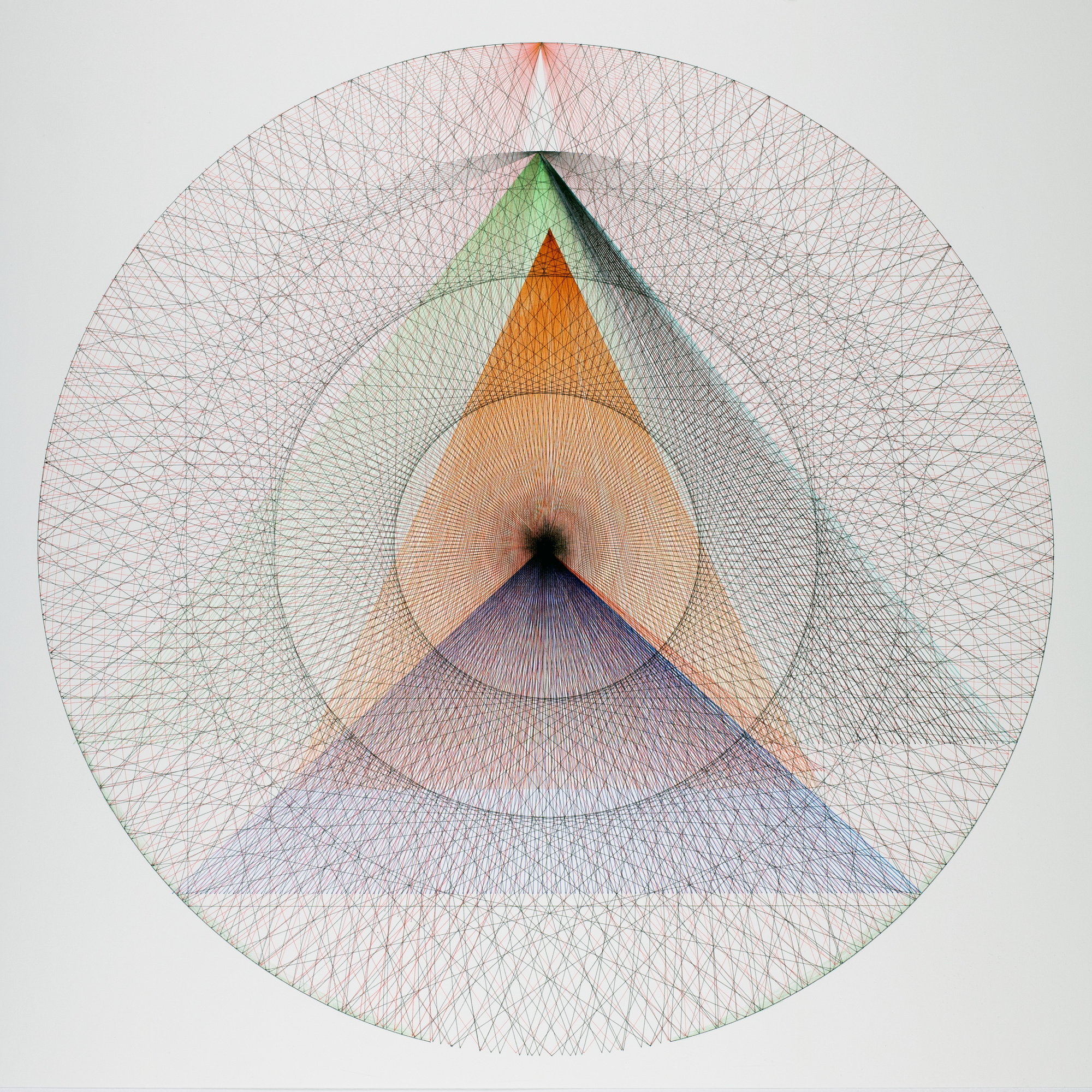
The hypothesis follows from this. If even the most radical break ends as one method beside the ones it opposed, the new adds to the past and does not replace it. A practice can then take up older procedures openly without falling into formal nostalgia, provided it re-runs how the older work was made and does not copy how it looked.
This practice names its sources in its titles and begins with how their work was made. The artist describes the sequence (November 2026): "It starts entirely with procedure: simulation, emulation. Then it transcends, and the new aesthetics are tuned and curated until they become mine." The first drawings of Entfaltung (→ Entfaltung on Paper) are that first step: "Emanation and Seraph I are clear examples of my attempts to emulate Emma's work: not to copy her, not to steal from her, but as the first steps in understanding her method." Here the program "re-executes how she drew, rather than copying what she drew" (→ entfaltung.harm.work/about), and a rule run again produces new figures: "a handful of settings, such as point count, symmetry and fill, span a space of figures, most of which Kunz never made".
Ease of movement
What the old procedures could not reach, in the artist's view, is ease of movement, more than any new material or medium: "The difference for me, what could not be reached in the past, is the ease of navigating a possibility space: how easily code can be developed and run, and how everything can change endlessly. That is the paradigm change. I don't care so much about the change in materiality or medium in this regard."
He made the same observation eight years earlier and felt the opposite about it. The description of his are.na channel contemporary generative graphics, opened on 21 December 2018, reads: "sometimes i feel ashamed that i'm doing very similar things like early computer artists from the fifties and sixties, because for me it's technically easier and faster to accomplish what they tried to do because of advances in technology". In 2018 the ease was a reason for shame. In 2026 it is the paradigm change.
The artist's archive already holds the formula, in Note 3004, a line from the video Strategies (2010/2011), whose list rewrites phrases from other people's advice: "The past haunts the present, but equally important so does the future." The idea is Derrida's hauntology (→ Impulse, Risk, Method).
3. Which way does the oracle lean?
Tainted tools
The usual charge against an artist who works with a blockchain or a language model is that the tools are tainted. The artist finds it tedious (November 2026): "In general it bores me when people accuse artists of using tainted technologies like blockchain or LLMs, as if I, as an artist, were not aware of how problematic these technologies are. Technologies are not neutral, they never are, but that doesn't mean I can't use them." He does not sort technologies into good and bad: "Technologies simply exist, and some have more power than others, and as an artist I have to relate to that somehow."
He also points to a double standard: "So many people complain that social media is evil while they tap away on their Meta or Google accounts, on an iPhone made by underpaid workers in China. It seems hypocritical, and artists seem to be held to a different standard."
He traces the double standard to fear of the new, and to what new technology does to an audience: "The problem with artists using new technology is that the audience often gets mesmerised by the technological innovation, and that keeps them from seeing through the technology into the artwork. Art is often used to demo technology. That is not what I want, and it is why I often use older, redundant algorithms." They do not work better, he adds: "With them you don't run the risk of being read as a tech evangelist." The Markov chain, Cartesian genetic programming and the cellular automaton that run his works all date from the twentieth century (→ Algorithmic Archaeology).
Christov-Bakargiev makes the same point against Pope Leo XIV's claim of an "ontological difference" between human art and machine output: "Artists have always used the technologies of their time" (source).
Armchair anthropologists
His answer to power is use. "The more power a technology gains in the world, the more urgent it becomes for me as an artist to respond to it, and not only by talking about it from the outside: I should use it. So many artists and critics have opinions about AI and crypto without a deep understanding of these technologies as users. They are armchair anthropologists."
The phrase names an old divide in anthropology. James Frazer wrote The Golden Bough, his study of magic, from other people's reports. E. E. Evans-Pritchard, whose study of Azande divination Dingemanse cites, began fieldwork among the Azande in 1926 and described their poison oracle from life among the people who consulted it. Kipke takes the fieldworker's side with Kunz: she reads the drawings through the practices that made them, the pendulum and the healing, rather than through the meanings later attached to them. The practice takes the same side with blockchains and language models.
Methodological agnosticism
This thesis takes his position as its premise: the useful questions are which way a tool leans and how the artist relates to its power. For him, relating means using, and what draws him is curiosity (November 2026): "I am simply curious about new technologies, because I see them as opportunities for new images, new techniques of image-making and new ways for images to circulate. The ethical questions about these systems are secondary to me."
He explains the order with a comparison from the study of religion: "In a practice of image-making and truth-finding with technological instruments, the question of ethics cannot settle whether a technology is right or wrong. It is like someone studying comparative religion, who makes no truth claims about the various theologies: they are all studied, compared and taken seriously, but truth statements lie beyond the scope of the researcher. It feels the same to me, as a human being in 2026. All these technologies are there, they are in use, and they are changing our realities, how we consider truth, and what image-making is. But it is not my responsibility, or within my reach, to pass a value judgement on that." Scholars of comparative religion call this bracketing; Ninian Smart named it methodological agnosticism.
Agnostics are sometimes sorted into soft ones, for whom the answer is unknown but could be known, and hard ones, for whom it cannot be known. The artist declines to choose (November 2026): "I don't even know whether these things could be known. I am not making an epistemological claim: some people say they know, and I don't know. I am soft agnostic about being soft agnostic." Kipke reads Kunz in the same spirit, through her practices, without ruling on her cosmology, and the artist's 2026 statement makes it his own rule: "I try to make no assumptions."
The die, the block hash and the pendulum
Every oracle is made by someone. A die comes from a factory, and no die is perfectly fair, but a die is indifferent to the question. So is the Ethereum block hash that moves the points of the Entfaltung tokens: neither the artist nor the collector can predict it, though the validator who produces a block can influence it.

Kunz's pendulum moves only in a hand. Kipke, following Knoblauch, records that experiments showed the dowsing rod moving only in the hands of the person holding it, and that around 1900 the cause came to be sought in that person. The pendulum's sign "is legible only to the person who set the sign and asked the often unspoken questions." Whether the lean comes from the person or from beyond was the question radiesthesia split over in Kunz's lifetime, between physicalists and mentalists (→ Entfaltung on Paper, Channelling).
The artist leaves it open: "I would so love to understand and believe more, but I have no convictions. I do trust Emma in how she operated. I tend to be a spiritual materialist, though not in the derogatory sense Chögyam Trungpa gave the term." Trungpa used the phrase, in Cutting Through Spiritual Materialism (1973), for the ego dressing itself in spiritual practice. The artist uses it without the reproach, for someone who works with matter and keeps the question of belief open.
The artist is also plain about what he does not know: "I really don't understand what Emma needed a pendulum for. I don't understand how she used it." The witnesses describe what she did with it, setting points, reading finished sheets, diagnosing patients, without saying what it gave her.
The language model's two leans
The language model leans two ways at once. Toward the past, because it answers from what has been written most often. And toward the asker, because it has been tuned with human feedback to give the answers people prefer. Dingemanse finds older precedents for the way such answers persuade. The diviner keeps an "ostensive detachment", presiding over the procedure without being party to the question, so the answer seems to come from the procedure alone. Adorno found newspaper horoscopes full of "apparently specific references" general enough always to fit; Dingemanse, with Garfinkel's term, calls this "specific vagueness", which leaves the interpreting to the reader.
In matters of taste the artist finds the result plain: "In terms of taste and aesthetics, most of what AI creates is slop, and reactionary: it goes back to things already seen, known, already discovered. That is what I want to work against. I don't claim that I manage."
Boredom and the body
He locates what the machine lacks in the body: "The machine can only reproduce and recombine what it already knows, in ways that comfort the person who prompts it. There is no rebellion and no fear, because there is no body: no discontent, no boredom, no fear of the scarcity of life. Life is short for human beings, and that makes us stop doing things that seem a waste of time, things that are repetitive."
Carolyn Christov-Bakargiev places the lack in the same place and draws a different consequence: for her the machine "has no void" and so cannot receive; for him it has no boredom and so never moves on. The two readings are set side by side on The Angelic and the Agentic.
Boredom is useful here: it makes a person drop what repeats and look for a direction. He described it doing that in his own practice in the Spike interview of 2021/22. Generative art based on random numbers "is kind of fun for a while; it's always different. But it's also always the same, in a way, and after a while you get bored, as there's no direction or growth." From there he turned to genetic algorithms, from Death Imitates Language (2016) to Mutant Garden, where selection gives the variation a direction (→ Randomness and Pattern). A model is never bored by its own output, so nothing in it pushes away from what has already been seen. Kunz described a similar unrest as the motive of her drawing, though she gave it another source: "a particular lawfulness that I feel within me and that never lets me rest."
The unknown
"The language model knows nothing unknown," he says, "and as an artist I am only interested in the unknown." He describes that unknown:
"What lies beyond the bend in the road, on the other side of the horizon. The question that has not been asked yet, the combination of elements never seen before. A memory of something that never happened."
The last phrase is close to Fisher's own subject, the "lost futures" of his subtitle, which return as memories of what never happened. Fisher mourned them. The same subtitle, Writings on Depression, Hauntology and Lost Futures, names depression, and in January 2017 Fisher took his own life. The artist says (November 2026): "I have no counter-argument to Fisher, but I want to keep trying a more optimistic approach. I am a father."
The platform
The model also belongs to the order Fisher blamed for the cancellation of the future, with its "globalization, ubiquitous computerization and the casualisation of labour". Its corpus, which the series text of Entfaltung calls "our collective unconscious", comes back as a service on its owner's terms.
Dingemanse, citing a study by Alcaras and Ricci, describes what regular use does to work: it "alters the distribution of agency", so that "not only the prompt" is engineered "but also the prompter". The wiki has recorded that shift inside the practice too: what was an afternoon of typing becomes a paragraph, and the labour that counts becomes "increasingly only the labour of judging what the model produced" (→ Meditative Labour).
None of this is news to the artist, and his own texts say so. The text for Markov's Dream (2022) recalls how "operating systems became more graphically oriented", and that the platforms which followed "are owned by corporations". The text for Field (2023) finds it ironic to port an animation to Solidity, a language "developed to support (economic) transactions", and the wiki's summary of it puts the method plainly: "The tool is misused, and the misuse is the point" (→ Field). The 2026 statement on the Entfaltung drawings calls the questions of authorship that the new tools raise "tainted by evil capitalist forces", and goes on working with them (→ Entfaltung on Paper).
Induced fit
What the model returns depends on what is asked, and the artist does not treat the two as separable: "The answers are the obverse of the questions. They fit each other, or they don't, the way a molecule fits an enzyme. Neither the answer nor the question has an essence without the other." Biochemistry has a precise version of the image. Emil Fischer pictured enzyme and substrate in 1894 as lock and key, two fixed shapes. Daniel Koshland proposed in 1958 that the fit is induced: the active site of the enzyme closes around the substrate as it binds, and the substrate is strained in turn.
The image applies to the model as well as to modernism. A request for an image in a familiar style fits what the model already contains, and the model returns the familiar. A question that has not been asked yet does not fit anything stored, which is why the artist counts it among the unknown.
4. Or does it unfold what was folded?
The same machine lets the old procedures go where their makers did not take them.
The artist's statement names the change: "the only limits have been time, concentration and intelligence, and the last of these now seems almost infinitely stretched, because I no longer rely on my own single human intelligence. I can draw on the entire history of geometry, mathematics and aesthetics." In November 2026 he credited the model with a turn in the work's structure: "With the new Emma Kunz series, the embeddedness of nesting and the repetition of the grid seem to have found an amalgamation, made possible by the mathematical skills that programming with language models opened up to me" (→ The Grid).
The loop of problems and choices
The work with the model is a loop of problems and choices. He poses a problem that has several possible solutions, has the model produce several of them, often as parameters, and then picks, adjusts and curates. He leaves the mathematics, the geometry and the code to the model; the choosing stays with him.
The first prompt has to be precise: "When I leave artistic options open to the language model, it fills them in with uninteresting solutions." So the prompt often says what not to do. He knows what he wants mostly by knowing what he doesn't want, "a bit like apophatic theology", which speaks of God only by saying what God is not. The way of working is older than the model, which only formalised it: "This way of searching the possibility space, with the heuristic of not navigating to coordinates I don't want, is more clearly formalised when using a language model. It was already how I worked in my mind all those years."
Inside the loop, many of the model's answers can be checked. A star polygon closes or it does not; a shader renders or it fails; the plotter draws what the code says, line for line. Specific vagueness has little room in geometry, because the answer meets a result. That makes the model's reach something that can be measured, the balance Dingemanse asks for when he quotes Ada Lovelace: neither overrate a new engine nor, in the reaction that follows, "undervalue the true state of the case".
Searching the possibility space
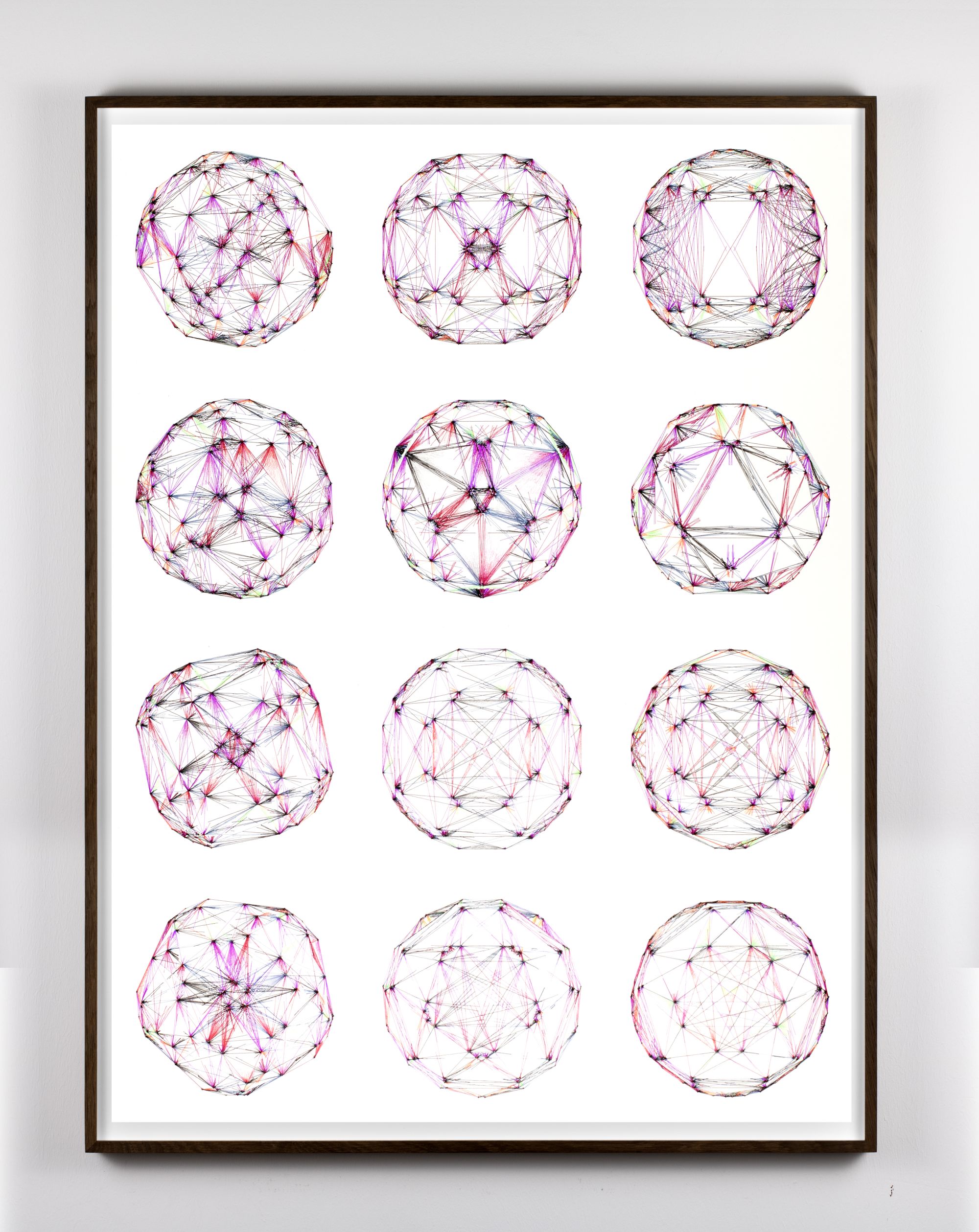
What the model adds is that ease of movement (question 2). "It is not so much speed," the artist says, "as the ease of navigating through this possibility space", a way "to see more coordinates within a multi-dimensional grid".
In 2018, before the model, he started an are.na channel called To Exhaust a Possibility Space, first named "permutations" (sources/ingested/arena-to-exhaust-a-possibility-space.md). It sets his Markov's Window and the Autobreeder of Death Imitates Language beside Bernd and Hilla Becher's water towers, the portrait typologies of Exactitudes and the paintings of Peter Halley, whose "whole oeuvre", the artist noted, "is basically a permutation of a single visual algorithm". Each lays variants of one form side by side.
The Tabula sheets do the same for Entfaltung. Each is a two-dimensional slice through a space whose other dimensions are the settings of the editor, and each token is one coordinate in it. The model makes it easier to move from slice to slice, so more of the space can be seen.
Closer to Kunz and Albers
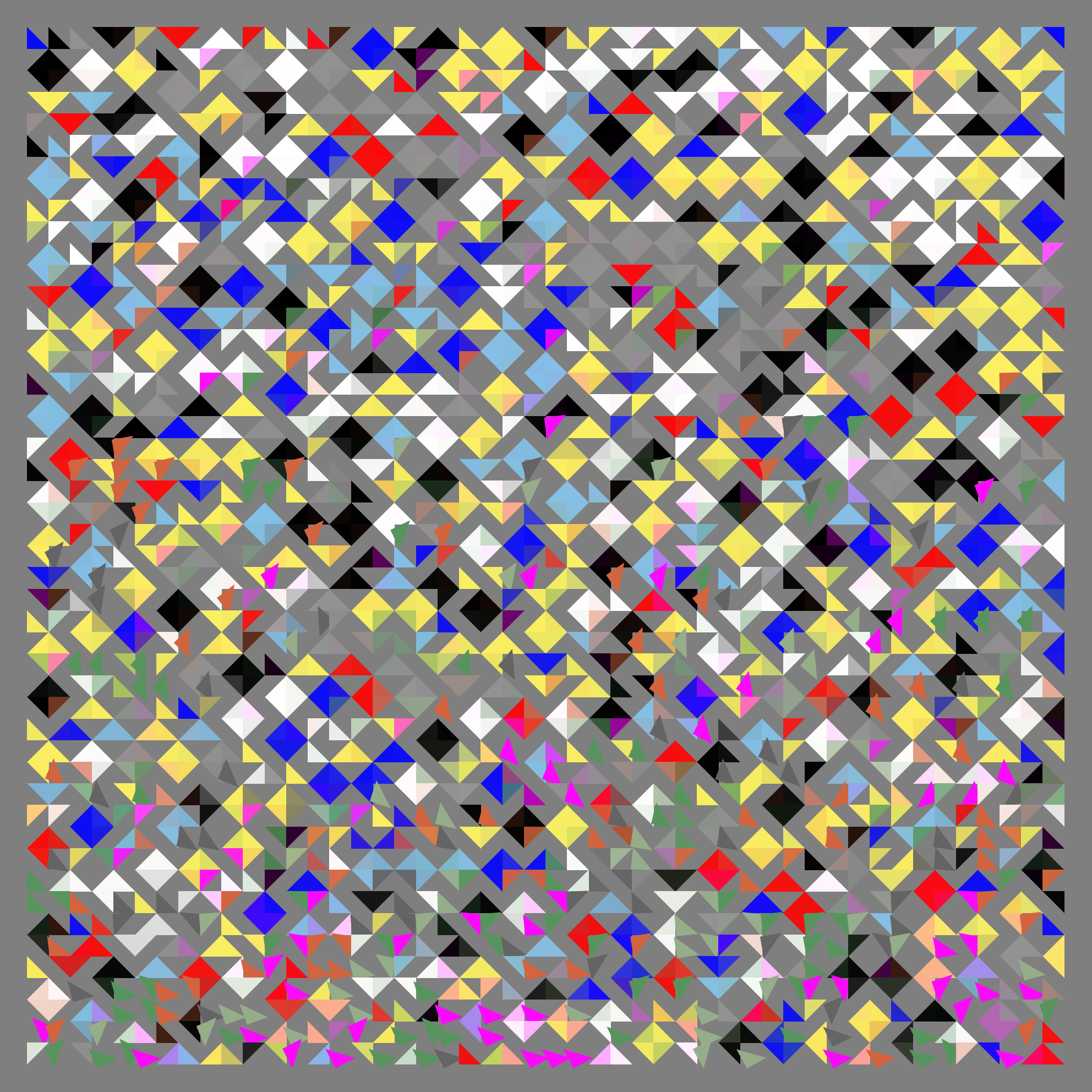
The model also brings him closer to the people whose procedures he rebuilds. Kunz promised that once her key was published, anyone could make her figures, "provided he knows how to handle numbers"; the fuller explanation she announced never appeared. Reverse engineering does not recover her key, but it shows something of how she worked: "Just as I discovered that Anni Albers had quite strong stochastic algorithms in her mind, Emma had a certain rigidity, but she often broke her own rules. When I noticed these things by reverse engineering, I felt really close to the minds of these women of genius."
Unfolding
Entfaltung names what happens here, in a topological sense. The artist explains the folding: "It refers to topological symmetry. The number of points in a structure is fixed, and it is their positions that generate the shape. So one structure contains the potential of infinitely many topologically identical structures, and we can reveal these by unfolding in space and time."
Kunz used the same word in the principle she printed in 1953 (question 1). In the tokens the unfolding is literal: the points and their connections stay fixed while their positions change every fourth block (→ Entfaltung on Chain). Each figure is new and none is invented from nothing, because each is one of the shapes a single structure already held.
5. Does the work still need to be new?
The artist's answer is to let the question go (November 2026):
"For me, being new is gradually becoming less important than gaining insight and understanding. The point is not to worry so much about being new: not the ego of being the first to do something, but letting go of that and continuing in a direct line from the artists who came before me, building further on a process they already began."
Fisher measured his culture by its ruptures and Krauss's modernists measured themselves by theirs; both looked for the new in a break with what came before. The artist measures a work by what it helps him understand, and lets go of the wish to be first. What it keeps are three ways of working, and each is a way of continuing a lineage.
Three ways of working
It names its sources and honours them. The titles say whom a work comes after: Kunz's Werk Nr. 172, Molnár, Posenenske. The artist calls this honour. In the announcement of Entfaltung he gave it as an aim: "I want to embed my work within this historical lineage, freeing digital art from technological novelty" (harm.work). In Fisher's terms the practice names its ghosts, and a haunting that is declared stops being a symptom and becomes a method, which the artist calls algorithmic archaeology (→ Algorithmic Archaeology).
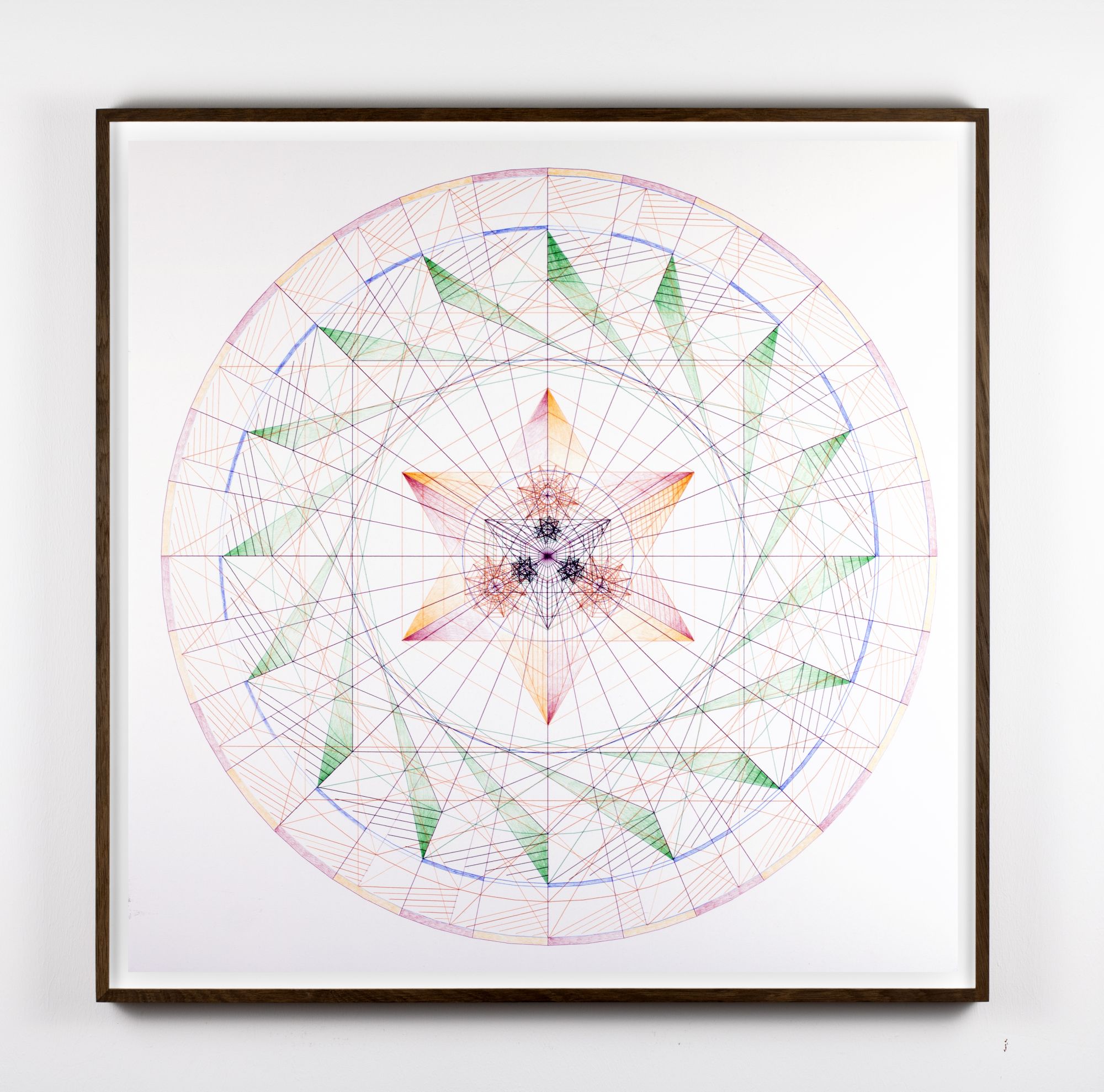
It searches the space a procedure opens. A copied style can only repeat. A re-run rule opens a space of figures, most of them unseen, and the work moves through it by search. Krauss saw the grid refuse development; the practice turns the refusal into a method, exploring a space where a modernist would have looked for progress. What the search yields is understanding: each coordinate reached shows something about the procedure that its author's own works do not show.
It keeps the reading and the hand. The practice keeps the criterion with the artist, the eye that judges each drawing before the next version of the code (→ Process Legibility). The drawings on paper are where that judgement was formed: "The drawings were necessary for me to understand the algorithm better. I had to think with my hands and my eyes, and I think this came close to Emma's method." The hand also brings what code does not bring by itself: "Working on drawings by hand always produces it", the artist says of the imperfect mirror; "when programming, asymmetry requires intention" (→ The Grid, The imperfect mirror).
Footnotes to Plato
He describes the whole with an image from philosophy: "a bit like how all philosophy can be seen as footnotes to the Greek philosophers." Alfred North Whitehead put it that way in Process and Reality (1929): "The safest general characterization of the European philosophical tradition is that it consists of a series of footnotes to Plato." He meant the general ideas scattered through the dialogues, which later thinkers worked out further.
A footnote adds to someone else's text what its author could not yet say. The works of the last two years are footnotes of that kind, to Kunz, Albers, Molnár and Posenenske, written in code and on paper, and the artist measures them by what they help him understand. Nor is the continuation set against them: "My continuation is not even in opposition to those other artists. It is about understanding them, and seeing how their insights can be pulled into our time, our culture, our frame of reference, very much the way other writers are quoted in philosophy. Life is too short to reinvent the wheel completely."
Read this way, the practice answers Fisher without claiming a rupture. It continues work that others began, and that work is not finished.
See also
- The Grid — Krauss's grid against the loom and the screen; from nesting to the grid; the imperfect mirror
- Impulse, Risk, Method — Derrida's hauntology and Note 3004: the future haunts the present
- Entfaltung — Kunz's method from the eyewitness accounts; the pendulum taken apart
- Entfaltung on Paper — the hand at the pencil; channelling; authorship in an open tradition
- Algorithmic Archaeology — the method of declared sources; the timeline from the loom to the language model
- Meditative Labour — the prompted loom; the labour of judging
- Mediation and the Archive — Derrida's archive; Field and the death of Flash
- sources/ingested/dingemanse-critical-ai-literacies-2026.md — divination as the generative use of chance; prompt engineering as divination
- sources/ingested/arena-to-exhaust-a-possibility-space.md — the 2018 channel on permutation and the possibility space