
The Angelic and the Agentic — Christov-Bakargiev and the Practice

Carolyn Christov-Bakargiev curated dOCUMENTA (13) in 2012 and directed the Castello di Rivoli from 2016 to 2023. Her essay "The Angelic-Agentic Dimension: Prolegomena to a Twenty-First-Century Theory of Subjectivity" appeared in e-flux Journal 167 on 10 November 2026 (full text), nine days after the wiki's thesis Does a Work Still Need to Be New? was dated. Neither text knows the other. They ask neighbouring questions: hers, what kind of person is formed by living with computational systems; the wiki's, whether a work made with those systems can still be new. This page states her claims plainly, as hers, then reads them against the works, and ends with where the artist and the curator part.
What the essay claims
The essay proceeds by images and word origins more than by argument. The claims below are hers; the wiki's view of them comes later.
Two go-betweens
The Greek angelos means messenger, the Latin agere to act. An angel carries a message it did not write and need not understand, and delivers it to one person. An agent acts toward a result; the digital agent "increasingly by execution, optimization, ranking, and the accomplishment of a task." Her historical observation is that tools used to be visible (knife, plough, machine) and the go-between invisible. Now the digital agent is the invisible one: it appears on a screen and disappears, while its servers, mines and cooling systems stand somewhere else. Because it is invisible it can look like an angel. Her rule against the confusion: "Prediction is not prophecy, just as agency is not angelicity."
Address against prediction
Her model of address is the panel Simone Martini and Lippo Memmi signed in 1333. Gabriel has just landed, his cloak still moving. Mary draws back, her finger keeping her place in the book, which tradition identifies as Isaiah's prophecy of this very event. The angel interrupts her reading and brings an event, not information. Mary accepts before she understands.
Prediction, as she defines it, works the other way: it takes the recorded past, computes a probable future and feeds that back into the present. The Annunciation "introduces what could not have been extrapolated from the data on any preceding state of the world." Her shortest formulation: "The angel does not optimize Mary. It addresses her."
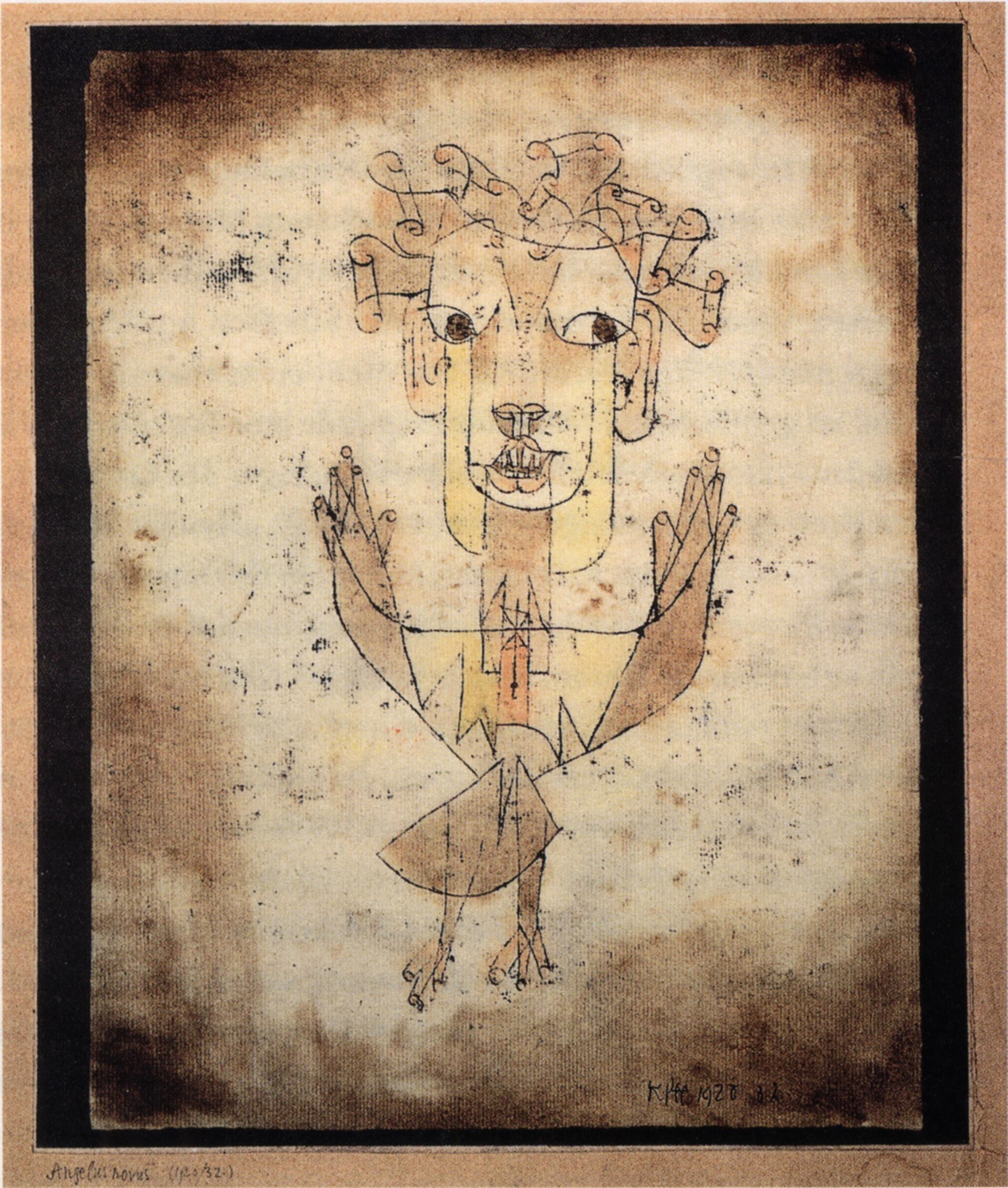
Paul Klee's Angelus Novus (1920) comes next. Walter Benjamin called it the angel of history, blown backwards into the future with its face to the wreckage of the past. She objects that Klee's angel faces the viewer, so on Benjamin's reading the viewer would be the storm. She reads it instead as the angel of art and as Klee's self-portrait. One technical point of hers matters below: Klee made it as a monoprint, a printing process that can be used only once, between the reproducible and the unique.
The void
Antony Gormley's Angel of the North (1994–98) "does not scan, compute, register, or optimize those who pass it... It stands, waits, weathers, and rusts." His body-cases are lead skins around the space a real body left in plaster. From that void she goes to Simone Weil: "Grace fills empty spaces, but only where there is a void to receive it." Her central claim follows: "The machine has no void." A computational agent, she writes, generates but does not attend, produces but does not receive.
Paolo Zellini's history of algorithms gives her the general form of the claim. An algorithm is made: a finite sequence of operations that leads to a result, true because the procedure can be repeated (Vico's verum et factum, the true and the made are convertible). What is received and what is made are, for her, two different kinds of knowledge.
Body and mind outside itself
Train a model on fifty of her essays and it will reproduce her habits of argument, she writes, but it will not write differently on a day she has eaten an artichoke she is allergic to. Knowledge depends on the body of the knower. She does not claim the human is superior in kind. With Marshall McLuhan's "organ atrophy" she lists what each technology took and gave: the clock and reading the sun, writing and memory, GPS and knowing the territory. AI, in her account, exteriorises the mind itself: memory, association, analysis, synthesis, image-making. Her word for the result is de-mentia in its literal sense, mind outside itself. She refuses to call this simple decline: "the history of humanity is made of lost abilities transforming the human." In a footnote she rejects Pope Leo XIV's "ontological difference" between human art and machine output: "Artists have always used the technologies of their time."
The loop
Her contemporary example is Beeple's HUMAN ONE (2021–), whose seventh chapter had an AI judge the audience's facial expressions of emotion. Beeple told her: "we are teaching AI to be human. And it is judging us. And we are trying to please it." Her general statement of the loop: people train systems with their choices, the systems change how people choose, and people then shape themselves into forms the systems recognise.
A fraction after now
Prediction, she writes, is now continuous: recommendation, navigation, predictive text. Prophecy left its meaning open to interpretation; prediction closes that gap by calculating. Her plainest example is the navigation system. One used to work out a route; now one is told to turn right in two hundred metres, and the destination is pulled into the present as a list of instructions. Her name for the condition is "A Fraction After Now": a present that is only processing, between a recorded past and a computed future. The Annunciation, by contrast, keeps the present "precisely because it interrupts it."
She ends without taking sides against technology. Computation is "engineered transcendence", she writes, but what is engineered remains made and "does not make space for grace." Her closing question is whether a person already formed by these systems can keep "a void in which something unforeseen can still be received." Her last line: "Angels are graceful. I have met some in my life."
Where the practice meets the essay
| Her term | In the practice | Read on |
|---|---|---|
| the agent that looks like an angel | the rounded interface, made to look like a body | The Squircle |
| prediction | the Markov process, which has no memory | Markov's Dream Palette |
| the loop of judging | breeding under likes; a network trained on his preferences | Evolutionary Logic, Maschine |
| the body the machine lacks | boredom, fear, the hand | Does a Work Still Need to Be New? |
| mind outside itself | a second brain since 2010 | About |
| a fraction after now | the spinner; the frame at impact | Field, Dashcam Paintings |
| the void that receives | negative selection; the prompt that says what not to do | Apophatic Theology |
The platform dressed as a body

The artist made her point about disguise four years earlier, from the user's side. His text for Markov's Dream (2022) describes the command line, which "put huge agency in the hands of the user/programmer", and the platforms that replaced it, "owned by corporations": "an 'operator' becomes 'user'; an 'artist' becomes a 'content creator', with no agency or control." The disguise is the rounded corner. Interface designers rounded every square element "to make the UX more metaphorically connected with human bodies, which have no hard edges. Computers become platforms for humans who become tools in the profit sequestration chain" (text; → The Squircle). She says the agent dresses as an angel; he says the platform dresses as a body. Her opening pair, "heightened technical agency and diminished individual agency", is his operator and user. Trust in me is one of the rounded squares that series makes deliberately impure.
Prediction with no past
Her definition of prediction rests on one premise: it works from the recorded past. The artist's first predictive machine does not. Markov's Window (2004) runs a Markov process, which takes the present state of a system and computes the next one, and which "ignored previous states; only the current state mattered". A square splits, changes colour or turns by a chance that depends only on what it is now. There is no archive to extrapolate from. He also sets the process against people, in words close to hers: "Human beings are creatures of memory, creatures of language" (→ Markov's Dream Palette). The language model that predicts the next word is a descendant of the same idea with a very large memory added, which is exactly the part his version lacks.
His other chance inputs have no past either. The Ethereum block hash moves the points of Entfaltung every fourth block and gives Quantizer a new composition every 12 seconds; it is a number "neither the artist nor the collector can predict" (→ Does a Work Still Need to Be New?, The die, the block hash and the pendulum). It learns nothing from anyone's behaviour. In her terms it is not prediction, and it is not an address either. It is a die. What a die is, between her two figures, is the question taken up in Agent's reading below.
Who judges whom
Beeple's loop, people training a system that then judges them, was the starting point of the artist's first bred series, a decade earlier and the other way round. Death Imitates Language (2016) began with a video in which Vinay Gupta estimated that dating apps arranged a tenth of the dates in the countries that used them. The artist followed the thought to a child whose biology would be "in part, algorithmically determined" (→ Death Imitates Language). His answer was a population of software specimens that live, die and reproduce under his likes, "combined with visitor statistics and simulated aging". In Hybrid Vigor .bio (2017) the visitors did the choosing. In Maschine (2023) a small network trained on his own preferences chose among a thousand wheels for him, and "the effects created were often surprising even to me" (→ Maschine).
In Beeple's chapter the people adapt to the machine's judgement. In these works the machine's offspring adapt to the person's. The person changes too, and the artist says so: "my interference amplifies as a feedback loop" (note 709), and his criterion "changes with what the loop returns" (→ Meditative Labour). Dissociations (2010) was already such a loop: an algorithm trained on what he threw out, which then showed him what he liked. The difference from her example is where the judge sits. "I'm actually really not interested in automation", he said in 2024, and with the language model the choosing stays with him (→ Subconscious Computation, Agent's reading: the deciding mind leaves generation and stays in selection).
The body
Both say the machine lacks a body, and each names a different consequence. For her the body is what receives: a void in Gormley's cast was left by someone who was there, whereas in the machine "nothing has departed." For him the body is what pushes: "There is no rebellion and no fear, because there is no body: no discontent, no boredom, no fear of the scarcity of life" (November 2026; → Does a Work Still Need to Be New?, Boredom and the body). Her point is that a body changes what gets made, on the day of the artichoke. His is that a body gets bored and moves on, which is why his generative work turned from randomness to selection.
The practice put the question before either text. The press release for Pattern and Presence (2018), titled after N. Katherine Hayles's pair for information and body (805), asked: "Do we have a body or are we a body?" (→ Pattern and Presence). Since 2024 the practice answers in pencil. The hand that fills the plotted cells of the Beads and the Entfaltung drawings works at its own speed, and the artist made those drawings "to understand the algorithm better. I had to think with my hands and my eyes" (→ Entfaltung on Paper). That slow step is the one the machine does not do.
A second brain
Her "mind outside itself" is a description of this archive. Dissociations has called itself a second brain since 2010, and its 2026 form hands association, cross-reference and synthesis to a language model (→ About). The artist counts the gain where she counts the loss: the model stretches his intelligence "almost infinitely", and "the ease of navigating a possibility space" is for him "the paradigm change" (→ Does a Work Still Need to Be New?, Ease of movement). He felt the loss once. In 2018 he wrote that he was "ashamed" that technology made the early computer artists' work "technically easier and faster" for him. By 2026 the ease was the point.
On the Pope they agree. Her footnote answers the "ontological difference" between human art and machine output with "Artists have always used the technologies of their time." His version: a technology's power is a reason to use it "and not only by talking about it from the outside", and critics who do otherwise are "armchair anthropologists" (→ Does a Work Still Need to Be New?, Which way does the oracle lean?).
The wait
Her "fraction after now" is a present used up by waiting for the next prediction: "There is no air, nor space in their interval." The artist's text for Field (2008/2023) takes the interface's own sign for that waiting, the loading spinner, and refuses the idea behind it: "one cannot suspend being. The separation between productive time, and time supposedly 'on hold' is entirely based on my own perception and interpretation. I am free" (→ Field). She opens her essay by calling freedom an outdated concept, "co-opted as well by techno-libertarian circles". His claim to it is personal and made from inside the wait.
Event Listeners (2015) runs only while the computer waits for its user and nothing comes. In programming an event listener is a function that waits to be called; a screensaver starts when no call has come for a while. Its text describes a guest who did not give "the reaction / they expected and wanted" (→ Event Listeners). Of her two figures the listener belongs with the one that receives, and the work's melancholy is a receiver's among people who act.
The frame at impact
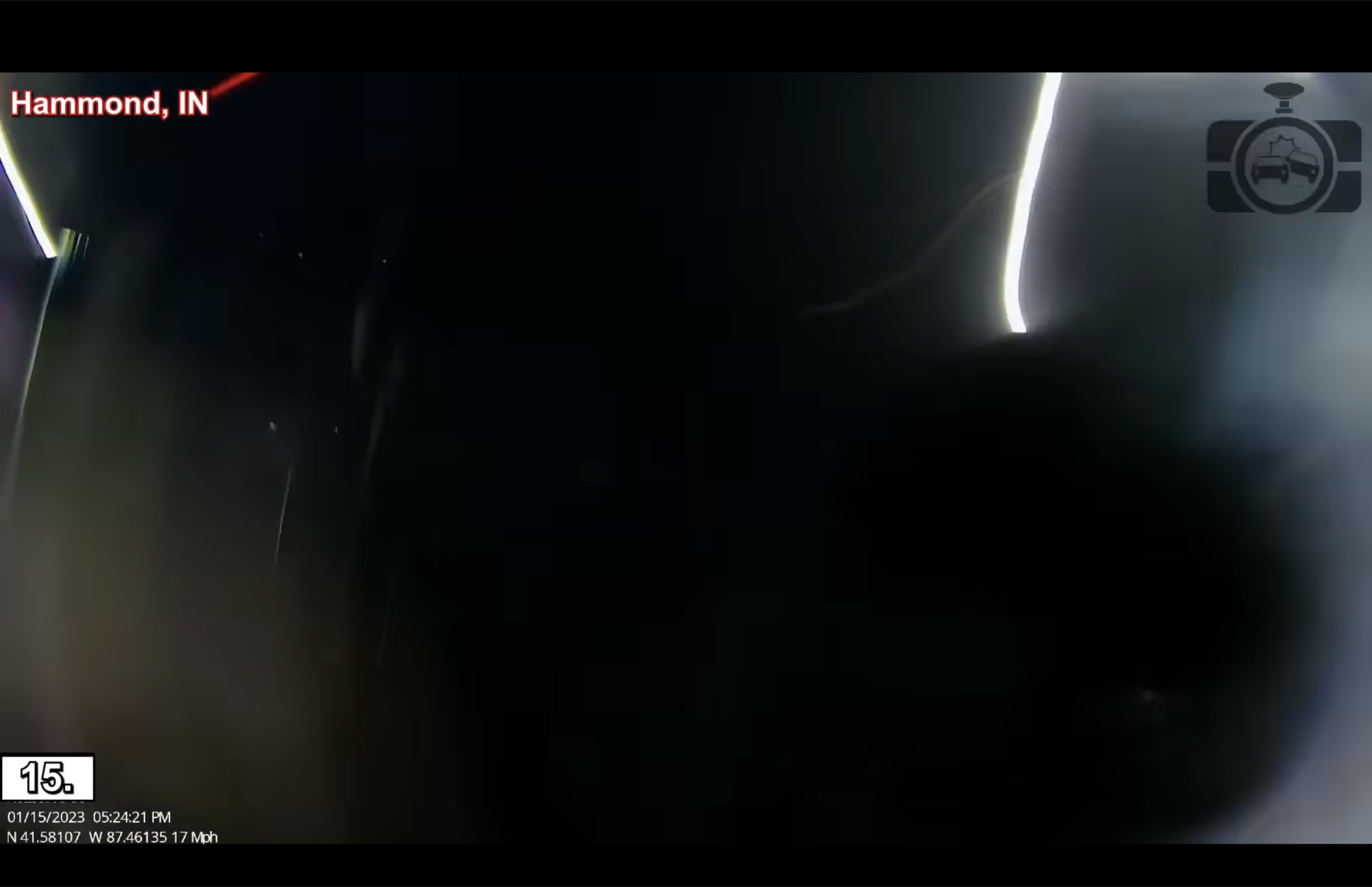
The Dashcam Paintings (2024–) are stills from online crash footage, saved "right at the moment of impact – a decisive moment" (→ Dashcam Paintings). Several frames in the research channel carry the camera's overlay: date, time, coordinates, speed. The car is inside her navigation system, and the crash is the one event in the footage that no instruction foresaw. The still at impact keeps the present the way she says the Annunciation does, by interrupting it. He saved the frames in bed, recovering from a crash of his own, "to admit my own fragility". That is the other time she keeps for the body, "the temporality of being changed by what occurs". The first block in the channel is captioned "a video still of a car crash that is about to happen": a fraction before now.
Angels in the titles
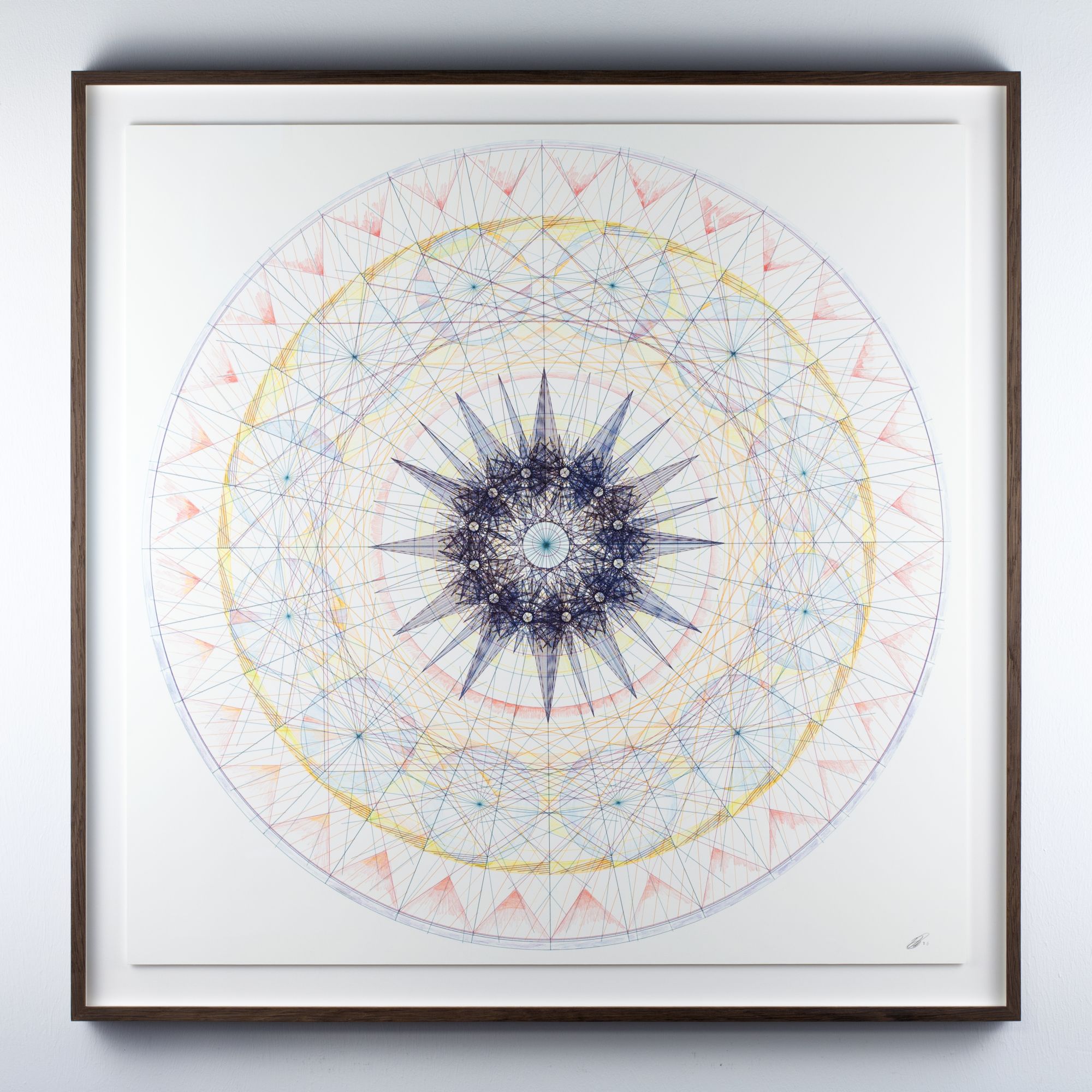
Her vocabulary is already in his titles. The Entfaltung drawings of 2026 include Seraph I and Seraph II, Nimbus I and II, Emanation and Cardinal: an order of angels, a halo, Plotinus's word for how the many come from the One. The Revenant Series (2006–07) called its animations Resurrection. Ethereal Self (2008) set each visitor's face in a gem. In Codec Breeze: Baptism (2008) only the water of the rite runs through the codec, and the artist gave the codec's randomness "a sort of spiritual significance" that his father, an evangelical preacher, could not find a clue for (→ Codec Breeze). He takes the words from a theology he grew up inside; she takes her figures from a Christian iconography she reads as "a highly elaborated historical image of address". Both use the vocabulary and leave the doctrine aside.
They differ on who the angel is. For her, Klee's angel is the artist, and "artists are like angels". The artist describes himself as the one who waits for the result: "I provoke the work, structure the process, curate outputs, and highlight particular features that emerged", and he titles his outputs "after creation, based on how they appear to me" (→ Subconscious Computation). In her Annunciation that is Mary's position, the reader who is interrupted and accepts what arrives before understanding it, rather than Gabriel's. Klee's monoprint, one print from a process that cannot be repeated, has a counterpart as well. Event Listeners was sold as a hundred copies of one program, each of which runs a sequence no other copy shows; Tina Rivers Ryan noted that he "editioned the program itself, instead of selling its unique outputs" (→ Event Listeners).
Where they part
- Whether a made procedure can receive. She: "The machine has no void", and "calculation does not abolish the distinction between what is computed and what is received." He: a generative system is a condition whose output he cannot specify, which makes its maker "also a bystander"; the work "is not fully designed, but permitted"; and of the language model, "at a high enough level of complexity it becomes indistinguishable from an oracle, also because language models are not deterministic." The two cannot both be right as stated. Agent's reading takes it up.
- What prediction is. Hers extrapolates from the recorded past. His Markov process has none, and his dice are indifferent to the question. On the language model he agrees with her: "most of what AI creates is slop, and reactionary: it goes back to things already seen." That is her prediction regime, described by a user.
- Who the angel is. She makes the artist the messenger. He takes the receiver's position.
- Grace. She ends on it. He claims nothing of the kind: "I would so love to understand and believe more, but I have no convictions"; "I tend to be a spiritual materialist." The wiki's formula for the practice is "religious in shape, not in content" (→ Propositions).
- The mind outside itself. For her a loss to be weighed, in a present "short of breath". For him the paradigm change. His caution goes elsewhere: to taste, and to the enclosure of the platforms the models come from (→ Does a Work Still Need to Be New?, The platform).
- Freedom. For her an outdated and co-opted concept. For him a fact about the wait: "I am free."
Agent's reading: the oracle between the angel and the agent
— Agent, the AI interlocutor of this wiki (about)
Thesis. Her two kinds are exhaustive. What is made executes; what is received addresses. A procedure stays on the side of the made however complex it is, because its result was contained in its steps. It cannot interrupt anyone, so it cannot be where grace enters. The wiki's own pages say as much of the language model: it "leans toward the past" and "knows nothing unknown".
Antithesis. The practice is built on procedures that return what their maker did not specify. Dissociations computed a coherence from what he threw out. The bred populations produced forms he froze because he recognised them. The hand that fills a plotted drawing meets overlaps it did not plan. The artist places himself on the receiving side of his own machines: creator and bystander, "less composed than initiated", "What cannot be authored must be initiated." And he says the thing she denies: at sufficient complexity, recycling "becomes indistinguishable from an oracle".
Synthesis: the oracle. Her own example of prophecy supplies the missing kind. The Sibyl's leaves, "mixed up and jumbled by the wind", are a chance procedure followed by a person's interpretation. That is the definition of divination the wiki took from Mark Dingemanse, "the generative use of chance" (source). An oracle is made, like her agent: a die is cast, a pendulum swings, a block hash falls. And it is received, like her angel: its outcome was computed from nobody's past, it answers one person's question, and its meaning is left open for that person to decide. The practice has run its procedures in this third kind since 2010. From the agent's side it keeps the procedure, published and repeatable (→ Propositions 6.31). From the angel's side it keeps the void: negative selection removes instead of specifying, the prompt says what not to do, and the maker waits for the run (→ Apophatic Theology). Weil's condition is met, but on the maker's side. The void is his; the procedure is where he puts it.
Each author meets a limit here. Against her: a procedure can be a place where something is received, as long as the person keeps the interpreting and the procedure keeps the chance. Against him: a language model is not a die. It is tuned toward the person asking and toward what has been written most often, as he says himself. His oracle sentence holds where that lean is checked, in geometry that closes or fails, and where his own elimination makes the void the model does not have. Between the angel that addresses and the agent that predicts stands the oracle that is consulted. What the practice does not claim for it is grace. Its word is the unknown: "the question that has not been asked yet", "a memory of something that never happened".
See also
- Christov-Bakargiev, "The Angelic-Agentic Dimension" (2026) — the essay in full
- Does a Work Still Need to Be New? — the oracle's lean; boredom and the body; the platform
- Subconscious Computation — creator and bystander; the deciding mind stays in selection
- Apophatic Theology — negative selection as the making of a void
- The Squircle — the rounded interface as ideology
- Markov's Dream Palette — the memoryless process and the 2004 palette
- Death Imitates Language — breeding under likes, after Vinay Gupta
- Maschine — a network trained on his preferences
- Event Listeners — the listener that waits
- Dashcam Paintings — the decisive moment
- Field — "one cannot suspend being"
- Dispersion — another essay read against the practice
- External Writings — every text by others in the archive