
Event Listeners (2015)
Event Listeners is a screensaver for macOS, made in 2015 and sold in an edition of 100. harm.work describes it in one line: "Generative Lindenmayer systems iterating over dissociative feels of social inadequacy." Twenty of the editions were bought by the MAK, Vienna's Museum of Applied Arts, in April 2015, paid in Bitcoin, the sale that led to left gallery. That purchase is told on several pages of this wiki; this page is about the work.
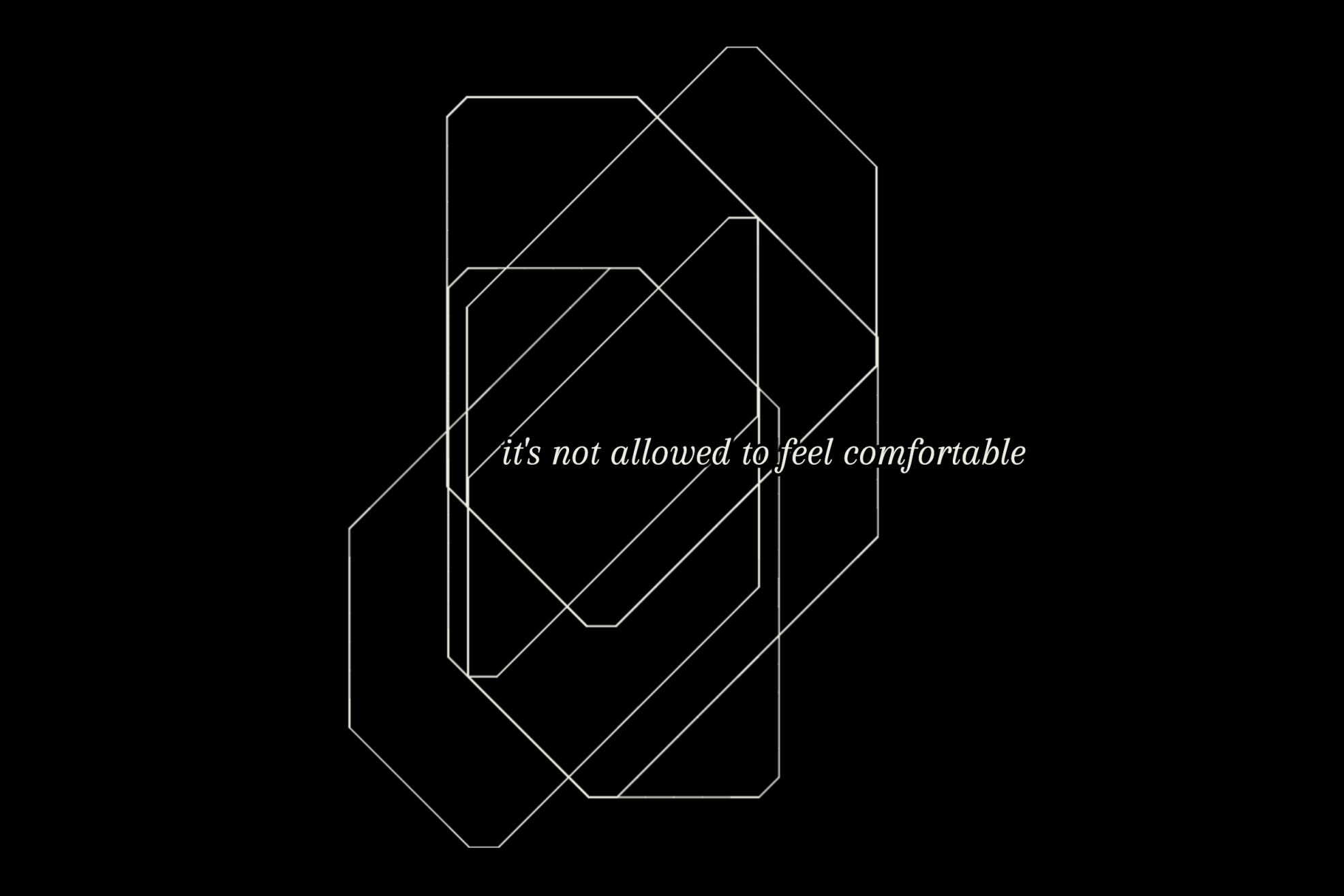
Thin white outlines of stretched octagons overlap on a black ground, all drawn with 45° turns, and across them runs one line of italic text: "it's not allowed to feel comfortable". The line comes from the text the screensaver shows; the figure is one of the L-systems it draws.
Branching rules on a black screen
An L-system, named after the biologist Aristid Lindenmayer, grows a figure by rewriting: a short string of symbols is replaced, symbol by symbol, by longer strings, over a few iterations, and the result is read as instructions for a pen (draw forward, turn left, turn right, remember this position, return to it). A few rules give ferns, trees and snowflakes. In Spike #70 the artist describes Event Listeners as "a generative work that uses relatively simple algorithms to define recursive structures we often find in nature, like how trees branch", and says it "reminded me of all the screensavers that I had known since the 1990s" (→ Spike #70).
The web version that harm.work uses as the token's animation, dated 31 March 2015 in its page header, is the same program as the screensaver, run in a browser (the artist, November 2026), and shows how a scene is made. Nine times in ten the program invents a new L-system: a starting string of one to four symbols, a rule of up to nine characters for each symbol, with turns and branches among them, an angle of 36°, 45°, 60° or 90°, and four to seven iterations. The tenth time it takes one of seventeen classic systems from the L-systems library by Kevin Roast (2009) that its renderer is built on, among them the dragon curve, the Koch snowflake, the Sierpinski triangle, a Penrose tiling and a "fractal plant". The figure is drawn line by line in one random colour on black. Drawing stops after a random number of steps, between 3,000 and 8,000, whether the figure is finished or not; two and a half seconds later the screen clears and the next system begins.
So the screen shows two kinds of figure. The invented rules mostly give sparse things: a single line with a few ticks, a ring, a lattice of outlines. The classic systems give the trees and curves that the 1990s screensavers showed. The cut-off makes many figures stop part-way. Note 876, On recursion, says that recursive structures "tend to be endless" unless "forcefully brought to a halt", and that without a stop condition the "Self inflation" "eventually bursts like a bubble" (→ Recursion and Self-Reference). Here the halt is a counter drawn at random, and it falls wherever it falls.
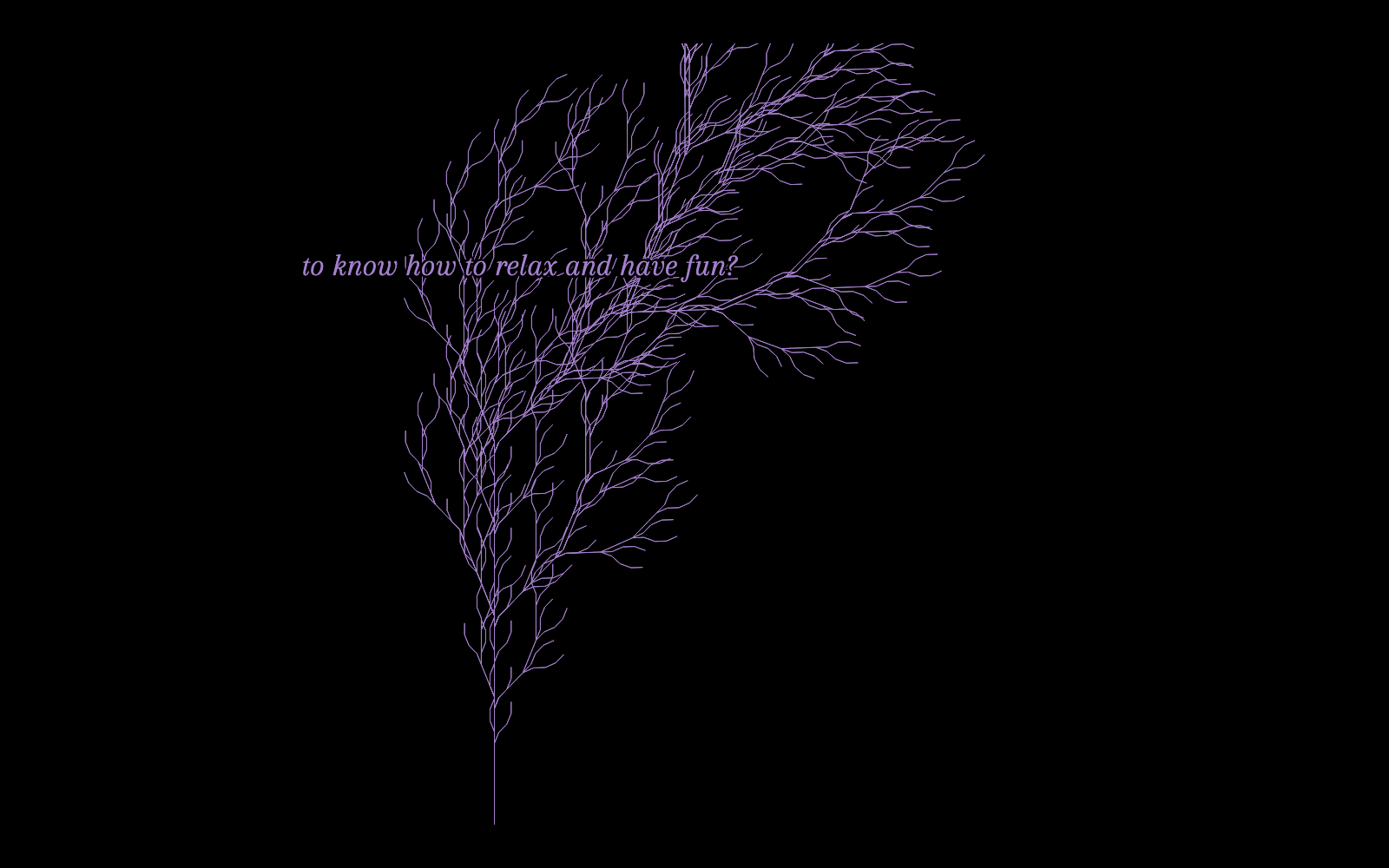
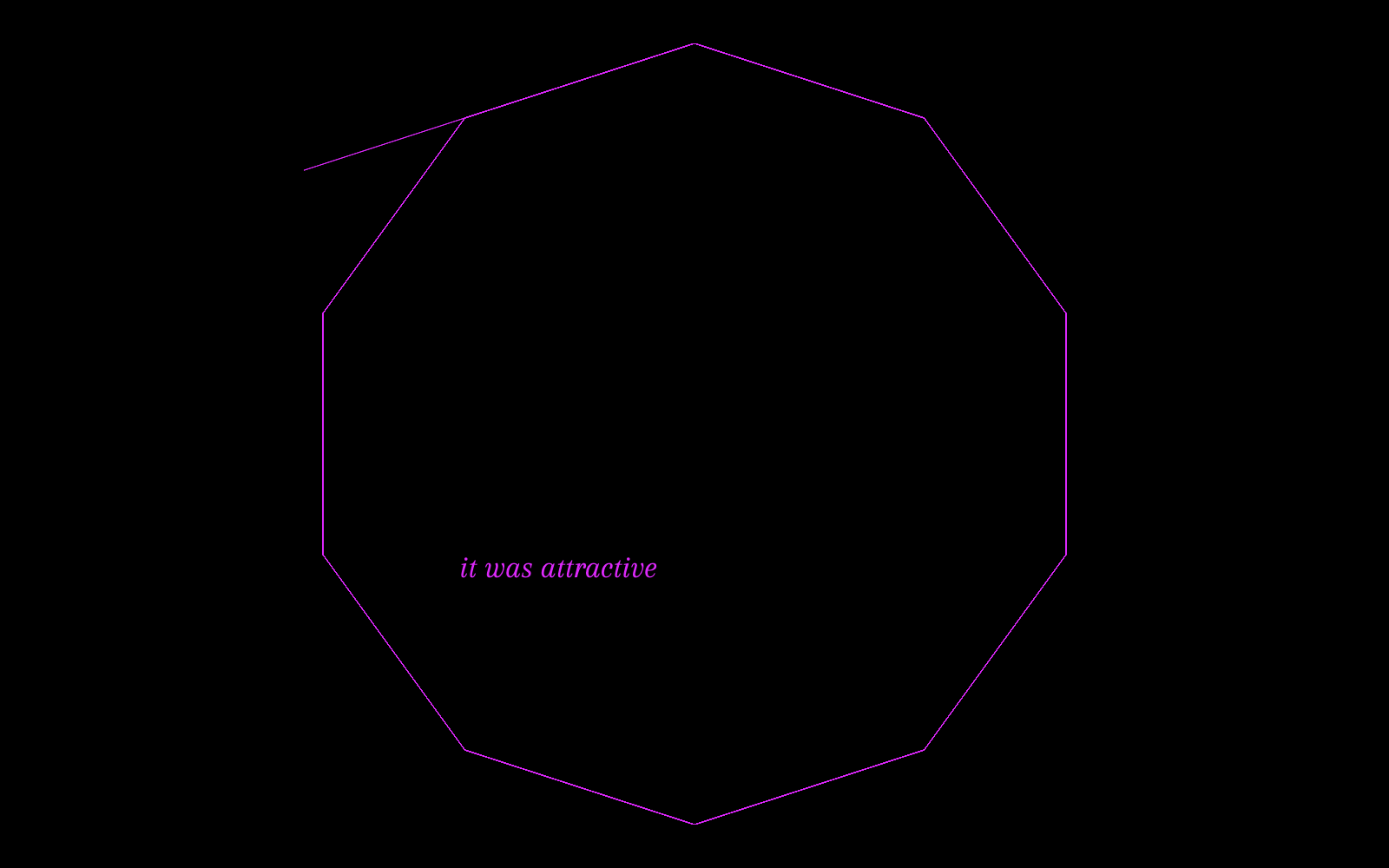
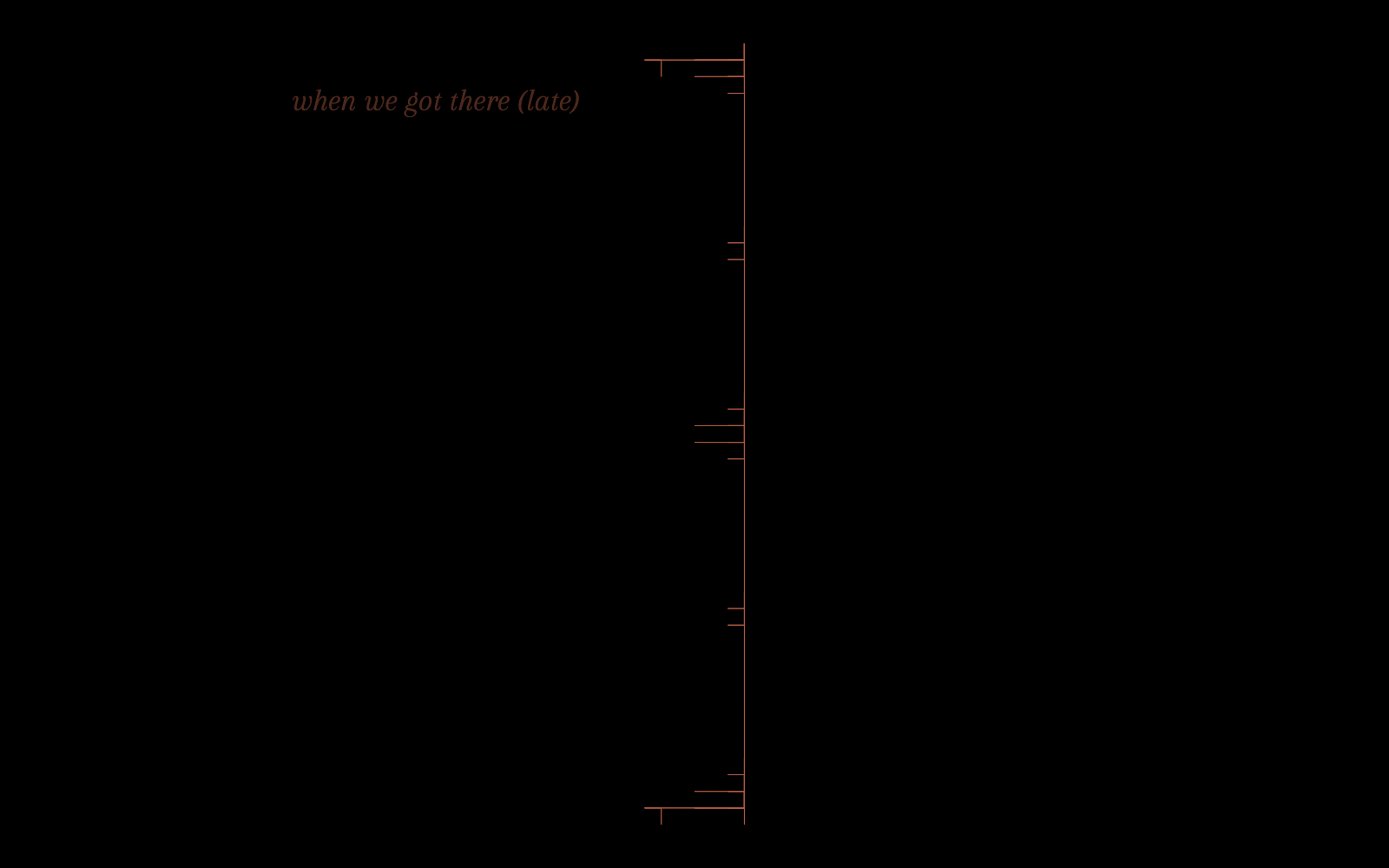
Frames of the web version, captured in November 2026. In the first a lavender tree spreads to the upper right. In the second a magenta decagon is closed by the pen, with one stray stroke at the top left. In the third the system has produced only a vertical red line with short ticks.
The text: "dissociative feels of social inadequacy"
While the figures change, a text appears one line at a time, in italic, at a random place on the screen and in the colour of the current figure. Each line stays for two seconds plus a tenth of a second per character, fades, and gives way to the next; at the end the text starts again. Its blank lines are pauses. In full, as the program shows it:
the grouping had been stuffy
when we got there (late) / most of them had turned into leftovers
I'm telling you / the scenery made most people ignore each other / just like free is not the same thing / as empty, or discarded
how to act and pretend? / to know how to relax and have fun? / it was attractive / mainly because of coincidence / and the others seemed like / they had a sense of humour / but they looked so put out / when I hadn't put forth the reaction / they expected and wanted / expectation invariably disappoints / in some ways I learnt this / and in some ways I didn't / and I keep learning different versions of it
I have a tendency to think / people are more flexible than they are
that experience of belonging / within myself / when deciding / I don't belong / in my surroundings
some people take exception to it / as though / it's not allowed to feel comfortable / with sole being
that attitude / which others have / encourages my own
funny how things don't work
The artist's account in Spike #70: the screensaver aesthetic carried "a certain melancholy" for him. "When I was a child, I didn't have access to the internet and I was not living in a big city, there was a boredom that could only be addressed by becoming a better computer programmer. I was trying to understand the world and myself by writing software and making aesthetic systems. But in the end, I was just more isolated. So this melancholy is what the work is about." The graphics are "overlaid with these descriptions of experiences that I would have in social situations where one also follows a script, like family birthday parties, which often made me feel incompetent."
The same script also defines a list it does not use in this version: a hundred English words with short glosses, from "Ailurophile" ("A cat-lover.") to "Woebegone" ("Sorrowful, downcast."), the list circulated online as Robert Beard's "100 most beautiful words in English". Like many notes in the archive, the work carries found language next to its own (→ Mediation and the Archive).
The title and the screensaver
In programming an event listener is a function that waits for something to happen, a click or a key press, and runs when it does (event). A screensaver is the program that starts when no such event has come for a while, and the first touch of a key or the mouse ends it. The work named after the listeners therefore runs only while the computer is waiting for its user and nothing arrives. The text describes the same position from the other side: a guest at a gathering who does not produce "the reaction / they expected and wanted". The artist does not explain the title; this reading is the wiki's.
The one-line description uses the word that names the archive: Dissociations is the website he began in 2010 and the source of this wiki (→ Subconscious Computation). "Dissociative feels" turns the word to a feeling of being apart from the people in the room.
Bought with Bitcoin, April 2015
The MAK bought 20 of the 100 editions in April 2015 through Cointemporary, a Vienna-based online platform, and paid in Bitcoin; the editions had been registered through ascribe.io on the Bitcoin blockchain. Afterwards "all my 100 editions were sold to collectors and another museum" (Tokenising Sustainability). The circumstances are told on left gallery, Tokenising Sustainability and Subdued Iconoclasm. An Event Listeners token is also listed under the Vienna Biennale at the MAK in 2015, curated by Marlies Wirth.
The texts that cite the purchase do not claim the same first. The ZORA profile calls the MAK "the first institution in history to purchase a digital artwork with Bitcoin", which is a first of payment. Tina Rivers Ryan in Spike #70 calls Event Listeners "the first tokenised work ever purchased by a museum", and the artist's own essay "the first time a museum bought NFTs, and paid with a cryptocurrency", which add the token. The Senescenence press release (2026) says "the first time a museum purchased an artwork through blockchain technology", and the Verse text for Quantizer "the first blockchain-authenticated artwork acquired by a museum". harm.work is the most careful: the MAK became "the first museum in the world to buy a work of art with bitcoin — an early precursor of what would later be called an NFT." All of them describe the same transaction. What was new in 2015 was both things at once, a museum paying in a cryptocurrency for editions whose ownership was recorded on a blockchain; the word NFT came later, which is why harm.work calls the work a precursor.
Ryan adds a point about the form of the sale: the work "is generative, but you editioned the program itself, instead of selling its unique outputs as '1/1s'." Each of the hundred owners has the whole program, and no two screens show the same sequence.
From ascribe to Ethereum
When ascribe stopped its service, around 2017, the record of the editions stayed on the Bitcoin blockchain, but "in practice, we have lost access to it, as their web interface to retrieve it was discontinued" (→ Mediation and the Archive). In 2018 the collection moved to Ethereum: the token description reads "This Ethereum NFT version was programmed and deployed in 2018. A maximum of 100 tokens can be minted," and harm.work lists the tokens numbered 2 to 100, issued through left gallery. The information file of edition 47, reproduced on Tokenising Sustainability, adds "Nightly built in 2020": the screensaver was built again that year. The token page still offers the .saver file for download, and harm.work lists token 2 under the address zkm.eth; the Senescenence biography names the ZKM in Karlsruhe among the collections that hold his work. Whether the ZKM is the "another museum" of the 2021 essay is not recorded.
In the practice
The L-system returns in the plotter drawing Uttered Modality (2018), which the artist describes as generated "by an L-system — the same generative method behind my work Event Listeners", with many marks added by hand (→ Early Plotter Drawings). Randomness and Pattern reads the L-system as the plainest case of organic form from a few rules. The sale reached further into the practice than the figures did: it led to left gallery, to editions of downloadable objects, and to the record-keeping questions that run through Mediation and the Archive.
See also
- left gallery (2015–2022) — the gallery that grew out of the MAK purchase
- Spike #70 — The Squircle of Life — the artist on the screensaver and its melancholy
- Tokenising Sustainability — the 2015 tokens, ascribe, and the lost interface
- Subdued Iconoclasm (ZORA, 2021) — his account of the sale
- Recursion and Self-Reference — the stop condition of note 876
- Early Plotter Drawings — Uttered Modality, the L-system on paper