
Entfaltung on Paper — the Hybrid Drawings
The drawings on paper in Entfaltung are made in two passes. A pen plotter draws a construction that van den Dorpel programmed, and he then fills the slivers between its lines by hand, in pencil and coloured pencil. Twelve of them, most 60 × 60 cm on watercolour paper, are listed for the presentation at Art Basel Miami Beach in December 2026, beside the 36 tokens on Ethereum. This page reads the artist's statement on them (sources/ingested/entfaltung-drawings-statement-2026.md) against the rest of the wiki. The statement adds three things the wiki did not have. The tokens and the drawings divide Emma Kunz's method between machine and hand. The hand-fill is made of decisions. And the question of where Kunz's drawings came from is kept open, as the thing the work is built to investigate.
Two halves of one method
Kunz's method had two parts, and the statement assigns them to the two parts of Entfaltung. Her pendulum decided where the points fell. Then her hand filled the figure sliver by sliver, a fill that could take a day or more per sheet (→ Entfaltung, under The research). In the tokens both parts go to the machine once a work has been configured: "The Ethereum block hash turns the figure for three blocks and on the fourth moves its points into a new shape, and the program fills the slivers as it renders." The drawings keep the second part: "The plotter lays down the construction, and my hand does the work Kunz's hand did."
Algorithmic Archaeology had already described the drawings this way: "The plotter takes over her radial construction; the hand takes over her fill." The statement confirms it and adds the counterpart: what the drawings keep, the tokens give away. The division also sorts the two halves by time. A drawing is "finished and fixed, as hers were", and a token "never stops changing". Both are built from the same construction: a set of points, the lines that join them by a fixed procedure, and the slivers where those lines cross. The series therefore exists twice, once as a figure that has stopped and once as a figure that cannot stop. Quantizer (2025) set a precedent for the pairing, with block-hash compositions that also came out as plotter drawings. In Entfaltung the paper half is finished by hand.
The sequence
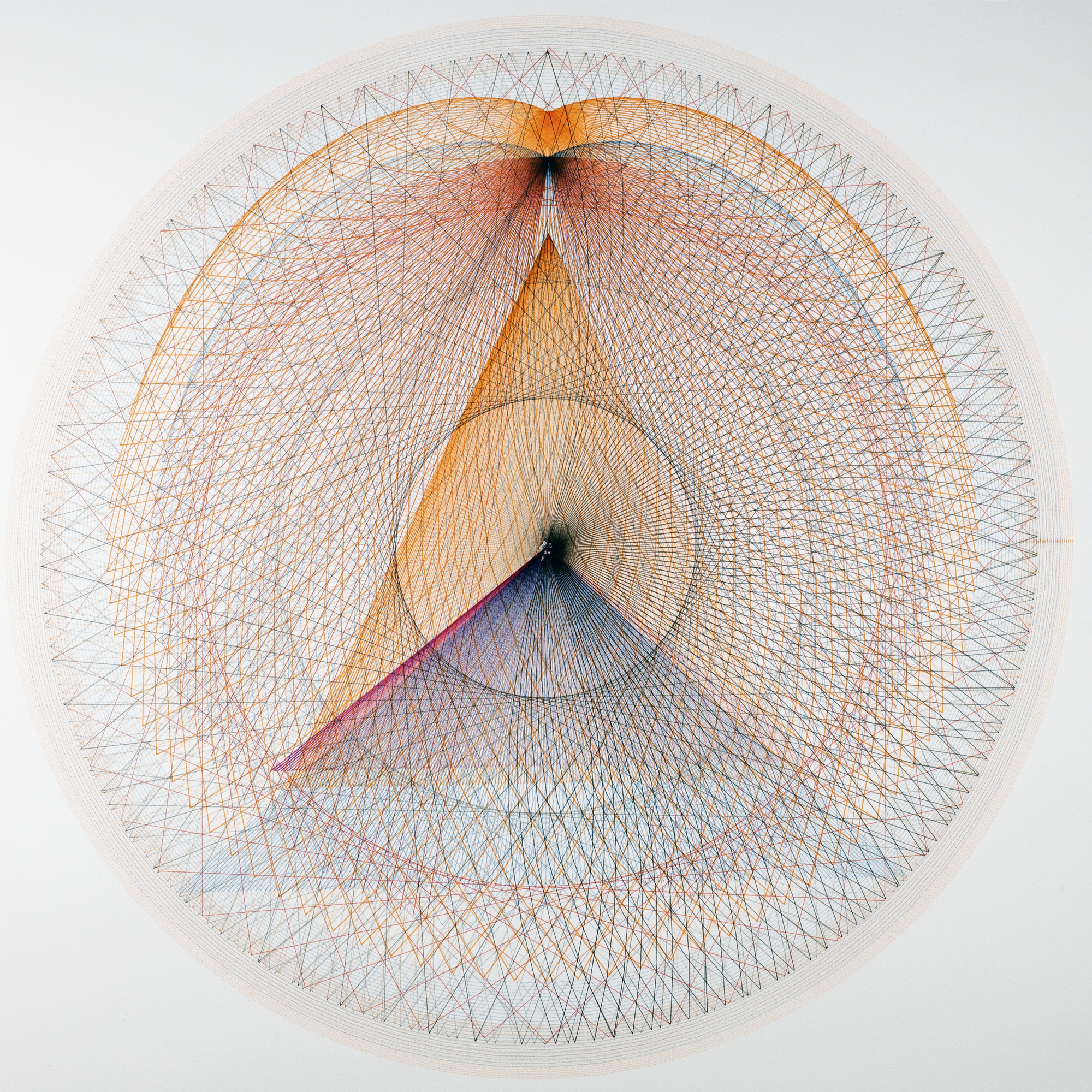
Entfaltung (3). A circle of crossing lines around one centre point, with two fans opening from it, one filled toward orange and one toward blue. It belongs to the radial register the statement calls closest to Kunz, yet it was made after Entfaltung (clam), a polygon with no single centre.
The statement tells the series as a straight line: "My first drawings stayed close to Kunz's … Gradually the drawings became more complex, moved away from hers, and became more my own." The artist's dating of the twelve drawings, given in October 2026, keeps the two ends and complicates the middle. The oldest is (17), a radial fan. Then come (transform) (15 June), a grid of thirty figures, and (clam) (1 July), a polygon webbed with lines. Next are (4), (3), (6) and (15), three of them radial again. Then (masking 1), (masking 2), (axis grid) (September), (cardinal) (8 October) and (duotone) (10 October).
Two corrections follow. First, the path away from Kunz was not monotone: after the polygon had appeared in July, the radial fan came back for most of the summer. Second, the systematic grid came second. The Entfaltung page lists its stages as re-drawing, generalising, mapping, and then space and time. On paper, a mapping grid was the second drawing, made before most of the radial sheets. The stages are a logical order, not a chronological one.
The statement also narrows where the series became van den Dorpel's own. The Entfaltung page puts that moment at stage four, when the construction leaves the plane for space and time. The drawings never leave the plane, yet the statement says they "became more my own" by growing more complex. In (cardinal), six star figures, nested hexagons and triangles overlap on one sheet. On screen the series got away from Kunz by adding dimensions; on paper it got away by density and layering.
Maps of the program
Entfaltung (transform). Thirty figures in five columns and six rows. Across, the number of legs rises from three to seven, so the outline runs from triangle to heptagon. Down, an inner offset shift changes, from a solid yellow fan in the top row to an open yellow and purple star in the bottom row.
This is the asymmetry grid from the Entfaltung page's third stage, outer-point count against inner offset shift, made as a hand-coloured plotter drawing. Entfaltung (axis grid), from September, maps two parameters of the rendering algorithm the same way. Across, it varies the rule that decides which intersecting lines close into a face; a closed face hides the lines behind it. Down, the main structure grows from two legs to five. The statement calls such sheets "maps of the program itself" and says what the parameters become: "In the tokens, settings of this kind are fixed once for each work and become its traits." The grid drawings are the paper side of the editor in which the tokens are configured (→ Entfaltung, under The instrument). The format puts the range on display and privileges no single figure, the same move the wiki traces from the N→∞ matrix to the Quantizer trait tables.
The statement describes the loop that produced the sheets: "The code informed the drawings, and the drawings informed the code. Each drawing, and each version of the program, became both the origin of the next iteration and the means to it." Asked whether the loop reached the token code too, the artist answered "definitely in both directions". A loop in which each output becomes the next input is the structure the wiki tracks under recursion, and a finished sheet is its stop condition. Between iterations, the eye that judges a drawing before the next program is written acts as the manual fitness function described in Evolutionary Logic: selection by looking, before any criterion has been formalised.
Decisions at the pencil
Entfaltung (masking 2). A many-sided outline with points on its rim and on an inner ring, joined by lines in orange, yellow, blue and violet. Several faces are filled so densely in brown and orange that they read as solid planes, while the hexagon at the centre is left white. How dark each face goes, and in which colours, was decided at the paper.
The statement lists what the pencil has to decide: "how to shade, where slivers should appear, what overlaps what, and in which colours". It also names four things that direct those decisions: "my eye", "my hand", "my code" and "the large language model I worked with". This narrows a claim in Meditative Labour. That page calls filling cells by hand "not technically demanding" and places its value in duration: "a piece of time that the artist's body had to be present for". It also argues that under LLM-assisted programming "the labour that mattered is increasingly only the labour of judging". The statement puts the judging inside the making.
It also describes how the decisions are made. They are "open and closed at once". There are many ways to fill a sliver, but the plotted lines "are already on the sheet. I have to follow them, and I cannot alter or undo them." Inside that template the mind "moves between focus and wandering": keeping the pencil inside the lines, choosing "a solid fill, a gradient or a fade", following an intuition about colour, then "drifting off while my hand continues". The plotter has already taken the decisions that cannot be revised, and what remains for the hand is a bounded freedom. The statement draws the consequence itself: "Inside that template I work freely, and my mind is free too." The constraint is what frees the mind.
Van den Dorpel, an avid yoga practitioner, takes that last sentence as a possible definition of yoga (October 2026). It is the same practice the wiki meets under Codec Breeze, a spirituality "geared by a meditative practice rather than a source of authority". The definition differs from the classical one in where it puts the restraint. Patanjali's Yoga Sutras (1.2) define yoga as the stilling of the fluctuations of the mind, which is a restraint on the mind itself. Here the restraint falls on the form, the held posture on the mat or the plotted line on the sheet, and the mind is left to move.
Agent's reading: criterion at the speed of the hand
Thesis (Process Legibility). When a machine does the making, what the artist keeps is the criterion, "the capacity to recognise when a surprise opens something and when it merely fills space". Judging is fast and needs no labour.
Antithesis (Meditative Labour). What the artist keeps is labour: the slow fill, technically undemanding, valued for the time the body spent on it.
Synthesis. At the pencil, each decision about a sliver is a judgement, and it can be made only as fast as the hand can carry it out. The higher concept is criterion at the speed of the hand: judgement slowed to the rate of making, and exercised once per sliver instead of once per output. Slowed this far, the criterion stops being a continuous act of attention. It comes and goes, from focus on a line to the choice of a fill to a stretch where the hand continues and the mind is elsewhere. The plotted template makes the intervals possible, because the decisions that cannot be undone were taken before the pencil arrived. The antithesis's duration turns out to be the duration of judging, and that duration includes the stretches when the judge has drifted off. This is also why the fill cannot be prompted. Each decision is taken with the pencil already on the sliver, in answer to what the previous one left behind.
Channelling as a research question
Entfaltung (15). A circle with a blue inner ring, a ring of green slivers turning around the centre, and a six-pointed star in yellow, orange and red at the middle. Of the twelve drawings it comes closest to a mandala in the sense the wiki takes from Carl Jung: centred, radial, built outward from one point (→ Mandala Q&A).
The statement's central question is how Kunz channelled. It sets out two possibilities without choosing between them. Either her source was an inner search, "and she herself was the source she tapped into", or it was "something deeper and shared, something we can all access within ourselves". The statement recalls Kunz's own view, that her results came from "powers that lie dormant in everyone". Next to it stands Jung's collective unconscious, "a layer of the mind that everyone shares", followed by a question: "Could I access something like it?" The rule of method is stated plainly: "I try to make no assumptions." Of the instruments in the loop, the one closest to Kunz's pendulum is the large language model, used "for its mathematical magic of a higher order". Algorithmic Archaeology already reads the model as a source trained on the collective corpus, "something close to what Carl Jung called the collective unconscious". The series text on harm.work calls it "our collective unconscious". The statement adds a third shared layer, the genetic code, "a 3.5 billion year old technology" in the title of the Julian Miller interview.
The statement places the channel in the pencil work. Of the state in which the mind drifts while the hand continues, it says: "I think this is the state Kunz worked in. She is said to have received her answers while drawing, in sittings of a day or more." The comparison concerns the second half of her method, not the pendulum. Her answers are reported to have come while she filled the figure, after the points were set, and that is the half the drawings keep. If the state is the same, the drawings are where the series can come near what Kunz did. The tokens hand the fill to the machine, so this question cannot be put to them.
The movement from personal to shared has happened before in the practice. Our Inner Child (2023) turned "our own inner child" into "a larger sense of a collective inner child". It is the same question the statement asks of Kunz, whether her source was hers or everyone's.
The question conflicts with the Entfaltung page, which reads the series as permitted rather than received. The generative system produces what the maker did not specify, "but no claim is made that it reports from anywhere". The statement makes no claim about where a source would be. But it does not rule one out, it names candidates, and in its last paragraph it says who can reach it: "Anybody has access to this higher order."
Agent's reading: channelling as a research question
Thesis (Kunz). The drawing is received from a real source beyond the maker's deciding mind, a higher order.
Antithesis (the Entfaltung page). The drawing is permitted by rules. There is no source to report from, only a structure the maker did not specify (subconscious computation; the apophatic stance).
Synthesis. The statement keeps what is true in each. With Kunz, it treats the source as something real enough to consult: a pendulum, a language model, a ledger every participant shares. With the permitted reading, it makes no claim about where the source is. The higher concept is channelling as a research question. Where the source lives (inside the maker, shared by everyone, or above both) is the open variable the work is built to investigate, not a premise it starts from. The statement makes one positive claim, about access, not location: anybody can reach the source. That agrees with Kunz, who said her results came from powers dormant in everyone, and it holds for every candidate address, since a mind, a shared unconscious and an order above both could each be open to all. Where the source is stays open; who can reach it is settled. "What I want to understand is how she channelled" names the project's object. Every instrument in the project is a way of asking: the reconstruction of Kunz's procedure, the hand at the paper in the state she is said to have worked in, and the model trained on everyone's writing. The wiki already had the formula in Bridge Between Realms, where the archetypal is real "even if it exists only in the brain's deeper layers". The statement turns that tolerance into method.
Authorship, and the self that remains
Entfaltung (duotone). The newest drawing, from 10 October 2026: an octagonal outline crossed by two families of lines, red and blue, with triangles pointing up and down at the centre. The fill is light, a pale wash of pink and blue in a few faces, and the rest is left as line.
The statement ends on the oldest terms in the practice. Drawing "for as long as I can remember" and programming "since I was about thirteen" have both "felt limitless": no permission is needed, the materials are cheap, and the only limits are "time, concentration and intelligence". Bridge Between Realms dates the origin to age eleven, when the computer was a world "infinite in possibility" whose "limitation was only one's own programming ability". The two dates fit, the computer arriving at eleven and programming from about thirteen. The statement then moves the limit. Intelligence "now seems almost infinitely stretched, because I no longer rely on my own single human intelligence." Note 702 had already put the artist's asset there: "What's in your hands, I think and hope, is intelligence."
The statement also qualifies a story the wiki has told. Programming and drawing "are very different activities, but over the years they have served me in the same ways: as a refuge, as a place to be absorbed, as a way to hand over control, and as freedom." Hence: "My renewed dedication to drawing does not feel like a departure from the work I made by programming." Meditative Labour tells the return of the hand as a counterweight: "when the loom of code thinned, the loom of the hand thickened." The statement accepts the timing but not the opposition. The two activities carry one function, which Bridge Between Realms first described for the computer at eleven, a world "meditative in its depth" and safe. Drawing now carries it too.
On authorship the statement gives three reactions in one sentence and then a reason: "The questions of authorship and authenticity this raises dazzle me, but they also seem to free me, and in the end they seem irrelevant. I would not take credit for what others did, but I am working in the same open tradition they worked in. Anybody has access to this higher order. And apparently I have not lost myself, however hard I have tried." Asked what the losing would have been, the artist said it is the same giving up as at the pencil, where control is handed over and part of the work becomes automatic: "giving up myself and becoming part of something greater". The trying has a long record. Note 592 calls authorship "a historical invention" that the Middle Ages did without. Dissociations (2010) trained an algorithm on the artist's unconscious preferences by having him eliminate items (→ About). Propositions replaces composition with initiation: "The artist does not author the result; he authors the conditions under which a result is allowed to emerge." In the Loomer press release (2015, 3003), van den Dorpel explains why he used to write his exhibition texts in the third person: "An outsider perspective suggests neutrality, and protects me from explaining my own work." The same text says that what the work is about "runs ahead of myself, and I will never quite fully catch up with it (even though I suspect it's always about the same)".
The 2026 statement is written in the first person, and it reports the result of all that trying: the self the systems were built to dilute is still recognisable in what they produce. Read through Jung's individuation, which the practice already names as the destination of the mandala (→ Mandala Q&A; Subconscious Computation), that result is what giving the self up is expected to produce: the ego yields to something larger, and the person becomes more fully themselves. The statement was itself drafted from the artist's notes with the LLM that maintains this wiki and then approved by him, which makes it one more instance of its own subject.
The reason the statement gives for setting authorship aside is new in the corpus. Earlier positions dissolved authorship into the system: initiation in place of composition, the conditions in place of the result. The statement dissolves it into a tradition. The artists the practice reconstructs, Kunz among them, drew on the same source, and the source is open: "Anybody has access to this higher order." Taking credit for what they made is ruled out; working in their tradition is not, because the tradition belongs to no one. The practice has held this view of the work before. In the surf clubs, as Chris Coy put it, work was posted "with the understanding that it would belong to everyone as soon as it was online" (→ Surf Clubs). Eric Raymond's open-source credo gave the 2013 New York exhibition its title (→ Release Early, Release Often). Algorithmic Archaeology argues against "a belief that working with algorithms is something this generation invented". The statement extends the same openness from the work to its source.
See also
- sources/ingested/entfaltung-drawings-statement-2026.md — the artist's statement this page reads, with Entfaltung (17), (clam), (axis grid) and (cardinal)
- Entfaltung — the series' stages, the editor, the tokens; the permitted/received reading this page qualifies
- Algorithmic Archaeology — Kunz in the timeline; the plotter takes the construction and the hand takes the fill; the LLM as collective source
- Meditative Labour — the hand-loom and the earlier machine-then-hand drawings, Beads I–III
- Process Legibility — the criterion as what the machine cannot supply
- Subconscious Computation — Jung, the creator/bystander position, the mandala as individuation
- Bridge Between Realms — the computer at eleven; the archetypal as real wherever it lives
- Recursion and Self-Reference — the feedback loop and its stop condition
- Evolutionary Logic — selection by eye as a manual fitness function
- Our Inner Child (2023) — from the personal to the collective inner child
- Release Early, Release Often and Surf Clubs — openness of the work, which the statement extends to its source