
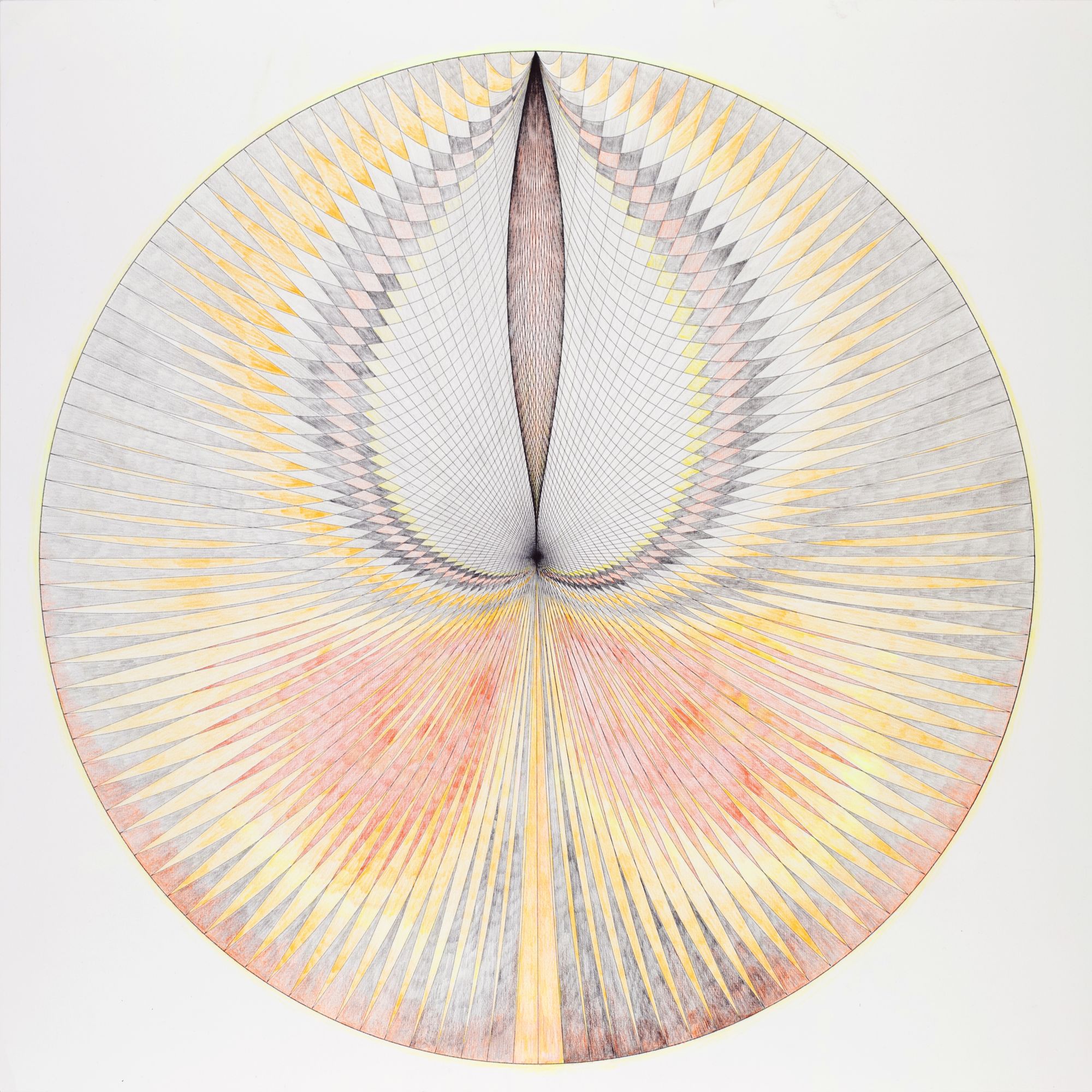
Entfaltung: the drawings — artist's statement (2026)
Artist's statement by Harm van den Dorpel, October 2026, on the drawings on paper in Entfaltung. Drafted from the artist's notes with the LLM that maintains this wiki and approved by him. The drawings are listed on harm.work.
Entfaltung takes two forms. One is a series of 36 tokens on Ethereum, living drawings computed in real time. The other is a series of drawings on paper, made with a pen plotter and finished by hand in pencil. I made them in parallel, from the same research and the same programs, and each changed the other while I worked.
The research was into sacred geometry, and in particular into the pendulum drawings of the Swiss healer and artist Emma Kunz (1892–1963). Since 2019 I have been reconstructing the procedures of artists who worked by rule and by hand before the computer, and writing new algorithms from them, a method I call algorithmic archaeology. With Kunz, I analysed many of her drawings and formalised, generalised and parametrised the procedures behind them. It seemed fitting to then work in her medium, pencil and coloured pencil on paper, at a comparable scale. I wanted to understand her way of working better, to be in her hands and in her head.
What I want to understand is how she channelled. Kunz said her figures came from a higher order. What is that higher dimension? Perhaps it was an inner search, and she herself was the source she tapped into. Or she reached something deeper and shared, something we can all access within ourselves. She herself said her results came from powers that lie dormant in everyone. I try to make no assumptions. Her contemporary Carl Jung described a collective unconscious, a layer of the mind that everyone shares. Could I access something like it? Perhaps we are all connected, even if only through genetic code, shared stories and archetypes.
My medium is code, and my medium is also my eyes and my hands. Kunz's drawings seem very approachable to me: open, sensible, sensitive, and sometimes sensual. I want to understand that better.
Each drawing starts as a program I write. The plotter draws its lines on the sheet. Then I fill the intersections of those lines by hand in pencil, which is meditative and labour-intensive work. Many choices are made during the pencil drawing: how to shade, where slivers should appear, what overlaps what, and in which colours. I felt directed as much by my eye as by my hand, by my code, and by the large language model I worked with for its mathematical magic of a higher order. The code informed the drawings, and the drawings informed the code. Each drawing, and each version of the program, became both the origin of the next iteration and the means to it.
The tokens and the drawings are built from the same construction: a set of points, the lines that join them by a fixed procedure, and the slivers that open where those lines cross. Between them they split Kunz's method in two. Kunz let the pendulum decide where her points fell, and then her hand could spend a day or more filling the figure, sliver by sliver. In the tokens I set the character of each work once, in my editor or in conversation with a collector, and from then on the machine does both halves. The Ethereum block hash turns the figure for three blocks and on the fourth moves its points into a new shape, and the program fills the slivers as it renders. Once a token is minted my hand no longer touches it, and it never stops changing. The drawings keep the other half. The plotter lays down the construction, and my hand does the work Kunz's hand did. When the last sliver is filled, the drawing is finished and fixed, as hers were.
The pencil work leaves me decisions that are open and closed at once. There are many ways to fill a sliver, but the plotted lines are already on the sheet. I have to follow them, and I cannot alter or undo them. Inside that template I work freely, and my mind is free too. It moves between focus and wandering: keeping the pencil inside the lines, choosing a solid fill, a gradient or a fade, following an intuition about colour, then drifting off while my hand continues. I give up part of my control, and part of the work becomes automatic. I think this is the state Kunz worked in. She is said to have received her answers while drawing, in sittings of a day or more.
Some of the drawings are maps of the program itself. Entfaltung (axis grid) varies two parameters of the rendering algorithm across one sheet. From left to right it changes the rule that decides which intersecting lines close into a face, and a closed face hides the lines behind it. From top to bottom the main structure grows from two legs to five. Entfaltung (transform), from June, does the same with the number of legs and an inner offset. On paper I can see a range of settings side by side. In the tokens, settings of this kind are fixed once for each work and become its traits. The loop between paper and code ran in both directions: what I decided at the paper went into the program the tokens run on, and changes in that program came back onto the paper.
My first drawings stayed close to Kunz's. I tried to understand her, to simulate her, to emulate her. The oldest, Entfaltung (17), is a radial fan close to her own constructions. Gradually the drawings became more complex, moved away from hers, and became more my own. In Entfaltung (cardinal) six star figures, nested hexagons and triangles overlap on one sheet. The tokens made the same departure when the construction left the plane and its points began to move. Kunz described her pictures as spaces one could walk into. In a token the viewer can turn the figure and zoom into it.
I have made drawings for as long as I can remember, and I have programmed since I was about thirteen. They are very different activities, but over the years they have served me in the same ways: as a refuge, as a place to be absorbed, as a way to hand over control, and as freedom. My renewed dedication to drawing does not feel like a departure from the work I made by programming. Both have always felt limitless to me. Anything can be drawn, imagined and made without asking anyone's permission, and the materials are cheap. It is a field without boundaries. The only limits have been time, concentration and intelligence, and the last of these now seems almost infinitely stretched, because I no longer rely on my own single human intelligence. I can draw on the entire history of geometry, mathematics and aesthetics. The questions of authorship and authenticity this raises dazzle me, but they also seem to free me, and in the end they seem irrelevant. I would not take credit for what others did, but I am working in the same open tradition they worked in. Anybody has access to this higher order. And apparently I have not lost myself, however hard I have tried.
Harm van den Dorpel