
Surf Clubs (2003–)
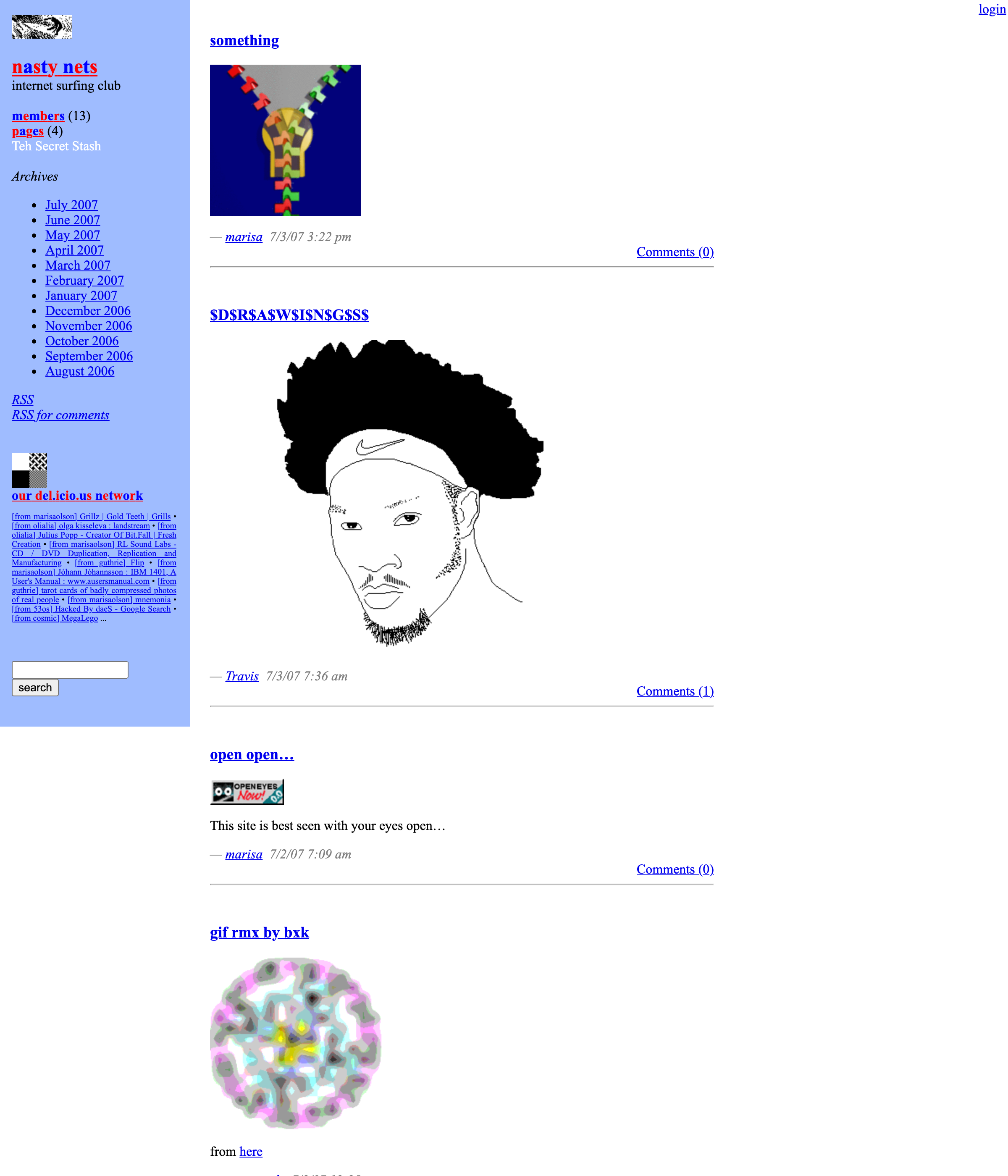
A surf club is a group blog where artists post what they find. Images, links, videos, sounds, half-made things — stacked vertically in one scroll, each post placed with some attention to the ones above it. Only members can publish; anyone can comment. The name comes from the tagline of Nasty Nets, "internet surfing club," and the form it named catalogues the oddities of the web with, as Rhizome's survey of the clubs puts it, "a certain kind of dry humor."
The dating is contested at the front end. Rhizome traces the lineage to 2003 and the group blogs around Jimpunk — noblog, 544x378 WebTV, SCREENFULL — which it calls "a missing link between earlier net art like JODI and later surf and art clubs." Charles Broskoski and Constant Dullaart title their account of the period Surf Clubs (2003–) for the same reason. But the form as such starts in 2006, when Nasty Nets and Supercentral both launched.
Why it happened exactly then
Dullaart dates the window by its technology, in the Spike conversation with Broskoski (sources/ingested/spike-70-surf-clubs-dullaart-broskoski.md):
Surf clubs blossomed after Google Images launched in 2001, but before the iPhone came in 2007 and using smartphones for media distribution became mainstream. Facebook only started to accept signups outside of US universities on 26 September, 2006.
Add cheap blogging software, the expiry of the animated-GIF patents, and Flickr, Delicious and YouTube arriving at once, and there was suddenly an enormous quantity of media and no machine deciding what any given person should see. Broskoski calls the result a Goldilocks zone:
There was a ton of content – not so much as overwhelming as today – and most of it tended to be pretty weird, or at least it was way easier to get to the weirder territories. Because of this, people were truly digging for the things that resonated with them.
His analogy is the thrift store: "It's not just about finding the diamond in the rough, but finding the thing that was important to you, to your own ongoing practice." Personal taste did the sorting, and the more idiosyncratic the better. Both men name the same thing as what has since been lost — friction. Content that has to be found is content that leaves a trace of the person who found it.
del.icio.us was the actual network
The blogs are what got archived, but neither Dullaart nor Broskoski says the blogs are where the community formed. Both point to social bookmarking.
I remember posting in 2006 to the weblog Squeakyfrom run by Hamy Caldwell and me. Harm van den Dorpel joined it briefly and later turned me on to the social bookmarking service del.icio.us, and I got to see all these people who had found posts on the blog I made, and had tagged my homepage. There was an instant sense of community when I got to see their online works and bookmarks. I remember seeing Petra Cortright bookmarking her dentist. — Constant Dullaart
Broskoski came to it through Cory Arcangel's class at Parsons, found the tagging corny, and tagged his early bookmarks unhelpfully on purpose. Then the network part arrived, and with it most of the people he still works with: "I met John Michael Boling through del.icio.us and he's been one of my best friends ever since." On the European side he names four:
I have vague recollections of coming across some of our European friends on del.icio.us, Harm van den Dorpel, Aleksandra Domanović, Jan Robert Leegte, Ola Vasiljeva.
He also describes the open question underneath all the tagging: "trying to figure out where the line was between research and Curation (with a capital C)." That question is the one Club Internet answered by building a gallery, and the one Broskoski answered by building Are.na.
The clubs
Nasty Nets (2006–2012, nastynets.com) coined the term and set the form: 1,360 posts by 39 authors. Rhizome's assessment is that "to some extent this is the blog that defined the surf club form." It got a DVD release through Rhizome and the New Museum in 2008, with cover artwork by Javier Morales, and an installation and screening at the 2009 Sundance Film Festival. Harm van den Dorpel was a member. The full roster: Travis Hallenbeck, Tom Moody, Marisa Olson, Joel Holmberg, Guthrie Lonergan, John Michael Boling, Camille Paloque-Berges, Javier Morales, Robert Wodzinski, Petra Cortright, Olia Lialina, Paul Slocum, Michael Bell-Smith, Constant Dullaart, Peter Baldes, Kevin Bewersdorf, Pascual Sisto, Chris Coy, Brian Blomerth, Damon Zucconi, Dennis Knopf, Britta Gustafson, Brenna Murphy, Aleksandra Domanović, James Whipple, Kari Altmann, Michael Guidetti, Jan Robert Leegte, Ethan Hayes-Chute, Charles Broskoski, Dragan Espenschied, Charles Westerman, Paul B. Davis, Harm van den Dorpel, Emma Davenport, Laura Brothers, Chance Jackson, Summer Shiffman, Jordan Wolfson.
Supercentral (2006–2010, supercentral.org) was Charles Broskoski's site before it was a surf club — a homepage and forum about skateboarding, converted in 2006. Rhizome reads that conversion as typical: artists "started off using homepages and online communities for non-internet cultural interests (often music), and then gradually shifted their interest to internet and computer culture itself." 2,389 posts by 23 authors, the most of any club here. Broskoski was its webmaster. Members: Charles Broskoski, Chris Pappas, Tommy McCutcheon, Ben Ellis, Brandon Brown, Willis Elkins, Scott Schwartz, Pete Dahlberg, Emily Grenader, Nate Boley, Jessica Williams, Claire Evans, James Whipple, Damon Zucconi, yarr, Will Macfayden, Robin Willis, Seneca Garcia, Ben Dahlberg, John Michael Boling, Eli Bock, Travis Hallenbeck, Veronica Ortuno. Broskoski went on to co-found Are.na, which is a surf club rebuilt as infrastructure — and which van den Dorpel still uses extensively.
Spirit Surfers (2008–present, spiritsurfers.net) is the one still running, and the one with a form of its own. Posts are framed and may be split into a boon and a wake. Dullaart's reading:
I understood this as the difference between the thing of beauty that was found online while surfing – an image or a bit of information – and the journey towards a thing. In my eyes, it enabled thinking about an entire conversation as an artwork, instead of a single argument, piece or comment.
Rhizome describes its theme as "comic spirituality," and notes that boon and wake "are ambiguous and have been interpreted many different ways" by the members. Harm van den Dorpel was a member. 833 posts by 17 authors: Kevin Bewersdorf, Paul Slocum, Marcin Ramocki, Ethan Hayes-Chute, John Transue, Luke Murphy, Krist Wood, Aron Namenwirth, Harm van den Dorpel, Dragan Espenschied, Travis Hallenbeck, Olia Lialina, Peter Wilson, Patrick Armstrong, Patrick Groth, Peter Blasser, Chad Hopper, Rachel Abelson. Several posted under pseudonymous INFO- handles, two of which — INFObeard and INFOpruner — turn up as members in the Club Internet database.
Club Internet (2008–2010, clubinternet.org) is van den Dorpel's own, and it is not a surf club: it has curators, run dates and one work at a time. Fifteen shows, around 274 works, 106 artists. See the Club Internet page for the full exhibition history. Dullaart's biography line in Spike names his role there: "contributing member of Nasty Nets and curator for Club Internet."
The other clubs Rhizome documents, for completeness: noblog / 544x378 WebTV / SCREENFULL (2003–2012, around Jimpunk); Double Happiness (2007–2015); Loshadka (2007–2013); Mouse Safari (2007–2011); You Had Better Know (2008–2010). Members of Loshadka and Mouse Safari — Billy Rennekamp, Travess Smalley, Parker Ito, Ken Seeno, Will Simpson, Justin Kemp, Eilis McDonald — show up repeatedly in the Club Internet programme.
One event is worth recording as the point at which the clubs met each other in a room: the Internet Sleepover at Eyebeam in New York on 24 August 2007, organised by Bennett Williamson, attended by members of Nasty Nets, Supercentral, Double Happiness and Loshadka, and by the future founders of Are.na. Rhizome describes it running "like a programmer demoscene meetup."
The ethos, and when it turned
Work posted to a surf club was understood to be common property from the moment it was up. Dullaart records the test case — Rhizome archiving Nasty Nets against the risk of hacking (which happened) or of a lapsed domain — and Chris Coy's answer:
all the work had been posted with the understanding that it would belong to everyone as soon as it was online, and everyone could do with it whatever they wanted – almost the opposite of the current attitude towards the commodification of digital files as NFTs.
Broskoski traces it to file sharing: "We are taking things from people, so we expect people to take things from us. A real abundance mindset." The same stance, stated positively, is the open-source credo van den Dorpel took as a title in 2013 (→ Release Early, Release Often).
There is a second position that dissolved faster, and Broskoski states it plainly:
There was definitely a time immediately prior where there was a kind of political stance – or at least I felt like this – that showing in a gallery or physical space was degrading and an inevitable mistranslation of the work, which was ideally meant to be seen by someone in their bedroom at 2 a.m. with a million other browser tabs open. The whole premise was that a work should be stumbled upon.
By 2009 that had gone. Dullaart curated two Amsterdam shows that year — one built from artists' del.icio.us bookmarks, exhibiting research and finished work on the same footing; the other, Versions, at NiMK with Annet Dekker and Petra Heck, taking the comment as a medium. Van den Dorpel was in Versions (→ 935). Club Internet's Free Fall opened with a party at Mediamatic in October 2008, and its AFK sculpture park documented an outdoor sculpture show in Berlin in September 2009. Within eighteen months the clubs had walked into physical space from both directions.
Why this matters for the practice
The surf clubs are where a generation met. Before social media took over the same function — and made it a feed rather than a room — a few hundred people found each other through bookmarks and comment threads, and the network held. Many of them were labelled post-internet in the years that followed; a large share of the same names turned up again in crypto art from 2015 on. Van den Dorpel's own path runs through all three phases in order, and each transition is legible in this archive: the clubs, then Club Internet as the first attempt to give online work an exhibition apparatus, then left.gallery from 2015 as the attempt to give it a market, then institutional shows.
The through-line is not a style. It is a repeated question about where work of this kind is supposed to live and how anyone is supposed to get hold of it — a question the clubs answered with nowhere in particular, and for free, Club Internet answered with a curated online show, and left.gallery answered with a downloadable file you own. Broskoski's version of that question is Are.na, and van den Dorpel is still one of its users. See Protocol, Taste, and Systems for the same trajectory read as a shift from personal taste to collective to systemic.
Connections
- Club Internet — the exhibition space van den Dorpel founded, with its full show and artist list
- left.gallery — what the ground prepared here later became
- Release Early, Release Often — the open-source credo behind the surf-club ethos
- Mediation and the Archive — documentation as constitutive, tested by a form whose works are mostly dead links
- Protocol, Taste, and Systems — taste as through-line, personal to collective to systemic
- sources/ingested/spike-70-surf-clubs-dullaart-broskoski.md — the Broskoski/Dullaart conversation this page draws on
- Rhizome's surf clubs survey — the catalogue of clubs, members and post counts