
Dispersion — Seth Price and the Practice
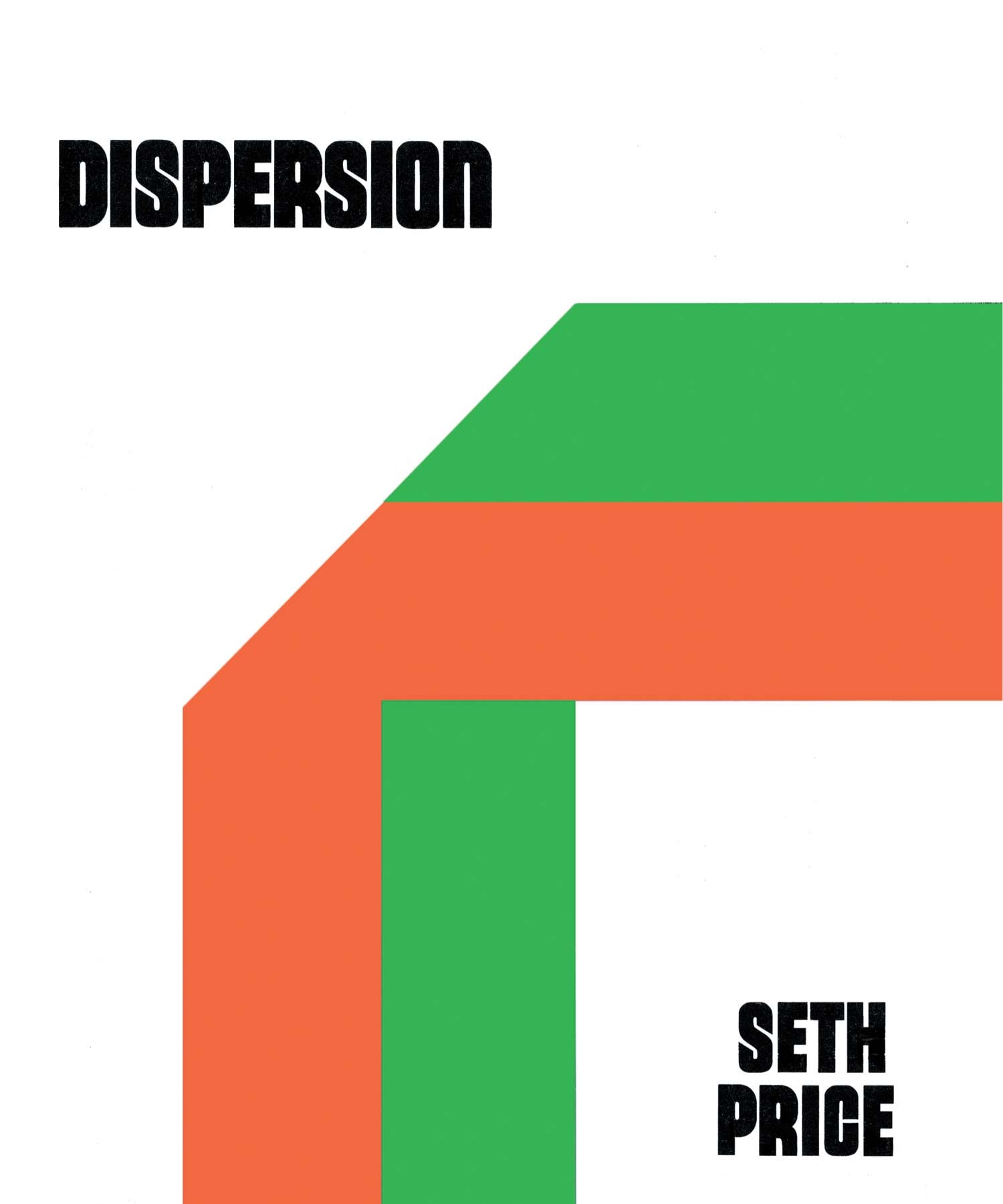
Seth Price's essay "Dispersion" opens on a sentence by Marcel Broodthaers: "The definition of artistic activity occurs, first of all, in the field of distribution." Price wrote it in 2002 and gave it away, as a booklet and as a PDF on his website, in more than one layout; the New Museum dated it "2001–", as a work still open. The wiki keeps the illustrated PDF of 2007 (full text). The essay asks what art becomes when it is released into "distributed media", books, records, videotapes, DVDs and computers, instead of being shown in a gallery.
Van den Dorpel counts it among the sources of his early work (the artist, November 2026):
This PDF by Seth Price was hugely influential on my early practice. Price was looked up to by a lot of net artists and post-internet artists. He belonged to the same generation as Cory Arcangel, and they had found a way to connect their practices to the greater art world and the art market.
Price was born in 1973, Cory Arcangel in 1978 and van den Dorpel in 1981. The double position van den Dorpel describes is one the essay names. When Rodney Graham releases a CD of pop songs, Price writes, "those in the art world must acknowledge the art gesture at the same time that these products function like any other artifact in the consumer market."
What the essay argues
Price starts from Conceptual art, whose expansion into new territory made works "increasingly vulnerable": "avant-garde work is often illegible without institutional framing and the work of the curator or historian." Work that tries to leave the art system survives as its documentation, and the system takes the documentation back as art. Price sets two archives against each other: the archive of high culture, which "relies on cataloguing, provenance, and authenticity", and a popular archive that lacks this administrative habit. His proposal is to release the work into the second:
"Suppose an artist were to release the work directly into a system that depends on reproduction and distribution for its sustenance, a model that encourages contamination, borrowing, stealing, and horizontal blur. The art system usually corrals errant works, but how could it recoup thousands of freely circulating paperbacks?"
He then redefines public art. Its discourse has made two demands, that the work be free of charge and that it stand in shared physical space, and "situating the work at a singular point in space and time turns it, a priori, into a monument." Price locates publicness in reproduction instead, so that "a popular album could be regarded as a more successful instance of public art than a monument tucked away in an urban plaza." The album is everywhere because it uses "the mechanisms of free market capitalism, history's most sophisticated distribution system to date." Classical Conceptualism had used magazines to send coded propositions to specialists; Price wants the generic forms of popular culture as well as its channels.
The internet enters late, as a "mass archive". His examples are Linux, a "radically incomplete" work that Linus Torvalds put online for others to finish, and the Daniel Pearl video, debated by people who had never seen it. "With more and more media readily available through this unruly archive, the task becomes one of packaging, producing, reframing, and distributing", and "Anything on the internet is a fragment, provisional, pointing elsewhere. Nothing is finished." He proposes an art of re-release, citing Harry Smith's Anthology of American Folk Music, UbuWeb's republication of the magazine Aspen and his own CD of early video-game soundtracks: "take what's free and sell it back in a new package." He reads Duchamp's Fountain as a work made by its distribution, argues for slowness and delay, and closes on appropriation: "Production, after all, is the excretory phase in a process of appropriation."
Why Price wrote it
In 2013 an interviewer for The Believer told Price that the essay "seems to suggest that the internet is a roundabout way of getting beyond the usual art-world market system". Price answered (The Believer):
"I don't know. I started writing that essay not because of any interest in the internet, but out of frustration about how to be an artist, or whether I even should "be" one. Is it possible to make objects anymore? Is that interesting? So really it was my thinking through how to enter this other world, and when I finished it, I thought the text itself might be a piece."
Asked next about his wish to work in film, he said: "the title of 'artist' is just so embarrassing. Just to assert it: 'I am an artist!' It took a long time to be able to say that." The essay itself ends on the same unease, calling the artist's social role "somewhat embarrassing, in that it's taken to be a useless position, if not a reactionary one". Van den Dorpel's press release for his first Los Angeles solo show, in 2015, has his version: "I still hesitate to call myself an artist. At obligatory gatherings I prefer to say I'm a computer programmer, which is more tangible" (→ Loomer). The essay was mostly read as a text about the internet. Its author says it was about whether to be an artist at all.
The essay in the record
Club Internet, 2009. The eighth show at Club Internet, curated by van den Dorpel, was called Dissociation; its database record was created on 22 November 2008. On 10 June 2009 he added Dispersion to it, credited to Seth Price and dated 2008, with links to Price's PDF of that year and to a copy on Club Internet's own server. It is one of 25 rows, of the show's 44, that are switched off. In August Ethereal Others .com joined the same show. The title is the word the archive took the next year for dissociations.com. Filing the essay as a work in an exhibition takes Price at his word: when he finished it, he "thought the text itself might be a piece."
Free, 2010. Free, Lauren Cornell's exhibition at the New Museum, took "Dispersion" as its touchstone and showed the booklet as a sculpture, nine panels each printed with one of its pages, which the exhibition text calls an Essay with Knots. Van den Dorpel showed the Redux collages, and Brian Droitcour's catalogue essay applied Price's criterion to Ethereal Self (→ Free).
2022 and 2024. Both showed again in The Painter's New Tools at Nahmad Contemporary, New York, a survey of painting made with software, screens and code (→ The Painter's New Tools). In the Verse Twitter Space of January 2024 van den Dorpel named Price among the artists he likes, after Dieter Roth and beside Sigmar Polke and Hilma af Klint (→ Verse, 2024).
Price, seen from 2026
Van den Dorpel's respect for Price has lasted. What he adds in 2026 is where he thinks Price stayed (the artist, November 2026):
I highly respect Price. He made interesting observations about media and redistribution, and used some of them as his medium. But there is something in me that wants to break out of the confines of fine art, and he seems to have stayed within them, while talking about breaking out.
The essay is itself one of those uses: Price gave it away as a PDF, and in 2010 it hung in Free at the New Museum as a sculpture, nine printed panels (→ Free). The wish to break out has a record. Each item below put work in front of people by a route that ran beside the gallery and the museum, and each met a limit.
- The surf clubs (2006–). Group blogs on which artists posted what they found and made. The work was public the moment it was online, and, in Chris Coy's recollection, belonged to everyone from then on (→ Surf Clubs). The clubs had no way to sell, and most of the links are now dead.
- Club Internet (2008–2010). His own exhibition space at clubinternet.org: 15 shows and some 274 works, one work on screen at a time, with guest curators and run dates. The works were links to the artists' own servers, and many have since gone; his own CVs called the space "non-archived" until its database was recovered.
- Websites as works (2008–2019). Ethereal Self .com, Dissociations .com and Dark Calendar .com are public at their own addresses, with no gallery between the work and whoever loads it. Brian Droitcour counted Ethereal Self's hits to call it public art by Price's criteria.
- A screensaver sold to a museum for Bitcoin (2015). Event Listeners was an edition of 100 files registered on the Bitcoin blockchain through ascribe.io; the MAK in Vienna bought 20 of them with Bitcoin, and the rest sold to collectors and another museum. When ascribe closed, the record stayed on the chain and became unreadable (→ Event Listeners).
- left gallery (2015–2022). The gallery he founded with Paloma Rodríguez Carrington sold "downloadable objects", files in editions of a hundred for about fifty euros, with ownership recorded outside the gallery and apps that the app stores would not carry. At left gallery: rite of access (Stroom Den Haag, 2019) the works stayed on view only as long as purchases and follows anywhere kept up the credit. ascribe closed, the Ethereum tokens found few takers, and the 2020 relaunch kept ownership in a database, which he called losing its "blockchain soul" (→ left gallery).
- Tokens (2021–). Mutant Garden Seeder was released with Folia, and Field, Bison and Markov's Dream carry their program or frames on-chain, so the work no longer depends on a server he runs (→ Mediation and the Archive).
The record is not one of leaving. "I never said I can do without the institutions," he adds, "but I have always kept one foot elsewhere too." Through the same years he showed in galleries and museums, from Free (2010) to the Stedelijk's collection display (2020) and The Painter's New Tools (2022); the MAK's purchase is what led to left gallery; and the Seeder tokens were first offered through Upstream Gallery. The channels ran beside the institutions, as the left gallery page argues, and the essay's first sentence, on distribution as the field where artistic activity is defined, describes that position.
The artist as publisher: Dürer and Roth
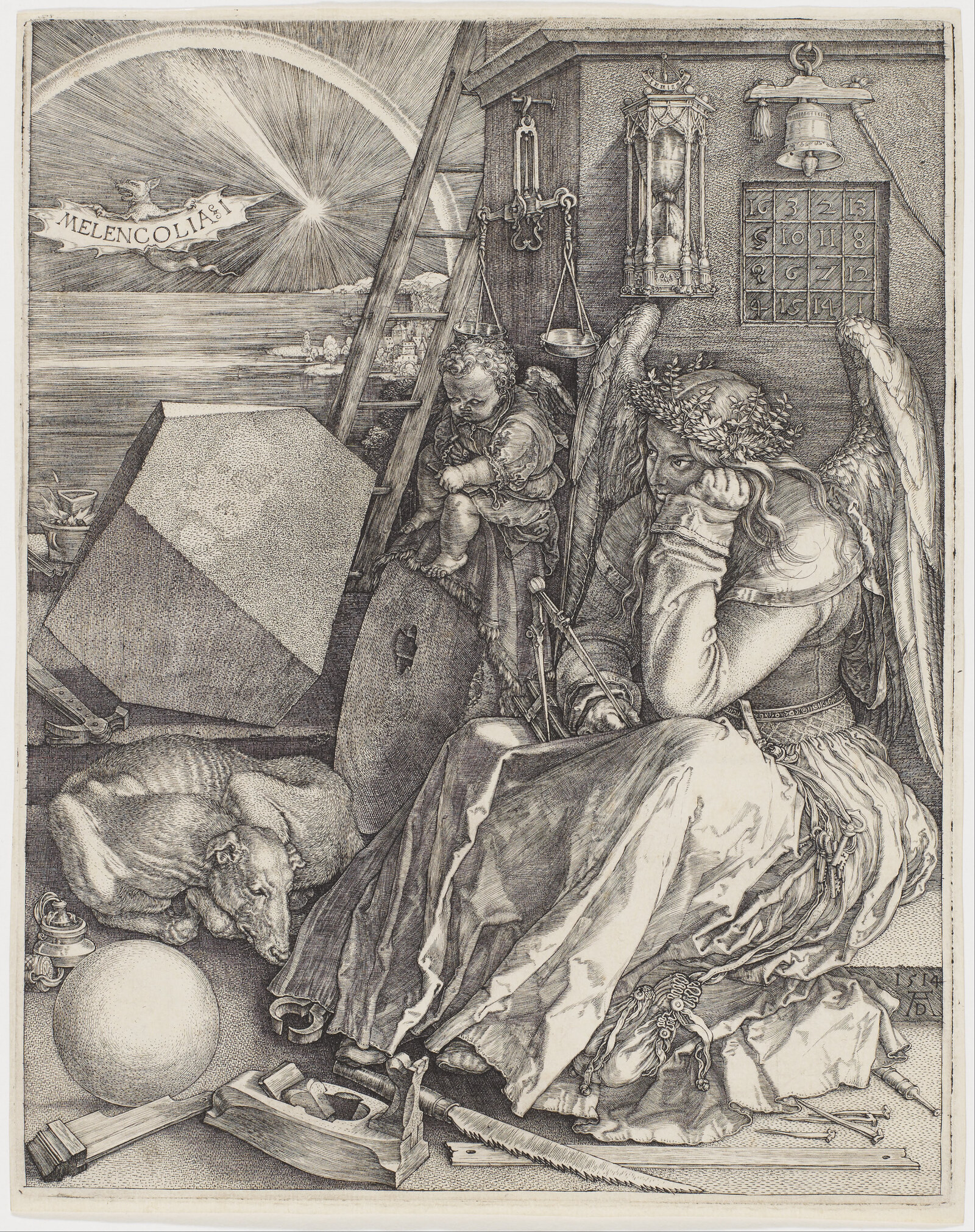
The artists van den Dorpel names as models for that step worked centuries before him (the artist, November 2026): "I have enormous respect for Albrecht Dürer. I am also fascinated by Dieter Roth." Dürer made the print his own channel. He published and sold the Apocalypse himself, at Nuremberg in 1498, in Latin and German; Wikipedia calls him the first artist to publish his own book. In 1511 he reissued it with the Life of the Virgin and the Large Passion, and he sold single impressions in considerable numbers, while copyists such as Marcantonio Raimondi copied whole prints. The last illustration in "Dispersion" is one of his prints, Melencolia I (1514), its date set above his monogram. Price closes an essay on distribution with a work by the artist who became his own publisher.
Dürer's circle appears in van den Dorpel's own work. The pixel sorter Danse Macabre dissolves a woodcut from the Nuremberg Chronicle (1493), printed and published by Dürer's godfather Anton Koberger, with woodcuts attributed to Michael Wolgemut, in whose workshop Dürer had begun his apprenticeship in 1486 (→ Pixel Sorters).
In the Verse Twitter Space of 2024 he called Dieter Roth the one artist he feels really close to (→ Verse, 2024). Roth published his own work through most of his working life; the facts here follow Wikipedia's account. He made the magazine Spirale (1953–64) with Marcel Wyss and Eugen Gomringer, founded the publishing company forlag ed. in Reykjavik with the poet Einar Bragi to bring out his artist's books, and from 1975 to 1987 published the Zeitschrift für Alles, which printed anything anyone sent him up to four pages, later five, until it ran to 1,396 pages. From the mid-1970s the publisher Hansjörg Mayer reissued his bookworks as the Gesammelte Werke, in 26 volumes. In the Order Form Exhibitions Roth sold manufacturing instructions: a buyer took them to a printer of their choice, and the second time to a baker, and made the work. The wiki's comparison: a token that stores its program on-chain and leaves the drawing to each viewer's browser has a related form. The score is sold and the performance happens elsewhere. The difference is who performs: Roth's buyer chose the printer, and a browser chooses nothing (→ Mediation and the Archive).
Public art, private portrait
Droitcour counted hits: Ethereal Self .com had "enough hits to be considered public art by Price's criteria". A few sentences after the passage he quoted, the essay describes the work more exactly:
"Perhaps an art distributed to the broadest possible public closes the circle, becoming a private art, as in the days of commissioned portraits. The analogy will only become more apt as digital distribution techniques allow for increasing customization to individual consumers."
Ethereal Self .com (2008) made a portrait for each visitor, from the visitor's own webcam, seen in the visitor's own room: the face refracted in the facets of a gemstone. Ethereal Others .com collected those private portraits into a grid that every later visitor saw. The pair runs Price's circle in both directions, from a site anyone could load to a portrait made for one person, and from there to a public record of its viewers. Van den Dorpel's own account, "a way of returning the gaze of the internet", and the private footage the sites caught are on Ethereal Self & Others.
Reframing found material, until 2015
Price's account of the task, "packaging, producing, reframing, and distributing; a mode of production analogous not to the creation of material goods, but to the production of social contexts, using existing material", fits the first decade of the practice. The surf clubs posted found images, links and videos as their work (→ Surf Clubs), and Club Internet built shows out of other artists' links. The early series start from found pictures: the Revenant Series (2006–07) from photographs of people asleep, Animal Configurations (2007) from Google image search, the Pixel Sorters from clip-art animals.
Redux (1), (2) and (3) (2009), the collages in Free, stand closest to Price's subject and reverse his move. Price takes material that circulates for free and sells it back "in a new package". Redux starts from the package, posters for Hollywood films whose copies circulated for free on peer-to-peer networks, and cuts away every figure and title until, in the catalogue's words, the object is "totally unlike, but haunted by its original content."
In 2015 van den Dorpel called the method spent. The press release for Loomer: "Often people approach explanations in terms of 'found imagery', which is 'culled' from the internet. I never minded the label 'post internet' but know it is not sustainable. The fact that the internet is my material doesn't mean much anymore. It's 2015 and modes of appropriation are default." From 2016 his images come from programs he breeds, beginning with Death Imitates Language (→ Evolutionary Logic). Found images return by choice: the internet image pool of Lexachast (2016) and the stills of the Dashcam Paintings (2024–). Of the essay's two programmes, reframing what exists stopped being his default around 2015. Distribution did not.
Re-release

"An entire artistic program could be centered on the re-release of obsolete cultural artifacts, with or without modifications, regardless of intellectual property laws." Price ties the idea to slowness: media culture "feeds on its own leavings", which shows "the paradoxical slowness of archived media, which, like a sleeper cell, will always rear its head at a later date. The rear-guard often has the upper hand, and sometimes delay, to use Duchamp's term, will return the investment with massive interest."
Since 2020 van den Dorpel's early works have been re-released on this pattern, most of them by him. Markov's Window (2004), a Flash animation he had forgotten for fourteen years, went on view in the Stedelijk Museum's collection display in 2020, and in 2023 he ran its algorithm again to pixel level for the Resolution Paintings. The Pixel Sorters were minted with Folia in 2021. Field (2008), written for the Flash player Adobe withdrew in 2020, came back in 2023 as six tokens whose code sits in the smart contract. Zeuchnungen (2012) went to Versum in 2022 and to his own Tezos contract in 2024. Bison (2005), first a Java applet, went on-chain frame by frame in November 2026.
Price re-released other people's forgotten material. Van den Dorpel re-releases his own, and the new package is a token that stores the program or its frames. He counts the upkeep as part of the work: "The continuous care and tending of the work, the archiving, the updating, is part of the work for me" (→ Mediation and the Archive, Bison). The essay's pictures point to a second kind of re-release. Two of them are 1960s computer graphics by the Japanese Computer Technique Group, set among clip art and Memphis patterns: obsolete forms of the kind its last paragraph means by "the redemptive circulation of allegory through design, obsolete forms and historical moments". The procedures van den Dorpel has rebuilt after Anni Albers, Emma Kunz, Vera Molnár and Herbert W. Franke are forms of that kind, taken from the history of computer and systems art instead of from pop culture (→ Algorithmic Archaeology).
Nothing is finished
Price takes Art & Language's phrase for Conceptualism, "radically incomplete", and gives it to Linux: Torvalds "placed the code for this 'radically incomplete' work on-line, inviting others to tinker". Eleven years after the essay, van den Dorpel named his first solo show in the United States after Eric S. Raymond's description of the same method, Release early, release often (Abrons Arts Center, 2013; → Release Early, Release Often). Several works since are built to stay unfinished: dissociations.com, running since 2010 and now carrying this wiki; the Mutant Garden Seeder tokens (2021), which mutate whenever a block hash matches their birth hash; the on-chain renderer of Entfaltung (2026), which can be updated by design.
The work as a palimpsest
Price reads Fountain as a work made by its distribution. "Never exhibited, and lost or destroyed almost immediately, it was actually created through Duchamp's media manipulations", the Stieglitz photograph and the article in The Blind Man. "In Fountain's elegant model, the artwork does not occupy a single position in space and time; rather, it is a palimpsest of gestures, presentations, and positions. Distribution is a circuit of reading." He sets this against Boris Groys's "deep malaise towards documentation and the archive", the worry that a work's record replaces the work.
The archive's formula, "The Work = The Work + Its Documentation" (992), accepts what Groys worries about (→ Mediation and the Archive). The plainest case is Assemblage (About) (2012): the online reviews of his London show About printed onto strips of synthetic glass and bent into a sphere. The Abrons press release of 2013 put it at the end of a chain that ran from a drawing found on DeviantArt through a collage, a press image and a review (→ About, Release Early, Release Often). Price calls distribution a circuit of reading; the sphere feeds the reading back into the object.
Where the practice and the essay part
Genre and the interface. Price asks art to use "not simply the delivery mechanisms of popular culture, but also its generic forms", and his examples are the album, the magazine, the novel and television. For van den Dorpel the mainstream medium is the internet itself (the artist, November 2026):
My practice has been based on using the internet for many years, the most mainstream medium there is.
The work has taken the internet's generic forms one after another: the website named after its domain (Ethereal Self .com, 2008; Dissociations .com, 2010; Dark Calendar .com, 2019, an empty week view in a calendar's dark mode), the group blog of the surf clubs, the macOS screensaver (Event Listeners, 2015), the apps, e-books and screensavers that left gallery sold as files, the animated GIF, the token, and with Lexachast the record and the live show. The essay looks past these forms. It treats web art as "the veneer of user interfaces floating on its surface" and finds what matters about the internet in the archive underneath. Van den Dorpel works in that veneer, down to the rounded corner of the interface, which he reads as ideology (→ The Squircle). By his own account, the practice went further into the mainstream medium than the essay looked.
Code. Products that embrace the codes of the culture industry, Price writes, contain "a utopian moment that points toward future transformation", and "could be written according to the code of hermeneutics". Beside an alchemical ouroboros he quotes that code: "Where we have spoken openly we have actually said nothing. But where we have written something in code and in pictures, we have concealed the truth…" The recent rule-based works take the opposite position on their own code: the rule stays readable in the image (→ Process Legibility, Magicians Conceal, Artists Reveal). The word means a cipher in Price's sentence and a program in van den Dorpel's work, and the two take opposite sides on hiding it.
Agent's reading: the copy disperses, the title is recorded
Thesis. Where the essay reached van den Dorpel's milieu, free meant free of charge. The New Museum took the title Free from the free-culture movement and made "Dispersion" the exhibition's touchstone. The surf clubs posted work, in Chris Coy's recollection, "with the understanding that it would belong to everyone as soon as it was online" (→ Surf Clubs). The Believer's interviewer read the essay as a way of "getting beyond the usual art-world market system".
Antithesis. The essay does not make price the test of the public. "Free of charge" is the first of the two demands it says have narrowed public art, a demand by which "economic considerations are primary in determining the divide between public and private". It calls the market "history's most sophisticated distribution system to date" and recommends selling what is free in a new package. Asked whether the internet had taken art past the market, Price said "I don't know." The art system then did what the essay expected of it ("The art system usually corrals errant works"): eight years after the booklet, the text hung in the New Museum as nine printed panels while the PDF stayed free online, and in van den Dorpel's view its author stayed inside that system. Van den Dorpel's own account of Price and Arcangel is that they connected their practices "to the greater art world and the art market".
Synthesis. For Price a work is public in proportion to how far it circulates, and a price is one of the channels it circulates through. The free PDF and the museum panels are one text in two channels, and neither cancels the other. Van den Dorpel built this split into the way his work is sold. left gallery (2015–2022) sold files in editions of a hundred for about fifty euros, a price nearer an album's than an art object's. He calls the token the end of that line: "NFTs are the culmination of using consumer forms of distribution for fine art" (the artist, November 2026). A token records who owns a work whose image anyone can load, and what it adds is the one thing Price's popular archive lacks, "cataloguing, provenance, and authenticity", written to a ledger outside the gallery's control. The copy disperses and the title is recorded. The reversal the left gallery page describes, from the surf clubs' refusal of ownership to the sale of files, was already written into the text that generation shared.
See also
- Dispersion, full text — the 2007 PDF, with its illustration captions
- Free (New Museum, 2010) — the exhibition that took the essay as its touchstone
- Club Internet — the Dissociation show and its record
- Ethereal Self & Others — the websites Droitcour read through Price
- Release Early, Release Often — Torvalds's method as a title
- Mediation and the Archive — 992 and the record as part of the work
- left gallery — files sold in editions, ownership on a chain
- Surf Clubs — work as common property
- Loomer (2015) — "modes of appropriation are default"
- The Painter's New Tools (2022) — Price and van den Dorpel in one show again