
Bison
Bison is a black-and-white animation in which an engraving of a bison collapses, pixel by pixel, into a heap. Harm van den Dorpel made it in 2005, at art school, as a Java applet. It became an animated GIF in 2007, a token on the NFT platform Folia's contract in 2021, and on 11 November 2026 a token whose frames are stored on Ethereum itself. It belongs to the Pixel Sorters (→ Pixel Sorters). He calls it "perhaps my oldest artwork on record that is still accessible. It is very dear to me, melancholic."
The frame above plays the token itself: the HTML page stored on-chain, running in your browser. The engraving shows the bison in profile, head lowered and horns curving up, its mane and coat drawn in thousands of short black hatchings. The dark pixels fall and pile up until the animal is a range of peaks; the heap rests for a second, and the loop starts again.
The applet (2005)
He made Bison at the Gerrit Rietveld Academie in Amsterdam, where he studied Time Based Arts from 2002 to 2006 (935), and dates it before his graduation: "I remember showing it to my teachers there." The picture was clip art he found on a forgotten Apache web server (→ Pixel Sorters, under The works). He wrote the program in Processing and ran it as a Java applet, a program a web page loads into the browser through the Java plug-in. The canvas measures 720 × 576 pixels, the frame of European PAL video, and the animation runs at 25 frames per second, PAL's frame rate.
The rule moves a dark pixel down until it lands on another, then lets it slip sideways. In Bison the rule contains no chance: "It was deterministic, unlike other pixel sorters, which used randomness and probability" (November 2026). The same picture collapses the same way on every run, in 306 frames, until no pixel can move.
By November 2007 the applet was online at harmlog.nl/bison/, on his website of the time, captioned "bison, Harm van den Dorpel, 2007". For visitors whose browser could not run it, the page said: "Your Java might not be working properly, download plugin." He remembers that applets were slow to load and less widely supported than Macromedia Flash, and that he encoded the animation as Flash video to show it. No copy of that version has been found.
The GIF (2007)
In October 2007 he rendered Bison as a GIF. A harmlog post titled "Bison" showed it at full size with the caption "animated gif (pixel algorithm applied to clipart picture), October 2007". The file name, bison_animgif_4col_25fps.gif, records four colours and 25 frames per second, and the post's keywords were "animation, falling, deconstruction, bitmap, death, animal, programming". harmlog filed it under falling and deconstruction, beside four Flash animations dated February to April 2006, each of something falling: a horse, a bulldozer, guards, a game of ping-pong.
Because the rule is deterministic, the GIF records the only run there is: every run of the applet produces these 306 frames. Nothing of the work was lost in the move from program to file.
The title followed the medium. The applet page called it "bison". From September 2008 harmvandendorpel.com showed the GIF under the title "bison.gif - Harm van den Dorpel, 2007", on a page whose stylesheet still had a rule for a Flash container that nothing on the page used. In 2011 the same page was titled "Bison, 2008". Folia minted it in 2021 as Bison.gif, and the 2026 token is called Bison again.
Shown (2008–2018)
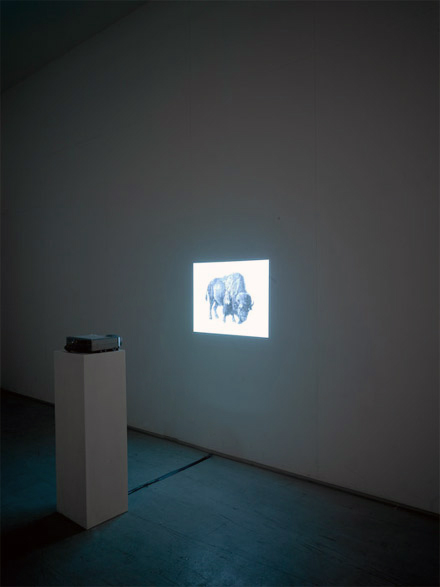
Bison was shown in browsers and in rooms. Club Internet, the online exhibition space he ran, put it in its first show, First Selection (8 May – 14 June 2008), 42 works by 24 artists shown one at a time, among them Rafaël Rozendaal's colorflip.com and Oliver Laric's 787 Cliparts. It came back in Once Upon a Time in the West (2009), the one Club Internet show curated by a critic, Domenico Quaranta, who set the American surf-club artists beside European net art and glitch. At De Nieuwe Vide, an artist-run space in Haarlem, it was projected in a group exhibition. The show's title is not recorded; De Nieuwe Vide's website added him to its list of artists between mid-March and early May 2008. The installation photograph, which his website showed beside the GIF in 2011, has the bison whole, projected at about the size of a monitor on a long white wall in a dark room, from a projector on a white plinth.
In 2011 he posted it to dissociations.com, the archive this wiki is built on, as "bison, 2008" (153). In April 2018 it was among the first blocks of his are.na channel Deconstruction, next to the web tool in which anyone can run a sorter on their own image (→ Pixel Sorters, under extinctr).
The Folia token (2021)
In March 2021 the NFT platform Folia minted Bison, as Bison.gif, in an edition of one with an artist's proof, in the drop of the collection Pixelsorters (→ Pixel Sorters, under The Folia drop). The tokens lived on Folia's shared contract, and their metadata pointed to the GIF on IPFS, fetched through a gateway, a web server that turns an IPFS address into a download. The token recorded where the file was. Whether the file could still be fetched depended on someone keeping it stored and on the gateway staying online. Collectors told him that a work this important deserved more resilient storage.
On-chain (2026)
On 11 November 2026 he minted two new tokens on his own contract, harm.work.2026 (0xb904…ae19): Bison, the edition of one, and Bison (AP), the artist's proof. Then he burned the two Folia tokens. His description in the token gives the history in three sentences: "Created in 2005 as a Java applet. Minted in 2021 as an animated GIF. That token was burned in favor of this new version, which is fully on-chain: every frame is stored on Ethereum and played by an HTML page that is itself stored on-chain." Each token also names, as attributes, the Folia contract and token ID it replaces, so the provenance travels with the token. The licence is CC BY-NC-ND 4.0.
The player shows the work as the GIF did. It draws the 720 × 576 frames in three tones, black, a dark grey and white, at 25 frames a second, and leaves the finished heap on screen for about a second before the loop restarts. It enlarges or reduces the picture only by whole factors and switches off smoothing, so on any screen each pixel stays a sharp square. A browser that runs no JavaScript gets the first frame, the bison whole. The page fetches nothing from elsewhere: no server, no gateway, no library.
"It is really meaningful to me that this artwork is still preserved pixel-perfect," he said on the day of the mint. "The new on-chain version was difficult to create, but it gives me hope it will not get lost, will not be forgotten."
Tending
Bison is still visible because it was moved each time the means of showing it began to fail: from applet to GIF when applets proved slow and unreliable to load, from a file on IPFS to the chain when collectors asked for something sturdier. He counts this work as part of the work: "Digital art needs tending to stay alive, unlike, let's say, a sculpture. The continuous care and tending of the work, the archiving, the updating, is part of the work for me." And: "I find pride in preserving my work."
The statement carries his formula "The Work = The Work + Its Documentation" (992) from the record of a work to its upkeep. Mediation and the Archive reads Bison against the works that keep only their code on-chain (under Flash, and the score kept on-chain).
Record
| Year | Form or place |
|---|---|
| 2005 | Java applet in Processing, Rietveld Academie |
| 2007 | GIF (October); applet on harmlog.nl |
| 2008 | Club Internet; De Nieuwe Vide, Haarlem |
| 2009 | Club Internet |
| 2011 | dissociations.com (153) |
| 2018 | are.na, Deconstruction |
| 2021 | Folia token, GIF on IPFS |
| 2026 | On-chain tokens; Folia tokens burned |
See also
- Pixel Sorters — the series, the rule, and the Folia drop
- Mediation and the Archive — Flash, ascribe, and what on-chain storage keeps
- Club Internet — where Bison was shown in 2008 and 2009
- Early Works (2007–2011) — the browser works of the same years, several now remakes or tokens