
Early Works (2007–2011)
This page collects the works on harm.work from 2007 to 2011 that belong to no series, with the three Diagonal Enlargements. The series of these years have pages of their own: the Revenant Series (2006–07), Pixel Sorters (2005–), Animal Configurations (2007), Ethereal Self & Others (2008–09) and Codec Breeze (2008). Markov's Window (2004), the one work of the series Window and Dream, is read on The Lozenge and The Markov's Dream Palette.
Van den Dorpel studied artificial intelligence at the Vrije Universiteit and then the Gerrit Rietveld Academie in Amsterdam, where he finished in 2006 (935). On his website of 2007, harmlog.nl, he wrote that his work "can be programming, sculpture or photography, and deals with deconstruction, composition and the way technology gives meaning to content" (archived by the Wayback Machine). Most of the works below were made to be seen in a browser, as Flash animations, GIFs or single-serving websites, and several now exist as remakes, videos or tokens. From 2008 he showed them in his online gallery Club Internet; from 2010 he posted to dissociations.com, the archive this wiki is built on (→ About).
Pseudo Psycho (2007)
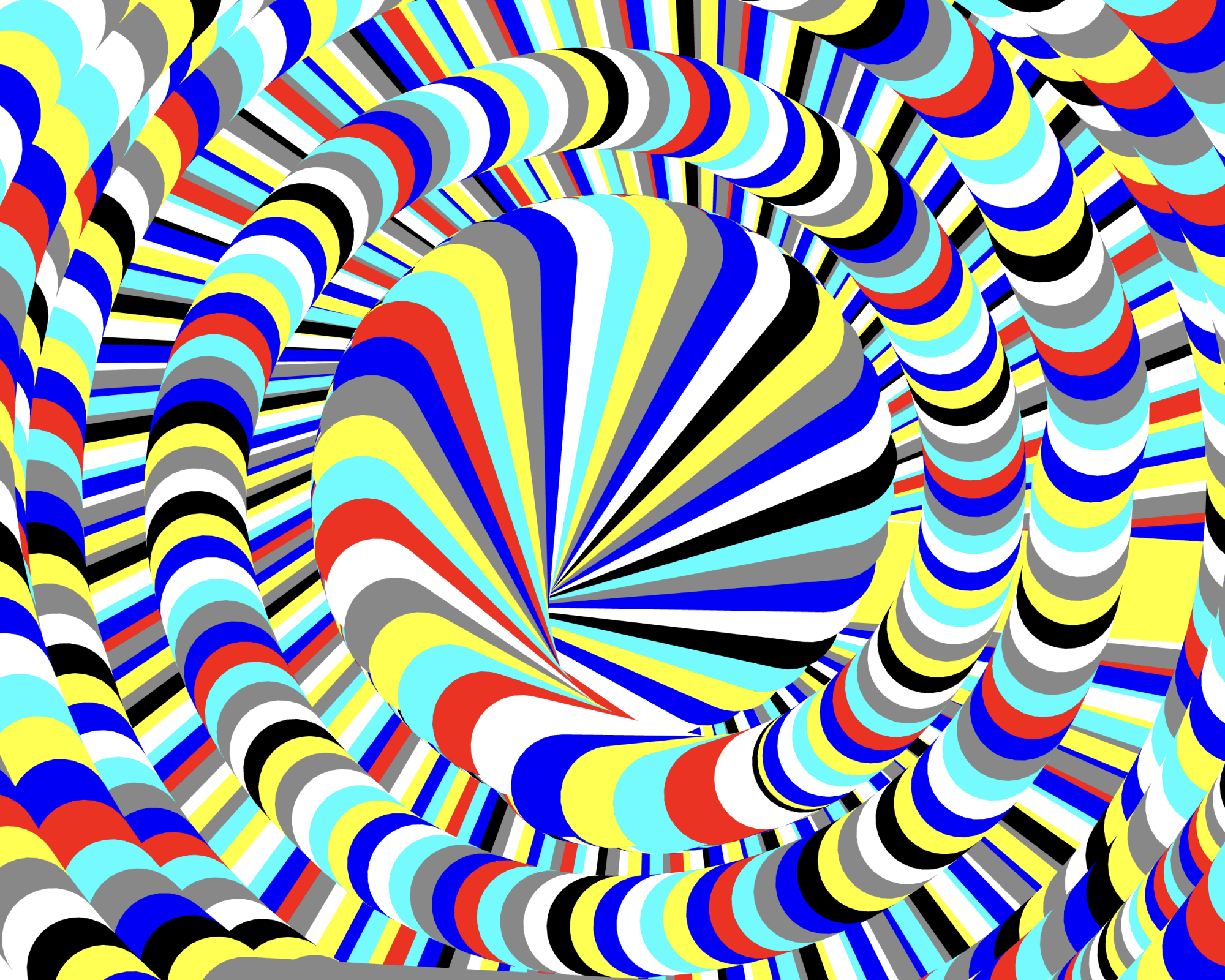
Thick coils of stripes, red, blue, yellow, cyan, grey, black and white, wind around a disc of stripes radiating from a point off its centre, and fill the frame to its edges.
Pseudo Psycho is "this interactive animation which I made while still in art school around 2004. I believe I called it 'Pseudo Psycho' at the time, in response to obligatory ceramics classes" (early series texts), and harm.work dated it about 2004. The artist's website of the time gives the year it was made: harmlog.nl headed the page "Pseudo / psycho 2007 … Posted June 2007", and later "interactive flash animation, August 2007". The artist confirms 2007 (November 2026), the date harm.work now gives. The stripes are flat vector shapes drawn by the player as it runs, which is the point of his note on harm.work, written in 2022: "It's ironic how much smoother and perfect these animations rendered back then as computed vector graphics, compared to the ugly lossy & glitchy encoded video offered by Instagram now in 2022." When Adobe withdrew the Flash player in 2020, he writes, "instantly a rich heritage of early interactive animations and net art disappeared from our web browsers (and our collective memory)" (→ Mediation and the Archive).
Lasso (2007)
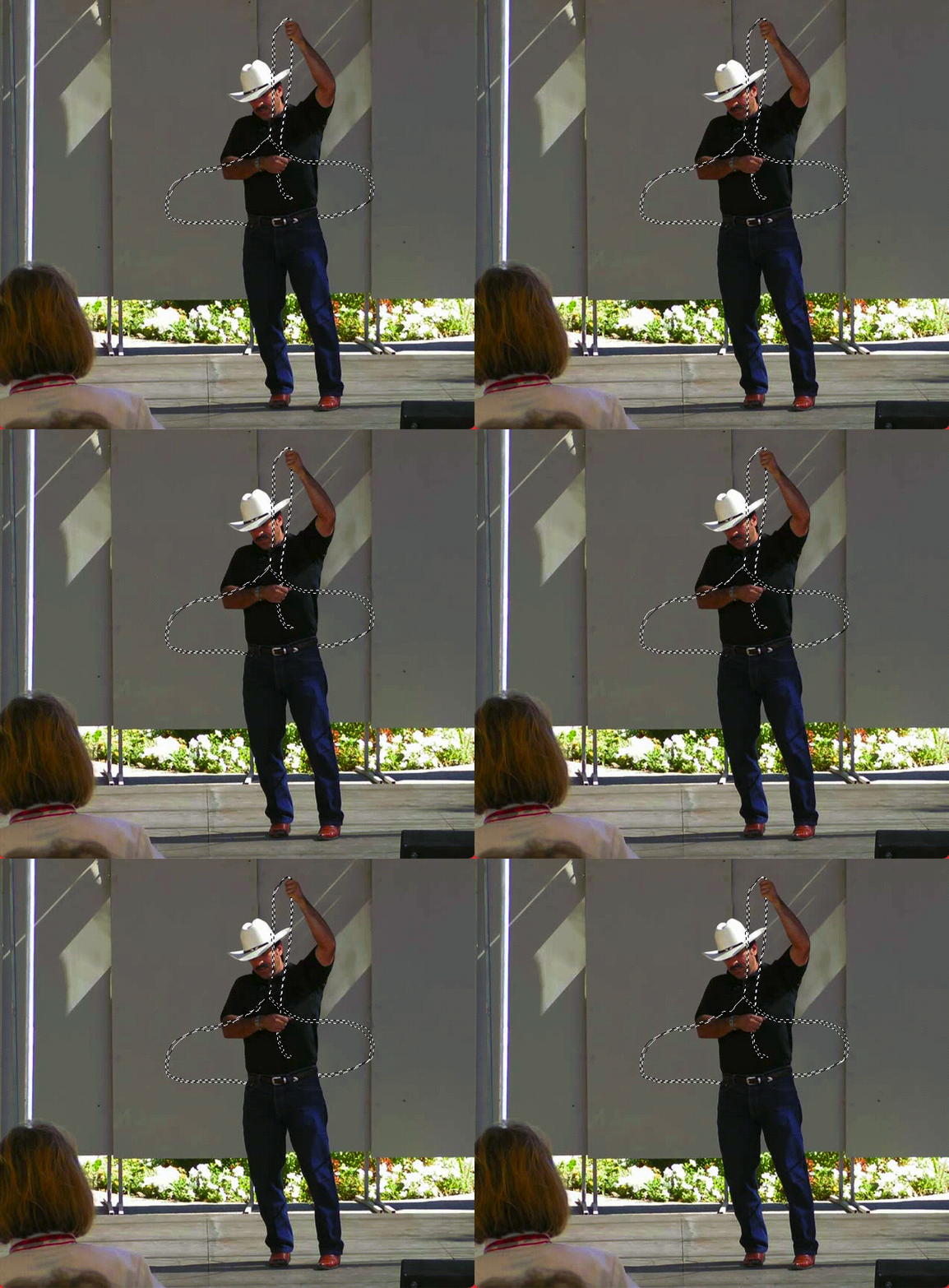
A man in a white cowboy hat and black shirt performs rope tricks on an outdoor stage, the back of a spectator's head in the foreground. His rope is gone. In its place runs the dotted black-and-white line that an image editor draws around a selection, looped above his head and around his waist.
In Lasso the rope becomes the "marching ants" of Photoshop's lasso tool, the tool named after it. harmlog.nl posted it in September 2007 as "flash animated from manipulated found photo", filed it under "interface" and headed one version of the page "lasso tool". Nothing else moves. The man stands frozen in mid-trick while the dashes crawl along the loop, as a live selection does on screen. The joke turns on a word, but the move is one he kept making: an element of the software interface put in the place of a thing in the picture. In Field (2008) loading spinners in a grid become "something like flowers" (→ Field (2008/2023)).
The Flash file survives as a token. In 2021 the NFT platform Folia minted Lasso.swf with three Pixel Sorters GIFs as the Pixelsorters tokens, in three editions and an artist's proof (→ Pixel Sorters, under The Folia drop).
White Rectangle (2008)
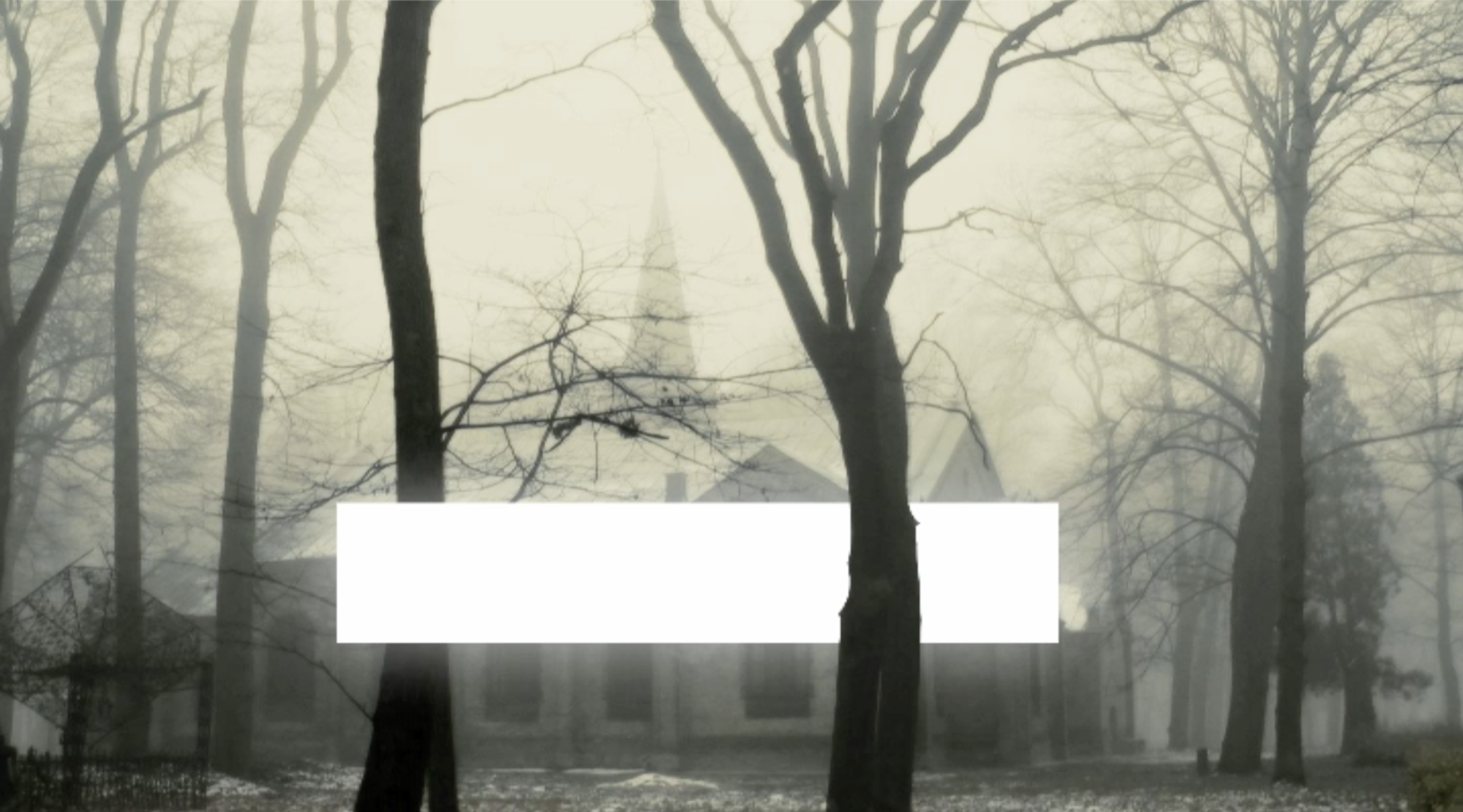
A grey, foggy winter photograph: bare trees in front of a church whose spire fades into the mist. A white rectangle lies across the middle of the picture, and one dark trunk passes in front of it.
White Rectangle was a Flash animation on a domain of its own, whiterectangle.org, titled "White Rectangle - Harm van den Dorpel, 2008" when the Wayback Machine archived it in May 2008. The rectangle moves: it slides across the picture and back and passes behind the trunk, so a flat, perfectly white shape travels through the depth of a photograph and is hidden by a tree in it. The 2024 remake in HTML and CSS (live version) and its token, White Rectangle of the Software collection, minted in 2026, are described on Software Editions.
The archive embeds the original Flash file in 1004, whose related notes are Highway (1012), another Flash animation of 2008, and Codec Breeze (855). Both works start from a still photograph and make one part of it move. On 13 June 2008 he entered the work in the fourth Club Internet show, which never opened. In April 2024 he filed the remake in his are.na channel anim beside other Flash works rebuilt in code (block; → Mediation and the Archive).
Exotica (2009)
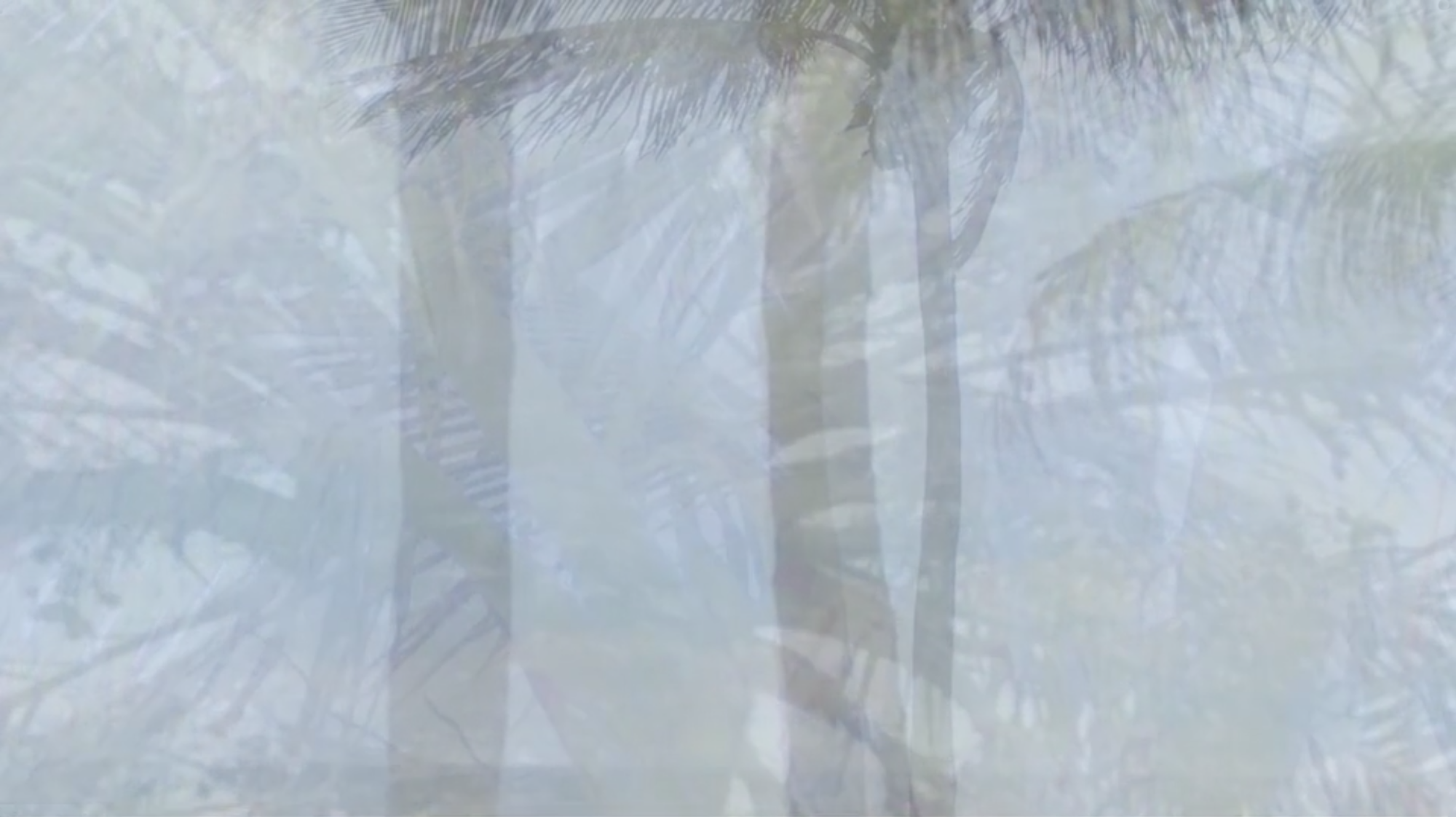
Palm trunks and fronds in several pale layers, one laid over another and washed out to white and blue-grey, like a view through mist.
Exotica is a slow video made from tropical images found with Google Image Search. His website of 2010 dated it 2009 and gave its means as "HD Video, Modified Slideshow Software (Ken Burns effect), Google Image Search, Brown Noise (noise generator), Infinite (Low Resolution Excerpt)", with a line on the title: "Ultimately lifting the desperate feeling of 'never physically having been there' to an exclusive experience: The (musical) colloquialism, exotica, means tropical ersatz: the non-native, pseudo experience" (archived by the Wayback Machine). Exotica is the 1950s easy-listening genre of imagined islands and jungles. The video file on that page was named after a line of the Talking Heads song "Heaven" (1979), "Heaven is a place where nothing ever happens", and the page quoted the song's lyrics; harm.work still does.
So the work is a paradise found by image search, panned and zoomed by slideshow software, in which nothing happens. The artist dates it 2009 (November 2026), as harm.work now does. harm.work describes a 2025 remaster: "Remastered to 4K in 2025, duration 8 minutes. Edition 3+1AP. To be installed alongside a noise generator playing soft pink noise." The noise has changed from brown to pink, both kinds of random noise with more energy in the low frequencies. Its archive note, 1305, holds only links: to Codec Breeze, to the video Cloud On Title and to Showreel (2009). The notes that link back to it show its thumbnail, a file named "heaventhumb.jpg". The slideshow move returns years later in Lexachast, whose visuals he called "a Ken Burns effect on steroids".
[a]{104} (2009)
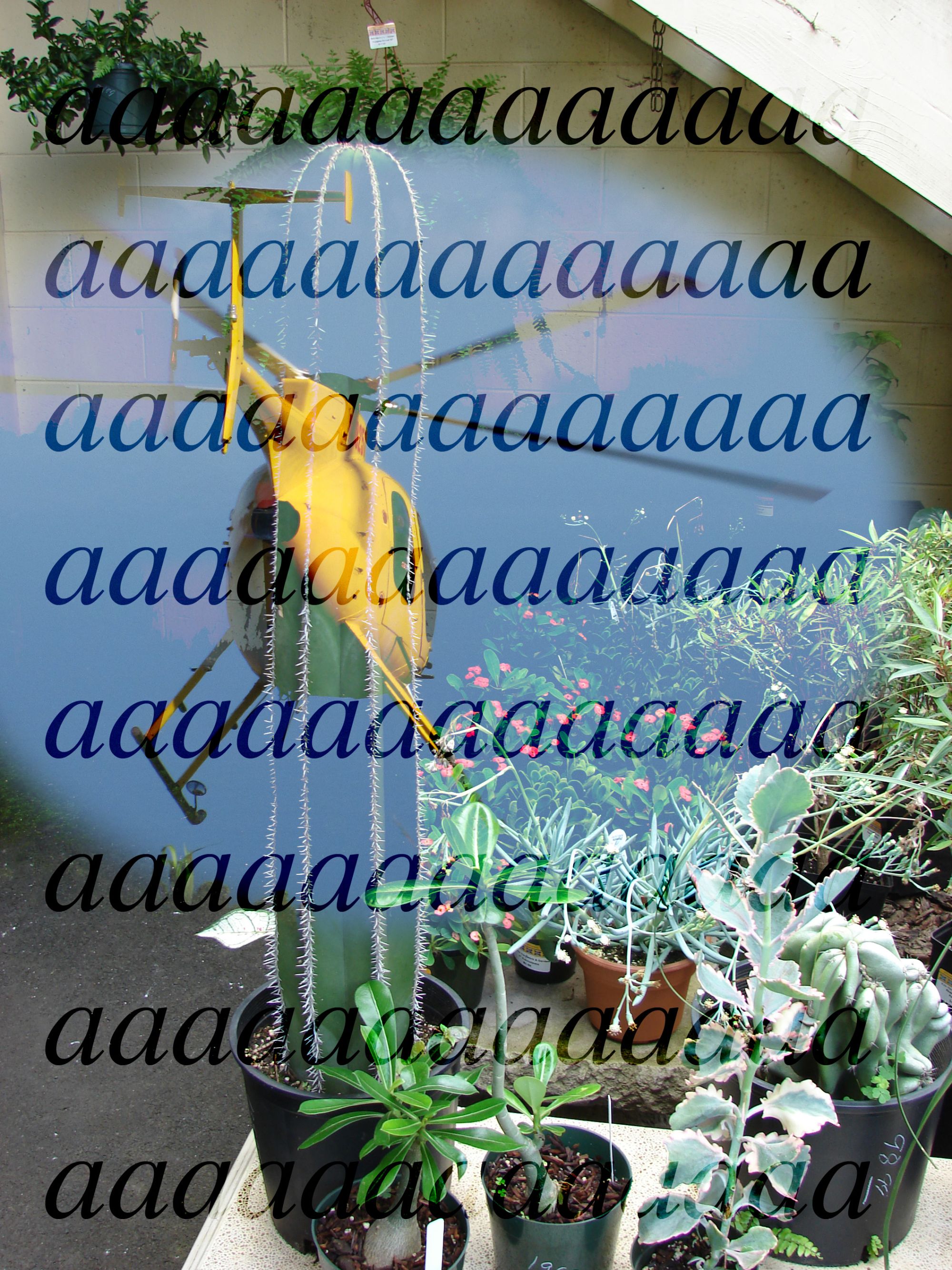
Eight rows of italic lowercase a's, black at the top and bottom and deep blue in the middle, run across a photograph of potted cacti and succulents on a bench beside a building. A yellow helicopter is laid upright over the tallest cactus, and a blue-violet oval of light spreads from the left.
harm.work describes [a]{104} exactly: "Found images of a yellow helicopter and a room with cacti, and 104 times the 'a' in Times New Roman (italic), superimposed using blending modes. The title is a regular expression which would exactly match the repeating characters in the image." In a regular expression, [a]{104} means the letter a, exactly 104 times; the rows hold thirteen each.
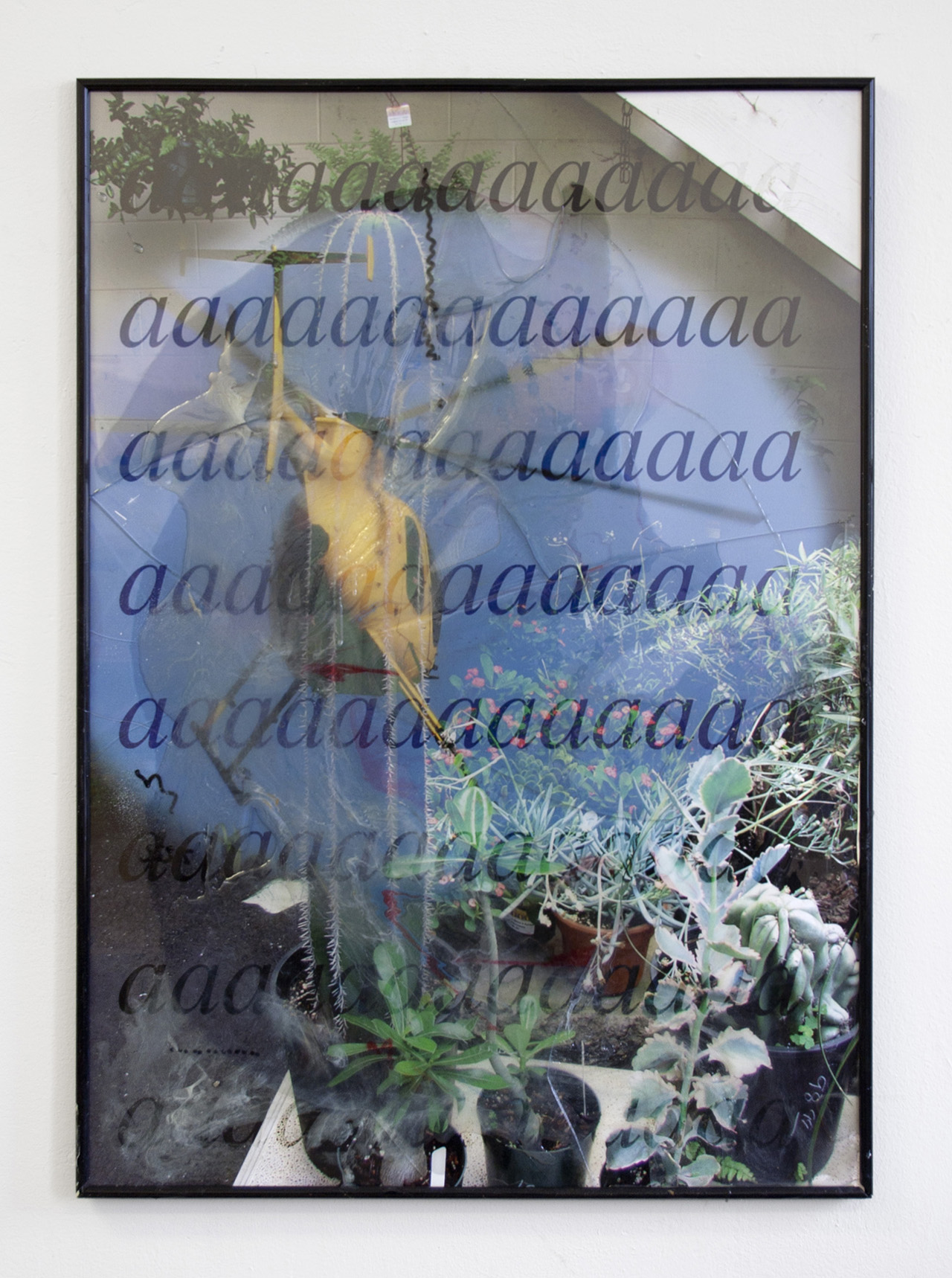
The same collage, printed and framed, behind glass covered in clear resin. The resin has run in blobs and rivulets over the helicopter and the letters, and black marker squiggles cross the top and the left edge.
The image had an earlier life as an object. "I once printed this collage and poured synthetic toxic resin over it, but I destroyed that work." The archive keeps it as note 695, titled [a]*: "Digital archival print, glass, pigments, synthetic resin, whiteboard marker. 70 × 100cm." The two titles are two regular expressions. [a]* matches any number of a's, none included; [a]{104} matches only this image. The renaming turned a pattern into a count. Among the note's related works are other pieces on glass, such as Very Beta Still (996, acrylics on paper, UV print and hand engraving on glass) and Assemblage (shell) (779); the collage itself is now a token on the Tezos platform Versum.
Saturation Transition (2009)
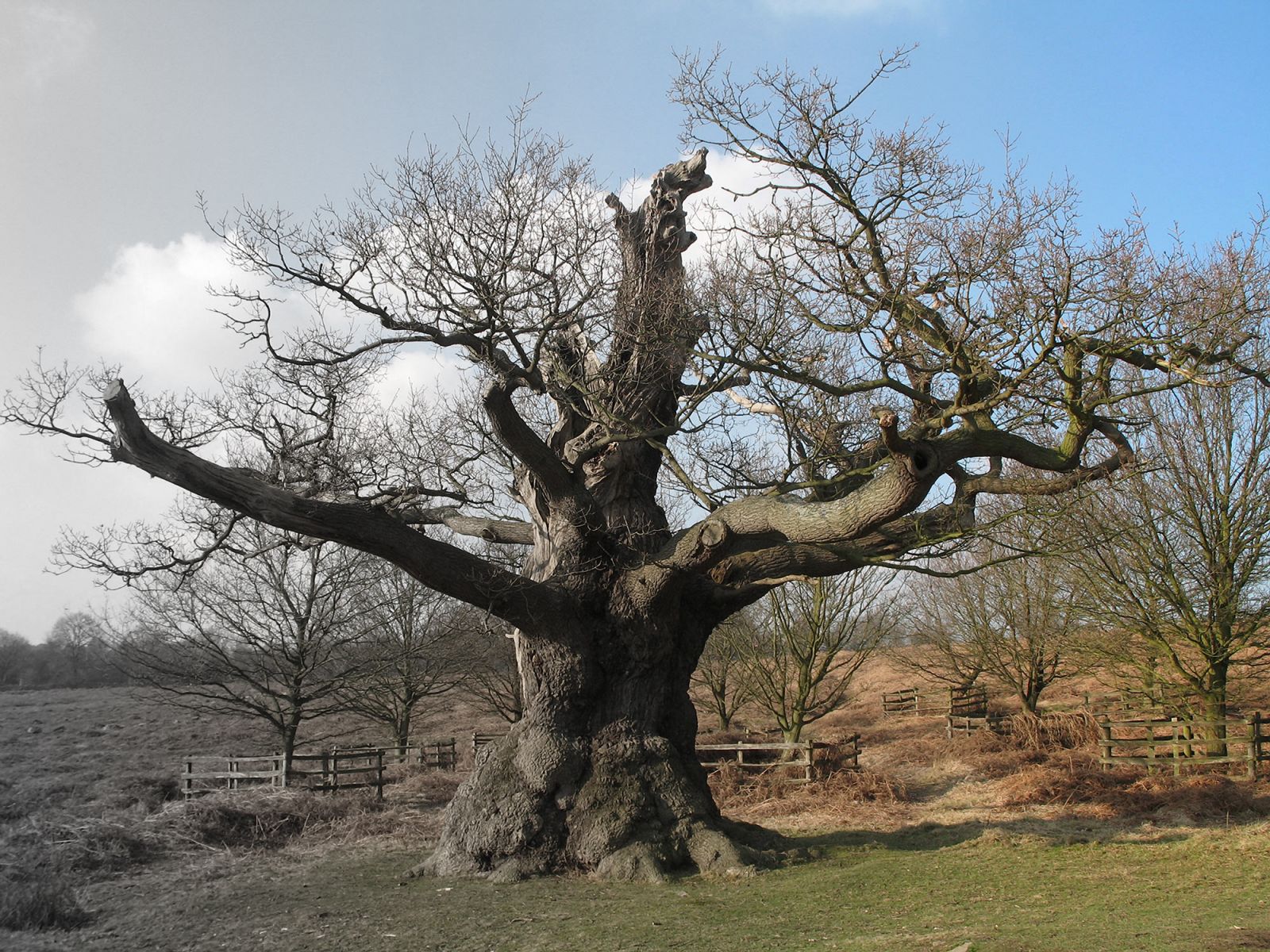
An ancient oak with a broken, hollow-looking trunk spreads its bare limbs over a winter parkland of fences, bracken and young trees. The left of the picture is grey; toward the right the colour rises until the sky is blue and the bracken red-brown.
Saturation Transition names its operation as Gaussian Goat does: colour saturation, turned up gradually across the width of a found or taken photograph (→ Animal Configurations). harm.work gives no text or medium. His website had a page "Saturation Transition, 2009" by January 2009, with three images whose files were numbered 01, 04 and 07 (archived by the Wayback Machine), so it may first have been a set of images.
Diagonal Enlargements (2009)
"I wondered, when enlarging low resolution bitmap images, if it were possible to come up with an alternative to square rectangular pixels. Why not extrapolate the connections between enlarged pixels diagonally? This resulted in new textures, while remaining perhaps more truthful to the original structure and composition." The three Diagonal Enlargements were "calculated in 2009 and minted in 2022" (early series texts).
An ordinary enlarger turns every pixel into a bigger square, so a curve becomes a staircase. The results show what his does instead: beside the squares it draws half-squares cut on the 45°, so that edges which would be staircases run as diagonals. The sources are found images of a few thousand pixels.
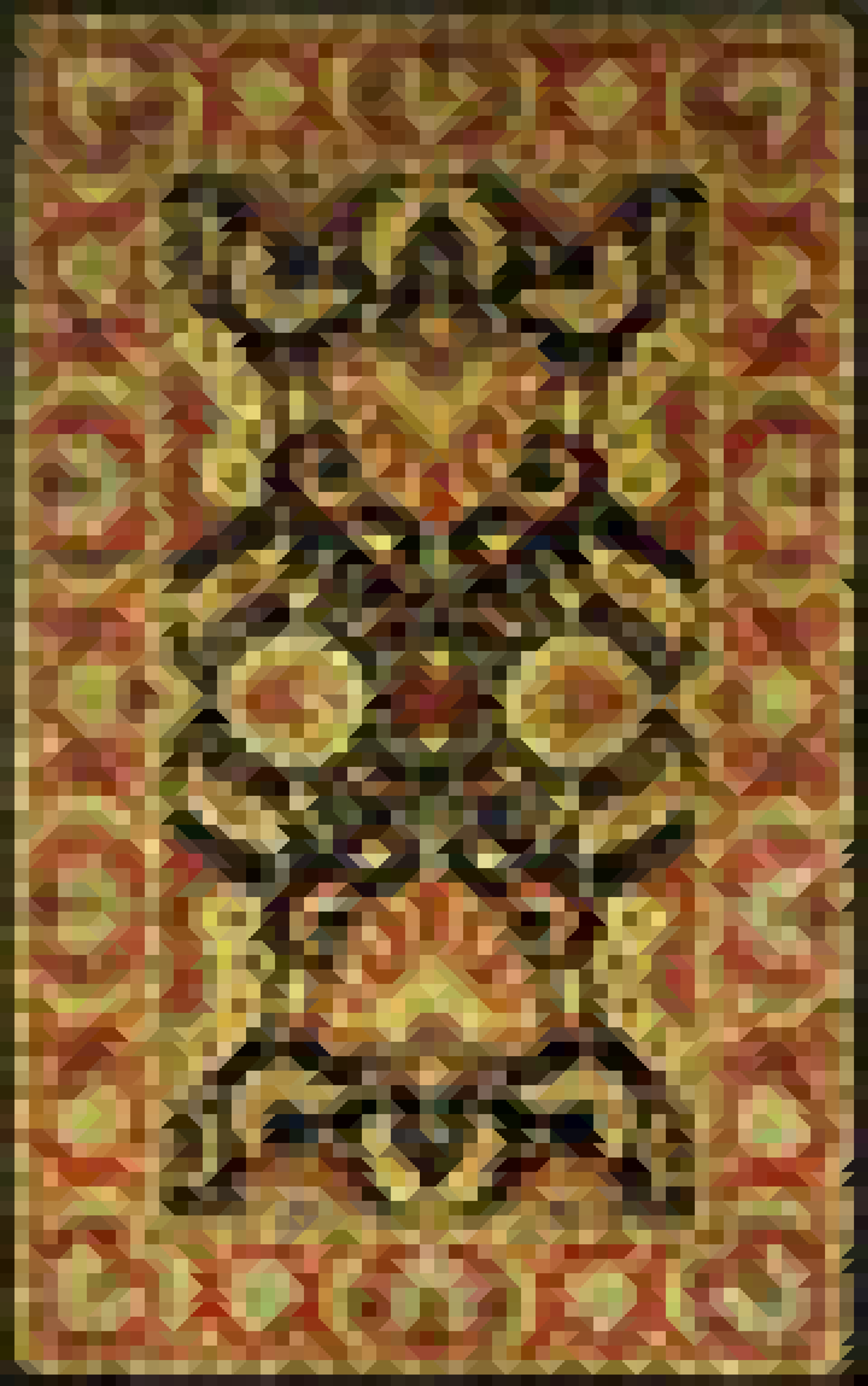
An oriental carpet, upright: a border of repeated medallions in rust, ochre and olive around a dark central field with a symmetrical pattern of hooks and lozenges, all built from squares and half-square triangles.
Rug is "A found low resolution image (60×96 pixels) of a rug, enlarged factor 6 with my self-invented diagonal enlarger algorithm, then enlarged 4 times with a regular nearest neighbour enlarger." It is also a token of the JPGs collection, Rug (→ Small Collections). A carpet is already made of knots on a grid, so the enlargement takes a woven pattern back toward its weave. Panda and Pizza are both "A found GIF image (50×50 pixels) … enlarged factor 100 (5000×5000 pixels)".

A panda's face on white: black ears and eye patches, a black nose and mouth, the white fur flecked with pastel pink, green, lilac and yellow cells from the GIF's small palette. Every edge runs at 0°, 45° or 90°.
In Panda the enlarger keeps the stray colours of the 50-pixel source GIF and enlarges them into tiles. In Pizza the round outline of the pie becomes an octagon, since the enlarger knows only straight and diagonal edges.
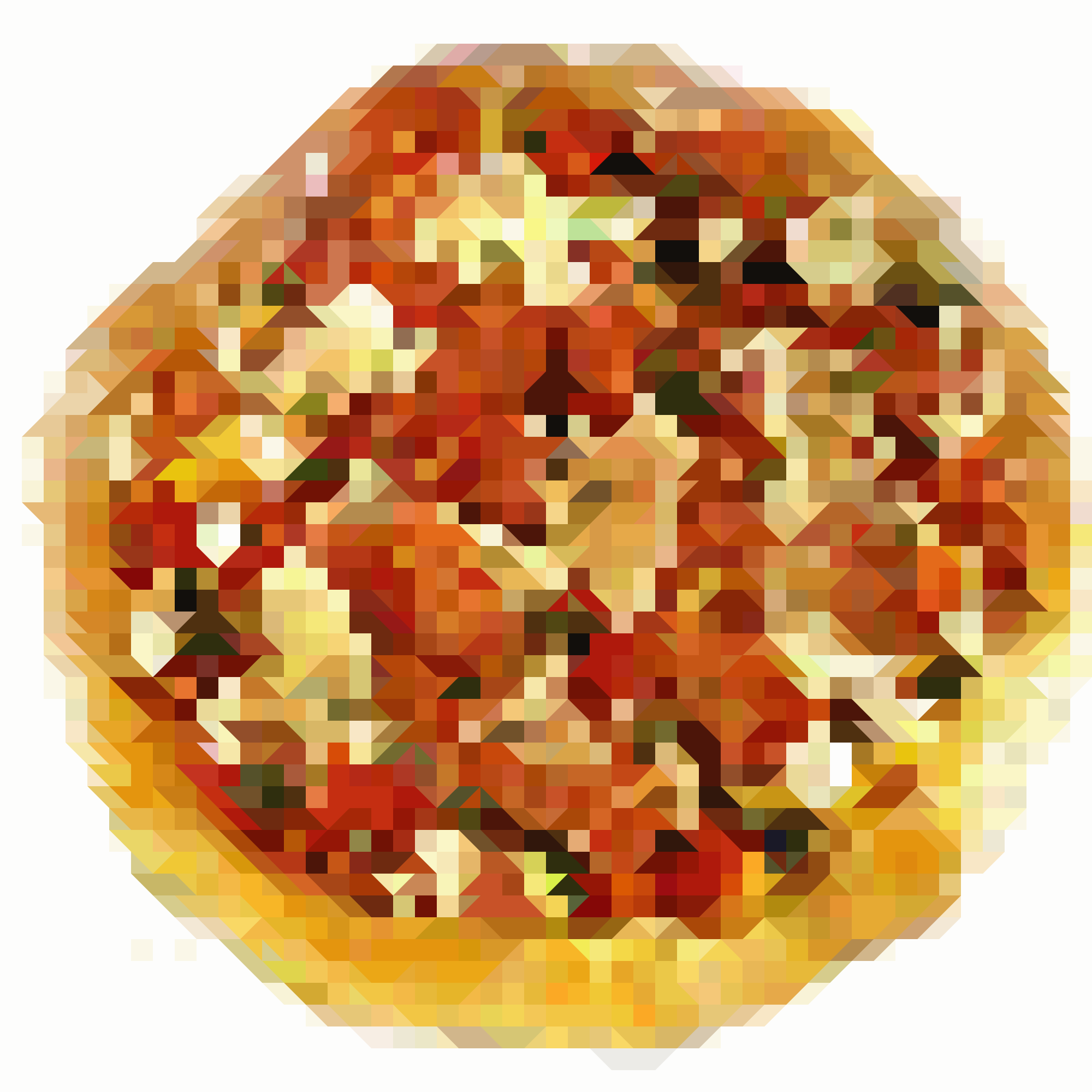
A pizza seen from above, its toppings a field of red, orange, ochre and dark brown cells, the crust a ring of yellow; its outline is an octagon of 45° edges.
The half-square triangle the enlarger places between pixels is one of the cell shapes of Stained Unravel (2026): "Right-angle triangles that fill exactly half a cell diagonally" (3001; → Stained Unravel). And the question the series asks, how much a low-resolution image can hold, comes back in the 2024 Verse conversation, where he says of old screens that "it was a necessity to express complex information only using the few pixels that were available", while showing low resolution on today's screens "is actually not necessary, it's mimicking something" (→ Verse Twitter Spaces (2024), Quantization and Dithering).
Sample (2011)
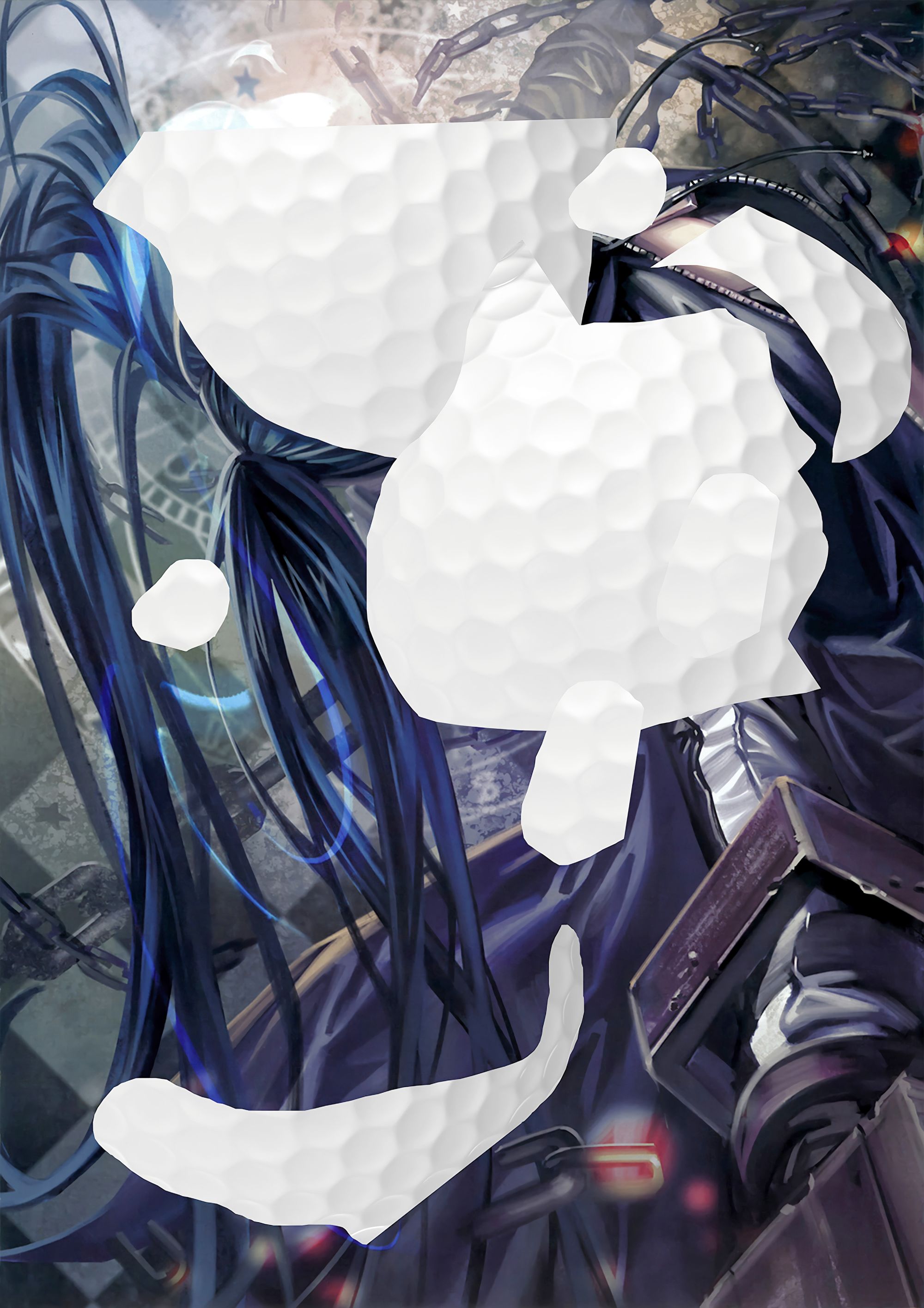
An anime-style illustration of a figure with long blue-black hair and a dark coat among chains, above a checkered floor. White shapes with the dimpled surface of a golf ball are cut over it: one large irregular mass across the face and chest, two small round pieces, a curved strip along the bottom.
Sample sets two kinds of surface against each other: a painted fantasy figure and the texture of a golf ball, cut to soft outlines that cover most of the figure. harm.work gives 2011 and 80 × 56 cm and names no medium; the work is also a token on Versum. The archive files the image as 742, added around 2012, with no caption.
Untitled (arrangement) and Untitled (leaves) (2011)
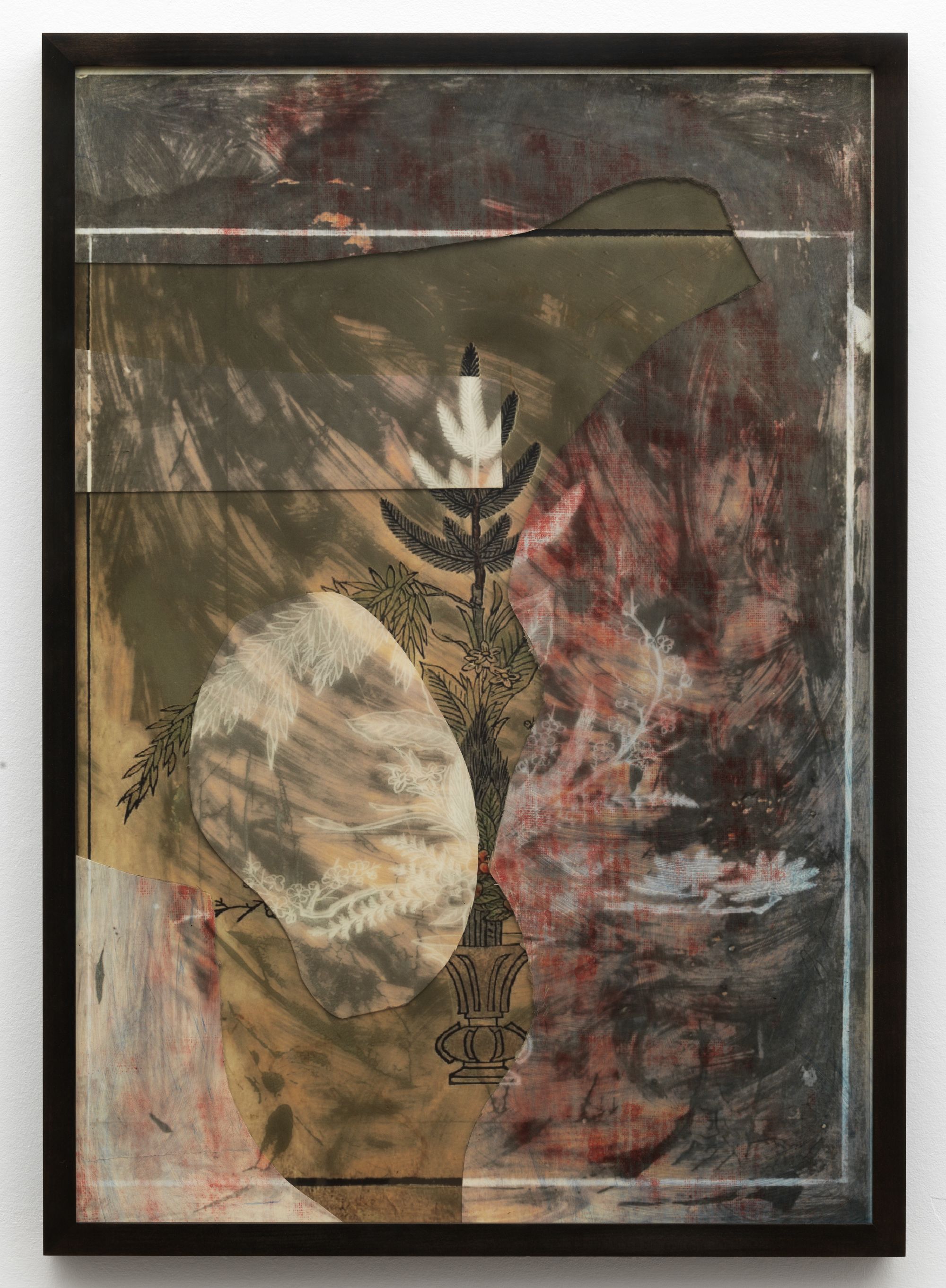
In a dark wooden frame, a printed engraving of a plant in a classical urn, its fronds rising up the middle. Over and around it lie cut layers of brushed and scratched surface in olive, rose-red and grey, and an oval of translucent white foliage on the left; a thin white rule frames the inner field.
Untitled (arrangement) and Untitled (leaves) are two collages of the same size and medium, "Mixed media collage with UV printed parts", 100 × 70 cm (harm.work). The archive has them as 600 and 601, "Untitled – 100 × 70cm", and their image files give the working names: "untitled_ikebana" and "untitled_blacklocustcase". Ikebana is the Japanese art of flower arrangement, and harm.work calls the first work an arrangement; the black locust is the tree whose compound leaves, rows of rounded leaflets, fill the second.
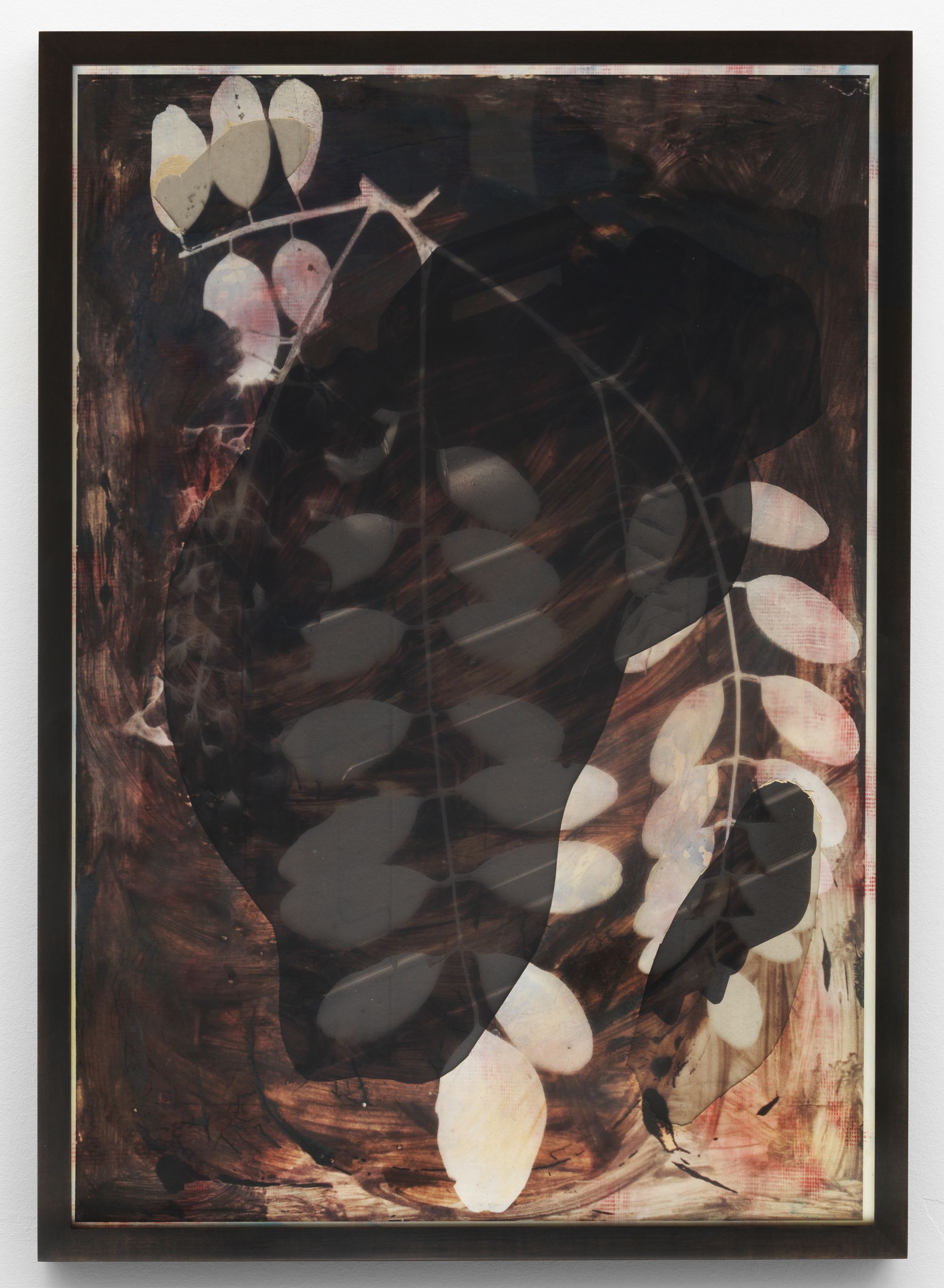
On a ground of dark brown brushwork, black locust leaves appear as pale pink-white silhouettes. A large dark translucent shape is cut over the middle, and the leaflets under it show through in grey.
Both mix the painted and the printed: brushwork that looks handmade, botanical images that look found, and UV-printed layers, the technique of the Assemblages he began the same year (→ Sculpture and the Object). harm.work also shows each in a second, rendered version, the urn under a blue jigsaw-shaped piece in a blue frame, the leaves overlaid with dark rods and fittings. A related work in the archive, 559, is a "Double sided print on acrylic glass, linen. 100 × 70cm": a black camera strap coiled over black locust leaves and white flowers laid on linen.
See also
- Revenant Series — found photographs of sleeping people, cut and animated in Flash
- Animal Configurations — found animal images reshaped with filters, 2007
- Pixel Sorters — the animated GIFs of 2005 onward and the Folia drop that included Lasso
- Ethereal Self & Others — the webcam websites of 2008–09
- Codec Breeze — still photographs set moving by compression, 2008
- Software Editions — the 2024 remake of White Rectangle as a token
- Small Collections — Rug among the JPGs
- Club Internet — the online exhibition space of 2008–2010
- Surf Clubs — the online scene these works were posted in