
Ethereal Self & Others (2008–2009)
Ethereal Self & Others is a pair of websites that filmed the people who visited them, through their own webcams, and a video made from what they recorded. harm.work describes the series as "Two connected websites, capturing and displaying people with their own webcam (after consent)", and lists three works: Ethereal Self .com, Ethereal Others .com and Ethereal Others (When No One is Looking), all dated 2008. The sites' own page titles in 2008 and 2009 read "Ethereal Self - Harm van den Dorpel, 2008" and "Ethereal Others - Harm van den Dorpel, 2009" (archived by the Wayback Machine), and the archive note for Ethereal Others .com also gives 2009 (245).
Van den Dorpel's text on the series (early series texts) is the fullest account of why he made it and why it is no longer online.
Single-serving sites
"I made Ethereal Self at a time when my peers and I were making works that consisted of a single artwork with a single domain name. At the time these were known as 'single serving sites'. Miltos Manetas, I think, was the first to recognise that this was a valid medium, the domain name." etherealself.com and etherealothers.com were such works, each a domain with one thing on it. White Rectangle had whiterectangle.org the same year (→ Early Works (2007–2011)), and he kept making them: Hybrid Vigor .bio (2017) and Hyphenation .xyz (2019) are later examples (→ Algues Artificielles, Différance).
What interested him was the people on the other side. "In a gallery context, you can see the people who come to see your work; however, on the web - at least in 2008 when this work was made - your visitors are essentially invisible." The sites were built to make them visible.
Ethereal Self .com
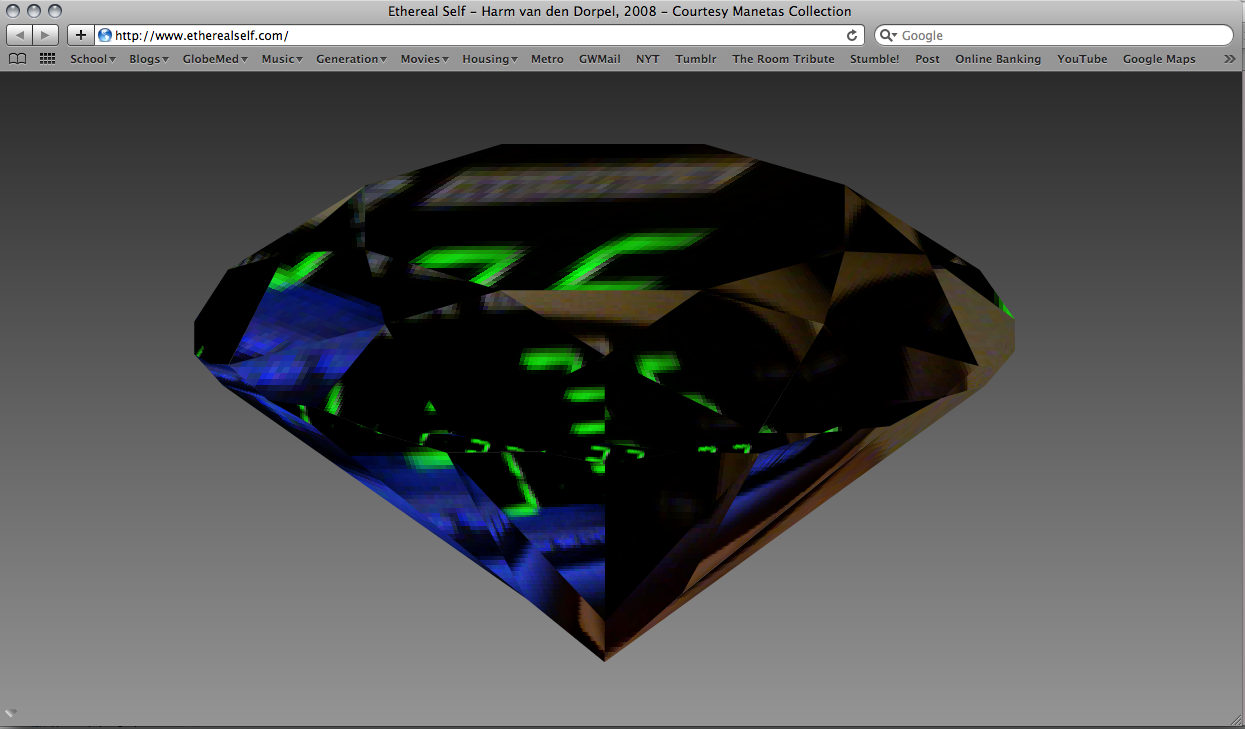
A browser window titled "Ethereal Self – Harm van den Dorpel, 2008 – Courtesy Manetas Collection". On a grey gradient floats a brilliant-cut gemstone whose facets carry a dark, blocky webcam picture, lit only by streaks of green and blue from a screen.
Ethereal Self .com asked for the visitor's camera and mapped the live image onto the facets of a cut gem, so the visitor saw their own face cut into a jewel. The screenshot above, filed in the archive as 189, catches a visitor in the dark; another, 1383, shows a man's eyes and nose repeated across the crown and pavilion of the stone. The title bar of the first credits the "Manetas Collection". The wiki has no other record of that collection holding the work.
The capture was the hard part: "These were the first days of attempting to stream images over the web, and in terms of the work, I wondered whether it would even be possible to send the user's webcam photos to my webserver to store. It was a rather complex process at that time, encoding the image in the browser, sending them to a server for decode, and then recording the image, but it was possible to do." The site ran in Flash, whose player asked the visitor's permission before a page could use the camera, which is most likely the "consent" in the harm.work description. That the pictures were kept, the visitors did not know, by his own account.
He describes the result as "a way of returning the gaze of the internet":
"The idea that a work existed on the web but as the artist, you really had only a very vague idea who anyone seeing your work might be prompted me to try to find out. These people were watching me without my knowing, and it turned out, over the course of creation of Ethereal Self and Ethereal Others, I was watching them without their knowing too."
The site was first shown in ORACLE (16 June – 12 July 2008), the second exhibition of his online gallery Club Internet. His website of 2010 lists two shows in 2009: The New Easy at Art News Projects, Berlin, and New Wave in the Internet Pavilion of the Venice Biennale, which Manetas created with the curator Jan Åman that year. The Club Internet database holds New Wave as its eleventh show. The photograph of the work on that website showed it next to Aleksandra Domanović's Dictum ac Factum. In 2013 the checklist for his first American solo show at the Abrons Arts Center lists "ETHEREAL SELF, 2008, Website, Location: Online", marked "Show in Red Hook Journal" (1035; → Release Early, Release Often (2013)).
Ethereal Others .com
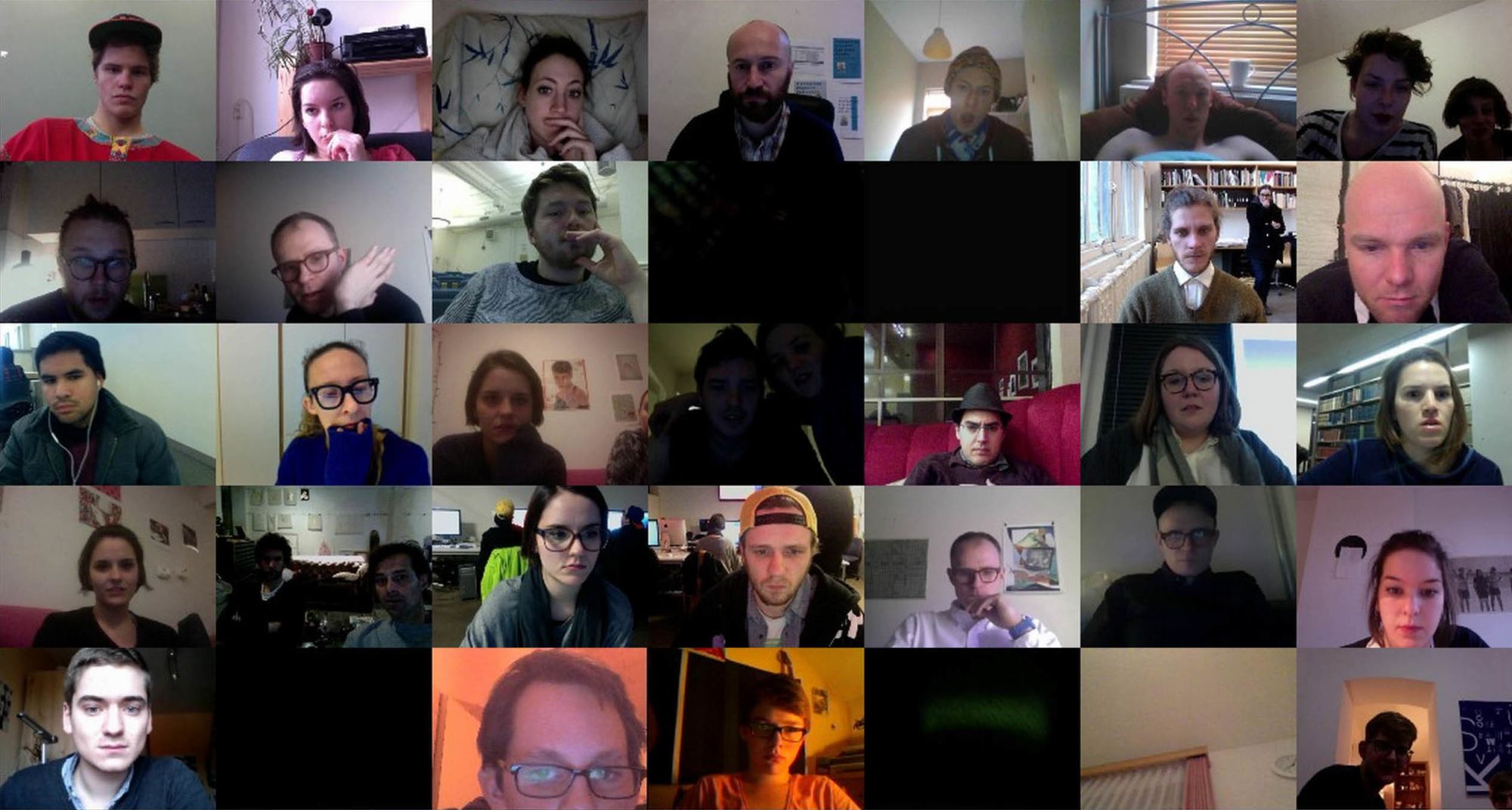
Thirty-five webcam frames in a grid of seven by five. People at desks, in bed under a patterned pillow, in libraries and studios, a man in a hat on a red sofa, two people sharing one frame; most look into the camera or just past it. Five cells are dark or show a room with nobody in it.
Ethereal Others .com turned the stored pictures outward: "the people who visited the site were listed in a grid". The two sites were "connected", in harm.work's word. In 2010 Brian Droitcour described the second as "the site's double", which "tiles snapshots of the viewers at the moment their webcams connect": visitors became the others of the title for whoever came next. In August 2009 the site served its grid as a run of cached page images (archived by the Wayback Machine), and the same month the work was added, dated 2009, to Dissociation, the eighth Club Internet show.
Some visitors left their cameras on. "Sometimes when visitors had forgotten to turn their cameras off, I would end up with hours of footage, some of it very private, that I didn't know what to do about."
Public art by Price's criteria (2010)
Droitcour wrote about the pair for the online catalogue of Free, Lauren Cornell's exhibition at the New Museum in 2010, although the sites were not in the gallery (→ Free (New Museum, 2010)). His essay "All Together Now" starts from Seth Price's "Dispersion" and calls Ethereal Self "a website by Harm van den Dorpel, with enough hits to be considered public art by Price's criteria. When viewers allow it to access their webcams, it shows their reflections refracted in a silvery gemstone." He reads the two sites as a picture of how platforms pool private acts: "Between these two sites, van den Dorpel visualizes the principle of Google Autocomplete or Amazon's shopping suggestions, which make individual interests and queries available for common use" (catalogue texts). Others read the work as a warning about privacy (below); Droitcour saw in it the shape of the commercial web. Fifteen years later he wrote about van den Dorpel's protocol works in Beautiful Rules (→ Protocol, Taste, and Systems).
When No One is Looking
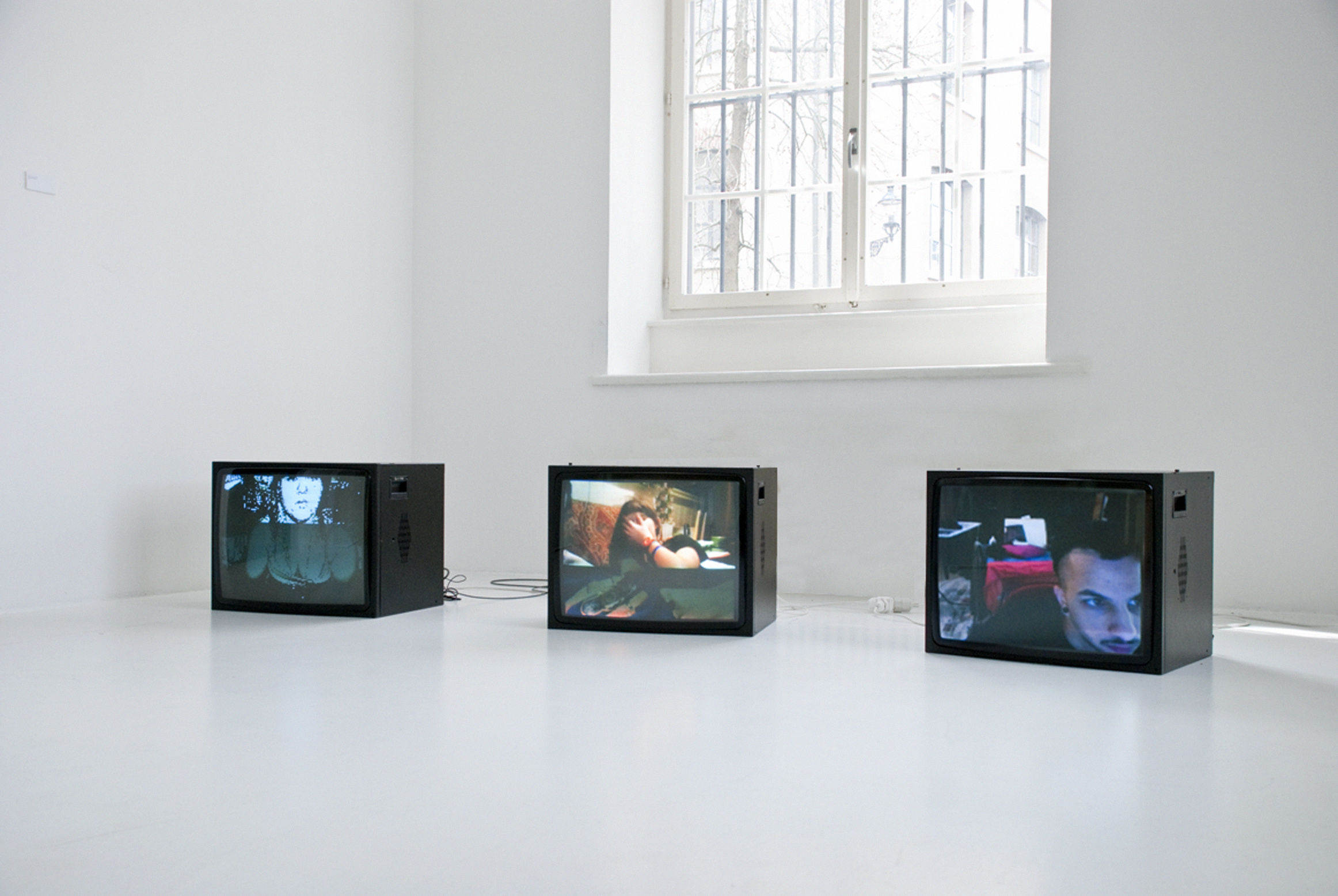
Three black CRT televisions stand on the floor of a white room under a barred window. The left screen shows a face in harsh black and white, the middle one a woman lying back with a hand to her head, the right one a young man's face low in the corner of a bedroom.
The footage became Ethereal Others (When No One is Looking). To show it, "Ultimately I created a script that would filter out all the movement by people in the images so the work could be shown in galleries and museums." What remains are the rooms. The still that harm.work and the Works Overview use is a dark office with an empty chair and a computer facing a window onto the building opposite. The archive embeds the video in 854, whose related notes include On recursion (876) and mise en abyme (878) (→ Recursion and Self-Reference).
989 is an installation view of Ethereal Others at plug.in, Basel, dated 2011. On its three monitors the people are still there, so it does not show the filtered version. The one plug.in exhibition with van den Dorpel that the wiki has found a record of is Surfing Club, curated by Raffael Dörig, which closed on 30 May 2010 and also included Aleksandra Domanović, Oliver Laric and AIDS-3D (VernissageTV). The photograph is from that show (the artist, November 2026); the note's 2011 date is later.
Readers took the work as a warning. "Given that this was pre-Edward Snowden, pre-Cambridge Analytica, etc., people read it as a kind of activist work, warning about the dangers to privacy posed by the web, connecting your living room to the entire world potentially. Now, of course, everyone knows about it, and so that reading is less significant." He gives his own reading instead:
"I find there to be a poetic quality to the empty interiors it depicts, and it reflects a kind of melancholy I felt at the time, wondering who all these people were, what they were making of my work. What did it all mean? Was there any value in any of it? I think there is, but a lot of that meaning is personal."
Switched off
The works are no longer online. "Reflecting on the darker and more corporate turn the internet has taken in recent years, I've decided that what might have been a valid artistic position thirteen years ago has taken a different meaning now, and so I've deactivated the work at the present." Counting from 2008, he wrote this around 2021. He gives a more specific reason now: Ethereal Self was in the collection of Miltos Manetas, as the screenshot's title bar says, and "I grew increasingly worried about the ethical implications of capturing people. I asked Miltos to draft a contract in which he would take all liability for the artwork's potential privacy infringement. He refused, so I took the artwork down" (the artist, November 2026).
The decision fits a pattern in how he treats the visitor. In Ethereal Self .com the visitor's image is the material and the artist the one watching. In Hybrid Vigor .bio (2017) visitors choose which seaweed drawings breed, "using the internet visitor as the fitness function" (→ Algues Artificielles). The audience stays part of the work, and what it gives changes: its face in 2008, its preference in 2017. When the face came to mean something else, he took the site down.
See also
- Club Internet — ORACLE, Dissociation and New Wave, where the sites were shown
- Free (New Museum, 2010) — Brian Droitcour's catalogue essay on the two sites
- Surf Clubs — the online scene of single-serving sites and group blogs
- Recursion and Self-Reference — note 876 and its related works
- Revenant Series and Animal Configurations — the found-image works of the years before
- Early Works (2007–2011) — White Rectangle, Exotica and other works of 2008–2009