
Free — New Museum, New York, 2010
Group exhibition, New Museum, 235 Bowery, New York, Second Floor Gallery, 20 October 2010 – 23 January 2011. Curated by Lauren Cornell. Exhibition text, press release and catalogue entries: sources/ingested/free-new-museum-2010.md. harm.work: Free.
Free was a museum group show four years after van den Dorpel left the Rietveld Academie (2006), while he was still running the online exhibition space Club Internet (2008–2010). The New Museum showed three of his collages: Redux (1), Redux (2) and Redux (3), movie posters cut by hand. His CVs of the period list the show among the group exhibitions of 2010 (932, 935), and the Abrons Arts Center's press release of 2013 still names it first (→ Release Early, Release Often).
The exhibition
The museum's text opens on public space: "'Free' explores how the internet has fundamentally changed our landscape of information and our notion of public space. Our shared space has expanded beyond streets and schools to more distributed forms of collectivity." Its touchstone was an essay by the artist Seth Price, "Dispersion" (2001–), shown in the gallery as nine panels, each printed with a page of the booklet. The sentence the exhibition text and the press release both quote:
"Collective experience is now based on simultaneous private experiences, distributed across the field of media culture, knit together by ongoing debate, publicity, promotion, and discussion. Publicness today has as much to do with sites of production and reproduction as it does with any supposed physical commons, so a popular album could be regarded as a more successful instance of public art than a monument tucked away in an urban plaza."
The title came from the free-culture movement, which the text describes as treating the internet's effect on music and publishing "as an opportunity for greater sharing and distribution of knowledge, rather than a threat". The show was "based in this commitment to openness — but not directly about the movement itself". It also set aside the internet's "formal properties — code and connectivity among them" to look at the internet "as a territory populated and fought over by individuals, government, and corporations".
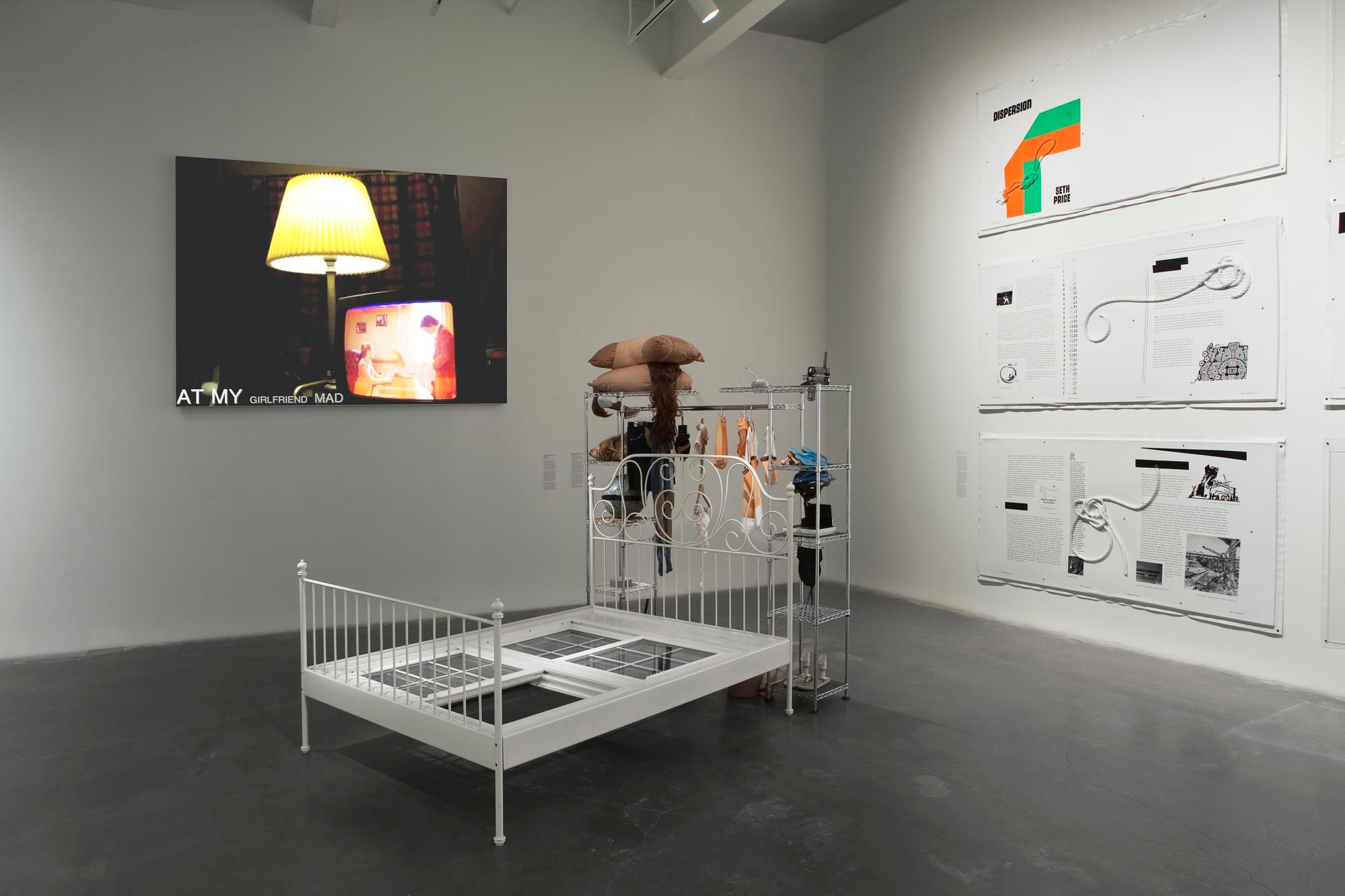
On the right wall hang the panels of Price's "Dispersion": large white sheets printed with the booklet's pages, its orange and green cover at the top. In front of them stands Pangea, the white iron bed of Lizzie Fitch's sculpture with clothes, pillows and a shelf of objects on its headboard; a video plays on the far wall.
The other artists were Liz Deschenes, Aleksandra Domanović, Martijn Hendriks, Joel Holmberg, David Horvitz, Lars Laumann, Andrea Longacre-White, Kristin Lucas, Jill Magid, Hanne Mugaas, Takeshi Murata, Rashaad Newsome, Lisa Oppenheim, Trevor Paglen, Jon Rafman, Clunie Reid, Amanda Ross-Ho, Alexandre Singh, and Ryan Trecartin with David Karp, the founder of Tumblr, whose video site riverthe.net was made for the show. Several came from the same online networks as van den Dorpel. Domanović, Hendriks, Holmberg and Rafman were among the 29 artists of Reverse Engineering: The Uncurated Reunion, a show he curated at Club Internet in 2009; Hendriks also guest-curated there, and Holmberg was a founder of the surf club Nasty Nets (→ Club Internet, Surf Clubs). The catalogue was a website, newmuseum.org/free, edited by Ceci Moss of Rhizome, with artist texts and essays by Cornell, Ed Halter, Joanne McNeil, Brian Droitcour and Caterina Fake. It survives in the Internet Archive.
Redux (1), (2) and (3)
The three collages are 100 × 70 cm each, framed in black behind glass. Each began as a Hollywood poster: Redux (1) as King Kong (2005), Redux (2) as The Lost World: Jurassic Park (1997), Redux (3) as Cloverfield (2008) (harm.work). All three films sell a monster or disaster made with expensive visual effects. No title, credit or actor is left in any of the collages.
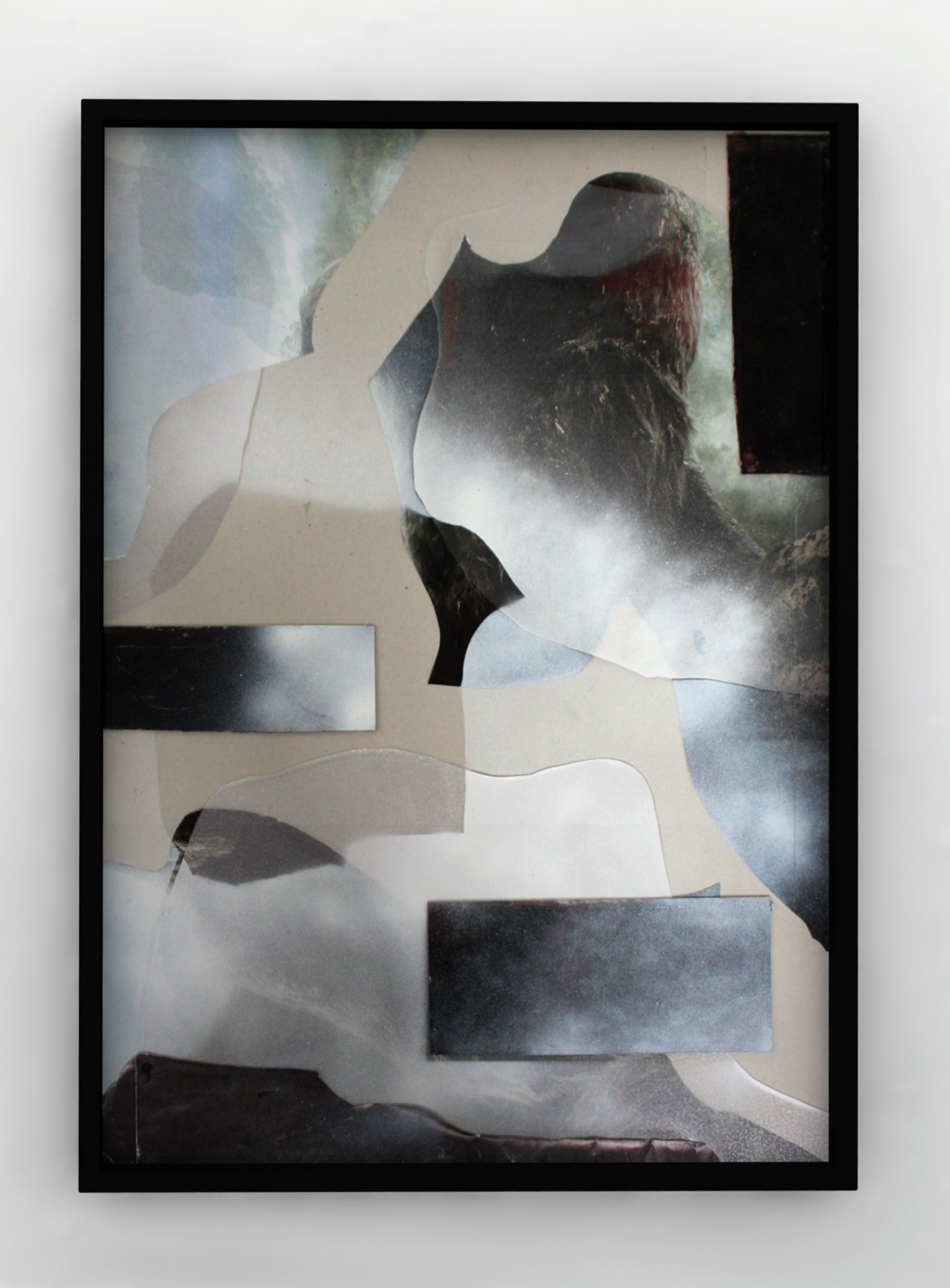
Redux (1): King Kong
Torn and cut pieces of the poster lie on a grey card ground. Near the top right a patch of dark brown fur survives, the only trace of the ape, with a strip of pale blue and green forest at the upper left. Three rectangles are cut straight, a dark one at the top right and two sprayed grey ones lower down; everything else has curved, irregular edges. White and silver spray paint clouds the lower half and blurs the edges of the pieces, so that the cut paper and the sprayed mist read as one surface.
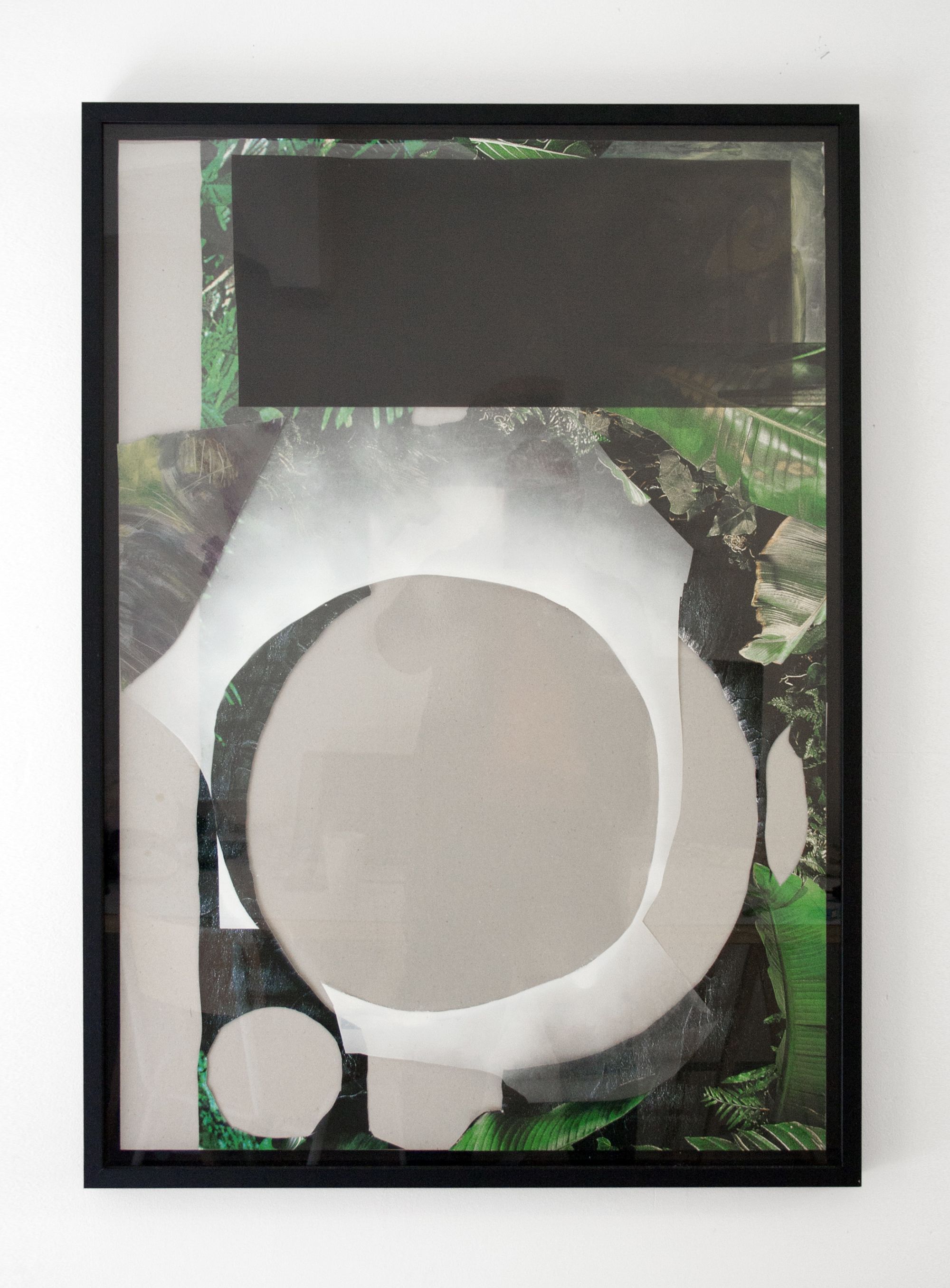
Redux (2): The Lost World
The most geometric of the three. A black rectangle fills the upper third. Below it a large grey disc, cut from bare card, sits inside a white sprayed ring, with a smaller disc beneath, and jungle leaves from the poster fill the space around them. Note 109 files the work as "Redux 2 (enhanced 2013)", so the collage was reworked in 2013; the archive does not say what changed.
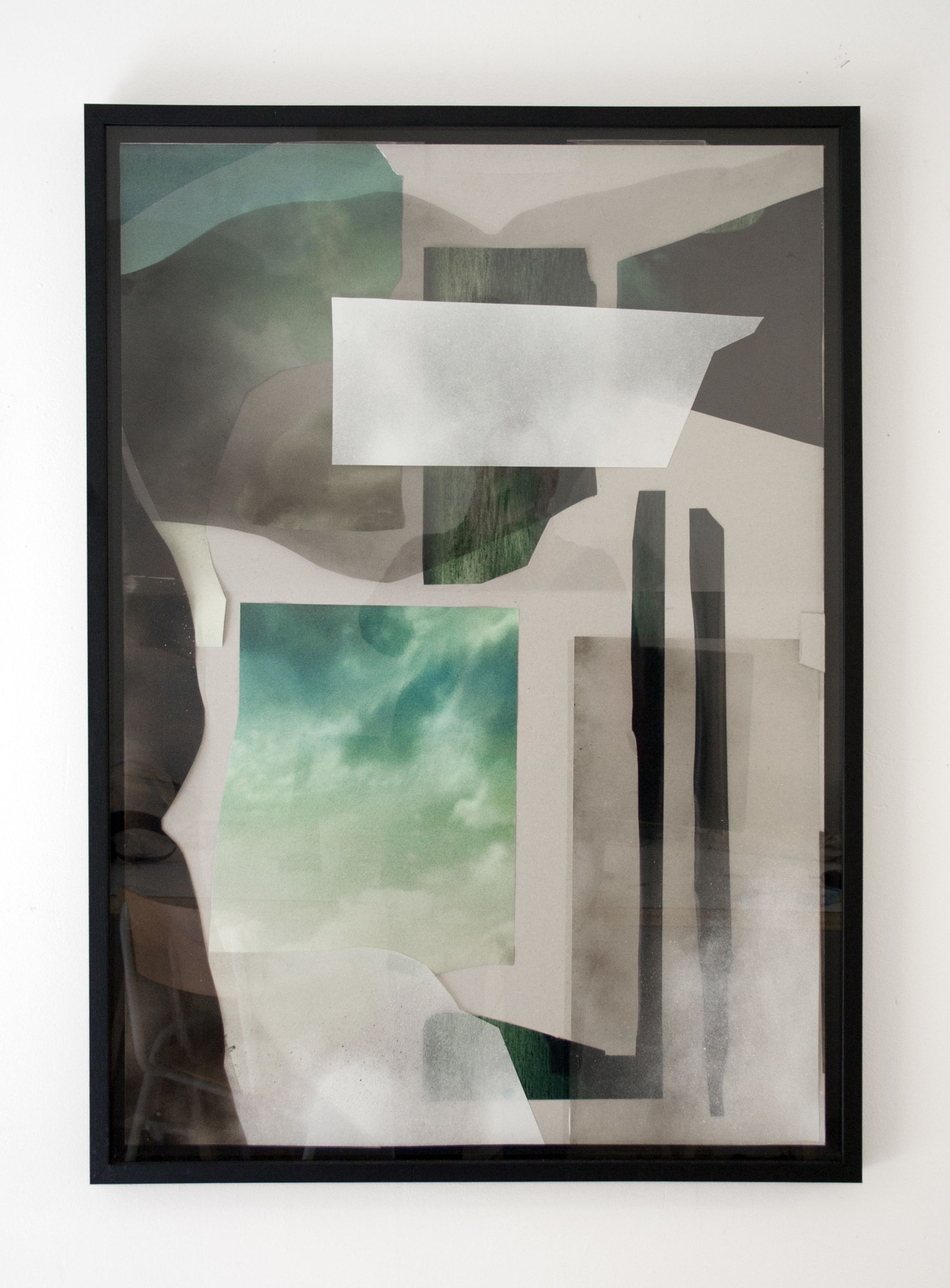
Redux (3): Cloverfield
Sky is what remains of Cloverfield: a block of turquoise and green clouds at the lower left, with grey and green planes above and two thin dark verticals at the right. A white trapezoid, sprayed grey, floats across the upper middle. Transparent sheets overlap, so some edges show through others.
What the catalogue says
The catalogue entry, signed J.G./L.C. (Jacob Gaboury and Lauren Cornell), connects the films' expensive effects to the cheap ones that copy them: the same technologies "are later used (by non-industry professionals) to capture and distribute the films for free via peer-to-peer networks and on CDs and DVDs." The collages "draw on the commercial branding of the DVD-R & CD-Rs to examine the way content is carried in a post-cinematic, sometimes illegal state, where packaging and presence has been completely stripped down." It ends on the object that is left:
"By removing all figurative elements from the original posters and adding other material such as plastics, acrylic, glass, and spray paint, the collages lose their primary narrative and commercial context. What remains is a vastly different object, abstracted from its original, relying almost entirely on pattern and texture to convey a complex media transition, that is totally unlike, but haunted by its original content."
The entry opens with Bruce Sterling: "The idea that the virtual is somehow philosophically separate from the actual is a period notion. It's done." This is the museum's reading of the work; no statement by van den Dorpel on Redux survives in the archive. It ties the collages to the show's subject, copies that circulate outside the market that made the original.
Dates and materials
The artist dates the three works 2009, as harm.work does (November 2026), and harm.work gives "Paper, plastic, spray paint". The raw notes date them 2010, the year they were shown, and list "Movie poster, plastics, foils, spray paint. 100 × 70cm" (67, 73, 115). The New Museum's catalogue gives "2010 – Plastic, acrylic, glass, and spray paint"; its digital archive captions the installation view "Works from Redux series, 2010" and dates the image record 2009. The wiki follows harm.work's titles and dates in captions.
The museum's installation view (photo Benoit Pailley) shows the three hung in a row on a white wall in the order (1), (2), (3), with a wall label at the left. The same photograph is reproduced on Works Overview.
Ethereal Self and Ethereal Others in the catalogue
Brian Droitcour's catalogue essay, "All Together Now", discusses two of van den Dorpel's websites that were not in the gallery, Ethereal Self .com and Ethereal Others .com (the series Ethereal Self & Others, 2008). Droitcour quotes the same sentence from "Dispersion" and then applies it:
"Ethereal Self is a website by Harm van den Dorpel, with enough hits to be considered public art by Price's criteria. When viewers allow it to access their webcams, it shows their reflections refracted in a silvery gemstone. Ethereal Others, the site's double, tiles snapshots of the viewers at the moment their webcams connect."
He reads the pair as a picture of how platforms pool private searches: "Between these two sites, van den Dorpel visualizes the principle of Google Autocomplete or Amazon's shopping suggestions, which make individual interests and queries available for common use." The two sites, "the object of public viewing and the record of its viewers", invert "domestic interiors into the internet's open space".
The artists' talk
On 21 October 2010, the exhibition's second day, Cornell moderated "Free Artists in Conversation" with Aleksandra Domanović, Martijn Hendriks, Alexandre Singh and van den Dorpel. The announcement asked: "What constitutes an expanded public space? How does a greater access to images, and a more democratically produced culture, affect their work?" The recording is held in the New Museum Digital Archive; it has not been transcribed for the wiki, so what he said about his projects is not recorded here.
Free in the practice
Free came while Club Internet was winding down and a year after the move offline at the AFK sculpture park in Kreuzberg (→ Club Internet). The Redux collages are cut from printed images, the method the Assemblages took into three dimensions from 2011 (→ Sculpture and the Object). left gallery uses the show in its own argument: van den Dorpel was in museum group shows from 2010, before the market for his files existed, so the institutions did not come at the end of a sequence.
The New Museum came back to him three years later. In 2013 its online series First Look, run with Rhizome and again curated by Cornell, commissioned Dissociations, the site this wiki grew out of (→ About).
See also
- Sculpture and the Object — the hand-cut work after Redux
- Surf Clubs — the network several of the artists came from
- Club Internet — his online exhibition space, 2008–2010
- About — Dissociations at the New Museum's First Look, 2013
- Release Early, Release Often — openness as a stance, three years later