
Animal Configurations (2007)
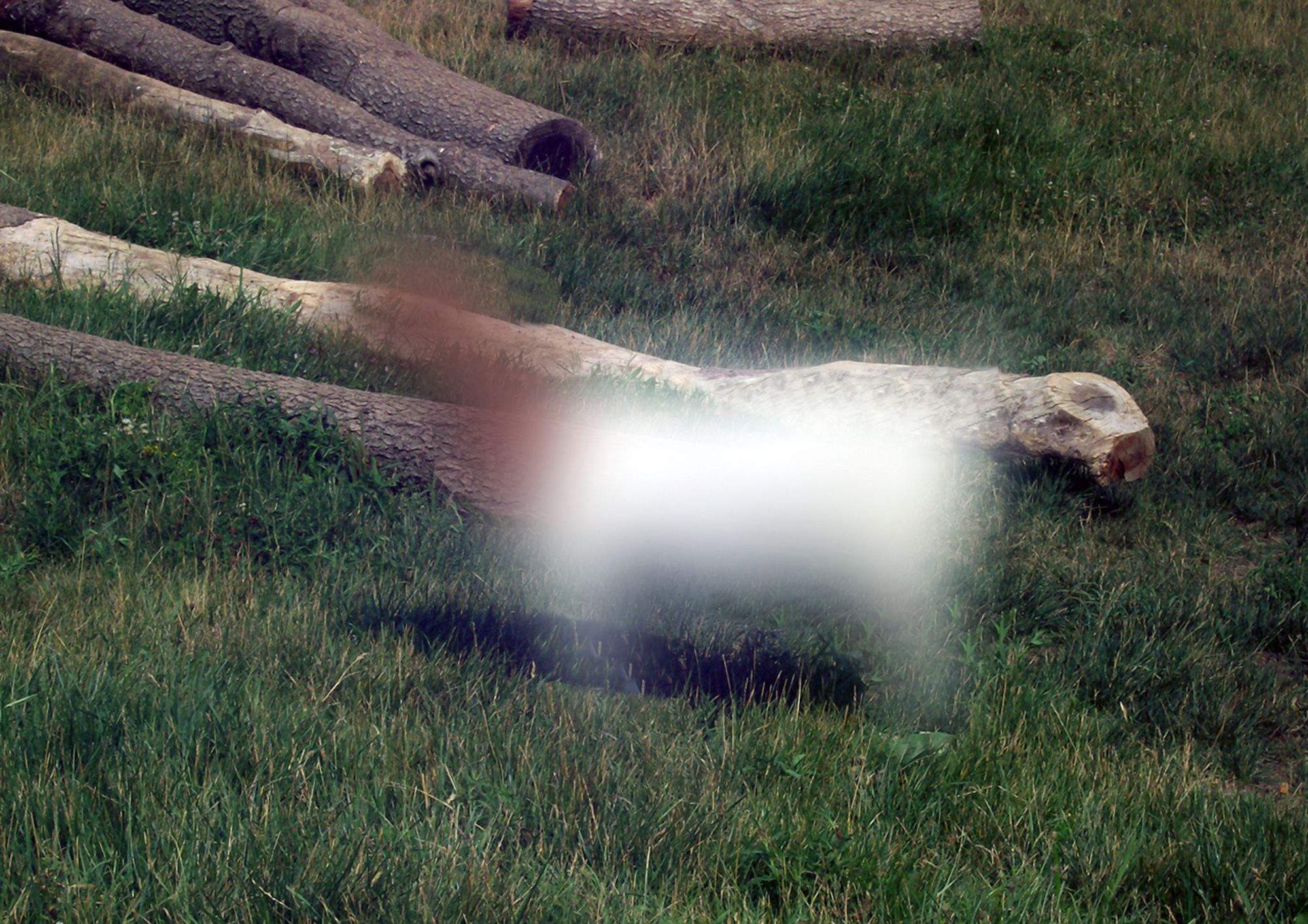
A goat stands on rough grass in front of a pile of felled trunks. Its body has become a soft white glow with a brown smear where the head should be, while its shadow on the grass and the logs behind it stay sharp.
Animal Configurations is a series of five images of animals made in 2007 from photographs found online: Bison, Ostriches, Death Roll, Gaussian Goat and Dogggie. In each, one animal has been reshaped inside its own photograph, folded, looped or blurred, and the landscape or studio backdrop around it is left as it was. harm.work describes the series as "found images of animals reconfigured with Photoshop or self-programmed software". Van den Dorpel calls them "some of my earliest works to receive a (somewhat) wide audience" (early series texts).
The title and date have moved. His website of 2010 listed the group as "Animal Series, 2008", in "lightjet prints 40 × 60 cm" (archived by the Wayback Machine), and the archive notes date Bison and the goat 2008 and Ostriches and Dogggie 2007 (246, 248, 250, 251). harm.work now gives 2007 for all five and lists no medium, and the artist confirms 2007 (November 2026). The goat was minted in 2022 as Goat.jpg, dated 2008, in an edition of three with a proof (→ Small Collections, under JPGs).
The five images
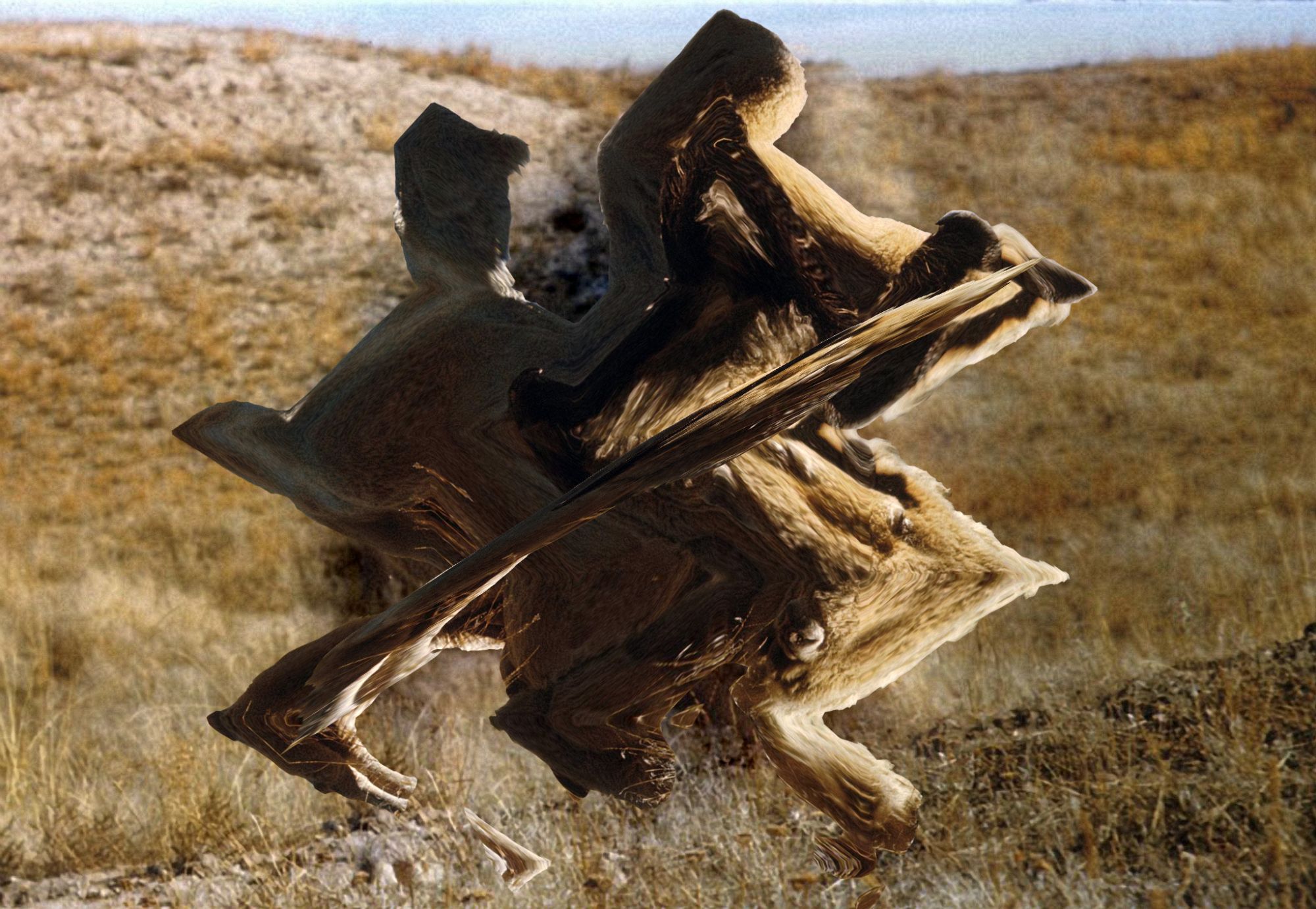
A bison on a dry prairie hillside has been folded into a zigzag. Its fur runs in stretched bands along a path of sharp turns, with an eye and a horn surfacing near the lower right and a long spike of fur crossing the whole body diagonally.
In Bison the deformation follows a path of straight segments and hard corners, and the texture of the fur is dragged along it. The other images use different operations, and two of the titles name theirs.
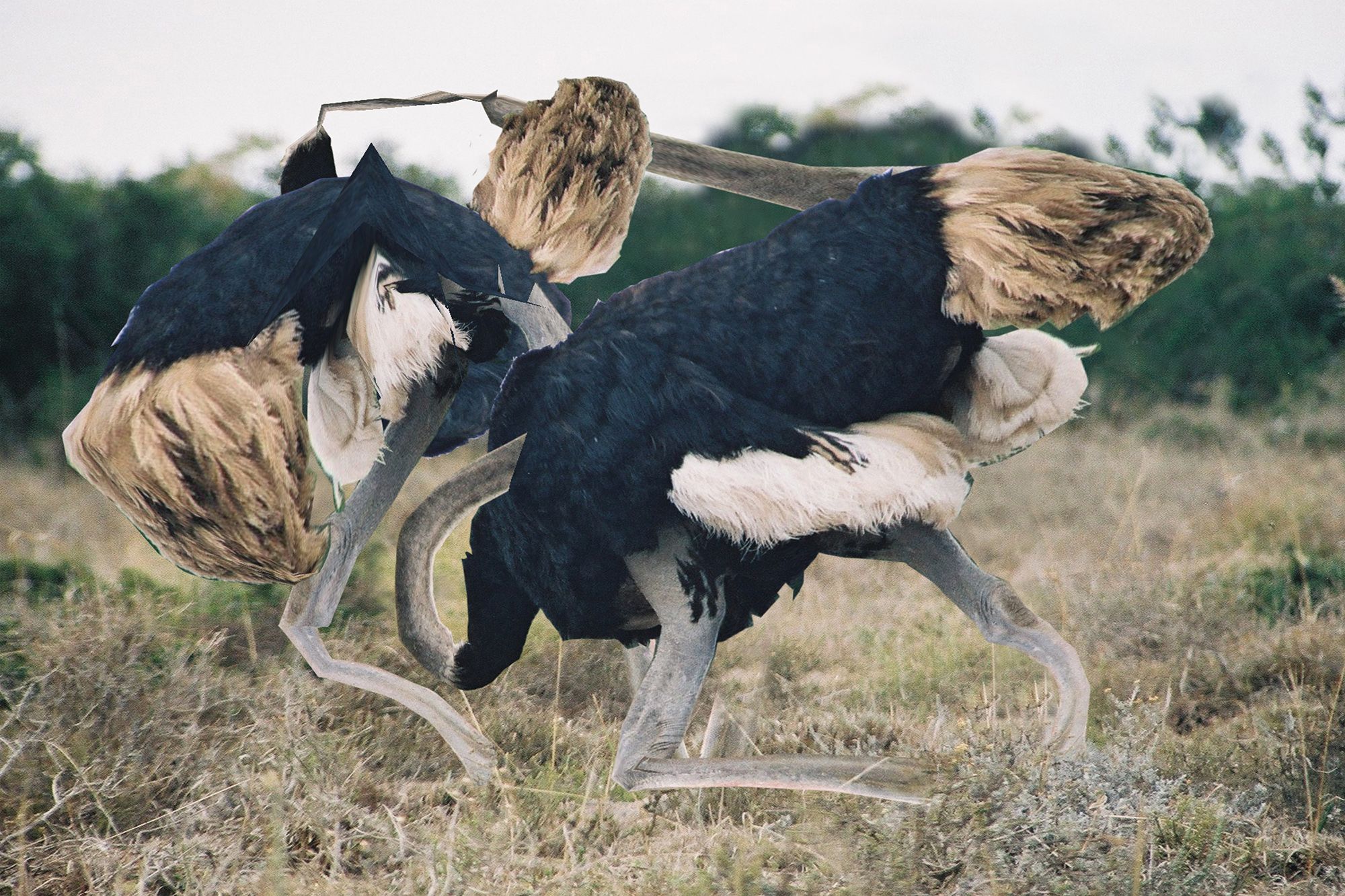
Two ostriches on a savanna, black bodies with pale tail plumes, are bent into loops. Their grey legs and necks run as flat angular bands, one neck turning back on itself in a hook, one leg drawn out along the ground.
In Ostriches the long limbs of the birds give the deformation most to work with.
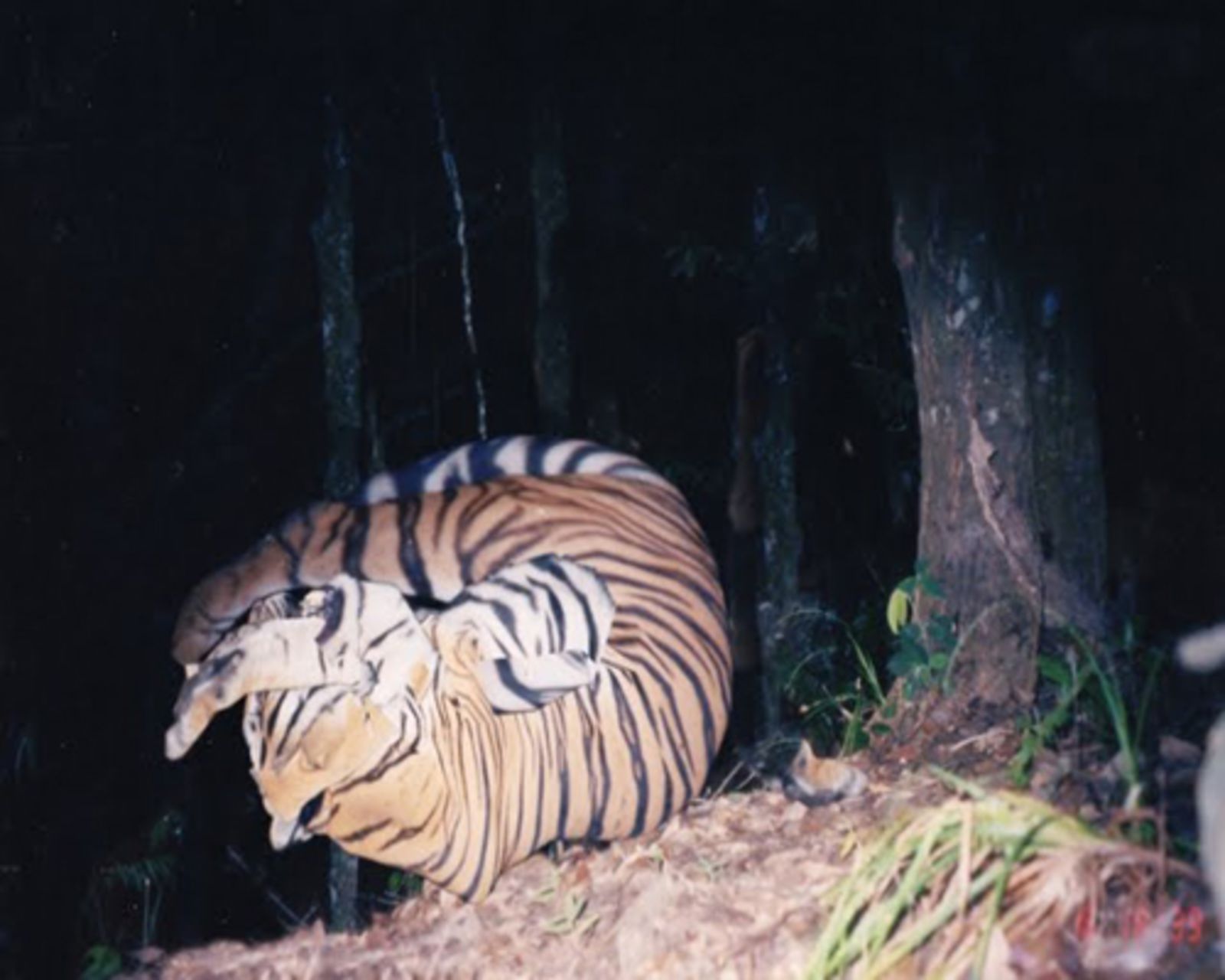
A night photograph from a camera trap, a date stamp in the lower right corner: a tiger at the edge of a dark forest, its body wound into a ball of stripes, the head tucked under, the legs and tail folded over its back.
In Death Roll the source was taken by a machine, a camera that fires when an animal passes, and the reshaping is done by another. A death roll is the spinning attack of a crocodile, which twists its prey until it drowns; here the predator is the one rolled up.
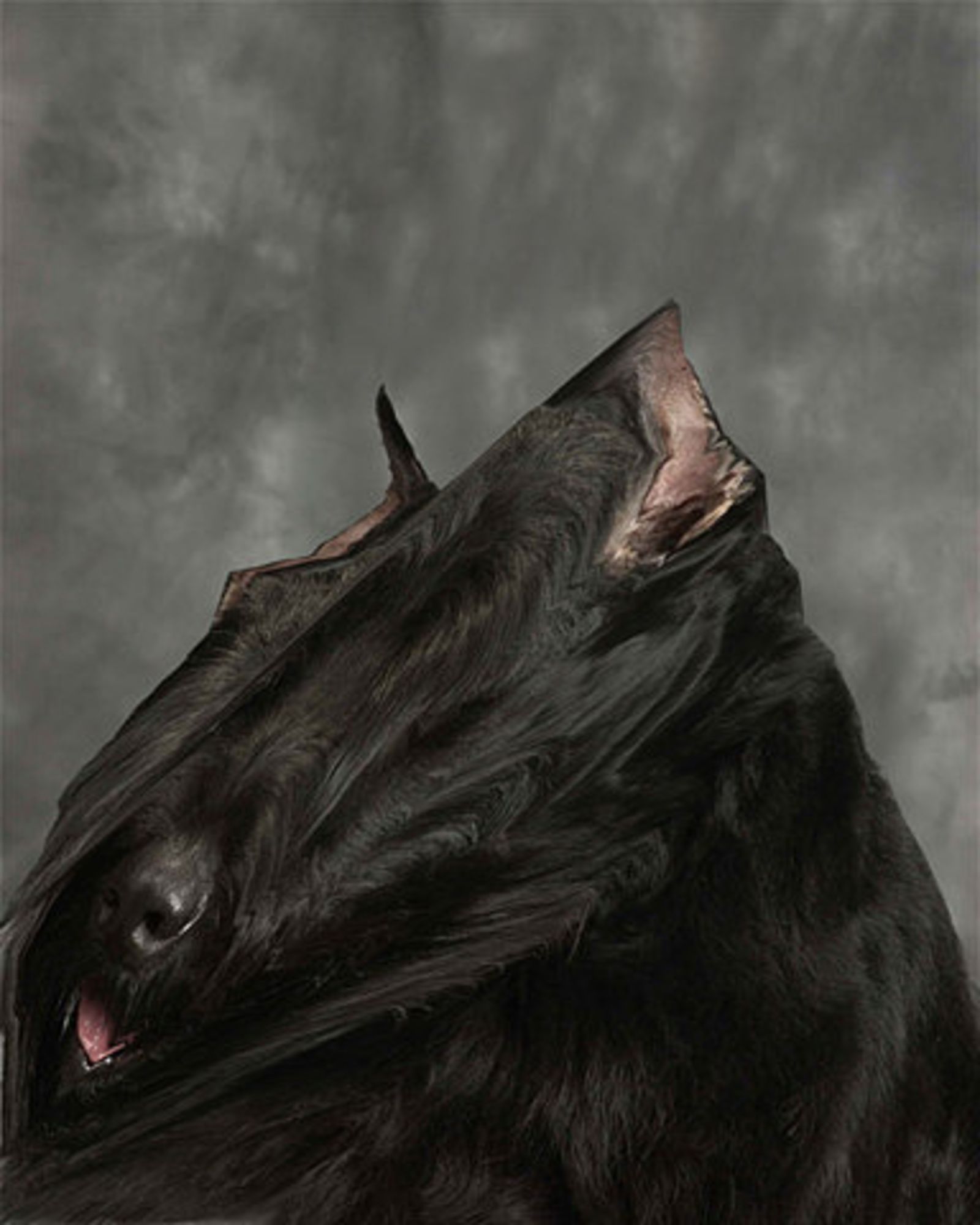
A black dog photographed against the mottled grey backdrop of a portrait studio. The top of its head is dragged up into a wedge, the ears pulled into points, the fur smeared into strokes; the nose and a pink tongue sit low at the left edge.
Dogggie is the only studio portrait, and its title adds a letter to the word as the image adds length to the skull. Gaussian Goat names its filter: a Gaussian blur, applied to the goat and nothing else, so the animal turns into the glow of an overexposure while its shadow keeps its outline.
Clinical images, generic animals
Van den Dorpel places the series at the moment when image search became a material:
"This was a time when artists were first getting excited about the ready availability of images they could access just by doing Google searches. The images were high quality, and often rather clinical. In their apparent simplicity, they were easy to manipulate, like sampling a song where the first bar is just drums."
The animals were chosen for being nobody in particular. "The images were more indexical in nature rather than being portraits in the way they would be if they were of humans, or, for example, of specific pets posed for the shot. They were just of 'animals'." He calls the results "pure products" of the internet, "the result of simple googling and downloading Photoshop illegally", and says this "genericness of their creation appeals to me and fits with the overall tenor of the project".
The archive files similar operations on other things. 531 is a brown Mephisto shoe whose leather and sole have been warped into waves, and Ancient Modeling (504, 2008) sweeps an Egyptian pyramid into a curve like a breaking wave, tourists still walking at its foot. Both are linked from the animal notes. The Revenant Series of the same year (→ Revenant Series) does to found photographs of sleeping people what these images do to animals: it cuts out one body and changes it, and leaves the snapshot around it alone.
The goat on Instagram
The series came back to him years later, when the images "started appearing in posts on Instagram - uncredited, I might add. The goat, in particular, proved to be very popular." The audience read them as photographs:
"People thought the images were very funny and they liked them, but when they found out the effects were created in software, they were disappointed. They thought I'd done them photographically with exposure effects, but, in fact, it was all a function of settings and filters."
What disappointed them was the means. A goat caught as a blur by a long exposure would have been a lucky photograph; the same blur made with a slider looked like a trick. Van den Dorpel does not defend the work against that reading. He takes the software origin as its point.
Before the configurations: the Pixel Sorters
The Animal Configurations text calls the stills "the first part in a series of images including black and white animated GIFs and other animations". Those are the Pixel Sorters, clip-art animals found on forgotten web servers and set to collapse pixel by pixel. harm.work dates them 2005, which would make them older than the stills they are said to follow (→ Pixel Sorters).
The archive keeps the two groups together. The notes for Bison and Dogggie link to Bison.gif (153), the note for Dogggie also to Owl (1053), and both GIFs link back to Dogggie. Both groups apply one operation to a found animal; in the GIFs the operation runs in time. A still of 2005, Owl.jpg, cuts a photographed owl apart along straight lines and scatters its eyes across the picture (→ Small Collections). Bison.gif was shown in the same online circles as the stills: the Club Internet database lists it, dated 2007, in the first show, First Selection (8 May – 14 June 2008), and in Once Upon a Time in the West (2009), curated by Domenico Quaranta (→ Club Internet).
See also
- Revenant Series — found photographs of sleeping people, cut and animated, 2006–07
- Early Works (2007–2011) — Lasso, the Diagonal Enlargements and other works made from found images
- Club Internet — where Bison.gif was shown in 2008 and 2009
- Pixel Sorters — the animated GIFs of 2005 onward, Bison.gif and Owl among them
- Small Collections — Goat.jpg and Owl.jpg in the JPGs collection