
Pixel Sorters
Pixel Sorters is a series of animated GIFs in which a black-and-white image comes apart under a rule applied to its pixels. The artist dates the originals to 2005, when he was at art school, and calls them "some of my oldest works" (Folia, 2021). In March 2021 the NFT platform Folia minted three of them, with the Flash animation Lasso (2007), as the collection Pixelsorters.
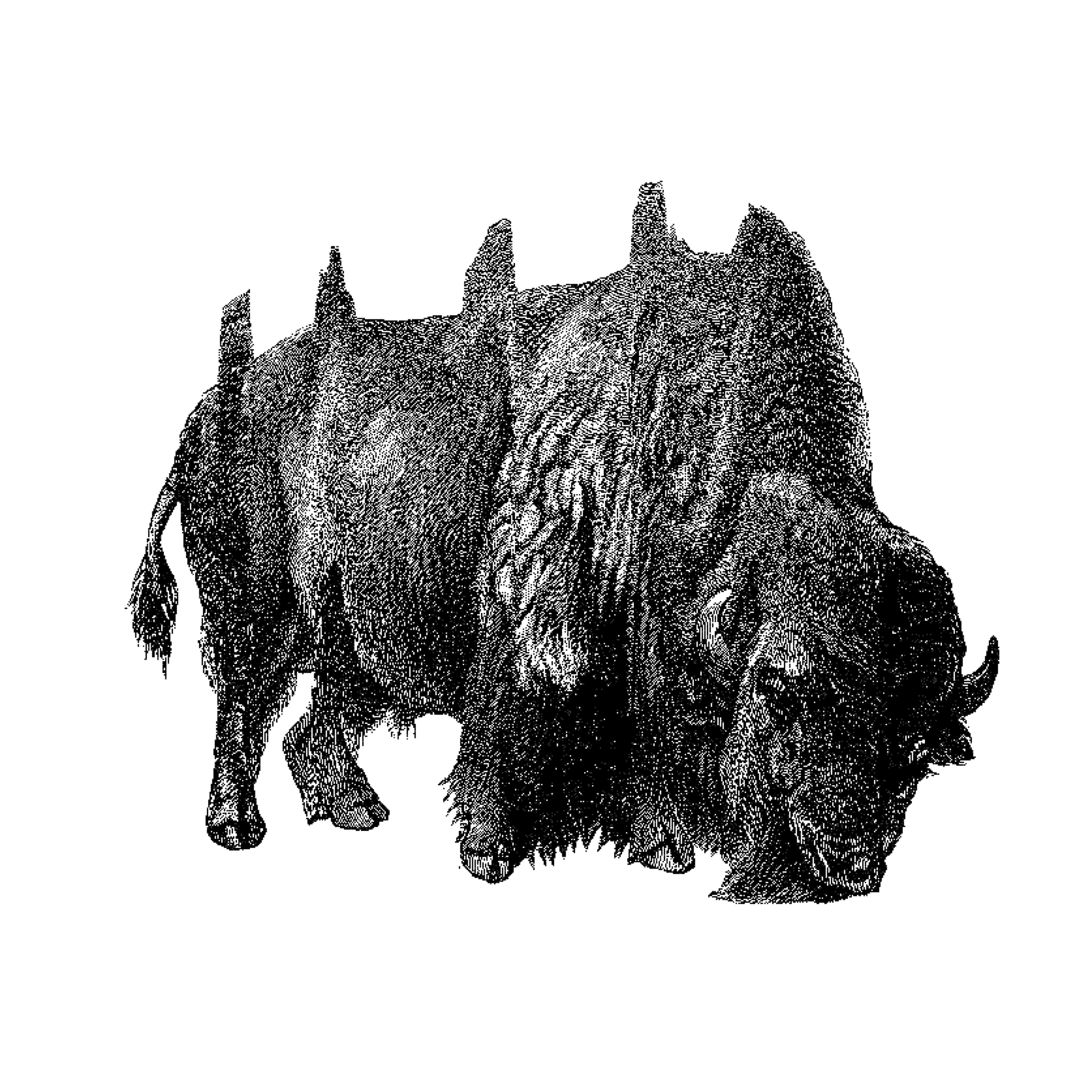
In this still of Bison.gif the animal is a stippled engraving, the kind found in clip-art collections. Its outline is intact at the legs and head; along the hump the dots have begun to run downwards in vertical streaks, so the back reads as a row of spikes.
The rule
The artist's text on harm.work, quoted in full in Folia's announcement, gives the mechanism: "The pixel sorter is based on a very minimal set of local rules: from a given pixel, the sorter analyses to determine if the points immediately adjacent have pixels. If there is one, the image stays still, if not, then the current pixel moves down. It's a simple process, but it gives the appearance of some kind of physical law being applied to the image, a kind of digital manifestation of entropy. Or maybe a bit like cellular automata even."
In his December 2021 conversation with Jenna Sutela he added what happens on landing: "Pixels fall down until they hit a dark pixel below, in which case they slip either to the left or right, creating somewhat sad collapsed compositions. They're certainly about decay and extinction" (conversation; → Outland — Sutela conversation). Falling plus a sideways slip is the rule of a pile of sand: dark pixels collect into mounds with sloping flanks until no pixel can move further. The name "sorter" fits that end state. Nothing is erased; the same pixels are sorted by height until the figure has become a heap.
Agent's reading: decay as settling
Thesis. The March 2021 text calls the process "a kind of digital manifestation of entropy", and in December he calls the works "about decay and extinction".
Antithesis. In the same December conversation, speaking of Mutant Garden, he says: "I don't often use the word 'entropy.' I understand that systems tend to want to evolve toward the highest degree of randomness, or equal distribution. I don't know if I'm looking for that. I'm trying to provoke complexity, but also to contain complexity or tame it."
Synthesis. The sorter's rule is local and simple, and it runs downhill to a stable heap. What decays is the picture, the arrangement of pixels that made a bison or a skeleton legible. The pixels themselves end in an order: sorted, still, piled. The entropy in the 2021 text is the loss of the image, and the halt is the containment he describes to Sutela. Both statements describe one process from its two ends.
The works
harm.work lists five works in the series. The first two are from 2005, as harm.work and Folia date them and the artist confirms (November 2026). The dissociations archive gives 2008 for bison (153) and Owl (1053), the year they were posted there as images.
- Bison.gif (2005): 306 frames, 720 × 576 pixels, according to the token metadata.
- Owl (2005): "This is a screenrecording, capturing a frame in intervals, while I manually erase pixels from the image" (harm.work). It is the one work in the series made by hand.
- Blob (2017): 223 frames, 512 × 512 pixels.
- Danse Macabre (2017): 245 frames, 480 × 379 pixels.
- Geodesic Dome Patent Drawing (Fig. 14) (2022): "Monochrome algorithmic animation of figure 14 of the Buckminster Fuller geodesic dome patent from 1965" (harm.work). Its still is on Early Plotter Drawings.
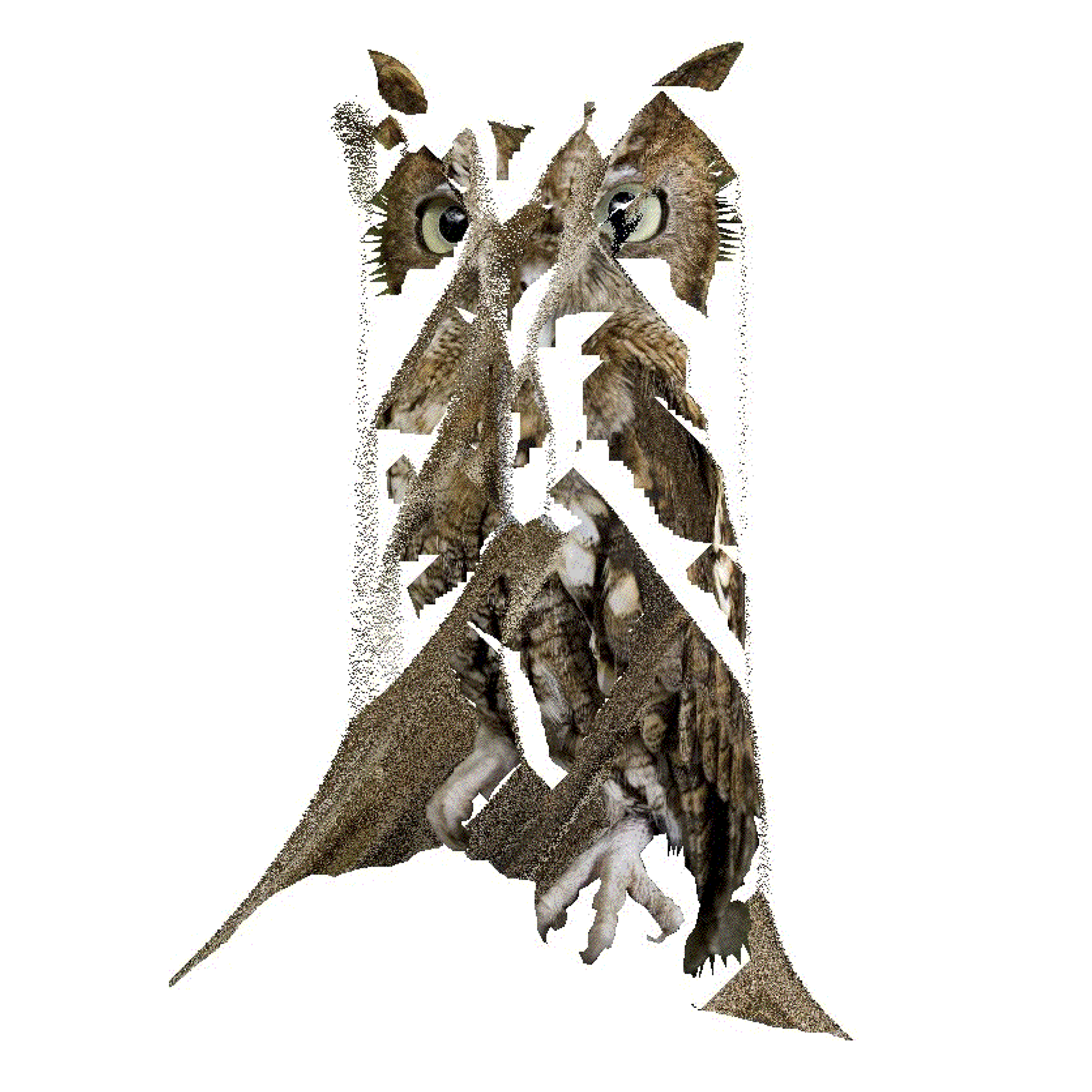
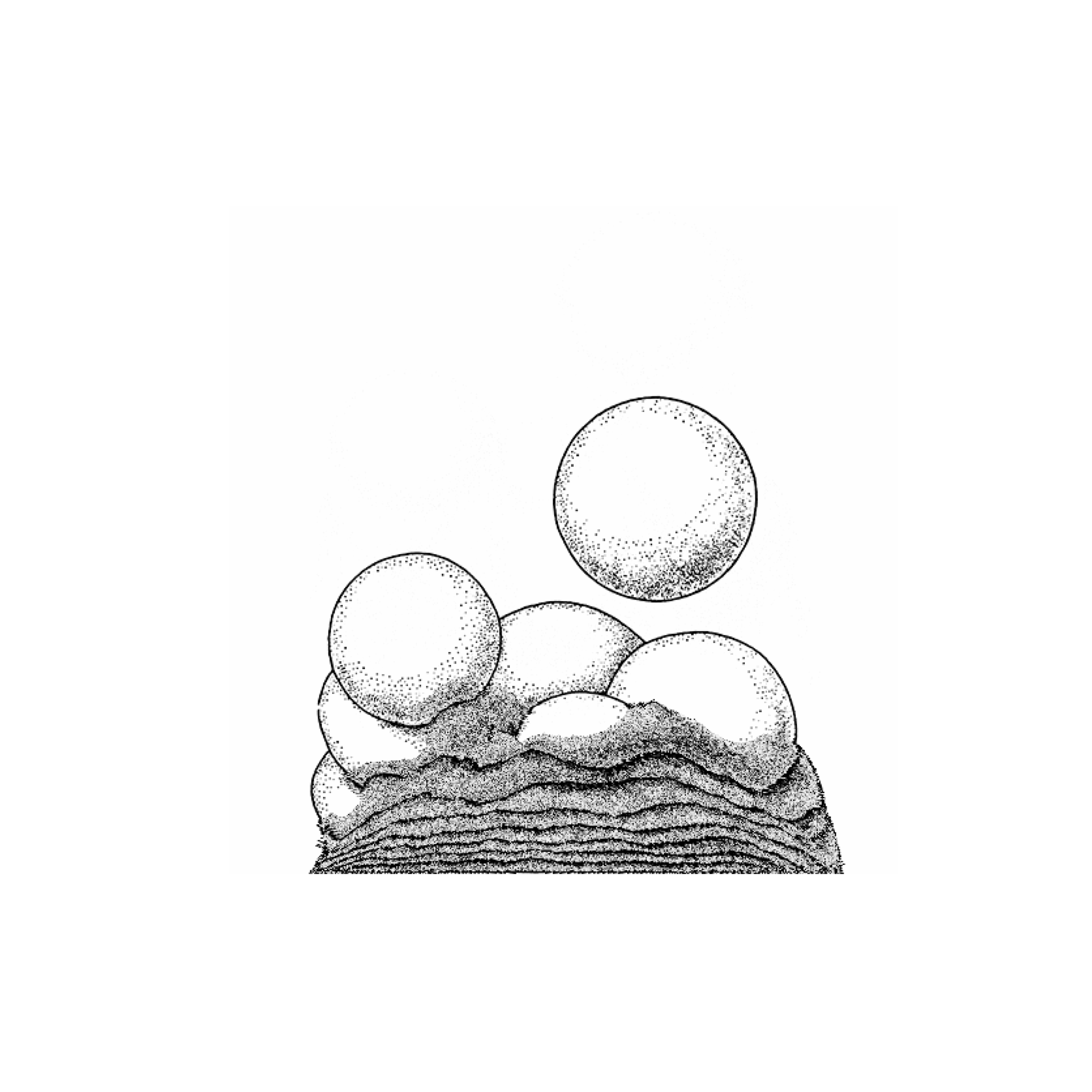
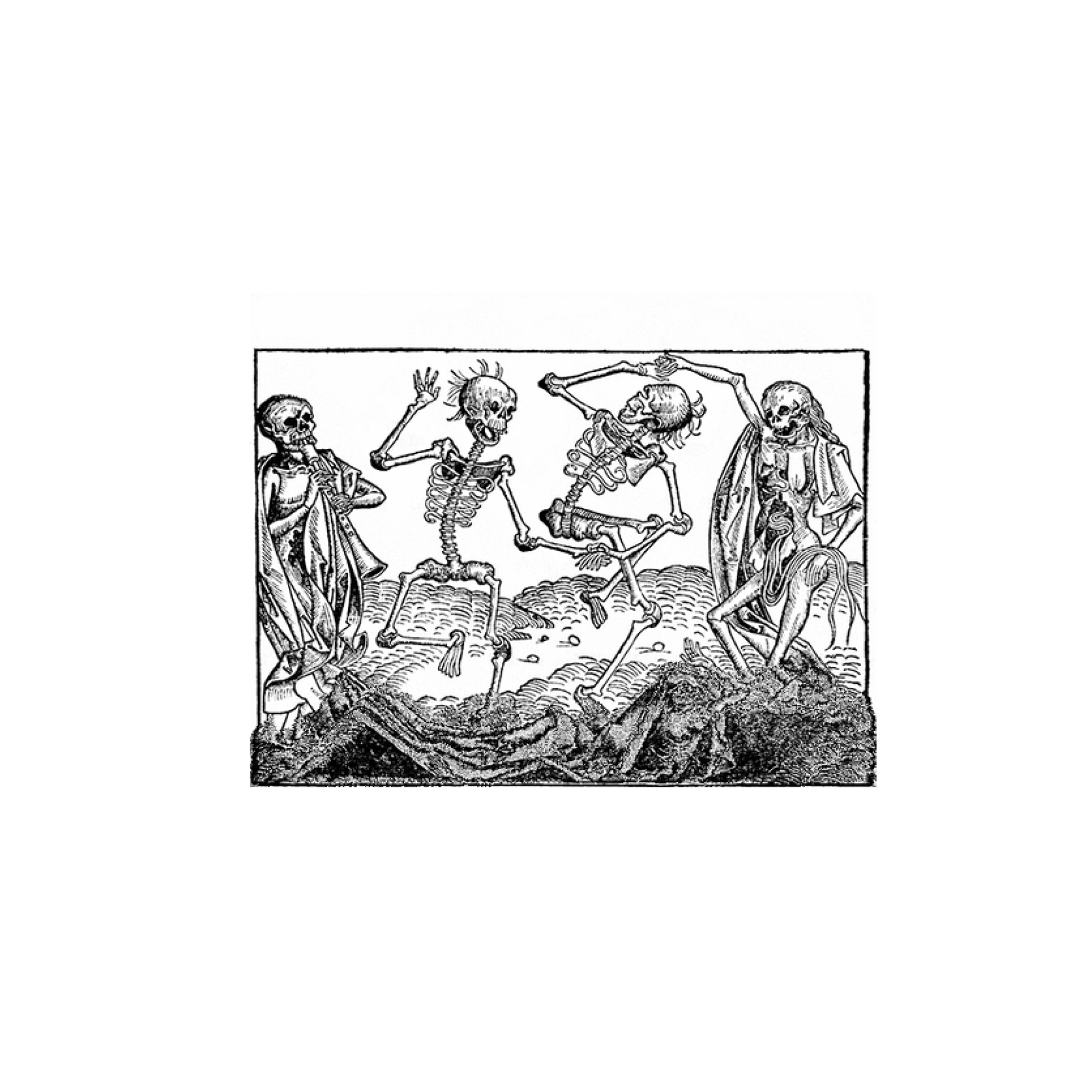
Owl is a colour photograph, not a line image: an owl's face survives at the top while the body below has been cut into vertical shards with white between them, ending in a point at the lower left. Blob starts from a stippled drawing of spheres resting on a wavy, layered mound. Danse Macabre uses the woodcut of four dancing skeletons from Hartmann Schedel's Nuremberg Chronicle (1493), attributed to Michael Wolgemut: one plays a shawm, two dance, a fourth rises from the grave. A danse macabre already shows bodies coming apart; the sorter takes this one apart again.
Stipple and woodcut hatching suit the rule: they are made of separate black marks on white, so each dark pixel can fall on its own. The artist's text describes how he found the sources: "I found the source images for these works by browsing websites - not really something one does today. Around that time, people would publish sites with Apache web server and essentially forget they were there, despite having uploaded their entire hard drive to them. I would go through sites like these and find clip art images of animals. There was a kind of amateurism about these sites and images that I liked."
The animals connect the series to Animal Configurations (2007), stills of animals found through Google searches, whose harm.work text calls them "the first part in a series of images including black and white animated GIFs and other animations".
extinctr (2018)
In March 2018 the sorter became a public tool. extinctr, commissioned by GIPHY Arts, was one of four web-based drawing and animation tools in Make Pictures at bitforms gallery, New York (23–25 March 2018), curated by Jeffrey Alan Scudder, beside Casey Reas's Sketch Machine. The gallery's press release describes it: "Extinctr is a pixel sorting algorithm and web tool by Harm van den Dorpel that accepts any image as input, and outputs an animated vertical decomposition of that image into a pixelated mound. The user can control the speed of the dismantling procedure (scatter) and record any duration of the process to export as a GIF." The name takes up the extinction he would name to Sutela three years later.
On 12 April 2018 he opened an are.na channel, Deconstruction, with fall.gif, bison.gif, owl.gif and the site itself, saved as "extinctr by harm van den dorpel, 2018" with the line "Remember what it looked like before it meant anything?" (block); Danse Macabre followed on 17 April. In the Verse conversation of January 2024 he named Scudder as one of two artists, with Travess Smalley, who made him "dare to go into pixel art" (transcript).
The Folia drop (2021)
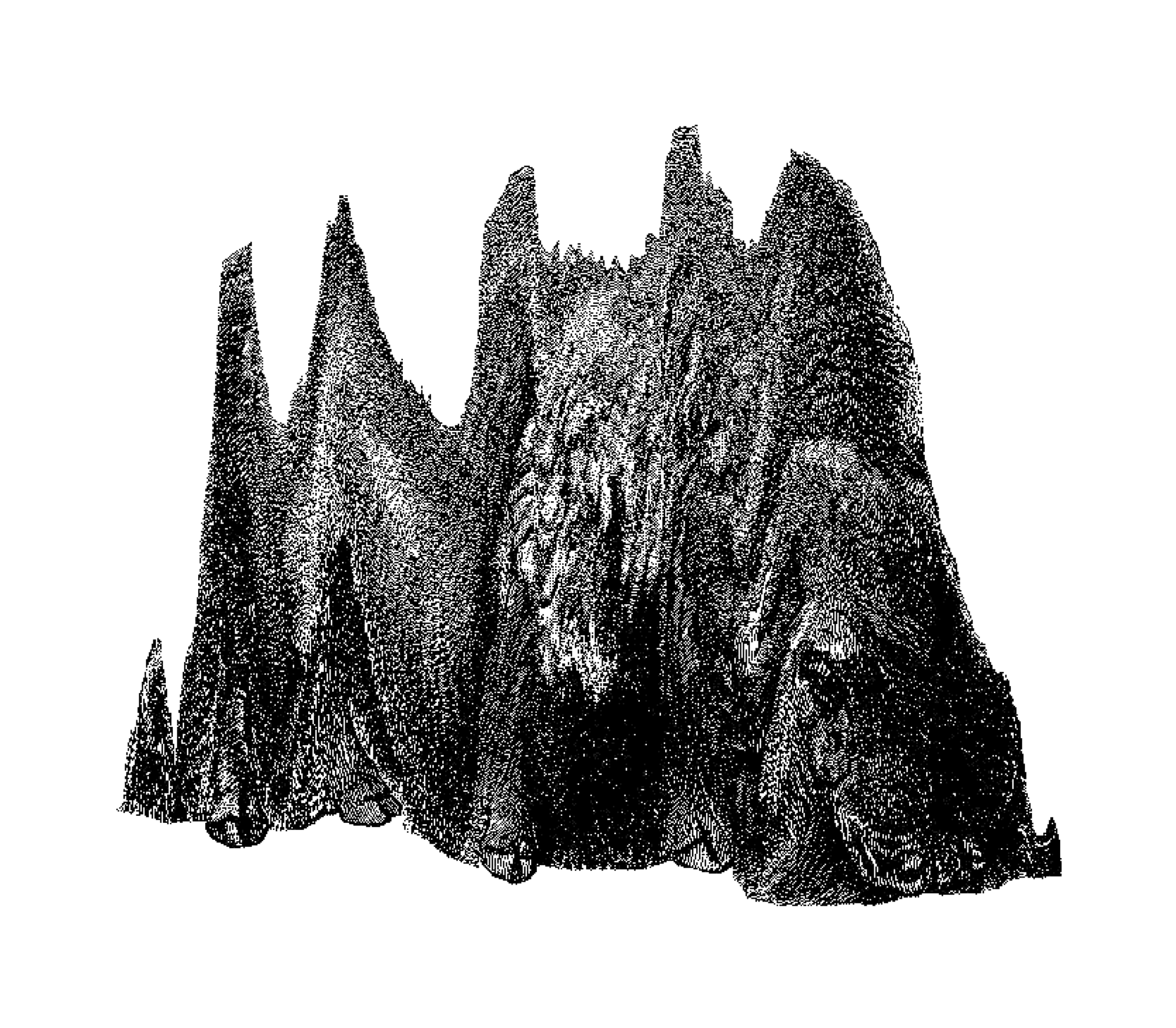
The announcement image of the Vintage NFT drop shows Bison.gif late in its collapse: the animal has become a range of black peaks, with only the shaggy texture of the engraving left inside them.
On 3 March 2021 Folia announced "the minting of four seminal works": three from the "Pixel Sorters" series, Blob.gif, Dansemacabre.gif and Bison.gif, and in addition Lasso.swf (announcement). Blob, Danse Macabre and Lasso were offered as editions of three with an artist's proof, Bison.gif as a single edition with a proof. harm.work's news item of 19 March gave the sale: "A series of early works - the oldest one being from 2005 - will be made available for purchase for the first time this weekend. This NFT drop includes 3 editioned pixel sorters, encoded to animated GIF. The offering has been curated by Folia, who have also recently minted work by Petra Cortright, Hesaitix, Travess Smalley and Oliver Laric (coming up)." Bidding started on Saturday 20 March, 9 pm CET, on the Folia website.
harm.work's collection Pixelsorters lists thirteen tokens: Blob.gif 1/3 to its proof (AP1), Danse Macabre.gif 1/3 to AP1, Bison.gif 1/1 and AP1, and Lasso.swf 2/3, 3/3 and AP1. Each token's description gives file format, frame count, pixel size and file size, the year made and the year minted ("Created 2005, Minted 2021").
The drop came out of the circumstance he described in Tokenizing Sustainability the same year: "the rush toward NFTs turned out to be an opportunity for me as well, as I had some old, and newer, artworks that never found their ways to art collectors, but which suddenly very well fitted the editioning, format, and price range of NFTs" (essay; → Tokenising Sustainability). The harm.work news item linked the essay under the words "NFT drop".
Lasso.swf (2007)
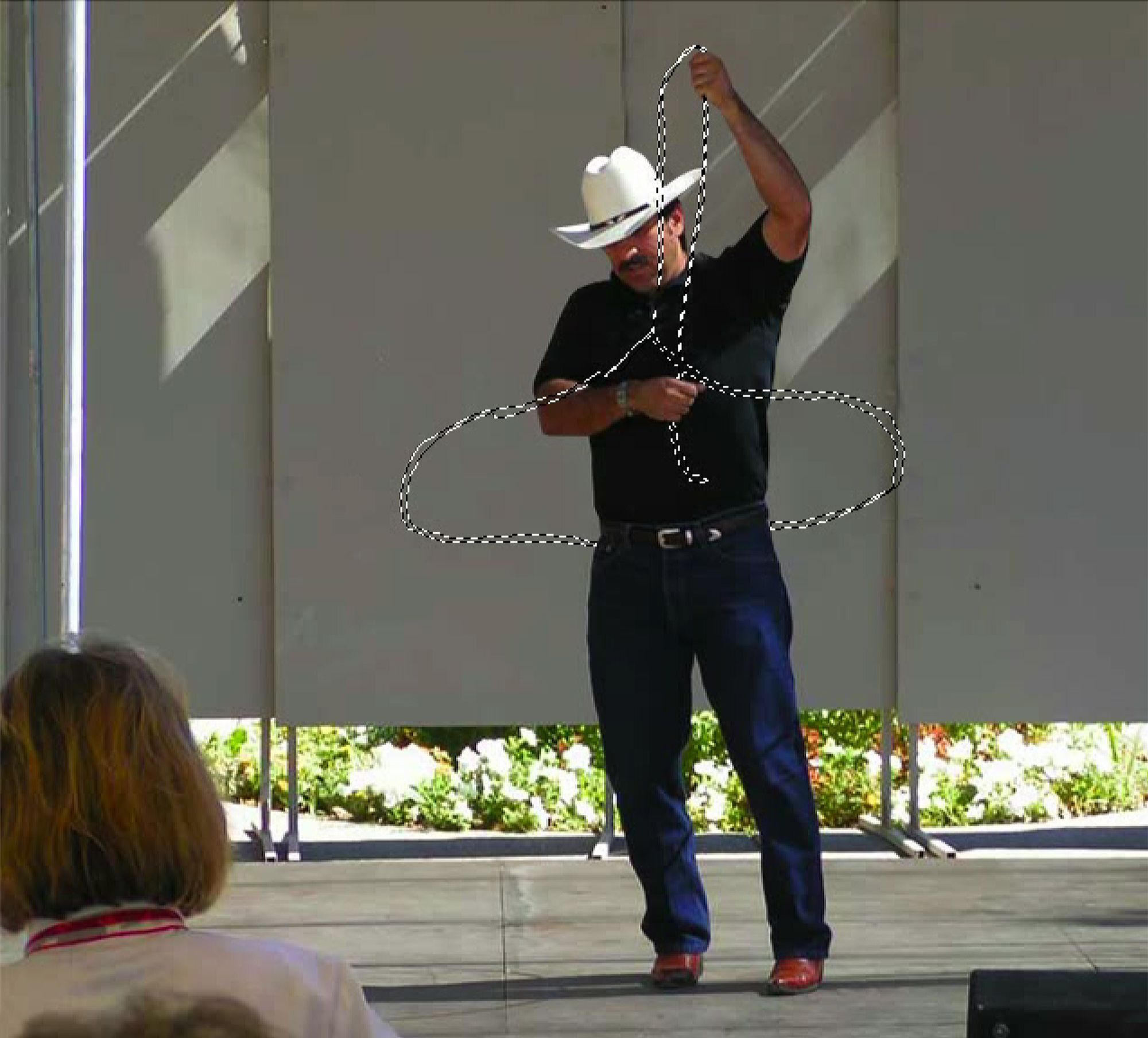
Lasso is not a pixel sorter. The still shows a trick roper in a white cowboy hat on an outdoor stage, spinning a loop; the rope is drawn as a dashed black-and-white line, the "marching ants" outline that image editors draw around a selection made with the lasso tool. The token metadata gives 103 frames at 1270 × 1150 pixels, made as a Flash file in 2007 and minted as a GIF.
Later
Found images came back into the pixel work in 2024. After the fully generated Struggle for Pleasure, he told Verse, "I started feeding it found images, and that is a new direction for me. I used to do that years ago" (→ Struggle for Pleasure, Swallow, Only Shallow). The 2024 algorithm rebuilds a found image at varying resolution, where the 2005 rule took one apart.
See also
- Outland — Sutela conversation (2021) — the Pixel Sorters beside Sutela's crypto vanitas
- Randomness and Pattern — rules that produce the look of physical law
- Mediation and the Archive — the Flash works and what became of them
- Folia announcement (2021) — the ingested text